📜 LEGEND · EXP. Nº3657
ACTIVE
Sadko and the Sea Tsar
Sadko and the Sea Tsar is a legend from Veliky Nóvgorod, río Vóljov, RU — a folk story passed down over generations. This file collects its origins, its meaning and how it has been retold.
Where does the legend of Sadko and the Sea Tsar come from?
- Location
- Veliky Nóvgorod, río Vóljov, RU
- Kind of legend
- Folk tale
- Coordinates
- 58.522, 31.276
- Testimonies
- 0
- Last updated
LOCATION
What is the legend of Sadko and the Sea Tsar?
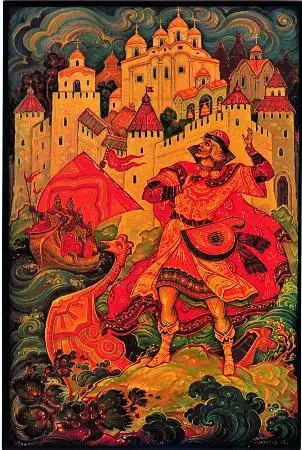
The Novgorod First Chronicle, under the year 1167, records that Sotko Sytinich laid a stone church to Saints Boris and Gleb inside the city kremlin. Scholars identified that man with Sadko, the merchant of the Russian epic songs; the encyclopaedia that made the identification famous, in 1900, wrote probably. What can actually be documented is stranger than the version usually told. In the oldest written texts, in a manuscript compiled in the Urals after 1742 and some 1,700 km from Novgorod, Sadko is not one story but two songs that do not join: in the first there is no gusli, no sea tsar and no shipwreck, and he grows rich because the Volga sends her greeting to her brother, Lake Ilmen; in the second his ship halts because in twelve years he has never let bread and salt down into the Caspian, and the saint who rescues him tells him to choose the ugliest of thirty maidens and never to touch her. The sea tsar's beautiful daughter belongs to Rimsky-Korsakov's opera of 1898. This file follows the chain link by link, from a chronicle entry to a Soviet film recut in Hollywood.
What is the history of Sadko and the Sea Tsar?
Start with the one piece of Sadko that is a document rather than a song. The Novgorod First Chronicle, under the world-era year 6675 — 1167 — records: "На ту же весну заложи Съдко Сытиниць церковь камяну святую мученику Бориса и Глѣба, при князи Святославѣ Ростиславици, при архiепископѣ Илiи". That spring Sotko Sytinich laid a stone church to the holy martyrs Boris and Gleb, under Prince Sviatoslav Rostislavich and Archbishop Ilia. It was consecrated in 1173. It stood inside the Detinets, the Novgorod kremlin, above the Volkhov. Nothing in the entry mentions a gusli, a sea tsar or a shipwreck: it records a rich Novgorodian paying for a stone building, which in a timber city of the twelfth century was the most expensive thing a private man could do.
That building is being read again right now. The Novgorod architectural-archaeological team of the Institute of Archaeology of the Russian Academy of Sciences, led by Vladimir Sedov, returned to the site in 2008 and has excavated there from 2018 onward, following trenches that A. A. Strokov and V. A. Bogusevich opened in 1940–41. In 2023 and 2024 they reached what the church stood on: oak beams roughly 20 cm thick, laid beneath the foundation to stop the weight settling unevenly. Radiocarbon gave those beams a calibrated range of 1161–1175 — the chronicle's own 1167–1173. For once the dates behind a folk hero can be checked against wood.
The church itself did not survive. It burned, was restored, collapsed and was rebuilt; in 1441 Archbishop Evfimy II raised it again on the old foundation, dismantled the stair tower and moved the small chapel of Andrew Stratilates onto the tower's base. When the cathedral came down in 1682 only the north wall and that chapel were left standing, and a document of the late seventeenth century closes the file: "Церковь в прошлых в давных годех в раззорении и вся до основания разобрана". The chapel was extended eastward and became a church in its own right — the only fifteenth-century side chapel in Novgorod still above ground.
The songs took a different road, and it does not pass through Novgorod. The oldest written Sadko is in the manuscript that Kirsha Danilov compiled after 1742 in the Urals, about 1,700 km east of the Volkhov. From 1768 it was in the hands of the ironmaster Prokofy Demidov; twenty-six of its seventy texts were printed in Moscow in 1804 under A. F. Yakubovich; the fuller edition came in 1818 from Count Rumyantsev's circle; the manuscript was then lost and reappeared only in 1894.
And in Danilov, Sadko is not one story but two songs that do not join. In "Садко богатой гость" there is no gusli, no sea tsar and no shipwreck at all. A young man who has spent twelve years on the Volga cuts a slice of bread, salts it and lowers it into the river in thanks; the Volga tells him to carry her greeting to her brother, Lake Ilmen; Ilmen sends a messenger who tells him to hire three seine crews; the catch, locked in his cellars for three days, turns into small coin, gold chervontsy and money. At the Nikolshchina guild feast he wagers he can buy every commodity in Novgorod, and on each of the three days he wins he builds a church — to Stephen the Archdeacon, to Sophia the Wise, to Nikola Mozhaisky — gilding crosses and cupolas and setting the icons with pearl. On the fourth day the only goods left in the market are cracked pots, and he buys those too, laughing: "не я Садко богат, богат Нов-город" — it is not I, Sadko, who am rich; Novgorod is rich.
The second song, "Садков корабль стал на море", is the one our own file was retelling, and it does not say what we said. Thirty ships run over the blue sea and only Sadko's stands still. He names his own fault: in twelve years of sailing he has never paid the sea tsar his due and never let bread and salt down into the Khvalynskoye sea — the Caspian. Lots are cast twice and he rigs both: floaters count as innocent, and his hop-wood lot sinks; sinkers count as innocent, and his ten-pood steel lot floats. He goes over the side on a golden chessboard, with the gusli and a sable coat. He is not dragged down to a crystal palace: he is carried ashore, walks along the sea and finds a great log hut with the sea tsar lying on a bench inside. He plays, the tsar dances — and it is the dancing, not the playing, that shakes the sea and drowns ships and "души напрасныя тово народу православнова". St Nicholas comes to him in a dream, not in person, and tells him to tear the golden strings and throw the gusli away. Then the tsar offers thirty maidens, and here Nicholas's instruction is the reverse of the one our file gave: do not take the pretty one, take the kitchen girl, the worst-looking of the lot; and once married, do not embrace her and do not kiss her. Sadko obeys, then in his sleep throws his left leg across her — and wakes under Novgorod with that leg in the Volkhov, looking at his own parish church of Nikola Mozhaisky. His thirty ships come up the river behind him and he pays forty thousand into the customs house.
The version everyone tells today is younger, and northern. When Brockhaus and Efron summed up the scholarship in 1900, they counted nine known variants, "записанных исключительно в Олонецкой губ." — recorded exclusively in Olonets Governorate, 400 to 470 km north of Novgorod — of which only two were complete. In the fullest, sung by Sorokin, the poor gusli player charms the Water Tsar on the shore of Lake Ilmen, wins the wager over the fish with golden feathers, boasts that he will buy every commodity in Novgorod and loses when the Moscow goods arrive; the maiden Nicholas tells him to choose is Chernava, he wakes on the bank of the river Chernava, and in thanks he builds churches to Nikola Mozhaisky and to the Mother of God. Every early record of this Novgorod story was taken down somewhere else.
Then the writers arrive. Ivan Surikov published a "Садко" in 1872; Aleksey K. Tolstoy's ballad appeared in Russkiy Vestnik in 1873 and its opening line already seats Sadko under the water tsar's crystal terem. Rimsky-Korsakov had written a symphonic tableau, Sadko op. 5, as early as 1867, performed under Balakirev. His opera, on a libretto shaped with Vladimir Belsky and others, opened on 7 January 1898 (26 December 1897, old style) at the Solodovnikov Theatre in Moscow, staged by Savva Mamontov's Russian Private Opera — the first of his operas produced by a commercial house rather than the Imperial theatres. It is there, and only there, that the maiden becomes Volkhova, the sea tsar's youngest and favourite daughter, who at the end dissolves into the river Volkhov that joins Lake Ilmen to the sea.
English readers met Sadko through Arthur Ransome's Old Peter's Russian Tales (1916), and that retelling can be measured. Across the full text — 71,746 words — "Sadko" appears 45 times, "Novgorod" 24, "Volkhov" 10, "merchant" 59, "daughter" 80. "Gusli" appears 0 times; "Ilmen" 0; "Nicholas" 0; "Chernava" 0. Ransome turned the gusli into a dulcimer, never named the lake, deleted the saint outright, and married Sadko to the tsar's youngest daughter, named Volkhov — the opera's solution, not the bylina's. He kept two things our own file had lost: the sea is the Caspian, as in Danilov, and what sends Sadko home is the forbidden touch.
The last link erases the name altogether. Aleksandr Ptushko filmed Sadko at Mosfilm in 1953, from the opera, with Sergei Stolyarov; it took the Silver Lion at Venice that year. In 1962 Roger Corman's Filmgroup recut it for American cinemas as The Magic Voyage of Sinbad, stripped out the music, had an uncredited young Francis Ford Coppola write the English dialogue, renamed the hero Sinbad and replaced the name of Novgorod with an invented one. Because Mystery Science Theater 3000 later mocked that cut, it is the version most English speakers have actually seen.
Timeline: the documented record of Sadko and the Sea Tsar
- 1167 (year 6675) The Novgorod First Chronicle records that in the spring Sotko Sytinich laid a stone church to Saints Boris and Gleb inside the Detinets, under Prince Sviatoslav Rostislavich and Archbishop Ilia. It is the only surviving document attached to the man later identified with Sadko, and it mentions no music, no sea and no wealth beyond the building itself.
- 1173 The church of Boris and Gleb is consecrated. Radiocarbon on the oak beams found under its foundation in 2023–24 gives a calibrated 1161–1175, matching the chronicle's 1167–1173.
- 1441 Archbishop Evfimy II rebuilds the church on the old foundation and dismantles its stair tower, moving the small chapel of Andrew Stratilates onto the tower's base — the piece that will outlive everything else.
- 1682 The cathedral collapses. Only the north wall and the chapel of Andrew Stratilates remain standing; a document of the late seventeenth century records that the church had long been in ruins and was dismantled to its foundations.
- after 1742 Kirsha Danilov compiles, in the Urals and about 1,700 km east of Novgorod, the manuscript that holds the two oldest written Sadko songs. From 1768 it belongs to the ironmaster Prokofy Demidov.
- 1804 Twenty-six of the manuscript's seventy texts are printed in Moscow under A. F. Yakubovich — the first printed collection of Russian byliny.
- 1818 The fuller edition appears, produced by Count Rumyantsev's circle. The manuscript is then lost and does not reappear until 1894.
- 1867 Rimsky-Korsakov composes the symphonic tableau Sadko op. 5, premiered at a Russian Musical Society concert under Balakirev — thirty years before the opera and often called the first symphonic poem written in Russia.
- 1873 Aleksey K. Tolstoy's ballad Sadko appears in Russkiy Vestnik (vol. 103, no. 1, pp. 84–93). Its first stanza already seats Sadko under the water tsar's crystal terem; Ivan Surikov had published his own Sadko the year before.
- 7 January 1898 (26 December 1897 o.s.) Rimsky-Korsakov's opera Sadko premieres at the Solodovnikov Theatre in Moscow, staged by Savva Mamontov's Russian Private Opera rather than by the Imperial theatres. Its Volkhova — the sea tsar's youngest, favourite daughter, who dissolves into the river at the end — has no equivalent in the byliny.
- 1900 The Brockhaus and Efron encyclopaedia sums up the scholarship: nine known variants, recorded exclusively in Olonets Governorate, only two of them complete, the fullest sung by Sorokin. It also proposes the identification with Sotko Sytinich — with the word 'probably'.
- 1916 Arthur Ransome publishes Old Peter's Russian Tales. Measured across its 71,746 words: 'Sadko' 45 times, 'Novgorod' 24, 'Volkhov' 10 — and 'gusli' 0, 'Ilmen' 0, 'Nicholas' 0, 'Chernava' 0. This is the Sadko the English-speaking world inherited.
- 1953 Aleksandr Ptushko films Sadko at Mosfilm, from the opera, with Sergei Stolyarov; it wins the Silver Lion at the Venice Film Festival.
- 1962 Roger Corman's Filmgroup recuts the film for American cinemas as The Magic Voyage of Sinbad: the music is stripped out, an uncredited young Francis Ford Coppola writes the English dialogue, the hero is renamed Sinbad and Novgorod is given an invented name. Thanks to Mystery Science Theater 3000, this is the version most English speakers have seen.
- 1978 The Sadko fountain opens in the northern part of the Kremlin Park in Novgorod: sculpture by Eduard Kurylev, bronze cast at the Leningrad 'Monumentskulptura' works. Local reference works note that the female figure beside him is traditionally taken for the opera's Volkhova, though another version calls her Chernava.
- 22 July 2024 The Institute of Archaeology of the Russian Academy of Sciences publishes the 2023–24 finding: oak beams about 20 cm thick under the foundation of the Boris and Gleb church, radiocarbon-dated to a calibrated 1161–1175. Sotko Sytinich's building is now dated by its own timber.
Is there a rational explanation for Sadko and the Sea Tsar?
There is nothing supernatural here to test. Sadko is a song, not a sighting: no witness, no date, no place claiming an event. The honest sceptical question is about transmission, and it has answers.
The one hard document is the chronicle entry of 1167, and it says only that a man called Sotko Sytinich paid for a stone church. That he is the hero of the byliny is a hypothesis, and the encyclopaedia that popularised it in 1900 was careful about it: "Древнейшей основой былины о С. была, вероятно, песня об историческом лице Съдке Сытинець" — probably. The archaeology of 2023–24 confirms the church and its dates; it says nothing at all about the songs.
The geography of the record is the strongest sceptical fact available and it cuts both ways. Not one early text of the Novgorod merchant's story was written down in Novgorod. The oldest is from the Urals, about 1,700 km east; the nineteenth-century variants are from Olonets, 400 to 470 km north. That tells us where singers were still singing in 1742 and in the 1860s. It does not prove the story is northern in origin, and it does not prove it is old: it means the chain of custody runs through two regions that are not the one the story is about.
The comparative theories are worth reporting with their own quarrel attached, and I take both from the 1900 Brockhaus–Efron entry rather than from the papers themselves, which I have not read. Aleksandr Veselovsky (Zhurnal Ministerstva narodnogo prosveshcheniya, part CCXLVIII, December 1886, pp. 251–284) pointed to an episode of the Old French Tristan cycle in which a man named Sadoc is thrown overboard by lot to stop a storm. Vsevolod Miller (Ocherki russkoy narodnoy slovesnosti, Moscow, 1897) derived the sea tsar from the Finnish Ahti and the gusli player from Väinämöinen. In 1898 I. Mandelstam replied in the same journal that the passages of the Finnish epic on which Miller built are not folk tradition at all but Lönnrot's own interpolations into the Kalevala — a comparison resting on an edited text. Whatever one makes of the parallel, that is the shape of the evidence.
Finally, the errors this file itself carried. Our previous text said Sadko "played the gusli until the sea churned into deadly storms": in the oldest song it is the sea tsar's dancing that raises the water, and Sadko is told to stop playing precisely to stop the dance. It said the saint told him "to marry the Tsar's daughter to be allowed to return home": Nicholas tells him to choose the ugliest maiden and never to touch her, and it is failing that — the left leg thrown across her in his sleep — that returns him. And the sea tsar's beautiful daughter is not in the byliny at all; she is Volkhova, invented for the 1898 opera and carried into English by Ransome in 1916. We also dropped the phrase "likely centuries older", which had no work, no passage and no century behind it. What can be dated is dated above.
Can you visit Sadko and the Sea Tsar?
The pin of this file sits on the Novgorod Detinets (58.5215 N, 31.2755 E) — about 35 m from the kremlin's mapped centre and some 230 m from the church of Andrew Stratilates. That is not a convention: it is the only place on earth with a physical object attached to the historical Sotko Sytinich. The Detinets is part of the UNESCO World Heritage property "Historic Monuments of Novgorod and Surroundings", inscribed in 1992.
Do not go looking for Sotko's church: it is entirely underground. What stands is the small church of Andrew Stratilates, moved in 1441 onto the base of the twelfth-century stair tower of the Boris and Gleb cathedral and made an independent church after the collapse of 1682. It is a museum object of the Novgorod Museum-Reserve, open 10:00–13:00 and 14:00–18:00, closed Tuesdays and Wednesdays, and — this is the museum's own condition — open only in dry weather. Admission as published by the museum: 150 ₽ full, 100 ₽ reduced, free under 14. Inside there are sixteenth- and seventeenth-century frescoes and a section of floor left open over the foundation of the old stair tower.
The city's Sadko monument is the fountain in the northern part of the Kremlin Park, opened in 1978: sculpture by Eduard Nikolayevich Kurylev, bronze cast at the Leningrad "Monumentskulptura" works, granite basin with a mosaic floor by the Novgorod monumentalist A. Zavyalov; it reopened after repairs on 28 May 2009. Sadko is shown playing the gusli beside a female figure — and the local reference guide itself notes the doubt this file has been describing: she is traditionally taken for the sea princess Volkhova, the opera's character, "но существует и другая версия" that identifies her as Chernava, the bylina's. The monument carries the same crack as the story.
Lake Ilmen, where the Olonets variants put the gusli-playing, is about 22 km south of the kremlin; the Volkhov leaves it and runs past the kremlin walls. Veliky Novgorod is roughly 167 km south of Saint Petersburg and 491 km north-west of Moscow.
One warning we will not pretend to resolve: entry requirements for Russia and the practicalities of travelling there have changed repeatedly since 2022. We have not verified them and this file does not state them. Check with your own foreign ministry and with a Russian consulate before planning anything, and confirm museum hours and prices directly with the Novgorod Museum-Reserve, since the figures above are simply what it publishes.
Sources consulted
- Кирша Данилов (Kirsha Danílov), ««Садко богатой гость», texto nº 28 de Древние российские стихотворения, собранные Киршею Даниловым (manuscrito compilado en los Urales después de 1742; impreso en 1804 y 1818)» — Древние российские стихотворения, собранные Киршею Даниловым, 1818 book
- Кирша Данилов (Kirsha Danílov), ««Садков корабль стал на море», texto nº 47 de la misma colección: el sorteo amañado dos veces, la isba del zar del mar, san Nicolás en sueños y la moza de cocina» — Древние российские стихотворения, собранные Киршею Даниловым, 1818 book
- Институт археологии РАН (Instituto de Arqueología de la Academia de Ciencias de Rusia), ««Дерево в камне: дубовые конструкции в основании фундамента храма Бориса и Глеба в Новгороде» — excavación del templo de Sotko Sýtinich, cita literal de la Primera Crónica de Nóvgorod para el año 6675 (1167) y radiocarbono calibrado 1161-1175» — archaeolog.ru, 2024 report
- Новгородский музей-заповедник (Museo-Reserva de Nóvgorod), ««На чем стоял храм»: campañas de 1940-41 y 2008-2024 dirigidas por Vladímir Sédov, hundimiento de 1682 y el documento de finales del XVII que da la iglesia por desmontada» — novgorodmuseum.ru, 2024 report
- Энциклопедический словарь Брокгауза и Ефрона, ««Садко» — entrada del Diccionario Enciclopédico Brockhaus y Efron: nueve variantes conocidas, todas de la gobernación de Olónets, resumen de la variante de Sorokin y bibliografía de Veselovski, Miller y Mandelshtam» — ЭСБЕ, 1900 book
- Arthur Ransome, ««Sadko», en Old Peter's Russian Tales — la versión que leyó el mundo anglosajón: sin gusli, sin Ílmen, sin san Nicolás y con la hija menor del zar llamada Vóljov» — Project Gutenberg (texto íntegro, 71.746 palabras), 1916 book
- Алексей Константинович Толстой (Alekséi K. Tolstói), ««Садко» (balada), publicada por primera vez en Русский вестник, 1873, t. 103, nº 1, pp. 84-93: el primer verso ya sitúa a Sadkó bajo el «terem de cristal» del zar de las aguas» — Русский вестник, 1873 book
- Wikipedia, «Sadko (ópera): estreno del 7 de enero de 1898 en el teatro Solodóvnikov con la Ópera Privada Rusa de Mámontov, y Vóljova, «his youngest, favorite daughter», que al final se convierte en el río» — Wikipedia (EN), 2026 web
- Wikipedia, «Sadko (película de 1953): Ptushkó, Mosfilm, Stoliárov, León de Plata de Venecia, y el remontaje de 1962 de Roger Corman como The Magic Voyage of Sinbad con diálogos de Coppola sin acreditar» — Wikipedia (EN), 2026 web
- Антология новгородской топонимики (ant53.ru), «Фонтан «Садко»: inauguración en 1978, escultor Eduard Kurylev, fundición «Монументскульптура», mosaico de A. Zavyálov, reapertura el 28 de mayo de 2009 y la duda Vóljova/Chernava sobre la figura femenina» — ant53.ru, 2020 web
- Новгородский музей-заповедник, «Церковь Андрея Стратилата — historia del traslado de 1441 sobre la base de la torre de la escalera, frescos conservados, horarios y precios» — novgorodmuseum.ru, 2026 web
- Wikimedia Commons, «File:Sadko palekh.jpg — ficha del archivo en Wikimedia Commons: «Palekh painting, Sadko», sin autor y sin fecha, subida el 22 de mayo de 2009 desde una galería personal» — Wikimedia Commons, 2009 web
- Wikipedia, «Palekh miniature: la laca de Palej nace en los años veinte del siglo XX, cuando los pintores de iconos pierden su oficio tras 1917, y sus primeras cajas representan cuentos y escenas de folclore» — Wikipedia (EN), 2026 web
Reviewed by V. Serrano on 2026-08-16 · How we verify our content
📎 Source: Enigma Atlas
💬 Field testimonies (0)
No testimonies yet. Add the first.
Add your testimony
🔒 Log in to add a testimony