📜 LEGEND · EXP. Nº0270
ACTIVE
Chang'e, Goddess of the Moon
The story everyone tells about Chang'e is younger than it looks. In the oldest surviving version, on Qin bamboo slips lifted from a tomb at Wangjiatai in 1993 and identified with the lost divination text Guicang, she is called Heng Wo, she steals the drug of no-death from the Queen Mother of the West and she flees to the moon alone.
Where does the legend of Chang'e, Goddess of the Moon come from?
- Location
- Ancient China, China
- Kind of legend
- Myth
- Coordinates
- 34.342, 108.94
- Last updated
LOCATION
What is the legend of Chang'e, Goddess of the Moon?
There is no archer husband, no jealous apprentice, no jade hare and no festival. Yi the archer arrives in the Huainanzi of 139 BCE, where he asks for the drug rather than earning it; the ten suns are in a different chapter of the same book and are never joined to it. In the first complete telling, by Zhang Heng around 120 CE, she lodges her body in the moon and becomes the toad whose shape is read in the lunar markings. The tender modern version, in which she swallows the elixir to keep it from a thief, is credited to 'outer eight chapters' of the Huainanzi: the Han imperial catalogue lists thirty-three outer chapters, all lost, and no block of eight.
What is the history of Chang'e, Goddess of the Moon?
The version of Chang'e that circulates almost everywhere — an archer rewarded with an elixir, an apprentice who breaks in to steal it, a wife who swallows it to keep it from him — is credited, when it is credited at all, to the "outer eight chapters" of the Huainanzi. Those chapters cannot be consulted, and the reason is on the record. Ban Gu's catalogue of the Han imperial library, finished around 111 CE, enters the work in two blocks: Huainan nei, twenty-one chapters, and Huainan wai, thirty-three. Only the inner twenty-one came down to us. There is no "outer eight" in the catalogue, and nothing outside the inner twenty-one has been readable for well over a thousand years.
What can be read is a chain of dated passages. In order, they tell a different story, and they tell it in a different order.
Late third century BCE — a theft, and nobody else in the room. In March 1993 Qin bamboo slips were lifted from tomb 15 at Wangjiatai, in Jiangling (Hubei); the divination material written on them has been identified with the long-lost Guicang. Under the Guimei hexagram the slips read: "In old times Heng Wo stole the drug of no-death from the Queen Mother of the West, and took it, fleeing to the moon." Her name here is Heng Wo, later written Heng'e and only afterwards Chang'e, once Han writers began avoiding the personal name of Emperor Wen, Liu Heng. In the oldest version there is no husband, no ten suns, no rabbit, no cassia tree and no festival. There is a woman, a theft and the moon.
139 BCE — the archer arrives, and he asks rather than earns. The Huainanzi, presented at the court of Emperor Wu, has the line everyone quotes: "It is as when Yi requested the drug of no-death from the Queen Mother of the West, and Heng'e stole it and fled to the moon; bereft, he had nothing with which to continue it." It is not a story but an analogy, in a chapter arguing against living on what one has borrowed. Yi asked for the drug; nothing there turns it into a reward, and nothing there calls Heng'e his wife. The ten suns are in a different chapter of the same book, where Yao commands Yi to deal with six plagues at once and "shoot up at the ten suns" — with no elixir, no marriage and no count of suns felled. The "nine" surfaces in the Taiping yulan of 983, quoting a Huainanzi fuller than the one we have: "Yao ordered Yi to shoot up at the ten suns; he hit nine of them. The crows all died and their wings fell."
c. 120 CE — the first complete narrative, and the toad. Zhang Heng's Lingxian, surviving through quotation, gives the first complete narrative, and it matches the buried slips down to the oracle: she consults the diviner You Huang, is told "auspicious — the graceful returning maiden will journey west alone", and then "lodged her body in the moon, and became the toad". That last clause is what the whole passage is for: it explains the dark markings on the lunar disc. The hare arrives separately and shares the work rather than the loneliness; a Han yuefu ballad has "the white hare kneels, pounding the toad-pills".
Ninth century — regret, a woodcutter, and the first sceptic. The most famous poem ever written about her, by Li Shangyin, keeps the theft and adds remorse: "Chang'e must regret having stolen the numinous drug — the emerald sea, the blue sky, night after night her heart." Around 860 Duan Chengshi's Youyang zazu reports what "is anciently said": that in the moon there is a cassia and a toad, that the tree is five hundred zhang high, and that a man is condemned to cut at it forever, "surnamed Wu, named Gang, a man of Xihe, who erred while studying immortality". That is the earliest appearance of Wu Gang anywhere — and it is nine hundred years later than the text the modern retelling claims to be quoting.
1593-1900 — the festival, and what it actually worshipped. Shen Bang's gazetteer of Wanping county records in 1593 that "gentry and commoners alike make flour cakes in this month and send them to one another, of unequal size, called mooncakes". Forty-two years later the Dijing jingwulüe describes the rite itself: on the fifteenth of the eighth month the paper shops sell moonlight prints showing "the full moon, and seated on a lotus the Bodhisattva of Universal Moonlight; beneath the flower, the moon-wheel and the cassia hall, with a hare standing upright at the pestle, pounding in the mortar". The Yanjing suishi ji of 1900 describes the same print in Qing Beijing, now headed by the Lord of the Grand Yin, "in the manner of a bodhisattva", with the jade hare below; the mooncakes were stamped "with the toad and hare of the moon palace"; and a Beijing proverb settled who did it: "men do not bow to the moon, women do not sacrifice to the stove". Chang'e is not in any of it. "Reunion", likewise, had a specific meaning: a married daughter visiting her parents had to be back in her husband's house that night, "and so it is called the reunion festival".
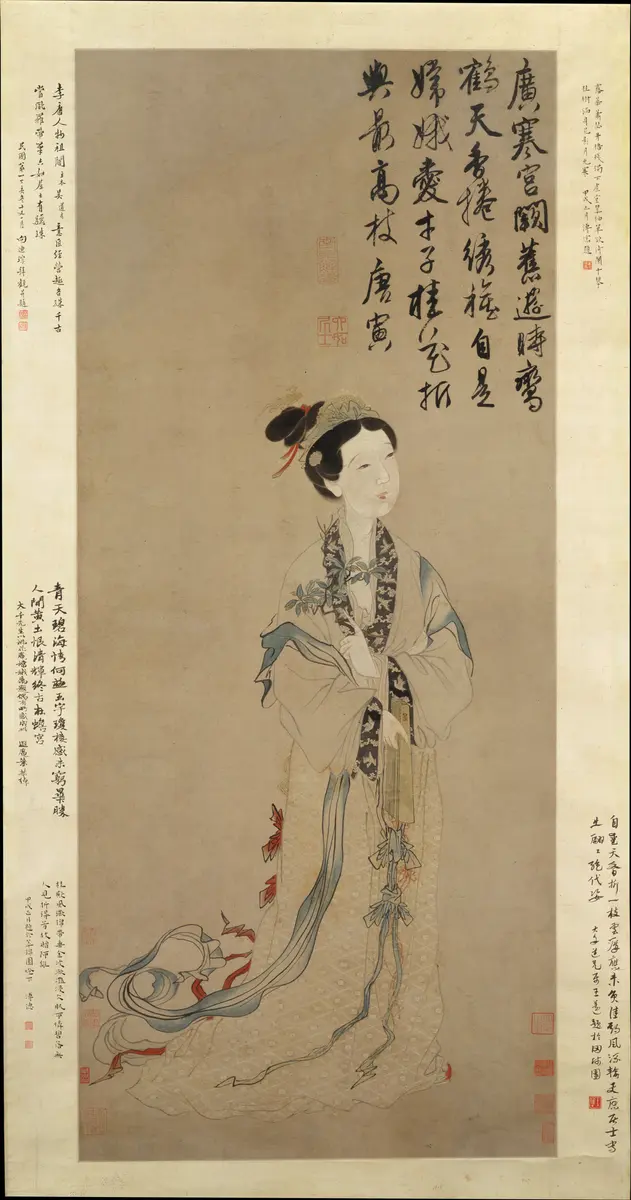
Where Ming art does show her, the subject is usually success in the examinations. The Metropolitan Museum's hanging scroll after Tang Yin carries his quatrain: "Chang'e, being one who loves a gifted scholar, breaks off for him the topmost branch of the cassia." She is not being mourned. She is being asked for a favour.
Timeline: the documented record of Chang'e, Goddess of the Moon
- late 3rd century BCE The oldest surviving version of the story is buried in a Qin tomb at Wangjiatai, Jiangling. Under the Guimei hexagram of the Guicang the slips read: 'In old times Heng Wo stole the drug of no-death from the Queen Mother of the West, and took it, fleeing to the moon.' No archer, no ten suns, no rabbit, no festival: a woman, a theft and the moon.
- 139 BCE The Huainanzi is presented at the court of Emperor Wu. In 'Lanming xun' the archer appears for the first time beside her — 'Yi requested the drug of no-death from the Queen Mother of the West, and Heng'e stole it and fled to the moon' — inside an analogy against living on what you have borrowed. The ten suns are in another chapter entirely, and the two episodes are never joined.
- c. 111 CE Ban Gu's Hanshu catalogues the imperial library. The Huainanzi is entered as twenty-one inner chapters and thirty-three outer ones. Only the inner twenty-one survive — which is why the 'outer eight chapters' cited today for the apprentice version cannot be consulted, and are not in the catalogue either.
- c. 120 CE Zhang Heng's Lingxian gives the first complete narrative, matching the buried slips down to the oracle of the diviner You Huang, and ends: 'Heng'e then lodged her body in the moon, and became the toad.' The point of the story, in its oldest full form, is to explain the dark markings on the lunar disc.
- mid-9th century Li Shangyin writes the four lines by which most Chinese readers still know her, and they keep the theft: 'Chang'e must regret having stolen the numinous drug — the emerald sea, the blue sky, night after night her heart.' In the Tang the story is still about a woman who took something and cannot come back.
- c. 860 Duan Chengshi's Youyang zazu records the cassia and the toad in the moon and, for the first time in any text, the woodcutter: 'surnamed Wu, named Gang, a man of Xihe, who erred while studying immortality and was sentenced to fell the tree.' In the same paragraph he prefers a natural explanation: the toad and cassia are 'the shadow of the earth', the gaps 'the reflection of water', and this 'comes closer'.
- 983 The Song encyclopaedia Taiping yulan quotes a fuller Huainanzi than the one that survives: 'Yao ordered Yi to shoot up at the ten suns; he hit nine of them. The crows all died and their wings fell.' The famous 'nine' is not in the received text of the Huainanzi at all.
- 1593 Shen Bang's gazetteer of Wanping county, on the western half of Beijing, records the cake by name: 'gentry and commoners alike make flour cakes in this month and send them to one another, of unequal size, called mooncakes.' It is a gift between households, not an offering to a goddess.
- 1635 The Dijing jingwulüe describes the Mid-Autumn rite in Ming Beijing: the paper shops sell moonlight prints showing 'seated on a lotus, the Bodhisattva of Universal Moonlight; beneath the flower, the moon-wheel and the cassia hall, with a hare standing upright at the pestle'. Chang'e is not on the print. The text also fixes what 'reunion' meant: the married daughter had to be back in her husband's house that night.
- 1900 Fucha Dunchong's almanac of Qing Beijing describes the same print, now headed by the Lord of the Grand Yin 'in the manner of a bodhisattva' with the jade hare below, mooncakes stamped 'with the toad and hare of the moon palace', and the proverb that settles who officiated: 'men do not bow to the moon, women do not sacrifice to the stove.' In the whole almanac, some 18,000 characters in the Wikisource transcription, Chang'e's name never appears in any of its four written forms.
- 20 July 1969 At 03:23:17:28 mission elapsed time, hours before the landing, the capsule communicator reads Apollo 11 the morning papers: 'An ancient legend says a beautiful Chinese girl called Chang-o has been living there for 4000 years. It seems she was banished to the Moon because she stole the pill of immortality from her husband.' The reply, logged in the transcript under LMP — Aldrin, not Collins, as it is usually retold — is 'We'll keep a close eye out for the bunny girl.'
- 27 February 2021 Samples from the 1,731 g of soil returned by the Chang'e-5 probe go on public display at the National Museum of China, in a crystal vessel 38.44 cm high — the figure chosen for the 384,400 km between the Earth and the Moon.
- 25 June 2024 The Chang'e-6 return capsule lands in Inner Mongolia with what its agency calls 'the world's first samples collected from the far side of the moon', gathered in the South Pole-Aitken basin on 2 June. The programme has carried her name since its first orbiter in 2007, and its rovers that of the hare.
Is there a rational explanation for Chang'e, Goddess of the Moon?
The source cited for the apprentice version does not exist. The plot with the apprentice — usually named Peng Meng — travels with a citation to the Huainanzi's "outer eight chapters". Ban Gu's Han catalogue gives the work twenty-one inner chapters and thirty-three outer ones; only the inner twenty-one survive, and the catalogue has no entry for any "outer eight". The quoted passage also convicts itself. It ends with Chang'e, stranded in the Guanghan palace, setting "Wu Gang to fell the cassia and the jade hare to pound the drug" — and Wu Gang first appears in Duan Chengshi's Youyang zazu, around 860 CE, roughly a thousand years after the book it is being attributed to. A text cannot quote a character who will not be invented for another millennium. The apprentice version therefore has no surviving text behind it that can be read and checked.
The oldest explanation of the story is itself a sceptical one, and it is Chinese and ninth-century. In the same paragraph in which he records the cassia, the toad and Wu Gang, Duan Chengshi adds: "some say that the toad and cassia in the moon are the shadow of the earth, and the empty places the reflection of water; this comes closer." Modern selenography says something adjacent: the dark patches are basaltic maria, and the toad, the hare, the tree and the woodcutter are all pareidolia read into the same fixed pattern, which is fixed because the Moon is tidally locked and shows us one face.
What the sources will not support. No text before the modern period makes Yi's elixir a reward for shooting the suns; the two episodes sit in different chapters of the Huainanzi and are never joined there. No early text says the couple meant to ascend together, and none describes Yi laying out her favourite foods. And there is no evidence in the classical descriptions of the Mid-Autumn rite that the offering was made to Chang'e: the 1635 and 1900 accounts both name a moon bodhisattva and the pounding hare, and in the Wikisource transcription of the Yanjing suishi ji, a year-round almanac of Qing Beijing of some 18,000 characters, none of the four ways of writing her name (嫦娥, 姮娥, 常娥, 恒娥) occurs once, while the character for hare occurs six times (count of 25 September 2026). What can be said honestly is narrower and older: that she stole, that she went alone, and that in the first full telling she turned into a toad.
Can you visit Chang'e, Goddess of the Moon?
The legend has no site of its own. The coordinate on this file, 34.3416 N 108.9398 E, falls in Weiyang district of Xi'an, about 9 km north of the city centre. As Chang'an, Xi'an was the capital of the Western Han court that received the Huainanzi and of the Tang dynasty in which Li Shangyin wrote his quatrain, but nothing in the story is set there. What can be visited are the places and objects where the story settled later.
The festival. Mid-Autumn falls on the fifteenth day of the eighth lunar month, which in 2026 is Friday 25 September. The State Council's holiday notice of 4 November 2025 gives mainland China 25 to 27 September off, and the Hong Kong government's list of 2026 general holidays puts "the day following the Chinese Mid-Autumn Festival" on Saturday 26 September. For the Qing capital, the Yanjing suishi ji of about 1900 describes the cakes made for the moon offering as more than a chi across and painted with "the moon palace, the toad and the hare"; its author ranked the Zhimeizhai shop at Qianmen first in the city.
Beijing. The Altar of the Moon (Yuetan) was begun in 1530, the ninth year of Jiajing, and Ming and Qing emperors sacrificed there to the moon at the autumn equinox. It became a public park in 1955 and was placed on the sixth list of national key cultural relics protection units in 2006. The altar platform itself is gone: the page of the Beijing Municipal Bureau of Culture and Tourism says it was demolished in the 1960s and that since 1966 its site has been held by a 180-metre backup transmission tower of China Central Television, which also occupies the old store-rooms for ritual vessels and instruments. The bell tower survives, and so does the robing hall (Jufudian), which a district job centre occupied until 2006 and which was restored after it left; the enclosure wall was largely rebuilt from 2004, with a stretch of the Ming rammed-earth wall kept behind glass. The same page gives the address as 6A Yuetan North Street, Xicheng district, and a ticket of 1 yuan. The park opens from 06:00 to 21:00 in winter, with last entry at 20:00, and to 21:30 in summer, with last entry at 20:30; buses 13, 15 and 19 stop at Yuetan Gongyuan, and the page advises against driving because parking nearby is difficult. It was read on 24 September 2026. The clay tu'er ye, the "Rabbit Lord", enters the record in the Yanjing suishi ji as a Mid-Autumn figure that street craftsmen moulded from yellow earth.
Museums. Soil from the Chang'e-5 probe went on public display at the National Museum of China on 27 February 2021, in an artificial-crystal vessel shaped like a bronze zun: 38.44 cm high for the 384,400 km to the Moon and 22.89 cm wide for the 22.89 days of the mission. The Xinhua report of that day added that after Beijing the samples would go on a national tour, so it does not establish that they are still in the museum. The Metropolitan Museum of Art in New York holds the Ming hanging scroll "The Moon Goddess Chang E" (1981.4.2, gift of Douglas Dillon); on 24 September 2026 the museum's open-access collection record gave no gallery number for it.
Online. The classical passages quoted in this file can be read free of charge. The Huainanzi and the Yanjing suishi ji are at the Chinese Text Project; the Youyang zazu, the Taiping yulan and Zhang Heng's Lingxian, quoted inside the commentary to juan 100 of the Hou Hanshu, are at Chinese Wikisource. NASA hosts the Apollo 11 air-to-ground transcript, where the capsule communicator's line about "a beautiful Chinese girl called Chang-o" is logged at 03 23 17 28.
Sources consulted
- Liu An (comp.), «Huainanzi, 'Lanming xun': 譬若羿請不死之藥於西王母,姮娥竊以奔月,悵然有喪,無以續之 — the oldest transmitted text that names the archer alongside her; she steals, and the one left grieving is Yi» — Huainanzi, -139 book
- Liu An (comp.), «Huainanzi, 'Benjing xun': 逮至堯之時,十日並出…堯乃使羿…上射十日而下殺猰貐 — the ten suns, in a different chapter, with no elixir and no number of suns felled» — Huainanzi, -139 book
- Liu Yongjia (刘永加), «嫦娥是如何奔月的 ('How Chang'e went to the moon') — prints the transcription of the Guicang 'Guimei' slip from Wangjiatai tomb 15: 昔者恒我竊毋死之藥于西王母,服之以奔月» — Guangming Ribao, 2022 newspaper archive
- Zhang Heng (78-139 CE), «Lingxian, surviving through quotation: 姮娥遂託身於月,是為蟾蠩 ('Heng'e then lodged her body in the moon, and became the toad'), with the divination by You Huang» — Lingxian (quoted in the commentary to the Hou Hanshu treatise on astronomy), 120 book
- Li Shangyin (c. 813-858); Qinding Quan Tang shi edition, «Quan Tang shi, juan 540, Li Shangyin, '常娥': 常娥應悔偷靈藥,碧海青天夜夜心» — Quan Tang shi, 1705 book
- Duan Chengshi, «Youyang zazu, 'Tianzhi': 舊言月中有桂,有蟾蜍…人姓吳名剛,西河人,學仙有過,謫令伐樹 — and the rationalist gloss 或言月中蟾桂地影也,空處水影也,此語差近» — Youyang zazu, juan 1, 860 book
- Li Fang et al. (comp.), «Taiping yulan, juan 920, quoting the Huainanzi: 堯時,十日並出。堯命羿仰射十日,中其九。烏皆死,墮其翼 — the 'nine', absent from the received Huainanzi» — Taiping yulan, 983 book
- Ban Gu, «Hanshu, 'Yiwenzhi': 淮南內二十一篇 / 淮南外三十三篇 — the Han imperial catalogue of the Huainanzi: 21 inner chapters, 33 outer. No 'outer eight'» — Hanshu, 111 book
- Liu Tong and Yu Yizheng, «Dijing jingwulüe on the Mid-Autumn rite, quoted verbatim in the Yanjing suishi ji: 八月十五日祭月…紙肆市月光紙,繢滿月像,趺坐蓮花者,月光遍照菩薩也。花下月輪桂殿,有兔杵而人立,搗藥臼中…女歸寧,是日必返其夫家,曰團圓節也» — Dijing jingwulüe, 1635 book
- Fucha Dunchong, «Yanjing suishi ji, sections 中秋 / 月光馬兒 / 月餅 / 兔兒爺攤子: 上繪太陰星君,如菩薩像,下繪月宮及搗藥之玉兔 · 上繪月宮蟾兔之形 · 男不拜月,女不祭灶» — Yanjing suishi ji, 1900 book
- Wikipedia contributors, «月餅 (Mooncake), 溯源 section (citing Shen Bang, Wanshu zaji, 1593): 八月饋月餅:士庶家俱以是月造麵餅相遺,大小不等,呼為月餅» — Wikipedia, 2026 web
- NASA, Manned Spacecraft Center, «Apollo 11 Technical Air-to-Ground Voice Transcription, GET 03 23 17 28: 'An ancient legend says a beautiful Chinese girl called Chang-o has been living there for 4000 years. It seems she was banished to the Moon because she stole the pill of immortality from her husband'» — Apollo 11 mission transcript, 1969 archive
- Unidentified artist, after Tang Yin (1470-1524), «'The Moon Goddess Chang E', hanging scroll, ink and colour on paper, acc. 1981.4.2, Gift of Douglas Dillon — inscribed with Tang Yin's quatrain 廣寒宮闕舊遊時…自是嫦娥愛才子,桂花折與最高枝» — The Metropolitan Museum of Art, New York, 1981 web
- China National Space Administration, «About China's lunar mission: Timeline of Chang'e-6 mission — launch 3 May 2024, landing in the South Pole-Aitken basin 2 June, returner down in Inner Mongolia 25 June 2024, 'the world's first samples collected from the far side of the moon'» — CNSA (English site), 2024 report
- Xinhua, «Lunar samples on display at China's national museum — Chang'e-5 soil shown publicly from 27 February 2021, in a crystal vessel 38.44 cm high for the 384,400 km to the Moon» — People's Daily Online, 2021 newspaper archive
- Beijing Municipal Bureau of Culture and Tourism, «月坛公园 (Yuetan Park) — 始建于明朝嘉靖九年(1530年), where Ming and Qing emperors sacrificed to the moon; a public park since 1955. Address, hours and the 1-yuan ticket» — visitbeijing.com.cn, 2024 web
- General Office of the State Council, «国务院办公厅关于2026年部分节假日安排的通知 (State Council notice on the 2026 public holidays) — 中秋节:9月25日(周五)至27日(周日)放假,共3天» — People's Daily Online (人民网), 2025 report
- Government of the Hong Kong SAR, «General holidays for 2026 — 'The day following the Chinese Mid-Autumn Festival', 26 September, Saturday» — GovHK, 2025 web
Reviewed by V. Serrano on 2026-08-16 · How we verify our content
📎 Source: Enigma Atlas
💬 Field testimonies (0)
No testimonies yet. Add the first.
Add your testimony
🔒 Log in to add a testimony