📜 LEGEND · EXP. Nº0270
ACTIVE
The Cowherd and the Weaver Girl
For most of its recorded life this was not a love story at all.
Where does the legend of The Cowherd and the Weaver Girl come from?
- Location
- Yellow River basin, China, China
- Kind of legend
- Myth
- Coordinates
- 34.757, 113.665
- Last updated
LOCATION
What is the legend of The Cowherd and the Weaver Girl?
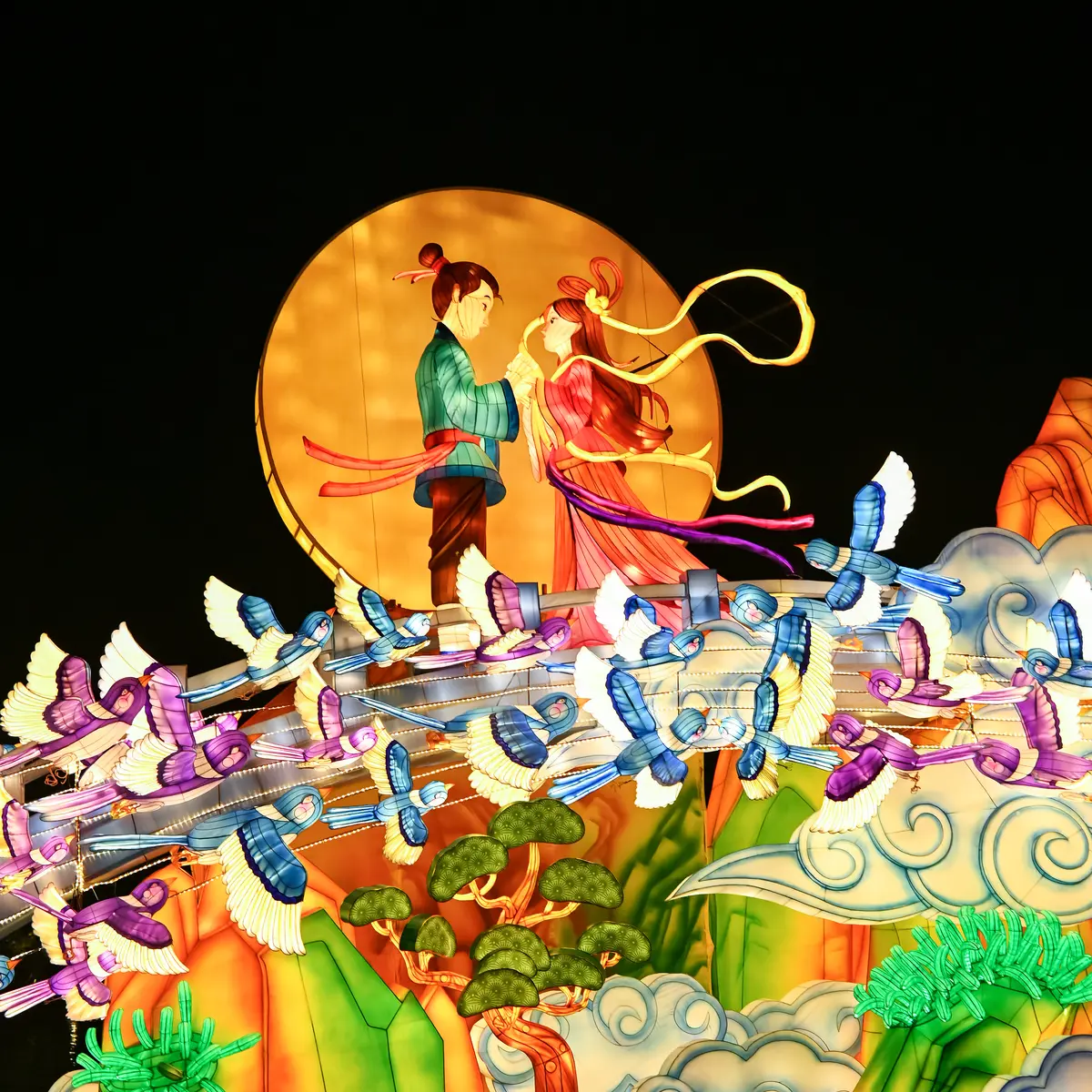
The oldest line that puts the Cowherd and the Weaver Girl together is a Qin wedding almanac buried around 217 BCE, and it cites their marriage as a bad omen because it failed; the Book of Odes names the two stars only to complain that she weaves nothing and he pulls no cart. The first complete narrative is Yin Yun's, written before 529, and in it she is the daughter of the Heavenly Emperor, not of the Queen Mother of the West, while the god who separates the couple is the same one who married them, punishing not her love but her abandoned loom. The magic ox, the robe stolen while she bathes, the two children and the Queen Mother's golden hairpin all arrive with the late-Qing stage: Mei Lanfang played the Weaver Girl at Qixi 1921 and released several hundred live sparrows into the theatre to make the magpie bridge. The festival's older name means “begging for skill”, and its earliest recorded rite is women threading seven-holed needles. Vega and Altair do stand 34 degrees apart, and about 14.6 light years.
What is the history of The Cowherd and the Weaver Girl?
This is a story with no author, no birthplace and — for most of its recorded life — almost no plot. What it has instead is a chain of datable texts, and the chain can be read link by link. Nearly everything in the popular modern plot is in the last link, and the last link is about a hundred years old.
c. 217 BCE — they are already a couple, and the marriage fails. The oldest surviving line that puts the two together is not poetry but a wedding almanac. Among the Qin bamboo slips excavated at Shuihudi in Yunmeng, Hubei, in December 1975 — a tomb sealed around 217 BCE — the Daybook (Rishu), section on taking a wife, warns against two days of the sexagenary cycle: "wushen and jiyou: the Draught Ox took the Weaver Girl to wife; it did not come off, and there were three castings-out." The first plot we possess is a divorce used as a bad omen.
The Book of Odes — two stars that refuse to work. In "Da Dong" (Lesser Court Hymns), the pair are named but do nothing: "There is the Han River in heaven... splayed is the Weaver Girl, seven times a day she shifts. Though seven times she shifts, she completes no patterned cloth. Bright is the Draught Ox, but he does not draw our carts." That is the whole of it. The lines complain of gods who do no work, a Weaver who completes no cloth and an Ox who draws no cart; and "splayed" describes the Weaver as a figure of three stars.
139 BCE, c. 91 BCE — the Weaver becomes a person. The Huainanzi lists her among the goddesses a sage would not bother to marry ("Consort Fu for a concubine, the Weaver Girl for a wife"). Sima Qian's Shiji, "Treatise on the Celestial Offices", fixes her rank in one clause: "the Weaver Girl is Heaven's granddaughter." That epithet — tiansun, Heaven's grandchild — is the ancestor of every later "granddaughter" in the retellings. It has nothing to do with the Queen Mother of the West.
The Han court threads needles. The earliest datable custom is a craft rite. The Xijing zaji records: "The Han palace women always threaded seven-holed needles on the seventh day of the seventh month, in the Kaijin Tower, and all practised it."
c. 195 CE — the magpies, and they reach us second-hand. Ying Shao's Fengsu tongyi is credited with the bridge: "On the seventh night the Weaver Girl must cross the river, and magpies are made into a bridge. It is said that on the seventh day the magpies' heads are all bald for no reason, because of the beam by which the Weaver Girl crossed." Only ten of the original thirty chapters of that book survive. This passage is not in them: it reaches us as a quotation inside a Tang compilation, Han E's Suihua jili. The most famous image in the legend survives only as a quotation inside a Tang compilation.
Han — the grief. The tenth of the Nineteen Old Poems gives the emotion without a single event: "Far, far the Draught Ox star; bright, bright the girl of the River of Heaven... all day she completes no pattern, her weeping falls like rain."
6th century — a night, and at last a story. Zong Lin's Jingchu suishiji fixes the date: "The seventh day of the seventh month is the night of the meeting of the Draught Ox and the Weaver Girl." And a passage transmitted as part of Yin Yun's (471–529) Xiaoshuo — an attribution Hao Jing contested in 2015 — gives the first complete narrative we have: "East of the River of Heaven there is the Weaver Girl, daughter of the Heavenly Emperor. Year after year she toiled at loom and shuttle, weaving cloud-brocade celestial robes, with no leisure to arrange her own face. The Emperor pitied her solitude and allowed her to marry the Draught Ox Lad west of the river. After the wedding she abandoned her weaving. The Heavenly Emperor was angry, ordered her back east of the river, and permitted them to meet only once a year."
Set against the modern plot, the differences are specific. She is the daughter of the Heavenly Emperor, and the Queen Mother does not appear. The god who separates them is the same god who married them, and out of the same feeling. There is no theft, no children, no magpies and no mortal husband: the Cowherd is a star on the far bank. What angers the Emperor is that she stops weaving.
c. 1100 — the meaning. Qin Guan's ci to the tune "Immortal at the Magpie Bridge" turns the annual separation into an argument: "If two hearts are to endure, what need have they of dawn upon dawn, dusk upon dusk?"
Late Qing and early Republic — the plot told today. The popular version was assembled for the stage. The Peking opera Tianhe pei ("Match at the River of Heaven"), arranged by Wang Yaoqing from a popular novel, runs: the merchant Zhang Youcai's wife pushes the brothers to divide the household, and the younger brother, the Cowherd, gets only an old ox; the ox is the Golden Ox Star in disguise, and it teaches him to go to the River of Heaven and steal the clothes of the Weaver Girl and so marry her; they farm and weave and have a son and a daughter; years later the Queen Mother summons her back, and when he pursues with the two children she draws the River of Heaven across their path — with a golden hairpin, in the standard staging — and allows them one meeting a year, for which a hundred birds build the magpie bridge. Mei Lanfang played the Weaver Girl in it at the Jixiang Teahouse in Beijing at Qixi 1921, changed her costume from Daoist robe to ancient dress, choreographed a bathing scene at the lotus pond and a magpie-bridge dance, and released several hundred live sparrows into the auditorium for the bridge.
And where the stolen robe came from. Not from this legend. The oldest Chinese hidden-garment tale is in Gan Bao's Soushen ji (4th century), and it is about somebody else: a man of Xinyu county in Yuzhang sees six or seven women in a field wearing feather robes, without knowing they are birds; he crawls up, hides the robe one of them has taken off, and takes her to wife. She bears three daughters. Then she has one of the girls ask the father where the robe is hidden — under the stacked rice — and she puts it on and flies away, and later comes back and takes the three girls with her too. That is the ending the motif carries: she leaves.
Timeline: the documented record of The Cowherd and the Weaver Girl
- c. 217 BCE The Qin Daybook buried at Shuihudi already pairs them, and does so as a warning: marrying on wushen or jiyou days is unlucky because 'the Draught Ox took the Weaver Girl to wife; it did not come off, and there were three castings-out'. The oldest plot we have is a failed marriage.
- 139 BCE The Huainanzi, presented to Emperor Wu, names the Weaver Girl among the goddesses a sage might take to wife — the earliest surviving text that treats her as marriageable rather than as a star.
- 120 BCE Emperor Wu has the Kunming Pool dug at Doumen, south-west of Chang'an, to train a navy. Two colossal stone figures are set on opposite banks to stand for the Cowherd and the Weaver Girl across the Heavenly River. Both still stand, about 3 km apart, and are protected as Shaanxi provincial monuments since 6 August 1956.
- c. 91 BCE Sima Qian's Shiji, in the Treatise on the Celestial Offices, fixes her rank in four characters: 'the Weaver Girl is Heaven's granddaughter'. Every later 'granddaughter', ours included, descends from this epithet — and none of them from the Queen Mother of the West.
- c. 195 CE Ying Shao's Fengsu tongyi is credited with the magpie bridge and with the bald magpies of the seventh night. Only ten of its thirty chapters survive and this passage is not among them: it reaches us as a quotation inside Han E's Tang-dynasty Suihua jili.
- 4th century Gan Bao's Soushen ji records the oldest Chinese hidden-garment tale — the feather-robe women of Xinyu county — in which the man hides the robe, takes the woman to wife, and she finds it years later and flies away, returning for her daughters. The motif that our file described as a secret marriage begins here, in a different story, and ends with her leaving.
- before 529 A passage transmitted as part of Yin Yun's (471-529) Xiaoshuo, an attribution contested by Hao Jing in 2015, gives the first complete narrative: the Weaver Girl is the daughter of the Heavenly Emperor, who out of pity for her loneliness marries her to the Cowherd across the river, then in anger at her abandoned loom sends her back and allows one meeting a year. No Queen Mother, no stolen clothes, no children, no magpies and no mortal husband.
- 6th century Zong Lin's Jingchu suishiji pins the meeting to the calendar — 'the seventh day of the seventh month is the night of the meeting of the Draught Ox and the Weaver Girl' — and describes the rite that goes with it: women threading seven-holed needles, offerings of wine, dried meat and fruit in the courtyard, and a spider's web found on a melon read as a favourable sign.
- c. 1100 Qin Guan writes his ci to the tune 'Immortal at the Magpie Bridge' and gives the legend the reading that has stuck in Chinese literature: 'If two hearts are to endure, what need have they of dawn upon dawn, dusk upon dusk?'
- Qixi 1921 Mei Lanfang plays the Weaver Girl in the Peking opera Tianhe pei at the Jixiang Teahouse in Beijing. It is this stage version, arranged by Wang Yaoqing from a popular novel, that carries the plot our file told: the magic ox, the stolen clothes, the two children, the Queen Mother and her hairpin. Mei changed the costume from Daoist robe to ancient dress, added a bathing scene and a bridge dance, and released several hundred live sparrows for the magpie bridge.
- 2006 The State Council enters the Qixi Festival in the first national intangible cultural heritage list as item Ⅹ-4, in the category minsu (folk custom), on the application of the Ministry of Culture. It is registered as a custom, not as a romance.
- 7 June 2008 State Council notice Guofa [2008] 19 enters 'the legend of the Cowherd and the Weaver Girl' in the second national intangible heritage list as item 523, number Ⅰ-36, under folk literature, for Heshun County (Shanxi) and Yiyuan County (Shandong). The same document adds the qiqiao customs of Xihe County, Gansu, to the Qixi entry Ⅹ-4.
- 23 May 2011 The expansion list published with notice Guofa [2011] 14 adds Chang'an District, Xi'an — the district of the two Han stone statues — to the same entry Ⅰ-36. Three localities now hold the legend officially; none of them is in Henan.
- 19 August 2026 Qixi falls on 19 August in 2026, on 29 August in 2025 and on 10 August in 2024, according to the Hong Kong Observatory's official Gregorian-Lunar conversion tables. The 2025 date is the one most often printed wrong: that year had an intercalary sixth month, and counting it as the seventh yields 31 July.
Is there a rational explanation for The Cowherd and the Weaver Girl?
There is nothing supernatural here to test. There are two stars, one calendar and one chain of books, and all three can be checked.
The stars. The Weaver Girl is Vega, alpha Lyrae, brightest of the three-star asterism the Book of Odes called "splayed"; the Cowherd is Altair, alpha Aquilae, in Chinese Hegu er, "the second star of the River Drum". From their ICRS positions (Vega 18h36m56.34s +38°47'01.3"; Altair 19h50m47.00s +08°52'06.0") the angle between them is 34.20 degrees — some sixty-eight times the half-degree width of the full Moon, which is why they are easy to find and hard to confuse. But they are not two lovers on opposite banks of one river. Their Hipparcos parallaxes (van Leeuwen 2007: 130.23 and 194.95 milliarcseconds) put Vega at 25.05 light years and Altair at 16.73, and the true distance between them works out at about 14.6 light years. The Milky Way that appears to divide them divides nothing: it is the disc of our own galaxy, thousands of light years behind both.
The date, and a trap in it. Qixi is the seventh day of the seventh lunar month, so it has no fixed Gregorian date. Against the Hong Kong Observatory's official conversion tables it fell on 10 August 2024, on 29 August 2025 and on 19 August 2026 — a nineteen-day spread in three years. And 2025 carries the trap: it had an intercalary sixth month, and sources that count the leap month as the seventh print 31 July 2025 instead. A July date for Qixi 2025 is the leap month counted as the seventh.
"China's day of romance". The festival's own older name is Qiqiao, "begging for skill", and both of its earliest datable descriptions are of craft rites: the Han palace women threading seven-holed needles in the Xijing zaji, and the courtyard offerings and spider's web on the melon in the Jingchu suishiji. When the State Council listed it in the first national intangible heritage batch in 2006 it registered it under minsu, folk custom, as Ⅹ-4. The equation with Saint Valentine's Day is a present-day usage, and none of the pre-modern texts in the chain set out in this file's history makes it.
The Queen Mother of the West. She is the villain of the popular modern plot, and she does not appear in the pre-modern chain at all. A full-text search of the post-Han corpus at the Chinese Text Project, made in August 2026, for the phrase "Queen Mother's hairpin" returned exactly one hit, and it is a plant: dragon's-whisker rush, glossed in the Taiping yulan as "another name for the Western Queen Mother's hairpin". The controls in the same corpus on the same day: "magpie bridge" returned thirty hits, and "Weaver Girl" in the pre-Qin and Han corpus returned twenty-two. The corpus works; she is not in it. She arrives with the opera.
And the honest verdict on the story itself. Wilt Idema, who wrote the standard study of what the twentieth century did to these tales, is blunt about this one: it is "the odd man out by far in this foursome"; it "may be traced back to the Book of Odes if needs be, and must have been known to all because of its connection to the Double Seven Festival, but there is hardly a story to speak of". The editors of the five-volume collection of sources on the legend (Ye Tao and Han Guoxiang, 2008) concluded that it was hardly ever treated in traditional regional drama or popular literature. Idema also names the operation that turns the modern plot into the ancient one: "English language surveys of Chinese ancient mythology often cheat the reader by introducing one of the modern folktales on the subject", and he footnotes a specific book — Yuan Ke's Dragons and Dynasties, Penguin, 1993, pp. 183–186.
One last label. Calling this one of the "four great folk legends of China" is not an ancient title. Idema, who uses the grouping, says he does not know when or where the term was coined, only that it "would appear to have been firmly in place by the 1950s" — a modern classificatory habit, which his article sets beside the Folklore Movement of the 1920s and its search for authentic national traditions.
Can you visit The Cowherd and the Weaver Girl?
On the ground. The legend has no single site. What exists on the ground is a pair of Han-dynasty statues and a set of official claims, each with a date.
The Doumen statues, Chang'an District, Xi'an. The heritage record kept by the ICOMOS International Conservation Center in Xi'an, last updated on 5 August 2021, says that Emperor Wu had the Kunming Pool dug in 120 BCE, partly to train men for a naval campaign in the south-west, and that two stone figures were set up on its banks to stand for the Cowherd and the Weaver Girl across the River of Heaven. It places the Cowherd at Changjiazhuang, east of Doumen town, with the lower body buried and 1.9 m showing above ground. The Weaver Girl, seated and 2.3 m tall, is inside the Doumen cotton mill, about 3 km away. Locals call the pair Shiye and Shipo, Stone Grandad and Stone Granny. A building now covers the Weaver Girl to protect her; the Cowherd stands in a hall with a boundary wall that villagers paid for, looked after by a local management committee and, in the record's words, open to visitors as a tourist site. The statues were listed in Shaanxi's first batch of provincial monuments on 6 August 1956, and their protection zones were fixed on 20 April 1992. The record dates them before the stone group at the tomb of Huo Qubing (117 BCE) and calls them the earliest large stone sculptures surviving in China.
The localities the State Council recognises. The legend entered the second national intangible-heritage list, signed on 7 June 2008 (State Council notice Guofa [2008] 19, item 523, number Ⅰ-36), for Heshun County, Shanxi, and Yiyuan County, Shandong. The expansion list signed on 23 May 2011 (Guofa [2011] 14) added Chang'an District, Xi'an. On 24 September 2026 the national heritage database returned those three localities for Ⅰ-36 and no others; none of them is in Henan.
The festival. Qixi entered the first national list in 2006 as Ⅹ-4. The local forms added since are the qiqiao festival of Xihe County, Gansu, in 2008; the Shitang customs of Wenling, Zhejiang, and the Tianhe qiqiao customs of Guangzhou, both in 2011; and the Qixi of Yunxi County, Hubei, in 2014. The festival falls on the seventh day of the seventh lunar month, which the Hong Kong Observatory's tables put on 19 August in 2026.
The two stars. SIMBAD gives Vega a declination of +38° 47′ and Altair one of +8° 52′. Seen from latitude 40° N, Vega crosses the meridian about a degree from the zenith and Altair about 59° above the southern horizon, and on August evenings both are high after dark. With Deneb in Cygnus they form the Summer Triangle. The Milky Way that separates them in the story shows only under a dark sky.
Sources consulted
- Anonymous (received text), «Shijing, Xiao Ya, 'Da Dong' (Mao 203): 'qi bi Zhinu, zhongri qi xiang... huan bi Qianniu, bu yi fu xiang'» — Book of Odes (Shijing), -600 book
- Anonymous Qin scribe; excavated Shuihudi tomb 11, Yunmeng, Hubei, December 1975, «Rishu (Daybook), section on taking a wife: 'wushen, jiyou, Qianniu yi qu Zhinu, bu guo, san qi'» — Shuihudi Qin mu zhujian, Rishu jia zhong (transcription), -217 archive
- Liu An (comp.), «Huainanzi, 'Chuzhen xun': 'qie Fufei, qi Zhinu'» — Huainanzi, -139 book
- Sima Qian, «Shiji, 'Tianguan shu': 'Zhinu, tian nusun ye'» — Shiji, -91 book
- Attributed to Ge Hong / Liu Xin, «Xijing zaji, juan 1, section 'Qixi chuanzhen Kaijin lou': 'Han cainu chang yi qiyue qiri chuan qikong zhen yu Kaijin lou, ju yi xi zhi'» — Xijing zaji, 400 book
- Ying Shao, «Fengsu tongyi — English Wikipedia overview of Ying Shao's work: of its original 30 chapters only 10 survive» — English Wikipedia (article 'Fengsu Tongyi'), 195 web
- Ulrich Theobald, «Yin Yun xiaoshuo — encyclopaedia entry on the work and on the fragment collections of Lu Xun (135 fragments) and Yu Jiaxi (154); it does not quote the Weaver Girl passage, and its bibliography lists Hao Jing (2015), who argues that the passage is not a genuine fragment of the Xiaoshuo» — ChinaKnowledge.de, 2012 web
- Gan Bao, «Soushen ji, juan 14, 'Maoyi nu': the feather-robe women of Xinyu county in Yuzhang» — Soushen ji, 350 book
- Zong Lin, «Jingchu suishiji: 'Qiyue qiri, wei Qianniu Zhinu juhui zhi ye' and the qiqiao rite» — Jingchu suishiji, 560 book
- Bo Songnian, «Minsu, xiqu he nianhua zhong de Qixi jie (Qixi in folk custom, opera and New Year prints) — on Tianhe pei, the stolen robe, the Queen Mother's golden hairpin and Mei Lanfang's 1921 staging» — China Intangible Cultural Heritage Network, 2007 web
- Xikao (Chinese opera repertoire database), «Jingju jumu kaolue: 'Tianhe pei' — plot synopsis, arrangement by Wang Yaoqing, and Mei Lanfang's costume reform» — Xikao, 2020 web
- State Council of the People's Republic of China, «Guowuyuan guanyu gongbu di er pi guojiaji feiwuzhi wenhua yichan minglu... de tongzhi (Guofa [2008] 19), item 523, no. I-36» — Guofa [2008] 19, 2008 report
- ICOMOS International Conservation Center – Xi'an (IICC-X), Silk Roads heritage database, «Niulang Zhinu shike (Cowherd and Weaver Girl stone statues), Doumen, Chang'an District, Xi'an: date, dimensions and provincial protection record» — silkroads.org.cn, 2021 archive
- China Intangible Cultural Heritage Digital Museum, «Qixi jie, national intangible cultural heritage item X-4, first batch, 2006, category minsu» — ihchina.cn, 2006 report
- State Council of the People's Republic of China, «Guowuyuan guanyu gongbu di san pi guojiaji feiwuzhi wenhua yichan minglu de tongzhi (Guofa [2011] 14), expansion list, item 523, no. I-36, Chang'an District, Xi'an» — Guofa [2011] 14, 2011 report
- Hong Kong Observatory, «Gregorian-Lunar Calendar Conversion Tables, 2024, 2025 and 2026» — Hong Kong Observatory, 2026 report
- Wilt L. Idema, «Old Tales for New Times: Some Comments on the Cultural Translation of China's Four Great Folktales in the Twentieth Century» — Taiwan Journal of East Asian Studies, vol. 9 no. 1, 2012 academic
- SIMBAD Astronomical Database, CDS Strasbourg, «Vega (alpha Lyr) and Altair (alpha Aql): ICRS coordinates and Hipparcos parallaxes (van Leeuwen 2007)» — SIMBAD, 2007 academic
- Anonymous (Han dynasty); transmitted in Wen xuan, juan 29, «Gushi shijiu shou, poem 10: 'Tiaotiao Qianniu xing, jiaojiao Hanhe nu... zhongri bu cheng zhang, qiti ling ru yu'» — Nineteen Old Poems, 200 book
- Qin Guan, «Queqiao xian ('Xian yun nong qiao'): 'Liang qing ruo shi jiuchang shi, you qi zai zhaozhao mumu'» — Song ci (Huaihai jushi changduanju), 1100 book
- Chinese Text Project (Donald Sturgeon, ed.), «Full-text search controls in the post-Han and pre-Qin/Han corpora: 'Wangmu zan' 1 hit (a plant gloss in Taiping yulan), 'queqiao' 30 hits, 'Zhinu' 22 hits» — ctext.org, 2026 web
Reviewed by V. Serrano on 2026-08-16 · How we verify our content
📎 Source: Enigma Atlas
💬 Field testimonies (0)
No testimonies yet. Add the first.
Add your testimony
🔒 Log in to add a testimony