📜 LEGEND · EXP. Nº0270
ACTIVE
The Legend of the White Snake
The tale everyone tells about West Lake is much younger than it sounds, and it used to be a horror story.
Where does the legend of The Legend of the White Snake come from?
- Location
- West Lake, Hangzhou, Zhejiang, China
- Kind of legend
- Folk tale
- Coordinates
- 30.232, 120.149
- Last updated
LOCATION
What is the legend of The Legend of the White Snake?
In the earliest Hangzhou version, printed around 1550, the woman in white has her guests' hearts cut out at table and ends sealed under three stone pagodas in the lake. In Feng Menglong's story of 1624 she has a name and a husband, but he is Xu Xuan, a drug-shop clerk rather than a scholar; her green companion is a thousand-year-old carp, not a snake; and she threatens to drown the whole city in blood. There is no realgar wine, no stolen herb of immortality, and no son. The compassionate version came later and it has authors. Around 1740 a troupe of actors bolted on the son who wins the imperial degree and frees his mother, over the written objection of the playwright whose script they were performing, and Fang Chengpei fixed the rest of it in 1771. Then, in September 1924, the real pagoda collapsed, quarried to death by people stealing its bricks for luck, and Lu Xun wrote that it served the monk right. This is the file of a story that keeps rewriting its own ending.
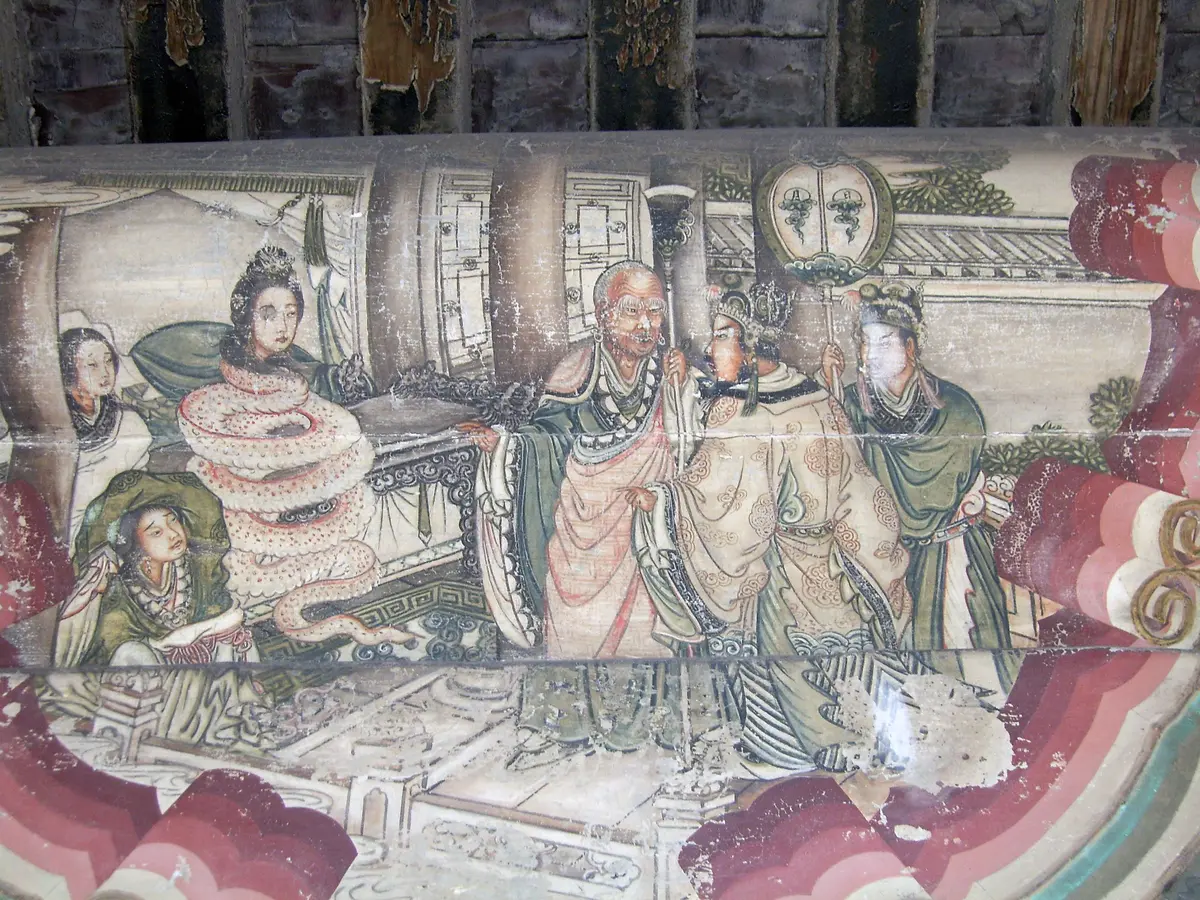
What is the history of The Legend of the White Snake?
Hangzhou has been telling this story for at least five centuries, and it has never told it twice the same way. The version repeated on tourist signs and websites today — a virtuous snake spirit called Bai Suzhen, her green-snake sister Xiaoqing, a gentle scholar named Xu Xian, a jealous monk, and a son who eventually frees his mother — is about two hundred and fifty years old. Nearly every element in it can be dated, and several of them replaced something older and much crueller. What follows is the chain of texts, link by link.
1547 — a snake AND a fish. The earliest datable link between West Lake and a white snake is not a story at all but a topographical gazetteer. In the third chapter of his Xihu youlan zhi (Sightseeing Record of West Lake), the Ming scholar Tian Rucheng describes Leifeng: a spur of Nanping Hill where the consort of the King of Wuyue raised a pagoda, planned at thirteen storeys, cut to seven for lack of funds and later to five on the advice of geomancers, so that people called it the Consort's Pagoda. Then, in one flat line: "It is popularly said that there are two monsters in the lake, a white snake and a green carp, held down beneath the pagoda." A carp — not a green snake. Our own file had quietly lost the older of the two creatures.
c. 1550 — the white lady eats hearts. In Xihu santa ji (Story of the Three Pagodas of West Lake), printed in Hangzhou by Hong Pian in his Qingping shantang collection, a young man named Xi Xuanzan walks out on the Qingming festival through Qiantang Gate, past Zhaoqing Temple and past the Broken Bridge, and rescues a lost girl called Mao'nu. Her mother, a woman in white, throws him a banquet at which two strongmen tie a young man to a pillar, slit his belly, take out his heart and liver on a silver dish and offer them to the guest with hot wine. He declines; the women eat. She keeps him half a month, then orders his heart cut out to make room for a newer man. Mao'nu saves him three times. His uncle, a Daoist, finally summons a spirit general who forces the three into their true shapes: Mao'nu is a black hen, the old woman an otter, and the lady in white a white snake. They are sealed in an iron jar and buried in the lake under three stone pagodas. There is no love in this story, no marriage, no husband worth the name, and no pagoda called Leifeng.
1624 — the tale gets its architecture, and its threat. Feng Menglong printed Madame White Is Kept Forever Under Thunder Peak Pagoda as story 28 of Jingshi tongyan. This is the version everyone means by "the old tale", and it is startling how little of our file survives contact with it. The man is not a scholar and is not called Xu Xian: he is Xu Xuan, twenty-two, an orphan working as a clerk in his uncle's herbal-drug shop at Guanxiangkou. They do not meet on the Broken Bridge: he meets her in the rain, in a hired boat, coming back from Baoshu Pagoda at Qingming, and lands at Yongjin Gate borrowing an umbrella. The green companion is called Qingqing, and she is not a snake — Madame White tells the monk that she is "a green carp of a thousand years from the pool under the Third Bridge in West Lake"; when she is forced into her true shape a carp ten feet long drops out of the sky and shrinks to a foot-long fish. The couple's shop is not a charity: Madame White's silver is stolen, twice, and Xu Xuan is convicted twice for it — first beaten and sent to a labour camp under Suzhou, then, wearing stolen headgear and a fan, given a hundred strokes and banished three hundred and sixty li to Zhenjiang. There is no Dragon Boat Festival scene, no realgar wine drunk by Madame White, no theft of a herb of immortality and no son. What there is instead is a threat, in her own mouth: if he betrays her, she says, "I will turn the whole city to blood; every soul will claw at the flood and tread the muddy waves, and all will die unnatural deaths." At the end it is Xu Xuan himself, not the monk, who claps Fahai's alms bowl over her head from behind and holds it down with all his strength. Fahai builds a small pagoda over the bowl, Xu Xuan begs alms until the seven-storey tower is finished, takes vows, and dies seated in meditation a few years later. The monk's closing poem is a warning against lust: "Had this old monk not come to the rescue, the white snake would have swallowed him whole."
1738 — the first play, and the son that its author hated. Huang Tubi's Leifeng ta, thirty-two scenes in two volumes, is the earliest surviving stage script. Huang softened one thing: he took the alms bowl out of the husband's hands and gave the capture to a Buddhist guardian. But the change that mattered was not his. In his own later preface, On Watching Leifeng ta Performed, he recorded what happened next, and the passage is the most valuable document in the whole chain: "No sooner was the draft finished than the actors insisted on staging it. Then some busybody tacked on the episode of 'Madame White bears a son who wins the degree', falling into the rut of the playhouse to please the audience's eyes and ears; it swept Wu and Yue and reached as far as Yan and Zhao. Alas! On the stage there is no happy reunion without a top graduate... But why is it absolutely impermissible in this play? Bai Niang is a snake demon, and to bring her into the world of caps and gowns — where does that leave me? I say the audience must hold their noses and flee her stench." The most famous element of the modern story was added by working actors, over the author's written objection, because a Qing audience would not go home without a graduation.
1771 — the version we actually retell. Fang Chengpei's Leifeng ta chuanqi, four volumes and thirty-four scenes, built on Huang's text and on a lost Chen-family playhouse manuscript, and it is here that the tale takes the shape our file describes. Fang added the scenes Duanyang (the festival wine), Seeking the Herb, The Water Battle, The Broken Bridge, Speaking at the Pagoda and Offerings at the Pagoda, and ended in comedy. He recast Fahai as a cold enforcer bent on breaking the marriage. He de-monstered Madame White into something close to an immortal. And he turned the green carp into a green snake — the sister our file calls Xiaoqing is 224 years younger than the fish she replaced. Note also the position of the Broken Bridge: in Fang it is scene 26, the reunion after the flooding of Jinshan, not the first meeting. The son, Xu Shilin, takes the top degree four years later, weeps at the pagoda, and moves Heaven to pardon his mother. When the guardian asks whether the tower should be torn down to release her, Fang's Fahai answers: "No need. Leave it for later generations to gaze upon; it also shows that the Buddha's power has no limit."
1924 — the tower answers back. Feng Menglong's monk had left a four-line prophecy: "When West Lake runs dry, when the rivers no longer rise, when Leifeng Pagoda falls, the White Snake will come forth into the world." On 25 September 1924, at about 1.40 in the afternoon, the pagoda fell. It had been standing since 977, burnt out by Japanese pirates in 1555, and it came down because people had been mining its base for bricks: the bricks contained rolled printed sutras, and because jing (sutra) sounds like jin (gold), "sutra bricks" had turned by rumour into "gold bricks", on top of an older belief that a Leifeng brick in the house kept snakes and scorpions out of the silkworm room and helped a woman bear a son. Lu Xun dated an essay on it a month later, on 28 October 1924, and his essay — one word long at the end, serves him right — turned Fahai from an enforcer of heaven into a meddling bigot and Madame White into the wronged party. He wrote a second essay on 6 February 1925 identifying the brick theft, and predicted that in prosperous times a new Leifeng Pagoda would surely be built again. Twenty-five years later the playwright Tian Han rewrote the legend for the modern stage; he threw out the filial son, made Madame White the embodiment of love rather than lust, and gave the last scene to Xiaoqing, who leads the creatures of the water in tearing down the pagoda. Lu Xun's 1924 essay had made the ruin a symbol of the patriarchal order; Tian Han put its destruction inside the story. The tower Lu Xun was glad to see fall was rebuilt, as he said it would be: founded on 26 December 2000 and completed on 25 October 2002.
Timeline: the documented record of The Legend of the White Snake
- 977 Leifeng Pagoda is completed on the south shore of West Lake, begun around 972 under the Wuyue king Qian Chu. Ming and Qing sources say it was raised for a royal consort and call it the Consort's Pagoda, a name that later corrupted into other forms.
- 1547 Tian Rucheng's Sightseeing Record of West Lake records the earliest datable form of the belief: 'It is popularly said that there are two monsters in the lake, a white snake and a green carp, held down beneath the pagoda.' A carp, not a green snake — the older of the two creatures is the one modern retellings dropped.
- c. 1550 Hong Pian prints Story of the Three Pagodas of West Lake in Hangzhou. The woman in white is a serial killer who has men's hearts cut out at table; she is exposed as a white snake and sealed under three stone pagodas in the lake. There is no romance and no Leifeng Pagoda.
- 1555 Japanese raiders besieging Hangzhou set fire to the pagoda, suspecting troops hidden inside. The wooden eaves and stairs burn away and only the red brick core is left standing — the gaunt silhouette that Qing writers and, three and a half centuries later, Lu Xun would describe.
- 1624 Feng Menglong prints 'Madame White Is Kept Forever Under Thunder Peak Pagoda'. The husband is Xu Xuan, a drug-shop clerk; the green companion is a carp; the couple meet in a boat, not on the Broken Bridge; Xu Xuan is convicted twice over her stolen silver, traps her himself with the alms bowl, and dies a monk. Fahai leaves the prophecy: when the lake dries and the pagoda falls, the white snake will come forth.
- 1641 Lu Ciyun records a documented panic: a drought cracks the bed of West Lake and smoke is seen at the pagoda's top. Residents run about shouting that the white snake has come out; he notes that some then faked portents to work on the frightened. Rain restores the lake and the alarm passes.
- 1738 Huang Tubi publishes Leifeng ta, the earliest surviving stage script, in thirty-two scenes. He removes the husband's hand from the capture and hands it to a Buddhist guardian.
- after 1738 Actors stage Huang's play and, in his own words, 'some busybody tacked on the episode of Madame White bears a son who wins the degree'. Huang recorded his disgust in print: a snake demon, he wrote, has no business in the world of caps and gowns, and the audience should hold their noses. The most famous element of the modern tale is a commercial addition against the author's written objection.
- 1771 Fang Chengpei's Leifeng ta chuanqi, in thirty-four scenes, fixes the story we retell: the realgar wine at the Duanwu festival, the theft of the herb, the flooding of Jinshan, the Broken Bridge as the scene of reunion, the son Xu Shilin taking the top degree and freeing his mother. Fahai becomes the cold villain, and the green carp becomes a green snake.
- 1921 The Broken Bridge is rebuilt in its present form at the eastern end of the Bai Causeway: a single stone arch 8.8 metres long and 8.6 wide. Nothing a visitor touches there is older than the twentieth century, although the place-name is attested from the Tang dynasty.
- 25 September 1924, about 13:40 Leifeng Pagoda collapses. The cause is documented and mundane: townspeople had been prising bricks out of its base for years, believing a Leifeng brick kept snakes out of a silkworm room and helped a woman bear a son, and because the bricks held rolled printed sutras and the word for 'sutra' sounds like the word for 'gold', rumour had turned them into gold bricks.
- 28 October 1924 Lu Xun dates his essay 'On the Collapse of Leifeng Pagoda'. He retells the version his grandmother told him, notes that his only wish as a child was to see the tower fall, argues that a monk should mind his own scriptures, and ends the piece with two words: serves him right. The legend's villain changes sides in print.
- 6 February 1925 In a second essay Lu Xun identifies the cause — country people digging out the bricks — and predicts that in prosperous times a new Leifeng Pagoda would be built again, asking whether its fate could not also be guessed.
- late 1940s – early 1950s Tian Han rewrites the legend for the modern stage, working not from Feng Menglong but from early Republican stage versions. He removes the filial son, makes the White Snake the embodiment of love rather than lust, and gives the final scene to Xiaoqing, who leads the creatures of the water in overthrowing the pagoda.
- 11 March 2001 Archaeologists open the sealed crypt beneath the ruins. Inside are an iron reliquary, a gilt silver Ashoka pagoda holding relics, Buddhist statues, silver ornaments, scripture scrolls and 3,428 coins. The tenth-century pagoda proves to have been exactly what the texts said it was, a Buddhist reliquary — and nothing in it has anything to do with a snake.
- 25 October 2002 The rebuilt Leifeng Pagoda is completed, seventy-eight years after the collapse and exactly as Lu Xun had predicted in 1925. It is 71.679 metres tall, built on a steel frame with copper columns and tiles, and has two hydraulic lifts; the ruins of the original are preserved and displayed beneath it.
Is there a rational explanation for The Legend of the White Snake?
Nothing in this file is a claim about a snake. The verifiable subject here is a chain of printed texts, and the honest questions are about that chain.
How old is "ancient"? Wilt Idema, the leading Western specialist on these materials, states flatly that the White Snake "is by far the youngest of the Four Great Folktales, as it cannot be traced back beyond the sixteenth century". Our own file called it "one of China's four great folk romances" as though that were an old title. It is not: the grouping of the White Snake with Meng Jiangnü, the Butterfly Lovers and the Cowherd and Weaving Maid is a product of the Chinese Folklore Movement of the 1920s and its search for an authentic national tradition, and Idema — who wrote the standard study of what the twentieth century did to these four tales — says outright that he does not know when or where the term was first coined, only that it was firmly in place by the 1950s. It is a modern label, and its effect was to freeze one version of a story that had never had one.
Did anyone ever expect the snake to come out? Once, and it is documented. The Qing writer Lu Ciyun recorded in his Hu ruan zaji that in the xinsi year of the Chongzhen reign — 1641 — a long drought dried the marshes, the lakebed cracked into a turtle-shell pattern, and smoke rose from the top of the pagoda. The residents ran about telling each other "The White Snake has come out!", panic spread, and, he notes, some people then faked portents to work on the frightened. Rain came, the lake refilled, the smoke stopped, and the town calmed down. That is what the tradition looks like when it is actually believed: seventeen years after Feng Menglong printed the prophecy, a drought supplied its conditions and a market in fake omens opened immediately.
Was anyone sceptical at the time? Yes, and by name. The dramatist Hong Sheng noted that Hangzhou had three old monsters — the three-legged toad of Jinsha Beach, the great turtle of Liufu Ditch and the white snake of Leifeng Pagoda — and added of the last: "whether the white snake exists or not simply cannot be known. The story-writers have the tale of Madame White kept forever under Leifeng Pagoda; is that how it was?"
And the pagoda itself? The collapse of 1924 needs no supernatural reading and never had one: it is a documented case of a building quarried to death by its own admirers, brick by brick, under two separate superstitions about what those bricks could do. The structure standing today is not the one in the story. It was founded in December 2000 and finished in October 2002, is 71.679 metres tall, and is built on a steel frame with copper columns, brackets and tiles, with two hydraulic lifts inside.
Can you visit The Legend of the White Snake?
Leifeng Pagoda (Leifeng ta), 15 Nanshan Road, south shore of West Lake, Hangzhou. The tower standing there now is a reconstruction completed on 25 October 2002, built on a steel frame with copper cladding and fitted with two hydraulic lifts and steel stairs; it measures 71.679 metres from base to finial. The ruined brick core of the pagoda that collapsed in 1924, the one Lu Xun wrote about, is kept beneath it and can be seen from a gallery inside. Entry is ticketed separately from the lake: the Hangzhou Bendibao visitor guide, in its version of 24 March 2026, gave the adult price as 40 yuan and said that tickets can be booked up to seven days ahead. In the classical list of the Ten Views of West Lake, the pagoda's scene is "Leifeng Pagoda in Evening Glow".
The Broken Bridge (Duanqiao), about 3 km north of the pagoda across the lake. It stands at the eastern end of the Bai Causeway, where Beishan Road meets the walk out to Pinghu Qiuyue and Gushan Island, and it is crossed on foot without a ticket. The present single-arch stone bridge dates from a rebuilding of 1921; it is 8.8 metres long and 8.6 wide, with a clear span of 6.1 metres. The name is much older than the legend: the Tang poet Zhang Hu already wrote of the "broken bridge, its moss rough and worn" in a poem on the Gushan temple, and the bridge's own classical scene, "Melting Snow on the Broken Bridge", has nothing to do with snakes. In neither the sixteenth-century nor the seventeenth-century version of the story is this where the couple meet; in the 1771 play it is where they meet again, after everything has gone wrong.
Jinshan Temple, Zhenjiang, Jiangsu. The monastery that Madame White floods in the later versions is a real temple on the south bank of the Yangtze, about 230 km (144 miles) north-north-west of Leifeng Pagoda in a straight line. Tradition places Fahai there, and it is where Feng Menglong sent Xu Xuan to burn incense against his wife's three conditions.
None of these places is the scene of the events, because the events are literature. Hangzhou holds the geography the writers used, and one modern tower standing over the ruins of the one that fell.
Sources consulted
- Feng Menglong, «Bai Niangzi yongzhen Leifeng ta (Madame White Is Kept Forever Under Thunder Peak Pagoda), Jingshi tongyan, juan 28» — Jingshi tongyan, 1624 book
- Hong Pian (comp.), «Xihu santa ji (Story of the Three Pagodas of West Lake), Qingping shantang huaben» — Qingping shantang huaben, 1550 book
- Lu Xun, «Lun Leifeng ta de daodiao (On the Collapse of Leifeng Pagoda)» — Yusi; collected in Fen, 1924 book
- Lu Xun, «Zai lun Leifeng ta de daodiao (On the Collapse of Leifeng Pagoda, Again)» — Yusi; collected in Fen, 1925 book
- Wu Jieying, «Lun Ming-Qing zhi ji nihuaben yu xiqu zhong de Leifeng ta (Leifeng Pagoda in Ming and Qing Vernacular Stories and Drama), pp. 173-208» — Zhongguo wenxue yanjiu (National Taiwan University), no. 34, 2012 academic
- Wilt L. Idema, «Old Tales for New Times: Some Comments on the Cultural Translation of China's Four Great Folktales in the Twentieth Century» — Taiwan Journal of East Asian Studies, vol. 9 no. 1, 2012 academic
- Hangzhou Daily / Hangzhou wang, «100 nian qian de zuotian Leifeng ta dao le: Leifeng ta chongsheng ji (A century ago yesterday Leifeng Pagoda fell: the story of its rebirth)» — Hangzhou News, 2024 newspaper archive
- Chinese Wikipedia contributors, «Leifeng ta (Leifeng Pagoda): construction, 1924 collapse, crypt excavation and 2002 reconstruction» — Wikipedia (zh), 2026 web
- Shizhao, «File:Long Gallery-Legend white snake.JPG — Summer Palace Long Corridor painting, photographed December 2005» — Wikimedia Commons, 2006 archive
Reviewed by V. Serrano on 2026-08-16 · How we verify our content
📎 Source: Enigma Atlas
💬 Field testimonies (0)
No testimonies yet. Add the first.
Add your testimony
🔒 Log in to add a testimony