🦶 CRYPTID SIGHTING · EXP. Nº6501
ACTIVE
El Coco
El Coco is not a creature anybody has ever reported seeing. It is a word Spanish-speaking adults have used for five centuries to frighten children.
Where and when was El Coco sighted?
- Location
- España/Latinoamérica, Spain
- Date sighted
- Unknown
- Coordinates
- 42.878, -8.545
- Last updated
LOCATION
What is El Coco?
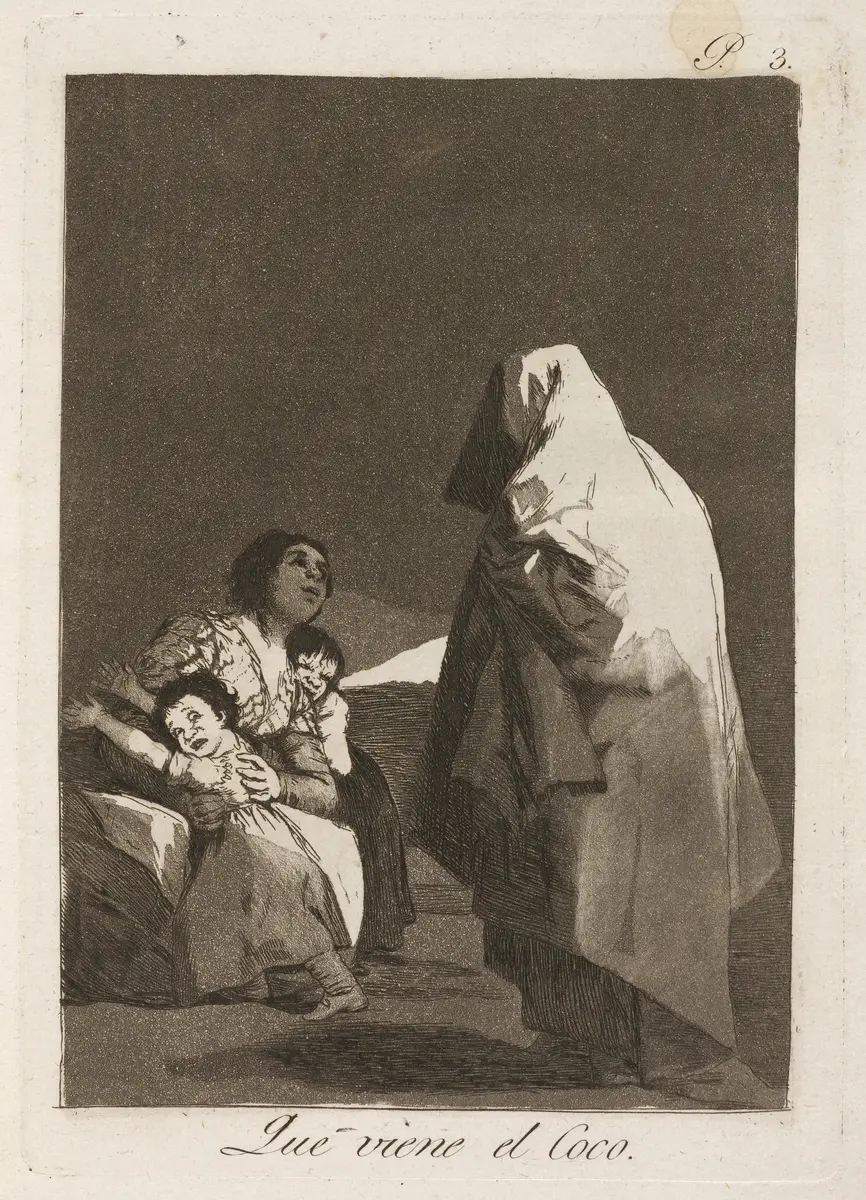
Its oldest dated definition sits not in a folklore book but in a chronicle of Portuguese India: around 1553, João de Barros explains that his countrymen named the palm nut a coco because that was the word women applied "to anything with which they try to frighten children". The fruit took its name from the bogey, not the other way round. A year later, in 1554, the word surfaces in Lazarillo de Tormes in a scene of unexpected cruelty: Lázaro's baby brother points at his own father, who is Black, and shouts "Mother, coco!" By the time Goya etched Que viene el Coco in 1799, plate three of Los Caprichos, the formula had been in print for two and a half centuries — and the contemporary commentators who annotated the series saw in it not a ghost but an accusation: "the disastrous abuse of early education… forcing him to fear what does not exist."
What is the history of El Coco?
The Coco enters the written record as a word, more than two centuries before Goya's plate of 1799.
The earliest dated definition among this file's sources is in a chronicle of the Portuguese expansion into Asia. Around 1553, João de Barros explains in his Década III why his countrymen call the Indian palm nut a coco: the Portuguese gave it "the name of COCO, a word applied by women to anything with which they try to frighten children", and the name stuck because nobody knew any other — the proper one was tenga among the Malabars and narle among the Canarins. Henry Yule and A. C. Burnell reproduce and translate the passage in Hobson-Jobson (1886), alongside the other two witnesses to the naming: Garcia de Orta, writing from Goa in 1563, says "we have given it the name of coco, because it looks like the face of a monkey", and Cristóvão da Costa adds in 1578 that the Portuguese call it coco "because of those three holes that it has".
In Barros's explanation the word already existed, as women's speech for frightening children, when the Portuguese gave it to the nut: the fruit took its name from the bogey.
"Mother, coco!"
A year after Barros, the word turns up in Castilian literature, and it arrives through an uncomfortable door. In Lazarillo de Tormes, printed in 1554, the little boy Lázaro calls his brother — son of his mother and of Zaide, a Black stablehand — sees his own father and bolts: "because the child saw my mother and me white, and him not, he ran from him in fear to my mother, and pointing with his finger said: 'Mother, coco!'". The father laughs. And Lázaro, still a child himself, records the line that turns the joke into something else: "How many there must be in the world who run from others because they cannot see themselves."
In the Lazarillo the Coco is what a child calls a face he does not recognise, and the Spanish Academy would still cite the passage as an authority for the word in 1729.
The dictionaries pin it down
Sebastián de Covarrubias gives the word three separate entries in his Tesoro de la lengua castellana o española (1611). One is the fruit, where he repeats the Portuguese argument: "The Spaniards gave it the name of coco because of the little face formed by the three holes, which look like eyes and a mouth." Another is kermes, the scarlet dye. The third is ours: "Coco, in the speech of children, means a figure that causes fright, and none so much as those that are in the dark, or show a black colour." Covarrubias then offers a biblical etymology, deriving it from Cush, descendant of Ham, "who reigned in Ethiopia, land of the Blacks". The etymology records that by 1611 the word already carried the racial charge that Lazarillo had staged half a century earlier.
The Diccionario de Autoridades (vol. II, 1729) defines it by what it is for: "A frightful and ugly figure, or a cry like a monkey's, made to frighten and restrain children." Among its supporting authorities it cites the Lazarillo passage. It also records the set phrase "Guarda el coco", illustrated from Lope de Vega's La Dorotea, whose example itself goes back to Lazarillo: "You are like the little Black boy of Lazarillo de Tormes, who when his father came in said, very frightened, mother, guarda el coco." The same entry quotes an interlude by Quevedo in which a thief threatens in song: "Give me the purse. Coco, coco, coco!"
Goya, 1799
By the time Francisco de Goya etched Que viene el Coco, plate three of Los Caprichos, the formula had been in print for two and a half centuries. The print — etching and burnished aquatint, 219 × 154 mm — carries its title engraved below the image and the mark "P.3." in the upper right corner. The ones screaming are the children: one throws up his arms to flee, the other clutches at his mother, who stays seated, holds both of them and raises her eyes towards a standing shape wrapped entirely in cloth, faceless.
What makes the case exceptional is that the contemporary manuscript commentaries explaining each plate survive, and all three discuss this one. The Museo Nacional del Prado manuscript says the print "represents the disastrous abuse of early education. Making a child more afraid of the Coco than of his own father, and forcing him to fear what does not exist." The Ayala manuscript is sharper: mothers "frighten their children with the Coco so they can talk to their lovers". The Biblioteca Nacional manuscript combines both readings: "foolish mothers make their children fearful by conjuring the Coco; and worse ones use this trick to be alone with their lovers when they cannot get their children away from them."
Lorca, 1928
The best account of how the Coco works was written by a poet. In his lecture Las nanas infantiles, Federico García Lorca observed: "The magical power of the 'coco' is precisely its blurredness. It can never appear, though it prowls the rooms. And the delightful thing is that it stays blurred for everyone." He then added a correction almost nobody quotes: "But Spain is not fond of the 'coco'. It prefers to frighten with real beings. In the South, the 'bull' and the 'Moorish queen' are the threats; in Castile, the 'she-wolf' and the 'gypsy woman'."
Galicia, Portugal and the Americas
The claim that "the myth of the Coco, or Cucuy, originated in northern Portugal and Galicia" is made in the English Wikipedia article "Coco (folklore)" (read on 25 September 2026). The sentence carries no citation of its own, and the reference that follows it supports only the use of coco for the human head. What is documented in the north-west of the peninsula is a related but distinct figure: the Coca, which the Dicionario da Real Academia Galega defines as a "legendary figure representing a monstrous serpent, brought out in some processions and popular festivals", giving the coca of Redondela as its example and tarasca as its synonym. The child-scaring coco is alive in Galician too, and the Academy records it with a domestic example: "Se non comes todo, vaiche vir o coco" ("if you don't eat it all, the coco will come for you").
Eloy Martos Núñez, of the Universidad de Extremadura, describes the Ibero-American case as syncretic: under a single name — Coco, Cuco, Cucuy — "very different images may be beating", contaminated by Indigenous and African figures and overlapping with the sack man and the sacamantecas.
Timeline: the documented record of El Coco
- c. 1553 In his Década III, the Portuguese chronicler João de Barros explains that his countrymen named the Indian palm nut coco after "a word applied by women to anything with which they try to frighten children". It is the oldest dated definition of the Coco among this file's sources, and in it the word for the bogey comes first: the fruit is named after it.
- 1554 Lazarillo de Tormes is printed. In the first tratado, the narrator's baby brother points at his own father, the Black stablehand Zaide, and cries "¡Madre, coco!". Lázaro's comment turns the joke around: "How many there must be in the world who run from others because they cannot see themselves."
- 1563 Writing from Goa, the physician Garcia de Orta gives the other half of the naming story: "we have given it the name of coco, because it looks like the face of a monkey, or of some other animal". In 1578 Cristóvão da Costa adds the detail that fixed the image for good: the Portuguese call it coco "because of those three holes that it has".
- 17th century According to Eloy Martos Núñez, the oldest known lullaby naming the Coco appears in a play, the Auto de los desposorios de la Virgen by Juan Caxés: "Ea, niña de mis ojos, / duerma y sosiegue, / que a la fe venga el coco / si no se duerme." The attribution rests on Martos.
- 1611 Sebastián de Covarrubias gives coco three separate entries in his Tesoro de la lengua castellana o española. The third reads: "Coco, in the speech of children, means a figure that causes fright, and none so much as those that are in the dark, or show a black colour." He then derives it from Cush, "who reigned in Ethiopia, land of the Blacks" — an etymology no linguist accepts, but a clear record of the racial charge the word already carried.
- 1729 The Real Academia Española publishes volume II of the Diccionario de Autoridades and defines the Coco by what it is for: "A frightful and ugly figure, or a cry like a monkey's, made to frighten and restrain children." Among its supporting authorities the Academy cites the Lazarillo passage of 1554, and it records the threat formula "Guarda el coco" as a separate entry, illustrated from Lope de Vega's La Dorotea.
- 1729 (vol. III) In the same year, the Benedictine Benito Jerónimo Feijóo devotes discourse IV of volume III of his Teatro crítico universal to "Goblins and familiar spirits", warning how many thefts and adulteries were committed "with either the perpetrators or the go-betweens covering themselves with the cloak of goblins", and that the fraud only prevailed "where the whole household is made up of easily credulous people".
- 1799 Goya publishes Los Caprichos. Que viene el Coco is plate three: etching and burnished aquatint, 219 × 154 mm, signed in the plate "P.3." at upper right. The three surviving contemporary manuscripts read it as a pedagogical indictment. The Prado manuscript: "the disastrous abuse of early education. Making a child more afraid of the Coco than of his own father, and forcing him to fear what does not exist."
- c. 1830 Eugène Delacroix copies the plate in aquatint; his version is in the Bibliothèque nationale de France. The original copper plate stays in Spain and is still held by the Calcografía Nacional of the Real Academia de Bellas Artes de San Fernando in Madrid, as number 174.
- 1928 In his lecture Las nanas infantiles, Federico García Lorca explains the mechanism: "The magical power of the 'coco' is precisely its blurredness. It can never appear, though it prowls the rooms." And he adds the correction almost nobody quotes: "But Spain is not fond of the 'coco'. It prefers to frighten with real beings."
- Today The Dicionario da Real Academia Galega still lists coco as a "ghost or imaginary figure used to frighten children", with the everyday example "Se non comes todo, vaiche vir o coco", and keeps coca as a separate entry for the "legendary figure representing a monstrous serpent" paraded at Redondela. The two are relatives, not the same thing.
Is there a rational explanation for El Coco?
Nobody has ever claimed to have seen the Coco, and there is no Coco sighting of the kind recorded for lake monsters. Every source that defines the word describes something said to a child, and the tradition itself knew that.
The sources say so, each of them by name. In 1553 João de Barros defines coco as "a word applied by women to anything with which they try to frighten children": a device for frightening, with no creature described behind it. In 1729 the Diccionario de Autoridades does the same from the lexicographer's chair. It defines the word by its use, "made to frighten and restrain children", and gives the threat formula "Guarda el coco" an entry of its own: "a way of speaking with which children are made afraid, so that they restrain themselves".
The criticism of the practice is just as old. In 1799 all three surviving manuscript commentaries on Los Caprichos read Goya's plate as a comment on child-rearing. For the Prado manuscript it depicts "the disastrous abuse of early education… forcing him to fear what does not exist"; the Ayala manuscript says mothers "frighten their children with the Coco so they can talk to their lovers". Seventy years earlier, the Benedictine Benito Jerónimo Feijóo had attacked the same ground from another angle in his Teatro crítico universal (vol. III, discourse IV, "Goblins and familiar spirits", 1729), recalling how many crimes had been committed "with either the perpetrators or the go-betweens covering themselves with the cloak of goblins", and that the fraud only prevailed "where the whole household is made up of easily credulous people".
In 1928 Federico García Lorca explained why the mechanism works: the Coco can never appear, and so the fear it produces "is a cosmic fear, a fear in which the senses cannot set their saving limits". A figure that never materialises cannot be disproved by experience. In the same lecture Lorca recorded the opposite habit, which weakens the cliché of a Spain ruled by the Coco: "Spain is not fond of the 'coco'. It prefers to frighten with real beings."
The tradition even jokes about its own effectiveness. Among the lullabies collected in Sisante (Cuenca) by Pedro Cerrillo and quoted by Eloy Martos is one that describes habituation to fear: "By telling my little boy / that the coco is coming, / he loses his fear of it / little by little."
Can you visit El Coco?
El Coco has no site, and the only physical things the tradition has left are Goya's plate and the objects around it.
The print Que viene el coco is plate 3 of Los Caprichos, an etching with burnished aquatint of 219 × 154 mm, catalogued as inventory 225 in the online catalogue of the Fundación Goya en Aragón, which is free and asks for no registration. The preparatory drawing, in black and red chalk on laid paper and measuring 198 × 140 mm, is at the Museo Nacional del Prado under inventory number D. 4208; like all works on paper it appears in rotations rather than on permanent display.
The original copper plate is number 174 of the Calcografía Nacional, inside the Real Academia de Bellas Artes de San Fernando at calle de Alcalá 13, Madrid 28014, a few minutes on foot from Puerta del Sol. On 10 September 2026 the Academia's own tariff page gave general admission at 10 euros and the reduced ticket at 5 euros, with the museum open from 10:00 to 15:00 and free entry from 13:30 to 15:00 Tuesday to Friday outside holidays. Guided visits to the museum run Tuesday to Friday at 11:00 and to the Goya cabinet on Thursdays at 12:00.
The nearest surviving relative of the figure is the Coca, which the Dicionario da Real Academia Galega defines as a monstrous serpent taken out at some processions and popular festivals, and whose example is the coca of Redondela in Pontevedra, paraded at Corpus Christi.
Sources consulted
- Henry Yule y A. C. Burnell, «Hobson-Jobson: being a glossary of Anglo-Indian colloquial words and phrases — entrada «Coco-nut» (cita a João de Barros, Década III, libro III, cap. 7, 1553; a Garcia de Orta, 1563; y a Cristóvão da Costa, 1578)» — John Murray, Londres, 1886 book
- Anónimo, «La vida de Lazarillo de Tormes y de sus fortunas y adversidades — tratado primero («¡Madre, coco!»)» — Burgos / Alcalá de Henares / Amberes, 1554 book
- Sebastián de Covarrubias Orozco, «Tesoro de la lengua castellana o española — tres entradas «Coco» (la fruta, la grana y «en lenguaje de los niños vale figura que causa espanto»)» — Luis Sánchez, Madrid, 1611 book
- Real Academia Española, «Diccionario de la lengua castellana (Diccionario de Autoridades), tomo segundo, letra C — entradas «Coco» y «Guarda el coco»» — Imprenta de Francisco del Hierro, Madrid, 1729 book
- Fray Benito Jerónimo Feijóo, «Teatro crítico universal, tomo III, discurso IV: «Duendes y espíritus familiares», sección III» — Madrid (ed. digital del Proyecto Filosofía en español), 1729 book
- Fundación Goya en Aragón, «Catálogo razonado en línea, ficha de la estampa «Que viene el coco», Caprichos 3/85, inv. 225 (con los comentarios manuscritos del Prado, de Ayala y de la Biblioteca Nacional)» — Gobierno de Aragón, 2024 report
- Federico García Lorca, ««Las nanas infantiles» (conferencia)» — Conferencias (ed. digital en Wikisource), 1928 book
- Eloy Martos Núñez, ««La imagen del joven a través de las ficciones de terror y sus fuentes folklórico-literarias. El caso iberoamericano»» — Universidad de Extremadura, 2004 academic
- Real Academia Galega, «Dicionario da Real Academia Galega — entrada «coco» («fantasma ou figura imaxinaria con que se lles mete medo aos nenos», con el ejemplo «Se non comes todo, vaiche vir o coco»)» — Real Academia Galega, 2026 web
- Fundación Goya en Aragón, «Ficha de la estampa «Que viene el coco» (dibujo preparatorio, inv. D. 4208)» — Gobierno de Aragón, 2024 report
- Real Academia Galega, «Dicionario da Real Academia Galega — entrada «coca» (5): «figura lendaria que representa unha serpe monstruosa e que se saca nalgunhas procesións e festas populares», con el ejemplo «A coca de Redondela» y el sinónimo tarasca» — Real Academia Galega, 2026 web
- Colaboradores de Wikipedia, «Coco (folklore) — «The myth of the Coco, or Cucuy, originated in northern Portugal and Galicia» (frase sin cita propia; consultado el 25 de septiembre de 2026)» — Wikipedia en inglés, 2026 web
Reviewed by V. Serrano on 2026-08-11 · How we verify our content
📎 Source: Enigma Atlas
💬 Field testimonies (0)
No testimonies yet. Add the first.
Add your testimony
🔒 Log in to add a testimony