🦶 CRYPTID SIGHTING · EXP. Nº6501
ACTIVE
Cuélebre
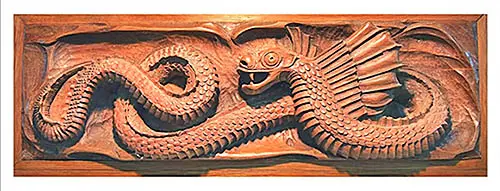
The cuélebre is the winged serpent of Asturian mythology, known also in Cantabria — where it is called culebre — and in León as culuebro, culebrón or sierpe.
Where and when was Cuélebre sighted?
- Location
- Asturias, Spain
- Date sighted
- Unknown
- Coordinates
- 43.362, -5.849
- Last updated
LOCATION
What is Cuélebre?
The definition set down by the folklorist Aurelio de Llano in 1922 is more precise than the creature's later reputation: «a winged serpent that guards treasure and enchanted persons», living in woods, in caves, and in springs with large underground cavities. It guards; it does not abduct. Its scale is hard enough to turn bullets, and it can be killed only by a wound to the throat. When it grows old and its scale thickens, God forbids it to remain here and it flies away to the mar cuajada, the curdled sea, where the old cuélebres watch over a seabed of riches no man can take. The name hides no mystery: it comes from Latin colŭbra, snake. Its written trail begins at least in 1885, in a ballad collected by Juan Menéndez Pidal in which the flying cuélebre guards an accursed castle and has swords for wings.
What is the history of Cuélebre?
The cuélebre was not first written down in 1925, and the man who first recorded it methodically was not Constantino Cabal.
On 24 July 1922, in Zumaya, Ramón Menéndez Pidal signed the preface to a book published that same year by the Talleres de Voluntad in Madrid: Del folklore asturiano: mitos, supersticiones, costumbres, by Aurelio de Llano Roza de Ampudia. Menéndez Pidal praised the "stubborn enthusiasm" of a man who had walked the whole of Asturias gathering material. Llano was born in Caravia, at the foot of the Pico del Castro, and wrote that he had heard these stories as a child on the settle beside the hearth while the women spun. In 1918 he resolved to finish the collection "without a subsidy from anyone".
In that book the cuélebre has a chapter of its own, pages 48 to 50, and a definition worth reading slowly, because it contradicts nearly everything now repeated about the creature:
"The Cuélebre is a winged serpent that guards treasure and enchanted persons. It lives in woods, in caves, and in springs with large underground cavities."
Guards. It does not abduct. The cuélebre of the Asturian springs is a sentry, not a kidnapper, and what it keeps is two things: the gold and the enchanted person. In the tales Llano collected, the one who enchants the girl is a sorcerer or her own father; the cuélebre arrives afterwards, to stand watch. Its scale, Llano says, is hard enough to turn bullets, and it can only be killed by a wound to the throat.
The creature's end is the strangest part of the myth and precisely the part that drops out of summaries. When it grows old and heavily encascarado — when its scale has grown thick and hard — God forbids it to remain here and it flies away to the mar cuajada, the "curdled sea", where the old cuélebres expelled from their homes all live. At the bottom of that sea lie heaps of riches that no man can take, because the cuélebres are watching them.
What makes Llano a source rather than a second-hand digest is that he records who told him each item, when, and where. Eusebio Fernández, aged 89, of Llerices in Cangas de Onís, told him on 9 March 1921 about the cuélebre of Vega de Cueturrasu, which came out of a cave to eat one sheep a day until it was caught in the fork of an oak. Carmen Peláez, aged 71, at Cardo in Gozón, gave him a variant of the disenchantment tale in April 1921. Ramón el Cano, aged 70, gave him another at Caravia in July 1920. And Ángeles Balbín, fifteen years old, of Caravia, had given him one already in August 1918. These are names our earlier entry had erased completely.
Llano was no credulous enthusiast: he was the first to clean house. In the opening pages (pp. 3-5) he denounces the Busgoso, the Espumeros, the Ventolines and the Lavanderas as "myths brought in a few years ago by various writers" that "lack any Asturian tradition", and he corrects the error of the ayalgas — not enchanted maidens at all, but simply buried treasure, from Leonese-Asturian ayalga, 'a find', as R. Menéndez Pidal had shown in his 1906 study of the Leonese dialect. He corrects Rogelio Jove y Bravo (Mitos y supersticiones de Asturias, Oviedo, 1903), Félix de Aramburu (Monografía de Asturias, Oviedo, 1899) and Bernardo Acevedo (Boal y su concejo, Oviedo, 1898), and even retracts parts of his own Libro de Caravia of 1919. After that sifting, his list of genuine Asturian mythology is short: the Nuberu, the Xanas, the Cuélebre, the Sirena, the Trasgu, the mocking Devil, the Güestia, the Witch, and the Enchantments of Midsummer morning. That the cuélebre survived the filter says more about its authenticity than any amount of later repetition.
And it is older than Llano. In 1885 Juan Menéndez Pidal — Ramón's elder brother — had published in Madrid Poesía popular, his collection of the ballads sung at the danza prima, the esfoyazas and the filandones. In ballad LXXXVII, "La muerte del impío", the traitor marquis's castle is left accursed and no one may approach: "Woe to him who came near! / A crimson dragon guards it, / the flying cuélebre: / it has swords for wings, / and it killed all who came" (pp. 258-259). In another ballad, "La pastorcilla", a mother fears "lest some culebro enchant her", and Juan Menéndez Pidal notes at the foot of the page: "In Asturias the dragon is called indifferently cuélebre and culebro" (p. 226).
That footnote from 1885 is also the key to the name. Xosé Lluis García Arias's Diccionario General de la Lengua Asturiana records cuélebre with senses that begin at the most ordinary level: "male snake", "large snake", and only then "the dragon of Asturian mythology". Behind it stands Latin colŭbra, 'snake'. In his Manual elemental de gramática histórica española (1904, §13), Ramón Menéndez Pidal sets out the sound change: from cólobram (for colŭbra) comes the old Spanish culuebra, with a diphthong, and from that the modern culebra, which loses it. Asturian kept the diphthong that Castilian levelled out. Put plainly: the cuélebre is, literally and without metaphor, the big snake — the bestiary came afterwards.
Constantino Cabal (Oviedo, 1877-1967) reached this material later and by another route. He began publishing folklore in 1923, after Llano and by his own account influenced by him, and his mythological work is not a single 1925 book but a series of three volumes under the shared title La mitología asturiana: Los dioses de la muerte and Los dioses de la vida, both 1925 — the latter printed in Madrid by Juan Pueyo, 341 pages — and El sacerdocio del diablo, 1928. Cabal wrote copiously, but his work dates from 1925 onwards: for the cuélebre it is neither the earliest nor the closest to the informant. For the cuélebre, the source that holds up is the one from 1922.
Timeline: the documented record of Cuélebre
- 1885 Juan Menéndez Pidal publishes his collection of Asturian ballads, «Poesía popular», in Madrid. Ballad LXXXVII, «La muerte del impío», holds the oldest printed appearance we have been able to read at first hand: the accursed castle is guarded by «a crimson dragon, / the flying cuélebre: / it has swords for wings». A footnote records that «in Asturias the dragon is called indifferently cuélebre and culebro».
- 1904 In his «Manual elemental de gramática histórica española», Ramón Menéndez Pidal sets out the development of Latin colŭbra: *cólobram yields Old Spanish culuebra, with a diphthong, and from that modern culebra, which loses it. This is the basis for explaining why Asturian says cuélebre.
- 1917 Several neighbours in Caravia hear strange whistling in the Vallín woods and, believing it to be a cuélebre, arm themselves with shotguns and set out to kill it. Llano, himself from Caravia, records it in a single line: «they found nothing».
- August 1918 Ángeles Balbín, aged fifteen, of Caravia, gives Llano her version of the disenchantment: the rope binding the girl turns into a cuélebre, and her betrothed, home from the war, kills it with a spear-thrust to the throat. She is the youngest informant Llano names in the chapter.
- July 1920 Ramón el Cano, aged 70, tells another variant at Caravia: a father enchants his daughter on the mountain and leaves her guarded by a cuélebre, which must be kissed three times to free her.
- 9 March 1921 Eusebio Fernández, aged 89, of Llerices in Cangas de Onís, tells Llano about the cuélebre of Vega de Cueturrasu, which came out of a cave to eat a sheep a day until, startled by the shepherds' horn, it was caught by the neck in the fork of an oak and killed there.
- 6 November 1921 Llano visits the church of Santa María de Celón, in Allande, where a cuélebre was said to enter through a hole to eat the corpses buried in the church until a pilgrim killed it with his spear. He writes that the scene is carved on a stone set beneath the outer cornice of the apse, and adds, in the first person: «I saw it on 6 November 1921».
- 24 July 1922 Ramón Menéndez Pidal signs the preface to Llano's book at Zumaya, Guipúzcoa; it is printed that year by the Talleres de Voluntad in Madrid. It is the first systematic collection of the cuélebre: a chapter of its own, a geographical distribution, place names, and informants given by name and date.
- 1925 Constantino Cabal publishes the first two volumes of his series «La mitología asturiana»: «Los dioses de la muerte» and «Los dioses de la vida», the latter in Madrid, printed by Juan Pueyo, 341 pages. The third, «El sacerdocio del diablo», follows in 1928. It is therefore neither a single 1925 book nor earlier than Llano.
Is there a rational explanation for Cuélebre?
The most economical explanation of the cuélebre lies in its own name, and language supplied it before any sceptic did. The Diccionario General de la Lengua Asturiana does not open the entry with the dragon: it opens with "male snake" and "large snake", and only after several senses does "the dragon of Asturian mythology" appear. Behind it stands Latin colŭbra. A cuélebre is, literally, a big snake; everything else — the wings, the bulletproof scale, the hoard — is what the story added on top of an animal that actually exists.
The oldest sceptical testimony we have found comes not from a modern debunker but from the collector of 1885 himself. In the preface to Poesía popular, Juan Menéndez Pidal describes entering the Asturian grottoes, "lodgings of cuélebres and monsters which the imagination fancies it sees clinging to the hard rock during the hours of disenchantment, on observing the capricious shapes of the stalactites that adorn the roof". It is a description of pareidolia in all but name, and it is signed by a man who was collecting the myth, not attacking it.
The one hunt we have found documented ended as such things end. In 1917 several neighbours in Caravia heard strange whistling in the Vallín woods; believing it was a cuélebre, they took up shotguns and went to kill it. Llano — a Caravia man himself — disposes of it in four words: "they found nothing".
It is also worth knowing that the Asturian mythological corpus has proven inventions inside it. Llano devoted his opening pages to expelling the Busgoso, the Espumeros, the Ventolines and the Lavanderas, "myths brought in a few years ago by various writers" that "lack any Asturian tradition": he had been born on that coast and had never once heard of the Espumeros, nor could any villager account for them. He also corrected those who had turned the ayalgas into enchanted maidens, when ayalga simply means 'a find', buried treasure. That the cuélebre survived this sifting is the best argument for its authenticity as tradition; that the sifting was needed at all is the best reminder of how easily folklore is manufactured.
Finally, two features widely repeated today do not appear in the Asturian corpus we have been able to read. The tributes Llano documents are ordinary food: maize bread and rye bread at Brañaseca, a loaf a day in Oviedo, one sheep a day at Vega de Cueturrasu, a head of cattle in the Leonese version from La Vid. We have found in these sources neither the tribute of milk nor the demand for maidens; the sacrifice of a maiden to a dragon is an international motif travelling through saints' lives and the European folktale, and it has attached itself to the cuélebre from outside. Llano himself was the first to point out the kinship, comparing it with the dragon that guarded the apples of the Hesperides and with the one that kept the Golden Fleece.
Can you visit Cuélebre?
The cuélebre has no address, and the distribution Llano set down in 1922 is the nearest thing to one: "the geographical distribution of the Cuélebre myth is roughly the same as that of the Xanas", which is to say wherever there are caves and springs. The landscape behind that sentence is limestone country — sinkholes, springs rising straight out of rock, and caves with large underground cavities.
The places Llano named on page 49 are place names rather than attractions. In the east: the treasure cave at Buelnes, in the council of Llanes; the Cueva del Cuélebre at Noriega, in Ribadedeva; and the cuélebre of Vega de Cueturrasu, in Cangas de Onís. In the centre and west: Piedrafita, between Morcín and Quirós; the Prado del Cuélebre at El Xienal, in Quirós; Cuevafrás, above Barrio in Teverga, where shepherds passing below would chant "Cuelebrón de Cuevafrás, / baxa al riu y beberás"; Saliencia and the Valdecuélebre summer pasture, in Somiedo; and Brañaseca, in Cudillero, whose rhyme runs "Abre la boca, Cuelebrón, / que ahí te va el boroñón". These are names on hillsides and upland pastures, many of them on private or common land, and several fall inside the Somiedo or Ponga-Redes natural parks and under their rules.
At Celón, in the council of Allande, the carving Llano recorded on 6 November 1921 is described by modern scholarship as well. The church of Santa María is Romanesque of the early thirteenth century, a single nave with a barrel-vaulted rectangular apse, and the building and its surroundings are protected as a Bien de Interés Cultural. The relief is set into the outer wall of the apse and shows a figure driving a lance into a dragon. The Centro de Estudios del Románico of the Fundación Santa María la Real, in a description signed by Diego Martínez Fuenteseca and dated 13 December 2010, identifies that figure as Saint Michael, and records the local reading alongside it: a cuélebre that entered the church through an opening at the foot of the apse until a pilgrim or a knight killed it with a lance. Llano's pilgrim and the art historians' archangel are two readings of the same stone, and the stone faces outwards.
The other place Llano fixed inside a town is the Culebrón cave, which he put "behind the convent of Santo Domingo" in Oviedo. That convent, founded in 1518, was burned and badly damaged after the revolution of October 1934. Of the original complex the church survives, declared a Bien de Interés Cultural in 1944 and serving today as a parish church, together with part of the cloister, and the ground around it is built up.
The nearest institutional holding of Asturian material culture is the Muséu del Pueblu d'Asturies, the ethnographic museum of the council of Xixón (Gijón), on the Paseo del Doctor Fleming at La Güelga. Llano's book of 1922 and Juan Menéndez Pidal's collection of ballads of 1885 are digitised and in the public domain on archive.org, and both are listed among the sources at the foot of this entry.
Sources consulted
- Aurelio de Llano Roza de Ampudia, «Del folklore asturiano: mitos, supersticiones, costumbres (capítulo «El Cuélebre», pp. 48-50; criba de mitos apócrifos, pp. 3-5). Prólogo de R. Menéndez Pidal» — Madrid, Talleres de Voluntad, 1922 book
- Juan Menéndez Pidal, «Poesía popular. Colección de los viejos romances que se cantan por los asturianos en la Danza Prima, Esfoyazas y Filandones (romance LXXXVII «La muerte del impío», pp. 258-259; «La pastorcilla» y nota sobre cuélebre/culebro, p. 226)» — Madrid, Imprenta y Fundición de los Hijos de J. A. García, 1885 book
- Ramón Menéndez Pidal, «Manual elemental de gramática histórica española (§13: *cólobram por colŭbra > ant. culuebra > mod. culebra)» — Madrid, 1904 book
- Xosé Lluis García Arias, «Diccionario General de la Lengua Asturiana (DGLA), entrada «cuélebre, el»» — Editorial Prensa Asturiana, edición en línea, 2002 academic
- Constantino Cabal, «Los dioses de la vida (volumen de la serie La mitología asturiana); registro bibliográfico de la edición facsímil, que consigna el original: Madrid, Juan Pueyo, 1925, 341 p.» — Madrid: Juan Pueyo, 341 p. — existencia y datos verificados en el registro de la Library of Congress (LCCN 2010388507) y en Constantino Suárez, «Escritores y artistas asturianos» II (1936); NO consultado su interior, 1925 book
Reviewed by V. Serrano on 2026-08-11 · How we verify our content
📎 Source: Enigma Atlas
💬 Field testimonies (0)
No testimonies yet. Add the first.
Add your testimony
🔒 Log in to add a testimony