📜 LEGEND · EXP. Nº3657
ACTIVE
The Mountain of Souls
The Mountain of Souls is a legend from Soria, Castilla y León, ES — a folk story passed down over generations. This file collects its origins, its meaning and how it has been retold.
Where does the legend of The Mountain of Souls come from?
- Location
- Soria, Castilla y León, ES
- Kind of legend
- Ghost story
- Coordinates
- 41.766, -2.444
- Testimonies
- 0
- Last updated
LOCATION
What is the legend of The Mountain of Souls?
Soria's Monte de las Ánimas is a real hill, and on the map it carries a duller name: Monte de Peñaranda. Its famous one is ecclesiastical bookkeeping. Until the Mendizábal disentailment of 1836 the woodland belonged to a Cofradía de las Ánimas, a confraternity that spent its yield on masses for the souls of the dead, and the place-name was already in print in 1856, when the engineer Eduardo Saavedra drew San Juan de Duero from the hilltop. Five years later, on 7 November 1861, Gustavo Adolfo Bécquer published in the Madrid daily El Contemporáneo the story that swallowed the hill: Beatriz lets fall that she has lost a blue sash on the mountain, her cousin Alonso rides out on the night of the dead to fetch it, and at dawn the sash lies bloodstained on her prie-dieu and she is found dead of horror. The Templars who fight the nobles of Soria in it are Bécquer's invention. Soria's own tourist office states in writing that no document attests the order in the city, and that the monastery below the hill was Hospitaller.
What is the history of The Mountain of Souls?
The hill has two names, and the older one is the dull one. On the map it is the Monte de Peñaranda. Soria calls it the Monte de las Ánimas, the road below it is the Paseo de las Ánimas, and the reason has nothing to do with ghosts. Until the Mendizábal disentailment of 1836 the woodland belonged to a Cofradía de las Ánimas, one of the confraternities that existed all over Spain to pay for masses for the souls in purgatory. The brotherhood took the fruit and the aromatic plants of the hill and spent the income on requiem masses and funeral services. The hill was the endowment, and the endowment gave it its name. That is the account published by elige.soria.es, the heritage portal of Soria city council, and it is the version the council itself uses when it explains that the name is "not due to the Templars".
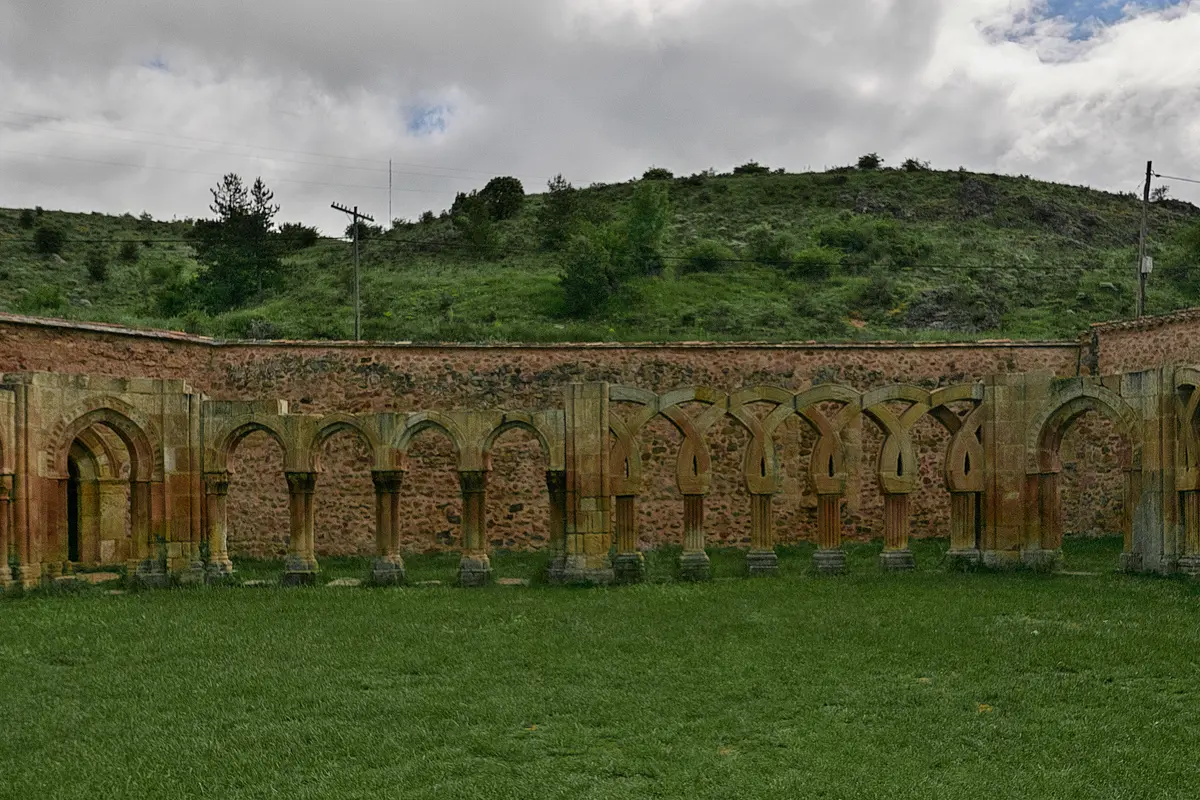
At the foot of the hill, on the left bank of the Duero beside the medieval stone bridge, stands the monastery of San Juan de Duero, and it was never a Templar house. A diploma of 1152, brought to light by Carlos Barquero Goñi and discussed at length by the art historian Javier Martínez de Aguirre, proves that the Order of Saint John of Jerusalem — the Hospitallers — already held a church outside the walls of Soria, by the river and near the bridge, in the middle of the twelfth century. Martínez de Aguirre argues that the church was not originally dedicated to the Baptist but to the Holy Sepulchre, and that the interlaced arcades of its cloister, which have no real parallel in Spanish Romanesque, were built as a deliberate evocation of the Anastasis rotunda in Jerusalem. The building that Soria's oral tradition assigns to the Temple is a different one: San Polo, a little over half a kilometre downstream, roofless for centuries and today a private house.
Gustavo Adolfo Bécquer knew this landscape at first hand. His uncle Curro lived in the city, and in May 1861 he married Casta Esteban, whose family came from the province; he travelled through the Campo de Gómara and the Tierra del Moncayo. By then he was a staff writer on El Contemporáneo, the Madrid daily founded in 1860, and it was there, on 7 November 1861, that "El monte de las ánimas" appeared — six days after the All Souls' night on which the narrator claims to have written it. The frame is journalistic as much as literary: a man woken by the tolling of the bells, setting down before dawn "this tradition that I heard not long ago in Soria".
What he wrote is a hunting party that ends badly. The counts of Borges and Alcudiel ride home at dusk on All Saints' Day; Alonso tells his cousin Beatriz that the hill once belonged to the Templars, brought from far away by the king to defend Soria after its reconquest, and that the hidalgos of the city, resentful and forbidden to hunt in the knights' preserve, forced a hunt that turned into a massacre. Friends and enemies were buried together in the churchyard of the chapel on the hill. Since then, Alonso says, on the night of the dead the chapel bell tolls by itself and the souls of the slain course through the scrub like a phantom hunt. That night Beatriz, coldly, tells him she has lost her blue sash on the mountain. Alonso rides out and does not come back. At first light she finds the sash on her prie-dieu, "bloodstained and torn", and her servants find her dead of horror.
Timeline: the documented record of The Mountain of Souls
- 1152 A diploma of this year, published by Carlos Barquero Goñi, records that the Order of Saint John of Jerusalem already held a church outside the walls of Soria, by the river and near the bridge. It is the documentary foundation of San Juan de Duero, and it names Hospitallers, not Templars.
- 1312 The Order of the Temple is suppressed. Soria's oral tradition holds that the nearby monastery of San Polo was Templar and that its property then passed to the Hospitallers of San Juan de Duero; the city's tourist office states that no document attests the order's presence in Soria at all.
- 1836 The Mendizábal disentailment ends the ownership of the hill by the Cofradía de las Ánimas, the confraternity that had spent its yield on masses for the dead. According to Soria city council's heritage portal, that ownership — not any ghost — is where the name Monte de las Ánimas comes from.
- 1856 Eduardo Saavedra publishes the first monograph on San Juan de Duero in the Revista de Obras Públicas and, as Martínez de Aguirre records, recommends viewing the monastery from the Monte de las Ánimas, which he used as the vantage point for his drawing. The place-name is in print five years before Bécquer.
- 7 November 1861 El Contemporáneo, the Madrid daily on whose staff Bécquer worked, prints "El monte de las ánimas". It is the earliest datable appearance of the story as we tell it, six days after the All Souls' night the narrator says he wrote it on, and six months after Bécquer married the Soria-born Casta Esteban.
- 1882 San Juan de Duero becomes the first building in the province of Soria to be declared a National Monument. Nicolás Rabal reports that 10,000 reales were then spent clearing the arcades of the rubble that buried them, and that many stone tombs came to light in the process.
- 1885 The second volume of the posthumous Obras de Gustavo A. Bécquer carries the text of the legend used for this entry, preserving the orthography of the period. Bécquer had died in 1870; the collected Obras first appeared in 1871.
- 1889 In his book Soria, Nicolás Rabal describes the monastery as looking like nothing more than an old abandoned hermitage, "with its bellcote and without bells", half hidden behind the walls of a ruined house. It is the dated evidence that San Juan de Duero had no bells to ring by themselves.
- 1986 Soria's Festival de las Ánimas begins: a group from the city's Escuela de Adultos, some 25 people, climbs the Monte de las Ánimas to read Bécquer's legend where it is set.
- 17 February 2021 Soria unveils Ricardo González Gil's bronze of Bécquer at the foot of the hill, on the 185th anniversary of the poet's birth, together with a recreated "Templar cemetery" of ten discoid stelae. The tourist office labels the cemetery a literary and not a historical recreation.
- 17 March 2023 The Junta de Castilla y León declares the Noche de las Ánimas — held every 1 November by the Asociación Amigos de las Ánimas and Soria city council — a Fiesta de Interés Turístico Regional, on the strength of a dossier of some 400 pages.
- 2025 The Festival de las Ánimas holds its fortieth edition. The council reports more than 15,000 attendances, over 6,000 paid tickets and 2,000 people at the public reading of the legend — the measure of how thoroughly the town does not avoid the hill.
Is there a rational explanation for The Mountain of Souls?
Four things this entry used to say do not survive contact with the sources, and the most useful sceptic turned out to be Soria itself.
The Templars are Bécquer's. In 2021 the city recreated a "Templar cemetery" at the foot of the hill, and the official tourist office describes it in writing as "a literary, not a historical recreation", adding that "there is no document attesting the presence of this order in our city, and so the name Templar cemetery is owed solely to Bécquer's literary work, who places the monastery of these warrior monks in this space, although those who really lived there were the Hospitallers". A municipality with every commercial reason to sell a Templar legend prints the disclaimer next to the monument.
The bell does not belong to San Juan de Duero, and there was none to ring. Read Bécquer's text closely and there are two different bells in it. One is the Angelus rung by human hands — "the Angelus has sounded at San Juan del Duero" — which Alonso uses simply to mark the hour. The other, the one that tolls by itself, is explicitly the bell of the ruined chapel up on the mountain, in whose churchyard the dead of the hunt were buried. The two had been fused into a single claim that the monastery's bells ring on their own. They could not: the church has been out of worship since the eighteenth century, and Nicolás Rabal, describing the site in his Soria of 1889, saw an abandoned hermitage "with its bellcote and without bells", as quoted by Martínez de Aguirre. The building has been the Medieval Section of the Museo Numantino for well over a century.
The name is older than the story, and that is the most important finding here. Martínez de Aguirre records that Eduardo Saavedra, publishing the first monograph on San Juan de Duero in the Revista de Obras Públicas in 1856, recommended viewing the monastery from the Monte de las Ánimas and used the hill as the vantage point for his drawing — five years before Bécquer printed a line. The Revista de Obras Públicas archive could not be opened while this entry was written, so that attestation is reported here at one remove, on Martínez de Aguirre's authority rather than from the 1856 original.
So what did Bécquer invent, and what did he find? The motif is genuinely old and not Spanish alone: the phantom hunt, the Wild Hunt, the Mesnie Hellequin, documented across Europe long before 1861. The hill and its ecclesiastical name were there. What no source consulted for this entry could date before November 1861 is the story as we tell it — Beatriz, Alonso, the blue sash, the Templar dead rising on All Souls' night. Every printed appearance of that narrative traced here begins with El Contemporáneo.
And the last line of the old entry had the modern town exactly backwards. Sorians do not avoid the hill on the night of the dead. Since about 1986 they have run a festival on it. In 2025 the Festival de las Ánimas held its fortieth edition, drew more than 15,000 people, sold over 6,000 tickets, and gathered 2,000 for the public reading of the legend beside the Duero.
Can you visit The Mountain of Souls?
The pin of this file, 41.7657° N 2.4440° W, falls on the east bank of the Duero, across the river from Soria, about 0.9 km east of the Puente de Piedra, the city's stone bridge, measured between coordinates. The hill is the Monte de Peñaranda, which the municipal tourist office calls "más conocido como Monte de las Ánimas". In 1856 the engineer Eduardo Saavedra recommended looking at San Juan de Duero from this hill, which he had used as the viewpoint for his drawing of the monastery.
The Monasterio de San Juan de Duero, Paseo de las Ánimas s/n, 42005 Soria, is the Medieval Section of the Museo Numantino. The museum page of the Junta de Castilla y León, consulted on 24 September 2026, gives the telephones 975 230 218 and 975 229 872, and describes a building in which "se conservan su original claustro y la iglesia", with medieval pieces from the Jewish, Islamic and Christian cultures of the province shown in the church. Its opening hours are 10:00 to 14:00 plus 16:00 to 18:00 in January, November and December; the afternoon runs to 19:00 from February to June and in October, and to 20:00 from July to September. Sundays and holidays are 10:00 to 14:00. It closes on Mondays, except holidays and the eves of holidays. The city's leaflet "Horarios y precios agosto 2026", which was the file served at turismosoria.es on 24 September, lists the cloister under a third number, 975 22 13 97, at 1 euro on weekdays and free on Saturdays and Sundays, with no entry in the last 15 minutes.
The statue of Bécquer stands at the foot of the hill beside San Juan de Duero, and the so-called Templar cemetery on a municipal plot next to it, beside the SO-P-1001 from Soria to Almajano; the tourist office lists both as "en la vía pública, sin horario de apertura". The bronze, by the Soria sculptor Ricardo González Gil, shows the poet seated on a fallen trunk with an empty space beside him, at the proportions of a standing height of about 1.84 m, which the office gives as his real height. It was unveiled on 17 February 2021, the 185th anniversary of his birth. The cemetery is ten discoid stelae recreated in sandstone, with motifs taken from real Soria stelae found at San Polo, Oteruelos and Renieblas, among others, around a marble cross for the tomb of Alonso and Beatriz. The office calls it "una recreación literaria, no histórica", and adds that "no hay ningún documento que atestigüe la presencia de esta orden en nuestra ciudad".
San Polo, the building that tradition assigns to the Temple, is 0.5 km south of the stone bridge, downstream on the path to the hermitage of San Saturio. The Spanish Wikipedia article on it describes the old church as a private home today, with the road running through its nave between two facing doors.
The Noche de las Ánimas is held every 1 November by the Asociación Amigos de las Ánimas with the city council, and the Junta declared it a Fiesta de Interés Turístico Regional in March 2023. According to the council in 2023, the reading of the legend has been held since 2013 on the esplanade of the Callejón de San Agustín, beside the Duero. The council's balance of the fortieth edition, dated 7 November 2025, counted more than 15,000 attendances, more than 8,000 people at the parade and 2,000 at the reading, with hotels at 100 % occupancy. SoriaNoticias reported on 26 August 2026 that the 41st edition runs from 23 October to 2 November 2026, with the reading on 1 November by the dubbing actress María Luisa Solá. The municipal tourist office is on 975 222 764.
Sources consulted
- Gustavo Adolfo Bécquer, «El Monte de las Ánimas» — Obras de Gustavo A. Bécquer, vol. II, pp. 77-90; transcription of the 1885 printing at Wikisource, original orthography preserved. First published in the Madrid daily El Contemporáneo, 7 November 1861, 1885 book
- Javier Martínez de Aguirre, «San Juan de Duero y el Sepulcrum Domini de Jerusalén» — Siete maravillas del románico español, Fundación Santa María la Real, Aguilar de Campoo; quotes Nicolás Rabal, Soria (1889), pp. 225 and 229, and Eduardo Saavedra, Revista de Obras Públicas, no. 24, year IV (1856), p. 278, 2009 academic
- Turismo Soria (Ayuntamiento de Soria), «Estatua de Bécquer y cementerio templario» — turismosoria.es, official municipal tourism portal (consulted 2026), 2026 web
- Elige Soria (Ayuntamiento de Soria), «El Más Allá en Soria: El Monte de las Ánimas, leyenda becqueriana» — elige.soria.es, municipal heritage portal, 18 November 2016, 2016 web
- Ayuntamiento de Soria, «El Festival de las Ánimas se consolida con la declaración de Fiesta de Interés Turístico Regional» — soria.es, municipal press release, 17 March 2023, 2023 report
- Desde Soria, «La escultura de Gustavo Adolfo Bécquer luce a los pies del Monte de Las Ánimas en el 185 aniversario de su nacimiento» — desdesoria.es, Soria local news, 17 February 2021, 2021 newspaper archive
- Ayuntamiento de Soria, «El 40º aniversario del Festival de las Ánimas de Soria supera sus expectativas y llena todas sus actividades» — soria.es, municipal press release, 7 November 2025, 2025 report
- Junta de Castilla y León, «Monasterio de San Juan de Duero (Sección Medieval del Museo Numantino de Soria)» — museoscastillayleon.jcyl.es, official museum site: address, telephones and seasonal opening hours (consulted 2026), 2026 web
- Turismo Soria (Ayuntamiento de Soria), «Horarios y precios agosto 2026 / Opening hours and entry prices August 2026» — turismosoria.es, official monument timetable and price leaflet, 2026 report
- Esther Guerrero, «Cthulhu, Álex de la Iglesia y Solá, la voz de Sigourney Weaver: Soria presenta un Festival de las Ánimas de otro mundo — dates of the 41st edition (23 October to 2 November 2026) and the 1 November reading» — SoriaNoticias, 26 August 2026, 2026 newspaper archive
- Wikipedia contributors, «Monasterio de San Polo (Soria) — the church, traditionally but undocumentedly attributed to the Temple, is today a private home with the road running through its nave» — Wikipedia (Spanish), 2026 web
Reviewed by V. Serrano on 2026-08-15 · How we verify our content
📎 Source: Enigma Atlas
💬 Field testimonies (0)
No testimonies yet. Add the first.
Add your testimony
🔒 Log in to add a testimony