📜 LEGEND · EXP. Nº3657
ACTIVE
The Cave of Salamanca
The Cave of Salamanca is a legend from Salamanca, Castilla y León, ES — a folk story passed down over generations. This file collects its origins, its meaning and how it has been retold.
Where does the legend of The Cave of Salamanca come from?
- Location
- Salamanca, Castilla y León, ES
- Kind of legend
- Myth
- Coordinates
- 40.965, -5.668
- Testimonies
- 0
- Last updated
LOCATION
What is the legend of The Cave of Salamanca?
Beneath the vanished church of San Cebrián in Salamanca lies a crypt that popular legend transformed, from the Middle Ages onward, into a secret school of magic and necromancy supposedly run by the Devil himself. According to the tale, seven students at a time would enrol to learn the black arts, on the condition that the last one to leave each year would pay tuition with his own soul, or at least his shadow. The legend is most often tied to Enrique de Villena, a real 15th-century nobleman and scholar whose wide learning and interest in astrology scandalized his contemporaries enough that, after his death, the Church allegedly burned part of his library as suspect. Storytellers say Villena himself studied in the cave and was the one student clever enough to trick the Devil: he let another unlucky classmate leave last, so that man 'se quedó sin sombra' ('was left without a shadow') forever, marked from then on as someone who had learned sorcery underground. Whether the cave ever hosted actual classes or only rumor, Salamanca's university city, the oldest in Spain, still points visitors to the closed-off cueva as the supposed birthplace of Spanish black magic.
What is the history of The Cave of Salamanca?
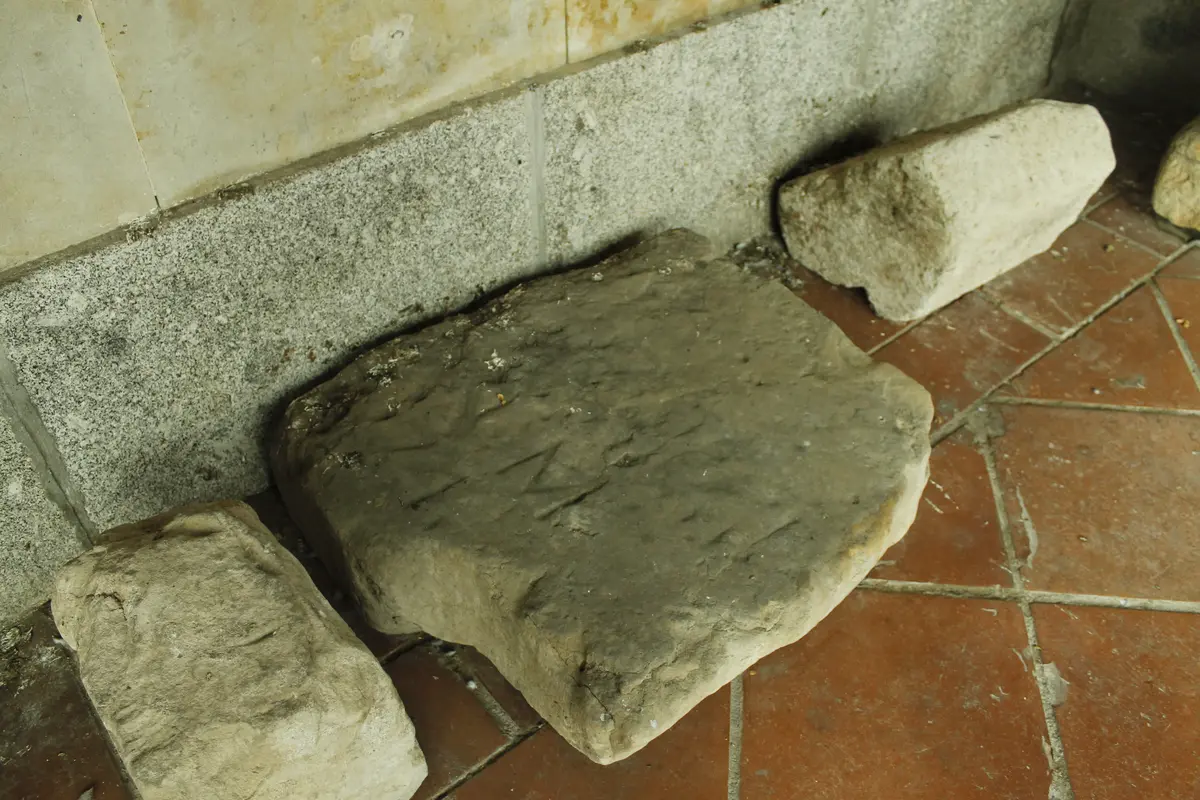
There is a Cave of Salamanca and it is not a cave. What visitors see today on the Cuesta de Carvajal, below the tower known as the Marquis of Villena's, is the crypt beneath the chancel of a vanished church: the parish of San Cebrián — San Ciprián, Saint Cyprian — founded by Frankish settlers around the middle of the twelfth century and documented from 1156. It stood inside the line of the first medieval wall, its apse doubling as a defensive bastion over the postern gate of San Ciprián. Because the ground falls away sharply from the cathedral hill, the crypt was buried on one side and open on the other, and to reach it you went down a slate barrel-vaulted staircase, "some twenty-odd steps". That staircase and that gloom are the whole of the "cave".
The oldest first-hand account we have been able to read belongs to a German traveller. Hieronymus Münzer, a physician from Nuremberg who toured the Iberian Peninsula in the last quarter of the fifteenth century, noted in his diary under the heading De specu Nigromantiae: "Est una specus subterranea magna… Et super eam stat una capella beati Cipriani… Vulgus variis deliramentis de hoc antro loquitur". There is a great underground cave, above it stands a chapel of blessed Cyprian, and the common people talk of this cavern with all manner of ravings. With the church still standing, the crypt was already being shown to foreigners and the legend was already fully formed.
What followed was an administrative demolition. Manuel Villar y Macías, working from the records of the parish's suppression for his Historia de Salamanca (1887), tells it flatly: the church, "being in ruins", was merged into that of San Pablo in 1580, and "four years later they sold almost all its stone for 160 ducats for the works of the Cathedral". In 1584 the apse and half the crypt came down. The other half survived, with its vault and the traces of its steps, sinking in status: junk room of a neighbouring palace, storeroom of a bakery and, by the twentieth century, a coal merchant's.
The legend, meanwhile, had settled into a fixed shape by the sixteenth century: the forbidden arts were taught in the crypt to seven students over seven years, and at the end lots were drawn to decide which of the seven paid for them all; whoever could not pay stayed locked up down there. Who the master was depends on who is telling it — a sacristan, a bachelor of arts, or the Devil himself — and the earliest version we have read already came debunked. It is that of Diego Pérez de Mesa, a professor of mathematics who studied at Salamanca around 1560: "the common people invent the cave of the University of Salamanca… where seven students went underground to study for seven years, learning the magic art from a head of wire". He added the explanation he had been given in the city: a minor cleric of San Ciprián taught forbidden arts in secret behind the high altar.
Enrique de Villena (1384-1434) enters the story through his reputation, not his biography. He was Count of Cangas and Tineo and Master of the Order of Calatrava, lost both dignities and ended as lord of Iniesta by royal grant; the marquisate he claimed never came to him, so the title he is remembered by was awarded to him by literature. When he died, King Juan II had his books brought in and ordered Friar Lope de Barrientos to see whether there were "a good fifty volumes of books of evil arts" and to burn them. Barrientos did so, at Santo Domingo el Real in Madrid, and later wrote of one of those volumes: "this is the book that you, as a most Christian King, commanded me, your servant and creature, to burn along with many others". Juan de Mena mourned the bonfire in his Laberinto de Fortuna: "Your books were lost before they were known, / and as at a funeral rite some were thrown / straight into the greedy fire." That was enough for a university town to hand him the cave. But his biographers have never documented that Villena set foot in a Salamanca lecture hall, and the old manuscript Feijoo published dates the events to "around the year 1322", sixty years before he was born.
The literary trail is what kept the story alive. In 1615 Cervantes published, among his Ocho comedias y ocho entremeses nuevos, the interlude La cueva de Salamanca: a student sheltering in a hayloft boasts of "the science I learned in the Cave of Salamanca… if it could be used without fear of the Holy Inquisition", and on that reputation alone passes off the sacristan and the barber — in fact the lady of the house's lovers — as demons. The cave never appears on stage: being a rumour is enough. Juan Ruiz de Alarcón, who took his bachelor's degree in canon law at Salamanca in 1600, brought it to the public stage in his comedy of the same name, performed at the royal palace on 9 July 1623 and printed in 1628: there the master is no longer the Devil but a sage called Enrico, and in the closing lines the playwright fixes the two motifs the legend would never drop — "why they say the great Marquis of Villena / tricked the demon with his shadow… They say he gave his body / to a little glass flask." Rojas Zorrilla returned to the material in Lo que quería ver el marqués de Villena (1645), and in 1733 Botello de Moraes published an unhinged Historia de las cuevas de Salamanca which notes, in passing, the prosaic fact: "the cave is walled up, as your worship has seen".
The strangest journey this legend made was across the Atlantic, where it stopped being a proper noun. In north-western Argentina — Santiago del Estero, Catamarca, La Rioja, Tucumán — and in Chile and Uruguay, salamanca became a common noun: the cave where the Devil teaches. And the bridge is not a guess: it has been argued since 1896, when Daniel Granada devoted two chapters of his Reseña histórico-descriptiva de antiguas y modernas supersticiones del Río de la Plata to "salamancas" and wrote that the name "is etymologically nothing other than the nominalised name of the ancient and celebrated city", expressly recalling that "cave called San Cebrián's". Granada already described the whole rite: you must "have courage and go into the salamanca", at whose entrance waits "a terrifying serpent", and whoever dares comes out able to play the guitar well or never miss a shot. Juan Alfonso Carrizo, in his Cancionero popular de Salta (1933), added the crucifix at the door that must be spat on to pass. And Berta Elena Vidal de Battini, who gathered thirty-eight versions of the story in 1984, summed it up in a line: "For the people, the Salamanca is the witches' sabbath."
It should be said that the matter has been disputed from the start. In 1907 Ricardo Rojas rejected the university explanation in El país de la selva — "such a hypothesis is not acceptable: the American tradition and the university itself took their name from the same historical city" — although in 1943, publishing his drama La Salamanca, he wrote that there "the Spanish devil absorbed the Indian Zupay". Current historiography moves the question elsewhere: Judith Farberman, who found the earliest archival mention — a 1761 trial in the Indian town of Tuama, Santiago del Estero — argues that the American salamanca is a mestizo product, heir to indigenous "gatherings and drinking feasts", not a clean loan. One last detail, against what half the internet repeats: the Diccionario de la lengua española does not define salamanca as a witches' cave, but only as "a natural cave found in certain hills" in Argentina, Chile and Uruguay. The witchcraft is in the etymology: "by allusion to the University of Salamanca, where, according to popular belief, magic was taught".
Timeline: the documented record of The Cave of Salamanca
- 1434 Enrique de Villena dies. King Juan II orders Friar Lope de Barrientos to check his library for "a good fifty volumes of books of evil arts" and burn them. The bonfire, not the cave, is the origin of Villena's magical reputation.
- c. 1495 The Nuremberg physician Hieronymus Münzer records the site in his travel diary under the heading De specu Nigromantiae: a great underground cave beneath a chapel of Saint Cyprian, of which "the common people talk with all manner of ravings".
- 1580-1584 The ruined parish is suppressed and merged into San Pablo; four years later almost all its stone is sold for 160 ducats for the New Cathedral, and the apse and half the crypt come down.
- 1595 Diego Pérez de Mesa, who studied at Salamanca around 1560, prints the earliest surviving debunking: the common people "invent" the cave, and the master was a minor cleric of San Ciprián teaching behind the high altar.
- 1600 The Jesuit demonologist Martín del Río writes that he was shown "a very deep crypt, the vestige of that unspeakable school", stopped up "barely a hundred years ago" by Queen Isabella. It is the sole known source for the Isabella story, and nothing corroborates it.
- 1611 Sebastián de Covarrubias, a former Salamanca student, records the story in his Tesoro de la lengua castellana o española and dismisses it in four words: "This I hold to be a fable."
- 1615 Cervantes publishes the interlude La cueva de Salamanca. The cave never appears on stage: it is a reputation the student exploits, boasting of what he learned there "if it could be used without fear of the Holy Inquisition".
- 9 July 1623 Ruiz de Alarcón's comedy La cueva de Salamanca is first performed at the royal palace; printed in 1628. He replaces the Devil with a human sage, Enrico, and his closing lines fix the two motifs the legend kept: the lost shadow and the glass flask.
- 1645 Rojas Zorrilla stages Lo que quería ver el marqués de Villena, set in student Salamanca, with a magician named Fileno and the seven disciples reduced to four.
- 1736 Feijoo devotes a discourse of his Teatro crítico universal to the caves of Salamanca and Toledo. He hunted for documentation and found "nothing but fables upon fables, and contradictions upon contradictions".
- 1761 Earliest known archival appearance of the American word: a trial at the Indian town of Tuama, Santiago del Estero, in which the accused describe salamancas with a great snake demanding blood, dancing, harp and guitar.
- 1896 Daniel Granada devotes two chapters of his study of River Plate superstitions to the "salamancas" and argues the Spanish origin explicitly, recalling the cave "called San Cebrián's". Ricardo Rojas contests the university version in 1907.
- 1993 After excavation and restoration in the early 1990s the site opens to the public as an archaeological area combining the church remains, the Cerca Vieja and the tower. The dig is published in Numantia by Misiego Tejeda and colleagues.
- 2026 A €46,402 municipal intervention against the site's chronic damp, the third in barely seven years after those of 2019 and 2021, is reported in late June as practically finished.
Is there a rational explanation for The Cave of Salamanca?
The legend has been taken apart for more than four hundred years, and the people who took it apart were insiders.
The earliest we have read is Sebastián de Covarrubias, himself a former Salamanca student, in his Tesoro de la lengua castellana o española (1611): "it seems to allude to the fable that at Salamanca enchantment and the art of necromancy were taught, in a cave called San Cebrián's. This I hold to be a fable."
One claim deserves a paragraph of its own, because everybody now repeats it — including the city council's own visitor page: that Isabella the Catholic ordered the cave walled up on learning that occult rites were practised there. That claim has a single known source, and it is not a document. It is the Jesuit Martín del Río, who in his Disquisitionum magicarum libri (Louvain, 1600) writes that while he was in the city "a very deep crypt was shown to me, the vestige of that unspeakable school, which barely a hundred years ago Queen Isabella ordered stopped up with mortar and stone". A demonologist, a century after the fact, reporting what he was shown. Mónica Marcos Celestino, who combed the entire corpus of the legend, states expressly that she could find the assertion "corroborated nowhere". There is no royal warrant and no municipal record. What is documented is far duller: a parish suppressed as ruinous in 1580, its stone sold in 1584 for the New Cathedral.
The definitive demolition, though, is Benito Jerónimo Feijoo's, in the discourse "Caves of Salamanca and Toledo, and the Magic of Spain", volume VII of his Teatro crítico universal (1736). Feijoo took it seriously: he wrote to two masters of his order in Salamanca asking them to find any document at all, and all that came back was an account by a professor named Juan de Dios, drawn from an old manuscript. His verdict on everything else is famous: "I tried to get to the bottom of this report; but I found nothing but fables upon fables, and contradictions upon contradictions."
His account of the mechanism is still the best available. Pagan magicians, he reasons, performed their rites in caves; and there was also a widespread claim that after the Muslim conquest the magic arts had been taught at Toledo, Seville and Salamanca. "It is likely, then, that the common people, joining one report to the other… assigned the caves of Toledo and Salamanca as schools of those arts with no other foundation." Two loose ideas, a real underground room and a university with a European reputation: nothing else is required.
He is merciless about the diabolical pact: "A ridiculous fantasy! As if the Devil could suffer an illusion that the most innocent child could not fall for." And if the sacristan really knew the magic arts, "what need had he of the miserable stipend his pupils paid him?" The only plausible residue he allows is this: "Merely that the sacristan hoodwinked the boys with a few sleight-of-hand tricks he knew, and for teaching them squeezed out of them what money he could. All the rest the common people added little by little, until they had built a gigantic fable."
One ingredient is almost never pointed out: the church was dedicated to San Cebrián — Cyprian of Antioch, who according to his hagiographic legend was a magician before he was a bishop and a martyr, and who gives his name to the Libro de san Cipriano, a book of conjurations that circulated widely in sixteenth-century Spain. A dark crypt beneath a temple consecrated to the sorcerers' saint was, quite simply, irresistible.
Can you visit The Cave of Salamanca?
The Cueva de Salamanca is at Cuesta de Carvajal 7, 37008 Salamanca, on the slope that runs down from the cathedrals towards the Arroyo de Santo Domingo. The official Turismo de Salamanca listing, consulted on 24 September 2026, gives opening hours of 08:30 to 21:30 from Monday to Sunday, free admission and a visit of about 30 minutes. It warns, in Spanish, that the steep street makes wheelchair access difficult and that inside the enclosure only the first section, the crypt, is accessible. The contact it gives is the tourist office at Plaza Mayor 32, 37002 Salamanca (923 21 83 42).
The "cave" of the name is the crypt of the medieval church of San Cebrián, which the listing says is all that has come down to us of the church. The route has three stops marked by information panels. The first is the church and its crypt: the excavations and restorations of the 1990s uncovered the perimeter walls of a small church with a rectangular plan and a semicircular apse, and a grille now closes the way down from the church to the crypt. This section holds a bust of Diego de Torres Villarroel by the sculptor Agustín Casillas, shown face on with "demonic eyes" and with an owl on the reverse. The second is the stretch of the Cerca Vieja, the twelfth-century wall, between the apse and the tower. The third is the tower of the Marquis of Villena, a fifteenth-century structure resting on one of the towers of the old wall and the only standing part of the palace of the Albandea family; metal stairs inside climb to a viewpoint. A modern concrete building on the wall between church and tower houses a small display room, and across the street is the city walls interpretation centre, Salmantica Sedes Antiqua Castrorum.
La Gaceta de Salamanca reported on 30 June 2026 that a €46,402 municipal intervention against the site's chronic damp was "practically finished", with only the final touches outstanding. It covered the waterproofing of the Plaza de Carvajal paving and of the walls of the Cueva, a copper gutter, new lighting, repairs to the metalwork and the treatment of ashlars affected by salts and seepage. The paper counted it as the third intervention in barely seven years, after one in 2019 supported by the Ministry of Culture and one in 2021 valued at €25,200, both aimed at the vegetation, stains and salt efflorescence on the Villamayor stone. The regional heritage commission approved the project on condition of a five-year maintenance plan.
Sources consulted
- Benito Jerónimo Feijoo, «Cuevas de Salamanca, y Toledo, y Mágica de España (Teatro crítico universal, tomo VII, discurso VII)» — Madrid, 1736 (edición digitalizada, Filosofía en español), 1736 book
- Miguel de Cervantes Saavedra, «Entremés de la cueva de Salamanca (Ocho comedias y ocho entremeses nuevos, nunca representados, 1615)» — Los entremeses (edición digitalizada, Project Gutenberg), 1615 book
- Mónica Marcos Celestino, «El marqués de Villena y la cueva de Salamanca. Entre literatura, historia y leyenda» — Estudios Humanísticos. Filología, 26, pp. 155-186, Universidad de León, 2004 academic
- Lillian von der Walde Moheno, «Magia y artilugios teatrales en «La cueva de Salamanca», de Juan Ruiz de Alarcón» — Hipogrifo. Revista de literatura y cultura del Siglo de Oro, 11.1, pp. 865-880, 2023 academic
- Marcela Beatriz Sosa, «Lo que quería ver el Marqués de Villena de Rojas Zorrilla, espejo metateatral de (espectadores) discretos» — IX Congreso Argentino de Hispanistas, Universidad Nacional de La Plata, 2010 academic
- J. C. Misiego Tejeda, G. J. Marcos Contreras, M. Á. Martín Carbajo, F. J. Sanz García y F. J. Pérez Rodríguez, «La iglesia de San Cebrián o la cueva de Salamanca» — Numantia. Arqueología en Castilla y León, 6, pp. 225-240, 1994 academic
- Turismo de Salamanca, Ayuntamiento de Salamanca, «Cueva de Salamanca — ficha oficial del monumento (dirección, horarios, accesibilidad y recorrido)» — salamanca.es, 2026 web
- Belén Hernández, «La Cueva y la puerta de San Vicente encaran su apertura» — La Gaceta de Salamanca, 2026 newspaper archive
- Daniel Granada, «Reseña histórico-descriptiva de antiguas y modernas supersticiones del Río de la Plata (capítulos VIII y IX, «Salamancas»)» — Montevideo, Barreiro y Ramos (ejemplar digitalizado, Internet Archive), 1896 book
- Judith Farberman, «Las salamancas mestizas. De las religiones indígenas a la hechicería colonial. Santiago del Estero, siglo XVIII» — Memoria Americana, 13, Universidad de Buenos Aires, 2005 academic
Reviewed by V. Serrano on 2026-07-29 · How we verify our content
📎 Source: Enigma Atlas
💬 Field testimonies (0)
No testimonies yet. Add the first.
Add your testimony
🔒 Log in to add a testimony