📜 LEGEND · EXP. Nº3657
ACTIVE
The Enchanted Cave of Don Rodrigo
The Enchanted Cave of Don Rodrigo is a legend from Toledo, Castilla-La Mancha, ES — a folk story passed down over generations. This file collects its origins, its meaning and how it has been retold.
Where does the legend of The Enchanted Cave of Don Rodrigo come from?
- Location
- Toledo, Castilla-La Mancha, ES
- Kind of legend
- Myth
- Coordinates
- 39.859, -4.024
- Testimonies
- 0
- Last updated
LOCATION
What is the legend of The Enchanted Cave of Don Rodrigo?
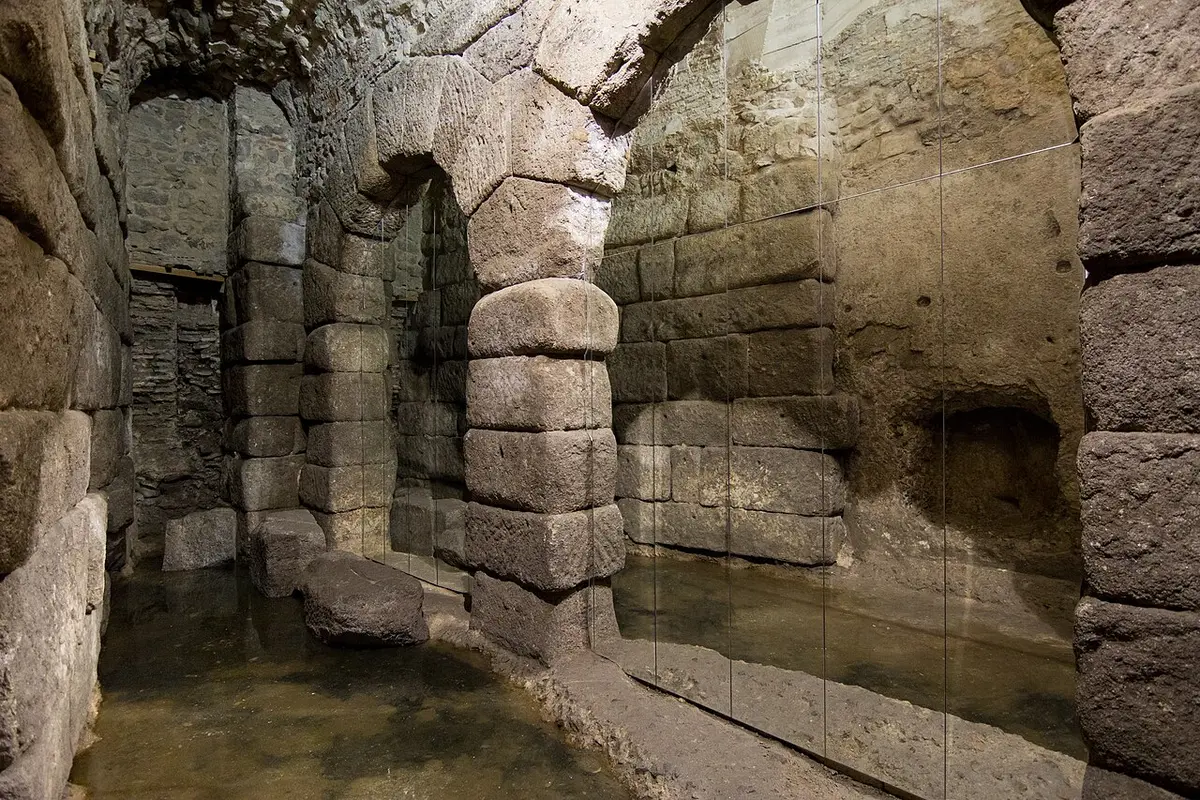
In Alfonso X's Estoria de España, written around 1270-1289, there is a palace in Toledo that had stood locked since the time of many kings. Roderic, the last Visigothic king, has it broken open because he thinks there is treasure inside. He finds an ark, and in the ark a cloth painted with men in head-cloths on horseback, carrying swords, crossbows and raised banners, and Latin letters warning that once those locks were forced, people like these would enter Spain and be lords of it. The chronicle ends the scene by having the king, sorry for what he has done, shut the ark and the palace as they were before. Nothing in that chapter mentions Hercules, a cave, a tower, or a woman's name. All of those were added later, by people who can be named: Hercules and the rite of one lock per king by the Portuguese chronicle of 1344, the cave by Pedro de Alcocer in Toledo in 1554, and the tower and the name Florinda by Miguel de Luna's forged history of 1592. What you can visit today, free of charge, is a Roman water cistern under a Toledo alley.
What is the history of The Enchanted Cave of Don Rodrigo?
The legend has a locked door at its centre, and the door moves. In the oldest text where it can be read it is the door of a house, no city named; six centuries later it is a palace in Toledo; six centuries after that it is a cave, and then a tower. Each of those moves has an author and a date, and the whole chain can be laid out.
The earliest version we have been able to read is Egyptian, from the ninth century. Ibn Abd al-Hakam, who died in 871, gives it as a tradition received from his father Abd Allah and from Hisham ibn Ishaq, and sets it apart from his main narrative. In John Harris Jones's 1858 translation it runs: "There was a house in Andalus, the door of which was secured with padlocks, and on which every new king of the country placed a padlock of his own, until the accession to power of the king against whom the Moslems marched. They therefore begged him to place a padlock on it, as the kings before him were wont to do. But he refused saying, I will place nothing on it, until I shall have known what is inside; he then ordered it to be opened; but behold inside were portraits of the Arabs, and a letter in which it was written: 'when this door shall be opened, these people will invade this country.'" That is the whole of it. No Toledo, no treasure, no chest, no cloth, no Hercules, and the king is not even named.
The fuller Arabic version, with Toledo in it, reaches Spanish readers through al-Maqqari, whom Emilio Lafuente y Alcántara translated in the appendices to his 1867 edition of the Ajbar Machmua. There the house is in Toledo, is watched by sworn keepers, and Roderic — "hombre investigador, despierto e inteligente" — breaks the locks "creyendo que iba a encontrar allí riquezas". Inside is a box, and in the box a roll of parchment painted with Arabs in turbans on thoroughbred horses, armed with swords and bows, their banners on their lances. Roderic repents and orders the locks put back.
Alfonso X's Estoria de España, compiled in Castile between about 1270 and 1289, gives the version that Spain remembers. Chapter 553 of Menéndez Pidal's edition is headed "De como el rey Rodrigo abrio el palacio que estaua cerrado en Toledo", and reads: "En la cibdad de Toledo auie estonces un palacio que estidiera siempre cerrado de tiempo ya de muchos reys, et tenie muchas cerraduras, e el rey Rodrigo fizol abrir por que cuedaua que yazie y algun grand auer." Inside, an ark; inside the ark, a cloth with Latin letters saying that when those locks were broken and the ark and the palace opened, people such as those painted on the cloth would enter Spain and conquer it and be lords of it. The painted men wear head-cloths, ride horses, carry swords, crossbows and raised banners. And the chapter ends with the detail that later tellings drop: the king was sorry he had had the palace opened, and had the ark and the palace shut again as they were before.
Two things are not in that chapter. Hercules is not, and neither is the custom of one lock per king. Both arrive with the Portuguese Crónica geral de Espanha de 1344 and its refundición of about 1400, where twelve guardians come to the newly crowned Roderic and ask him, in accordance with the will of Hercules, to add his lock to the door of "the palace of Hercules" — and where, as James Donald Fogelquist sets out, the count's daughter is first called la Caba. Pedro de Corral's Crónica del rey don Rodrigo, written about 1430 and printed in 1499, carried that shape to a wide readership as a book of chivalry.
The cave arrives in 1554, in Toledo, and it can be named. Pedro de Alcocer, writing the first printed history of the city, describes in his first book the great cave under the hill that the Greeks were said to have dedicated to Hercules, and adds that the Goths, unable to stamp out what was practised in it, "cerraron la puerta con fuertes cerraduras, que el rey don Rodrigo mandó después quebrantar, creyendo que avía dentro grandes tesoros". Later in the same book he closes the weld: "Deste rey escriven nuestros Cronistas, que hizo abrir aquella cueva de Hércules, que diximos al principio, que estava en esta cibdad: a que otros llaman Palacio." For Alcocer the cave is the thing and "palace" is what other people call it — the chronicles' term has become the secondary one.
The tower arrives in 1592, and it can also be named. Miguel de Luna, interpreter to Philip II, published in Granada La verdadera hystoria del rey don Rodrigo, passing off his own invention as a translation from an Arabic eyewitness, "el sabio Alcayde Abulcacim Tarif Abentariq". His sixth chapter puts the scene outside the city: "A una milla de la ciudad de Toledo a la parte Oriental, entre unos peñascos, avía una torre antigua de sumptuoso edificio... debaxo della a quatro estados estava una cueva." Greek letters over the door promise that the king who opens it "descubrirá bienes y males"; inside is a bronze statue on a pillar three cubits high, striking the floor with a mace, and four inscriptions, of which the one on the statue's back reads "A Árabes invoco". The tower collapses that same midnight. Luna also gives the count's daughter the name she carries in every modern retelling: Florinda, which appears seven times in his first edition and in no earlier text we have read.
Timeline: the documented record of The Enchanted Cave of Don Rodrigo
- 712 (date given by the Estoria de España) Alfonso X's chronicle places the first year of Roderic's reign in the era of 750, "quando andaua ell anno de la Encarnacion en sietecientos et doze", and the first Muslim landing two years later. Modern historians normally date Roderic's defeat to 711.
- by 871 Ibn Abd al-Hakam, who died in 871, records the oldest version we have been able to read: a house in al-Andalus with a padlock added by each king, opened by the last one, containing portraits of the Arabs and a written warning. Toledo is not named.
- c. 1270-1289 Chapter 553 of Alfonso X's Estoria de España sets the episode in a palace in Toledo, gives Roderic the motive of treasure, adds the ark and the painted cloth with its Latin letters, and ends with the king ordering both shut again.
- 1344, and its refundición of c. 1400 The Crónica geral de Espanha de 1344 turns the building into "the palace of Hercules", introduces the twelve guardians and the rite of the lock, and is the first work in which Count Julian's daughter is called la Caba.
- c. 1430, printed 1499 Pedro del Corral's Crónica del rey don Rodrigo rewrites the legend as a book of chivalry. It went through at least eight editions between 1499 and 1587, and was later copied, in a different hand, into the Toledo manuscript of the Crónica del moro Rasis.
- 1554 Pedro de Alcocer, in the first printed history of Toledo, identifies the chronicles' sealed palace with the real cave of Hercules in the city: "aquella cueva de Hércules... a que otros llaman Palacio". This is the earliest weld of story to site we have found.
- 1592 Miguel de Luna publishes in Granada his forged Verdadera hystoria del rey don Rodrigo, which moves the scene to an enchanted tower a mile east of Toledo with a cave beneath it, adds the bronze statue and the four inscriptions, and gives the count's daughter the name Florinda.
- 1605 (read in the 1617 issue) Francisco de Pisa denies the identification twice in print: the cave under San Ginés "no es aquella que abrió o quebrantó el Rey don Rodrigo". He replaces it, however, with Luna's tower. He also records the name Florinda as Luna's, and la Cava as an Arabic insult meaning "mala muger".
- 1736 Feijoo reports that "algunos creen" the palace was that cave, and that Archbishop Silíceo had men search it with torches: they found nothing but large bats. Several died soon after, which Feijoo attributes to the foul air. Silíceo had the entrance walled up.
- 1841 The church of San Ginés, first documented in 1148 and closed during the eighteenth century, is demolished. Houses are built over the Roman vaults, breaking the site up.
- 1850, printed 1852 Pascual de Gayangos publishes the surviving Castilian text of the Crónica del moro Rasis and notes that the reign of Roderic in the Toledo codex is a later addition, in a different hand, taken from Corral's book of chivalry.
- 18 January 2008 The Cuevas de Hércules are declared a Bien de Interés Cultural in the category of Monumento by the government of Castilla-La Mancha.
- 2010 The Consorcio de la Ciudad de Toledo completes the restoration and opens the site to visitors, free of charge. It has stayed open since.
Is there a rational explanation for The Enchanted Cave of Don Rodrigo?
The sentence our own file put between quotation marks — "the king who opens this will see great things, but before the year is out this kingdom will be destroyed" — is in none of the works it was credited to, and we have not found it in any work at all. What the texts actually say can be checked line by line. Ibn Abd al-Hakam: "when this door shall be opened, these people will invade this country". The Estoria de España: that when the locks are broken and the ark and palace opened, people such as those painted will enter Spain, conquer it and be lords of it. Feijoo, paraphrasing in 1736: "Por esta gente será en breve destruida España". Miguel de Luna, who is the only one whose wording begins like ours: "El Rey que abriere esta cueva, y pudiere descubrir las maravillas que tiene dentro, descubrirá bienes y males". Three of those four have no time limit at all, and none mentions a year.
The two works our file named as sources are the two where the episode is hardest to find. In the surviving Castilian Crónica del moro Rasis, as printed by Pascual de Gayangos, the story is simply not there: across the 15,000 words of the Arab-history section there is not one "cerradura", "cerrojo", "arca" or "pintado", while in the same stretch Toledo appears 21 times, Roderic 10 and Tarif 25. Gayangos also noted that the Toledo codex of the Rasis chronicle carries the reign of Roderic added in a different hand, copied from a book of chivalry — Corral's Crónica — and that the other manuscripts pass straight to the Arab history without it. The Ajbar Machmua, often named as an early witness, does not have the episode either: in the 53,000 words of the chronicle proper there is no locked house, no chest and nothing painted, while Toledo appears 33 times and Roderic 8. The passage that everyone quotes from that book is in Lafuente y Alcántara's appendices, and it is al-Maqqari, a seventeenth-century compiler.
The identification of the story with the cave under San Ginés was rejected in print by a Toledan, in Toledo, fifty-one years after it was made. Francisco de Pisa, describing the cave in the first book of his Descripción de la Imperial Ciudad de Toledo (1605), writes: "Hase de advertir que esta cueva no es aquella que abrió o quebrantó el Rey don Rodrigo, pensando hallar en ella grandes tesoros", and in his second book repeats it: "este palacio que avemos dicho (que otros llaman cueva) no es aquella de Hércules... sino otro muy diferente". Pisa's argument, however, is worth no more than his source: what he offers instead is Miguel de Luna's tower, which is a forgery of 1592.
The most useful sceptic is Benito Jerónimo Feijoo, in 1736. He records that "algunos creen" the enchanted palace was that cave — so the identification was still an opinion, not a fact, 182 years after Alcocer printed it — and he reports what happened when somebody went in and looked. Archbishop Silíceo, he writes, "la hizo registrar por muchos hombres, que entraron, y discurrieron por ella muy despacio con hachas encendidas; pero no dieron noticia de otra cosa, sino de que había en su concavidad grandes murciélagos". Some of those men died soon afterwards, and Feijoo attributes it, without hesitation, to "el infecto ambiente de la Cueva". Silíceo then had the entrance walled up. Feijoo credits this to Cristóbal Lozano's Los reyes nuevos de Toledo, and there we could not follow him: in the complete Madrid reprint of 1734, 212,894 words in four books, Silíceo is named once as archbishop and "murciélago" does not occur at all, with Toledo appearing 618 times and Ildefonso 16 in the same file. The inspection may well have happened; the citation, in the edition we could read, does not hold. The date of 1546 that circulates today is not in Feijoo, and we could not anchor it to any early source.
What is under the church, finally, is documented and unmysterious. The regional heritage catalogue records a Roman water cistern of the second half of the first century AD, part of the supply network of Toletum, rectangular, about six metres wide, eleven and a half long and four high, later relined in granite ashlar and divided by three arches, with a Visigothic building, a mosque and the twelfth-century church of San Ginés stacked above it. The church is first mentioned in 1148, was closed in the eighteenth century and demolished in 1841.
Can you visit The Enchanted Cave of Don Rodrigo?
The place the legend now points to is open and free. The Cuevas de Hércules occupy the Callejón de San Ginés, a short alley in the historic centre of Toledo, on the site of the demolished parish church of San Ginés; the Consorcio de la Ciudad de Toledo gives the number as 3, an older municipal listing as 2-3. The Consorcio owns the site, finished restoring it in 2010 and has kept it open since. It was declared a Bien de Interés Cultural, in the category of Monumento, on 18 January 2008. Admission is free.
The two official pages still disagree about the hours, both consulted on 22 September 2026. The Consorcio's own page gives "martes a sábados 12 a 14 y de 16 a 18 horas". The city tourist office gives "Días de cierre: domingo y lunes. Horario: martes a sábado de 10:00 a 14:00h y de 16:00 a 20:00h." Both carry the same telephone, 925 25 30 80, at the Centro de Gestión de Recursos Culturales. Neither page states the accessibility of the descent, which goes below street level into a Roman cistern.
What is down there is a barrel-vaulted Roman water tank of the later first century AD, relined in granite ashlar and divided lengthwise by three granite arches, under a modern metal-and-glass structure. Panels set out the archaeological sequence: cistern, Visigothic building, mosque, twelfth-century church. The space also takes temporary exhibitions of contemporary art.
The other two addresses in this legend cannot be visited. The palace of the Estoria de España is a literary object with no location beyond "la cibdad de Toledo". Miguel de Luna's enchanted tower, "a una milla de la ciudad de Toledo a la parte Oriental", towards the Huerta del Rey, is described in a forgery printed in 1592 and collapses in the same chapter that describes it.
Sources consulted
- Ibn Abd al-Hakam; trad. John Harris Jones, «Dhikr Fath al-Andalus: Ibn Abd-el-Hakem's History of the Conquest of Spain (pp. 19-20)» — Göttingen: W. Fr. Kaestner, 1858 book
- ed. y trad. Emilio Lafuente y Alcántara, «Ajbar Machmuâ (colección de tradiciones), crónica anónima del siglo XI; con apéndices de textos árabes traducidos (al-Makkari, pp. 172-173; Ibn Abd al-Hakam, pp. 213 ss.)» — Madrid: Real Academia de la Historia, 1867 book
- Alfonso X; ed. Ramón Menéndez Pidal, «Primera crónica general de España, caps. 553-554 (pp. 307-308)» — Madrid: Bailly-Baillière (Nueva Biblioteca de Autores Españoles, 5), 1906 book
- Pedro de Alcocer, «Hystoria o descripción de la Imperial cibdad de Toledo, libro primero» — Toledo: Juan Ferrer, 1554 book
- Miguel de Luna, «La verdadera hystoria del rey don Rodrigo, libro primero, cap. VI (primera edición)» — Granada: impressa por René Rabut, 1592 book
- Francisco de Pisa, «Descripción de la Imperial Ciudad de Toledo, libro I cap. V y libro II cap. XXXI» — Toledo: Diego Rodríguez (tirada de 1617 de la obra de 1605), 1617 book
- Benito Jerónimo Feijoo, «Cuevas de Salamanca, y Toledo, y Mágica de España (Teatro crítico universal, tomo VII, discurso VII, §§ 29-32)» — Madrid, 1736 (edición digitalizada, Filosofía en español), 1736 book
- Cristóbal Lozano, «Los reyes nuevos de Toledo, en quatro libros (comprobación negativa: sin el pasaje de la cueva que Feijoo le atribuye)» — Madrid: Marín (reimpresión de la obra del siglo XVII), 1734 book
- Pascual de Gayangos, «Memoria sobre la autenticidad de la Crónica denominada del moro Rasis, con el texto castellano conservado» — Memorias de la Real Academia de la Historia, tomo VIII, Madrid, 1852 academic
- James Donald Fogelquist, «Pedro de Corral's Reconfiguration of La Cava in the Crónica del Rey don Rodrigo (secciones 1.6-1.8)» — eHumanista: Monographs in Humanities, 3, University of California, Santa Barbara (la monografía no lleva año en portada; la bibliografía más reciente que cita es de 2005), 2005 academic
- Junta de Comunidades de Castilla-La Mancha, «Cuevas de Hércules de Toledo (ficha del Catálogo del Patrimonio Cultural; BIC 18/01/2008)» — Portal de Cultura de Castilla-La Mancha, 2008 report
- Consorcio de la Ciudad de Toledo, «Cuevas de Hércules: horario, entrada y descripción del conjunto» — consorciotoledo.com, 2026 web
Reviewed by V. Serrano on 2026-08-16 · How we verify our content
📎 Source: Enigma Atlas
💬 Field testimonies (0)
No testimonies yet. Add the first.
Add your testimony
🔒 Log in to add a testimony