📜 LEGEND · EXP. Nº3657
ACTIVE
The Lovers of Teruel
The Lovers of Teruel is a legend from Teruel, Aragón, ES — a folk story passed down over generations. This file collects its origins, its meaning and how it has been retold.
Where does the legend of The Lovers of Teruel come from?
- Location
- Teruel, Aragón, ES
- Kind of legend
- Folk tale
- Coordinates
- 40.346, -1.107
- Testimonies
- 0
- Last updated
LOCATION
What is the legend of The Lovers of Teruel?
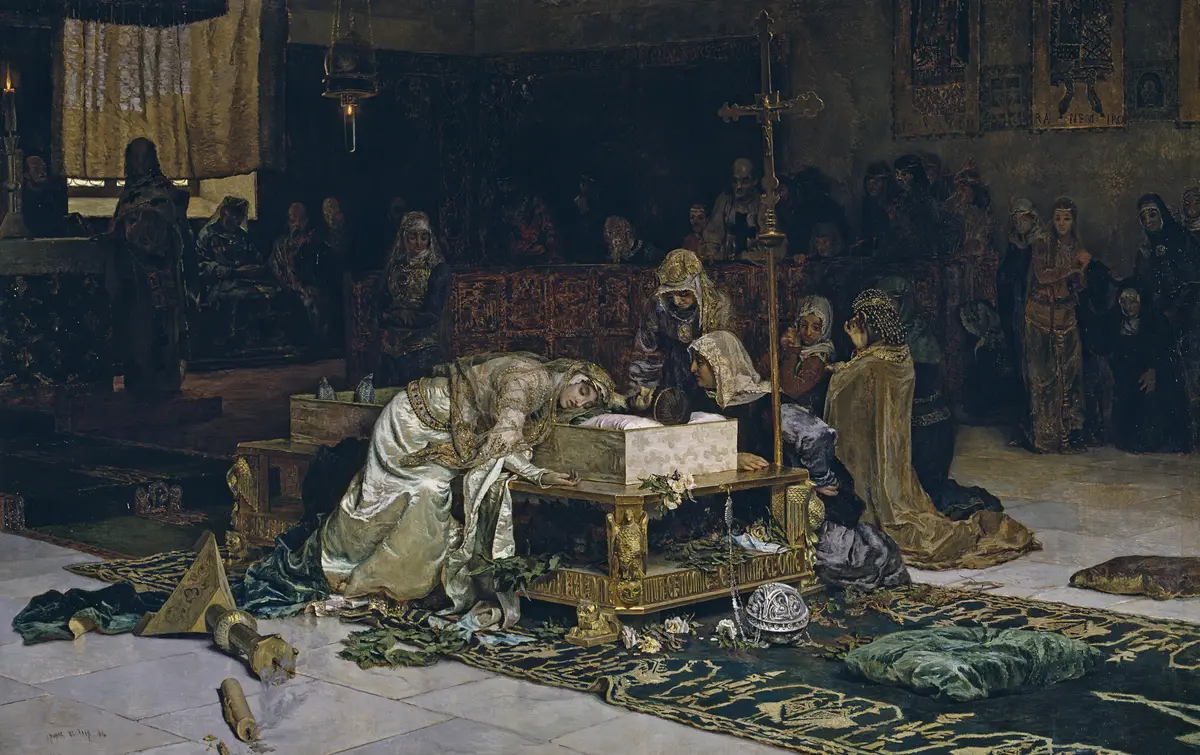
Teruel, in Aragón, preserves the tomb of Diego de Marcilla and Isabel de Segura, whose story of thwarted love is traditionally dated to the early 13th century, around 1217. Diego, a poor young nobleman, asked for Isabel's hand but her father demanded he first make his fortune; Diego left for five years to fight and trade, promising to return in time to marry her. He came back on the very last day of the deadline, only to find Isabel already wed to another man by her father's arrangement. Diego begged for a single kiss before dying of grief in front of her, and Isabel, refusing to let him go alone, kissed his corpse and died beside him. Both were buried together, and centuries later their mummified remains were placed in the Mausoleo de los Amantes, beneath the famous alabaster sculptures by Juan de Ávalos that show their hands reaching toward each other without quite touching. The tragedy became so proverbial in Spain that it produced a popular, half-mocking saying still repeated today: 'Los amantes de Teruel, tonta ella y tonto él' ('the lovers of Teruel, foolish her and foolish him'), poking fun at two people who let pride and timing cost them everything.
What is the history of The Lovers of Teruel?
What separates the Lovers of Teruel from any other tale of thwarted love is that there are two bodies you can go and look at. That is both its great appeal and the centre of the entire argument.
Tradition places the events around 1217. Diego de Marcilla, a nobleman without money, asks for the hand of Isabel de Segura; her father grants him a deadline — five years — to make his fortune. Diego returns on the day it expires, wealthy at last, to find Isabel marrying another man. He asks her for a kiss, she refuses because she is now married, and he drops dead at her feet. The next day, during his funeral, a woman in mourning approaches the body, gives him the kiss she denied him, and dies on top of him. The town buries them together.
The leap from oral tradition to document happens in 1555. During building work in the chapel of Saints Cosmas and Damian, in the church of San Pedro in Teruel, two mummified bodies appear — a man and a woman — and beside them a paper narrating a story said to have happened some three hundred years earlier.
That paper vanished. What survived was the testimony of the notary Juan Yagüe de Salas, who in 1619, knowing the story well, ordered a fresh exhumation and recorded the document's contents, the discovery and the mummies in a notarial protocol. Yagüe de Salas was not a neutral observer: he was also the author of a literary work about the Lovers. It was he who fixed the version we know today, and who turned a local tradition into an apparently documented fact.
The story has been rewritten ever since: Andrés Rey de Artieda's Golden Age tragedy "Los amantes", Hartzenbusch's Romantic drama in the nineteenth century, and since 2005 a mausoleum of their own. The bodies have been moved and displayed repeatedly across five centuries.
Timeline: the documented record of The Lovers of Teruel
- c. 1217 The date at which tradition places the deaths of Diego de Marcilla and Isabel de Segura. No contemporary document supports it.
- c. 1350 Boccaccio publishes the Decameron. The eighth novella of the fourth day, about Girolamo and Salvestra, tells essentially the same story. It is the oldest known written record of the plot.
- 1555 Building work in the chapel of Saints Cosmas and Damian, in the church of San Pedro in Teruel, uncovers two mummified bodies beside a paper narrating the story. The paper later disappears.
- 1619 The notary Juan Yagüe de Salas orders a fresh exhumation and records the discovery, the mummies and the contents of the lost paper in a notarial protocol. He is also the author of a literary work about the Lovers.
- 1903 Emilio Cotarelo y Mori questions the tradition, the reliability of the documents and the authenticity of the mummies, arguing that the legend originates with Boccaccio. Later scholarship refutes four of his six arguments.
- 2005 The Mausoleum of the Lovers opens, designed by the architect Alejandro Cañada, next to the church of San Pedro. The bodies go on permanent display.
Is there a rational explanation for The Lovers of Teruel?
Here the sceptical case is not a footnote: it is half a century of philological argument, and it has not ended in a draw.
The underlying problem is chronological. Giovanni Boccaccio tells essentially this same story in the Decameron (fourth day, eighth novella), with the names Girolamo and Salvestra, around 1350. Teruel places its events in 1217, more than a century earlier — but the first known written record of the Teruel legend is from 1555, two centuries after Boccaccio.
In 1903 Emilio Cotarelo y Mori published the frontal attack: he questioned the tradition, the reliability of the documents and the authenticity of the mummies themselves, arguing that the Lovers originate in Boccaccio's tale, which reached Spain in translation. On that reading, the 1555 paper and the 1619 protocol are not evidence but literature — Yagüe de Salas giving notarial form to an Italian short story.
Later scholarship has not entirely agreed. Writers such as Picoche, De la Vega and Guardiola Alcover compared the two texts in detail and concluded that certain structural components of Boccaccio's version imply dependence on an earlier text, which could only be the Teruel story. Of the six points on which Cotarelo built his theory, four have been refuted by modern criticism.
Two remain, and they are the ones that matter: the mummies are not clearly identified — nothing allows a name to be attached to them, let alone the date 1217 — and no text or reference to the Lovers exists earlier than 1350, the date of the Decameron. In other words: the legend may well predate Boccaccio, but there is no way to prove it, and the bodies do not prove it.
That is the honest position: two genuine medieval bodies, a beautiful story, and a documentary chain that starts three centuries late and passes through interested hands.
Can you visit The Lovers of Teruel?
The mummified bodies attributed to the Lovers lie in the Mausoleum of the Lovers, beside the church of San Pedro in the historic centre of Teruel. The Fundación Amantes de Teruel, which runs the complex, says that visitors enter through the door of the Mausoleum on the Plaza de los Amantes, and that people with reduced mobility use the entrance on Calle Comandante Fortea and Calle Matías Abad. Its telephone is +34 978 618 398.
The Fundación's page of hours, consulted on 24 September 2026, gives the opening times as Monday to Sunday from 10:00 to 14:00 and from 16:00 to 20:00, with the ticket office closing 30 minutes before each closing time. The complex shuts on 25 December and 1 January and on the Saturday, Sunday and Monday of the local Vaquilla del Ángel festival. General admission is €9 for the Mausoleum and the Mudéjar complex without the tower and its walkway, and €10 for the full visit; the reduced prices are €7.50 and €8.50, and children under seven go free. The Fundación puts the full visit at 60 minutes and the one without the tower at 45, and says that the ticket includes a guided tour or an audio guide.
The Mausoleum was inaugurated in September 2005 to a design by the architect Alejandro Cañada. The funerary monument with the two figures, whose hands stop short of touching, is older: according to El Reto Histórico, a commission set up for the fifth centenary of the discovery of the bodies, in 1955, gave the work to the sculptor Juan de Ávalos. On the Fundación's account the thirteenth-century tower of San Pedro, originally 25 metres high, is the oldest of the Mudéjar towers of Teruel. The church is fourteenth-century, with a single nave and side chapels, and the cloister dates from the second half of that century. The tower and the seven-sided apse have been World Heritage sites since 1986.
The Fundación states that the complex has no parking of its own and that there are three municipal car parks in the historic centre.
Sources consulted
- El Reto Histórico, «Los amantes de Teruel: leyenda, historia, momias y mausoleo» — elretohistorico.com, 2017 web
- Giovanni Boccaccio, «Decamerón, jornada cuarta, novela octava (Girolamo y Salvestra)» — c. 1350, 1350 book
- Emilio Cotarelo y Mori, «Sobre el origen y desarrollo de la leyenda de los Amantes de Teruel — texto completo digitalizado del estudio crítico» — Tip. de la Revista de Archivos, Bibliotecas y Museos, Madrid, 1903 academic
- Fundación Amantes de Teruel, «Mausoleo de los Amantes — horarios, tarifas y espacios visitables» — Información oficial de visita, 2026 web
- Marcial Carrascosa Ortega, «Un viaje de ida y vuelta: de los amantes Girolamo y Salvestra (Decamerón IV, 8) a la tragedia «Los amantes» de Andrés Rey de Artieda» — Capítulo en «Los viajes de Pampinea: novella y novela española en los Siglos de Oro», coord. Isabel Colón Calderón et al., pp. 185-197 (ficha en Dialnet), 2013 academic
Reviewed by V. Serrano on 2026-07-28 · How we verify our content
📎 Source: Enigma Atlas
💬 Field testimonies (0)
No testimonies yet. Add the first.
Add your testimony
🔒 Log in to add a testimony