📜 LEGEND · EXP. Nº3657
ACTIVE
The Bell of Huesca
The Bell of Huesca is a legend from Huesca, Aragón, ES — a folk story passed down over generations. This file collects its origins, its meaning and how it has been retold.
Where does the legend of The Bell of Huesca come from?
- Location
- Huesca, Aragón, ES
- Kind of legend
- Myth
- Coordinates
- 42.14, -0.409
- Testimonies
- 0
- Last updated
LOCATION
What is the legend of The Bell of Huesca?
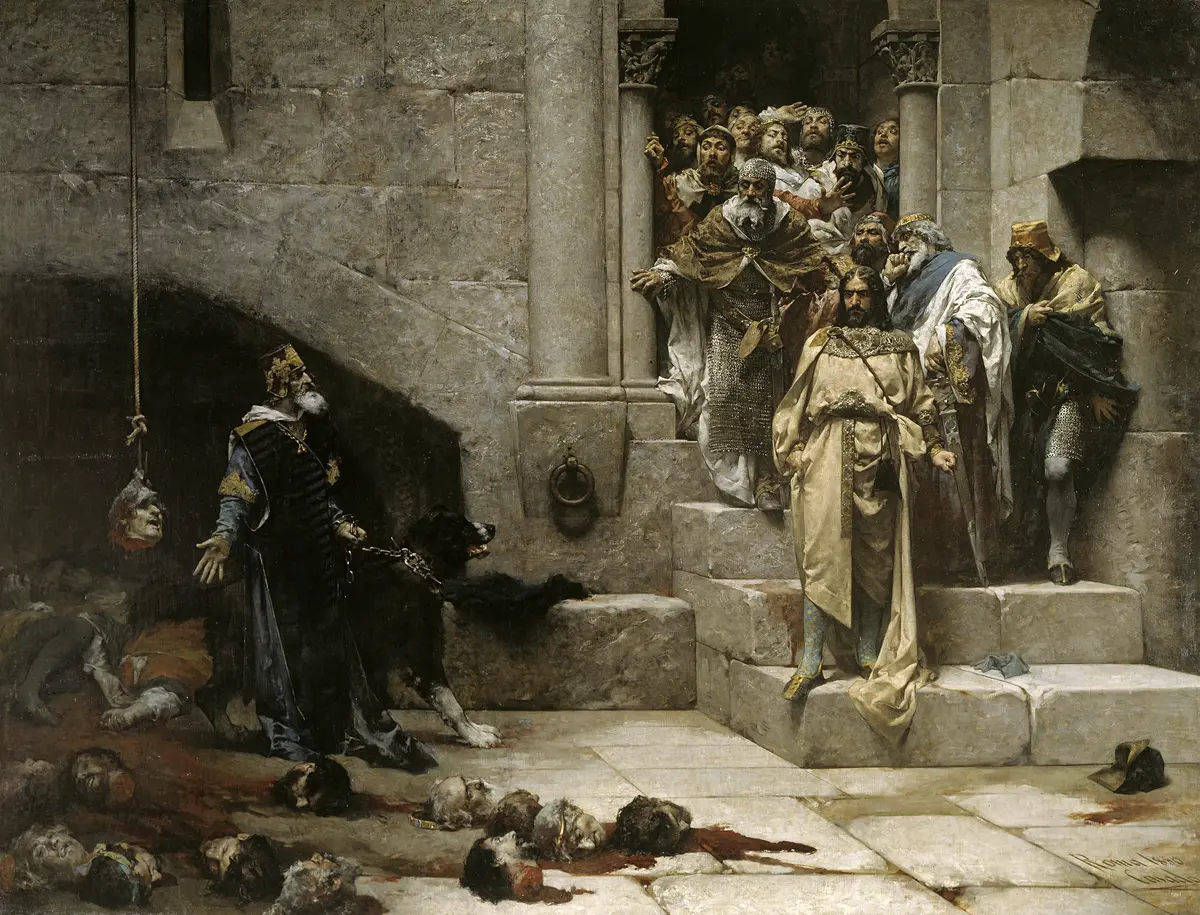
The Bell of Huesca is one of the rare legends where what happened and what was told afterwards can be separated cleanly, and what happened was harsh enough without the embellishment. In the summer of 1135 seven Aragonese office-holders were stripped of their holdings, Arab sources describe Christian nobles attacking a Muslim caravan during a truce, and a dry note written barely fifty years later in the Anales Toledanos Primeros records only this: they killed the potentates in Huesca. The rest arrives two hundred years afterwards, in the fourteenth-century Chronicle of San Juan de la Peña. There Ramiro II, the monk who left the cloister for a crown he never expected, sends to his old teacher for advice and gets no words back, only the abbot cutting down the tallest cabbages in his garden; then summons the nobles to Huesca to cast a bell that would be heard throughout the kingdom, has them shown in one at a time, and arranges thirteen severed heads in a circle with the Bishop of Jaca's hung in the middle as the clapper.
What is the history of The Bell of Huesca?
The Bell of Huesca is one of the rare cases in which what happened can be separated quite cleanly from what was told afterwards. And what happened was harsh enough without the embellishment.
The legendary account appears for the first time in the Chronicle of San Juan de la Peña, from the fourteenth century — roughly two hundred years after the events. It tells how Ramiro II of Aragon, nicknamed the Monk because he had left the cloister for a crown he never expected, found himself overwhelmed by a nobility that did not respect him. He sent a messenger to consult his former teacher, the abbot of Saint-Pons de Thomières. The abbot did not answer in words: he took the messenger into his garden and cut down the tallest cabbages — the tallest roses, in other versions — and told him to describe to the king exactly what he had seen.
Ramiro understood. He summoned the nobles to Huesca on the pretext of casting "a bell that would be heard throughout the kingdom" and had them shown in one at a time. According to the chronicle he ordered the beheading of thirteen ricoshombres and other knights. With the heads he assembled the object that gave the legend its name: arranged in a circle, with that of the most rebellious of them all — the Bishop of Jaca — hung in the centre as the clapper.
The historical kernel is real and documented. In the summer of 1135 seven nobles were stripped of their holdings: Fortún and Martín Galíndez, Bertrán de Larbasa, Miguel de Azlor, Miguel Aznárez de Rada, Íñigo López and Cecodín de Navasa. Arab sources describe Christian nobles attacking a Muslim caravan during a truce, something Ramiro II punished severely. That same year the king had to take refuge in Besalú, and on his return he solved the problem by executing the ringleaders.
And there is a dry note, written barely fifty years after the events, in the Anales Toledanos Primeros: "They killed the potentates in Huesca. Era MCLXXIV" — that is, 1135 or 1136. No bell, no clapper and no cabbages: just the record that the powerful were killed there.
Timeline: the documented record of The Bell of Huesca
- Summer 1135 Seven Aragonese nobles are stripped of their holdings: Fortún and Martín Galíndez, Bertrán de Larbasa, Miguel de Azlor, Miguel Aznárez de Rada, Íñigo López and Cecodín de Navasa. This is the documentary trace of the revolt.
- 1135-1136 Ramiro II takes refuge in Besalú and, on his return, orders the ringleaders executed. Arab sources place the trigger in an attack by Christian nobles on a Muslim caravan during a truce.
- c. 1185 The Anales Toledanos Primeros note, half a century after the events: "They killed the potentates in Huesca. Era MCLXXIV". No bell is mentioned.
- 14th century The Chronicle of San Juan de la Peña tells the full legend for the first time: the abbot's silent advice cutting the tallest cabbages, the bell pretext, the thirteen ricoshombres and the Bishop of Jaca's head as clapper.
- 1880 José Casado del Alisal paints La campana de Huesca, 474 × 356 cm. Honourable mention at the 1881 National Exhibition; the State buys it in 1882 for 35,000 pesetas. The image fixes the popular version of the legend.
- 1950 The painting, owned by the Museo del Prado, is deposited at the Huesca town hall, where it hangs in the Salón del Justicia and can be seen today.
Is there a rational explanation for The Bell of Huesca?
There is nothing supernatural here to refute. The interesting question is a different one: why did an ordinary political execution end up as a scene of symbolic butchery?
Modern historiography, led by Antonio Ubieto Arteta, has taken the mechanism apart. The event — executions of rebellious nobles at Huesca around 1135-1136 — is documented by three independent routes: the stripping of seven office-holders that summer, the note in the Anales Toledanos Primeros, and Arab chronicles about the attack on the caravan. But none of those sources mentions a bell. The casting ruse, the abbot's silent advice, the thirteen heads and the episcopal clapper appear for the first time two centuries later, in a fourteenth-century chronicle.
That gap is the key, because the garden episode is a classical motif: Herodotus already tells it of Thrasybulus of Miletus and Periander of Corinth, and Livy repeats it with Tarquin the Proud beheading poppies. The fourteenth-century chronicler fitted a real event into a narrative mould that was already more than a thousand years old — the ruler who learns to cut off the heads that stand out.
The numbers do not match either: the chronicle beheads thirteen ricoshombres; the documentary trace of the revolt names seven nobles stripped of their holdings in 1135. And the image of the bell works far too neatly — a king who wanted to "be heard throughout the kingdom" ends up being heard another way — to be a documentary accident.
On top of this sits a much later layer. In 1880 José Casado del Alisal painted the scene on a canvas nearly five metres across, and that image — the king standing before the ranked heads — is what almost everyone now pictures on hearing the legend. A good part of what we think we know about 1136 in fact comes from a nineteenth-century history painting.
Can you visit The Bell of Huesca?
The room where tradition places the executions is the Sala de la Campana of the Palace of the Kings of Aragon, which is now part of the Museo de Huesca, at Plaza de la Universidad 1, 22002 Huesca, in the northern part of the old town. The Gobierno de Aragón's page on the museum describes the palace as an example of late twelfth-century civil Romanesque; the Anales Toledanos Primeros date the killings "in Huesca" to 1135 or 1136 and name no room. The building has been a protected monument since 1931.
On 23 September 2026 the museum's own website returned a server error, and the Gobierno de Aragón's Cultura de Aragón page gave these terms: Tuesday to Saturday 10:00–14:00 and 17:00–20:00, Sundays and public holidays 10:00–14:00, closed every Monday and on 1 and 6 January and 24, 25 and 31 December, admission free. Groups have to request their visit in advance by email to [email protected]. The palace rooms on the visit are the Sala de la Campana, the Throne Room and the Sala de doña Petronila; the permanent collection fills eight galleries covering the province from prehistory to the twentieth century.
About 170 metres to the south is the town hall, at Plaza de la Catedral 1, declared a Bien de Interés Cultural in 2022. Its Salón del Justicia holds José Casado del Alisal's La leyenda del rey monje, known as La campana de Huesca (1880), which the Museo del Prado catalogues as P006751: oil on canvas, 356 cm high by 474 cm wide, on deposit at the Huesca town hall. The Spanish Wikipedia article on the painting records an honourable mention at the National Exhibition of Fine Arts of 1881, the purchase by the State in 1882 for 35,000 pesetas, its showing at the Paris Universal Exposition of 1889 and its handover on deposit to the town hall on 30 October 1950.
The city council's page on the building gives visiting hours of Monday to Friday, 9:00 to 14:00, and a number for groups, 974 292 100. With the museum closed on Mondays and the town hall at weekends, the room and the painting can both be seen on a single morning from Tuesday to Friday.
Sources consulted
- Carmen Orcástegui Gros (ed.), «Crónica de San Juan de la Peña (versión aragonesa) — edición crítica digitalizada del primer relato completo de la leyenda» — Institución Fernando el Católico, Zaragoza, 1986 book
- Carlos Laliena Corbera, «La apropiación mítica del pasado — las ejecuciones de 1135-1136, los Anales Toledanos y la fuente árabe de Ibn Idari» — Memoria, mito y realidad en la historia medieval. XIII Semana de Estudios Medievales de Nájera, 2003 academic
- Museo Nacional del Prado, «La leyenda del Rey Monje (La campana de Huesca) — ficha de catálogo P006751 del Museo del Prado» — Colección del Prado, depósito en el Ayuntamiento de Huesca, 2026 archive
- Alejandro Alagón (texto); Natalio Bayo (ilustraciones), «El rey monje y la Campana de Huesca» — Documentación institucional, 2015 report
- Museo de Huesca, «Visitar el museo — horarios y salas del Palacio de los Reyes de Aragón» — Información oficial de visita, 2026 archive
Reviewed by V. Serrano on 2026-07-28 · How we verify our content
📎 Source: Enigma Atlas
💬 Field testimonies (0)
No testimonies yet. Add the first.
Add your testimony
🔒 Log in to add a testimony