🦶 CRYPTID SIGHTING · EXP. Nº6501
ACTIVE
Nuberu
The Nuberu — also nubeiru, renubeiru or ñuberu, and "el Escolar", the Scholar, in San Martín de Luiña, Pola de Allande and Grandas de Salime — is the being who directs storms in Asturian folklore.
Where and when was Nuberu sighted?
- Location
- Asturias, Spain
- Date sighted
- Unknown
- Coordinates
- 43.188, -6.919
- Last updated
LOCATION
What is Nuberu?
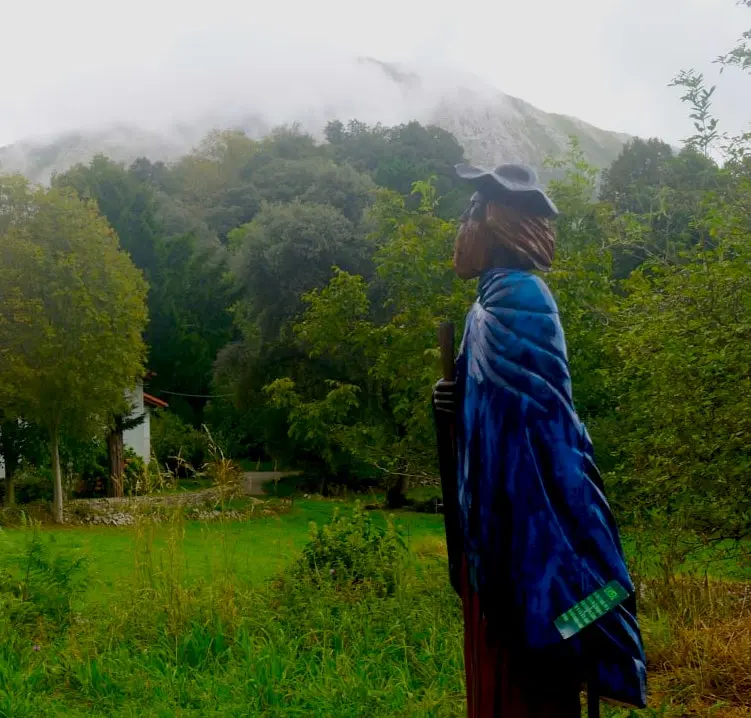
He was set down in print by Aurelio de Llano Roza de Ampudia in "Del folklore asturiano: mitos, supersticiones, costumbres" (Madrid, 1922), a book prefaced by Ramón Menéndez Pidal; the Nuberu opens it, on pages 6 to 15. Llano describes him as malign, ugly, of great height and colossal strength, dressed in skins, bearded, wearing a broad-brimmed hat and riding on a cloud. In the eight legends Llano collected he is called Juan Cabrito and lives with his wife and children in a city built on a mist-covered mountaintop in Egypt, from which he rides out to make thunder and empty the cloud wherever he pleases. Against him the bells were rung, blessed candles lit and an axe laid edge-upward on the roof. At Grandas de Salime, on 9 November 1921, Llano wrote down the charm the bells were said to hurl at the cloud: "Detente, nube y nublado, que Dios puede más que el diablo" — Stop, cloud and storm, for God can do more than the devil. Malign though he is, the same legends say he protects whoever treats him well.
What is the history of Nuberu?
The Nuberu did not reach print because someone heard a good story. It reached print because a man walked Asturias writing down who told him what, in which village, and on what day.
That man is Aurelio de Llano Roza de Ampudia, and the book is Del folklore asturiano: mitos, supersticiones, costumbres (Madrid, Talleres de Voluntad, 1922). The preface was signed by Ramón Menéndez Pidal at Zumaya, Guipúzcoa, on 24 July 1922, praising Llano's "stubborn enthusiasm". In his own foreword Llano says he was born at Caravia, spent his first seventeen years there, and in 1918 resolved to finish the collecting "with nobody's subsidy". In the index the Nuberu opens the first part of the book: pages 6 to 15, with the eight legends running from 16 to 27. Every dated testimony in that chapter is from 1921.
The chapter begins where no one expects it: in Carolingian Gaul. Llano opens with the tempestarii, sorcerers who, "in the belief of the common people", could raise thunder and hail, and who "received from private individuals a certain quantity of produce for preventing storms from damaging their crops"; some were put to death. He takes this — and cites it — from Feijóo and from Menéndez Pelayo. And he immediately rejects the comparison: the idea that the Nuberu resembles those tempestarii, he writes, "has no foundation, because the Nuberu is a supernatural being whose origin must perhaps be sought among the gods of the ancient Libyan or Asiatic continent". The following pages develop that: Egypt, the Cassiterides, Phoenician tin traders, the god Wotan. It is the diffusionism of its decade and it does not stand. The detail is worth keeping, because Llano had the whole mechanism on his first page and pushed it away.
The portrait is on page 9: "The Asturian Nuberu is the director of storms. He is a malign being, ugly, of great height and colossal strength. He wears a suit of skins, wears a beard, covers his head with a broad-brimmed hat and travels riding on a cloud." Two things follow in the notes: that in Asturias an unlovely person is said to be "uglier than the Nuberu"; and that on 13 November 1921, at Bao in the district of Ibias, several neighbours — among them the parish priest Ramón Rodríguez González and young Luisa Rodríguez — told him that the Nuberu had once fallen there "and he had a very big beard".
The names come in another note, on page 10: nubeiru in Quirós, Teverga and the villages bordering Galicia; renubeiru in Somiedo, Cangas de Tineo and San Antolín de Ibias; and el Escolar, the Scholar, in San Martín de Luiña, Pola de Allande and Grandas de Salime, where a few people also make him short. Llano argues against that with a reason of his own: whoever imagined the Nuberu could not have conceived a puny figure, because thunders are enormous spheres which he has to carry about and crash together so that the water and hail inside them break loose.
The defence occupies pages 10 to 13, and it is startlingly practical. The bells were rung and the priest went out to esconxurar. A priest of Villanueva de Teverga who died around 1856 used to surround himself with escolinos, schoolchildren, because their innocence strengthened the conxuru, and one day he threw a shoe at the cloud (told by José López, aged 80, from his bed, on 24 March 1921). Sometimes two men had to hold the priest down "so that the Nubeiru would not carry him off" (Hermenegildo Rodríguez, 74, San Martín de Luiña, 12 March 1921). At Brañaseca a blessed candle was lit and the bread-oven peel laid on the roof with an axe beside it, edge upward, to cut the lightning. In Allande the cart was turned upside down. At Sistema, in Ibias, a napkin with a loaf and a knife was set on the windowsill. And with the chapel's altar stone people "crossed the cloud" towards the four winds.
On page 13 Llano writes that the custom of ringing the bells against clouds, "once general", was by then reduced to Celón, Taladrid, Aguinos, Saliencia, La Pinera, Murias, Llueves "and a few other villages, very few". And there he sets down what the bells were said to hurl at the cloud, recorded at Grandas de Salime on 9 November 1921:
Detente, nube y nublado
que Dios puede más que el diablo.
Detente, nube.
Detente, tú;
que Dios puede
más que tú.
"Stop, cloud and storm, for God can do more than the devil. Stop, cloud. Stop, you; for God can do more than you." Six lines, not two. Beside the charm Llano lists other practices: lighting Tenebrae candles from the Holy Week office, and burning rosemary and laurel on Palm Sunday.
The eight legends (pp. 16-27) share one skeleton. The Nuberu loses his clouds and falls to earth; the rich farmer turns him away as a beggar and the poor one takes him in; on leaving he gives the warning that titles the tale: "If you go to the land of Egypt, ask for Juan Cabrito." Years later the host ends up a prisoner of war or lost on a journey, reaches Egypt, asks for Juan Cabrito and is received with honours; the Nuberu tells him his wife, believing him dead, is about to remarry, and flies him home astride a billy-goat in time to stop the wedding. Menéndez Pidal noted in the preface that these legends contained "themes of popular narrative not previously collected in Spain". And every ending is agricultural: what ruins the ungrateful farmer is not rain, it is hail.
Timeline: the documented record of Nuberu
- 1728 Benito Jerónimo Feijóo publishes volume II of the «Teatro crítico universal». In Discourse V, section 56 (pp. 152-153), he describes the tempestarii of the reign of Louis the Pious: men who charged "a fixed portion of produce" for preventing storms and who were executed "with no other guilt than the foolish conviction they held that they possessed it". This is the source Llano would cite two centuries later to open his Nuberu chapter.
- 1733 In volume V of the same «Teatro crítico» (Discourse V, §§34-37, pp. 122-124), Feijóo documents the Good Friday storm of 1718 on the Brittany coast: lightning struck precisely those churches where the bells had been rung. He concludes that the sound "acted as a physical cause in the descent of the lightning", and records Père Regnault's observation that bell-ringers "are frequently struck by lightning".
- c. 1856 Around this date dies the priest of Villanueva de Teverga who used to surround himself with schoolchildren in order to conjure the Nuberu, because their innocence strengthened the charm, and who one day, seeing that the cloud ignored him, threw a shoe at it. The story was told by José López, aged 80, a native of the village, from his bed on 24 March 1921. It is the oldest dated Asturian event in the chapter.
- 1918 Aurelio de Llano Roza de Ampudia resolves to finish "with nobody's subsidy" the collection of Asturian folklore he had long since begun. He says so himself in his foreword, recalling that he was born at Caravia and heard the mythological tales as a child beside the hearth.
- 12 March 1921 At San Martín de Luiña, in the district of Cudillero, Hermenegildo Rodríguez, aged 74, tells Llano that during the ceremony the priest had to be held up by two men "so that the Nubeiru would not carry him off". Llano adds that this was said "all over the West". The same day he records at Brañaseca the blessed candle, the bread-oven peel laid on the roof and the axe set edge-upward to cut the lightning.
- 21 July 1921 José Patallo, aged 60, from Llamosu in the district of Belmonte, tells Llano the only first-hand sighting in the chapter: as a boy, minding sheep at El Agüeiral with two shepherd girls — one of whom is now his wife — it began to thunder and one of the girls ran off downhill in tears, shouting that "the Nubeiru with the big hat" had just got in under an oak tree.
- 7 November 1921 At his house in Celón, district of Allande, Ramón Rubio, aged 81, gives Llano the variant that lays bare what all this is about. The Nuberu comes home exhausted and tells his wife: "I stoned seven parishes, and had it not been for a rascal who turned his cart upside down on me, I would have stoned seven more." The damage in the myth is hail, not rain.
- 9 November 1921 At Grandas de Salime, one of the three districts where the Nuberu is called "el Escolar", Llano records the charm the bells were said to hurl at the cloud: "Detente, nube y nublado / que Dios puede más que el diablo. / Detente, nube. / Detente, tú; / que Dios puede / más que tú." It runs to six lines and is printed on page 13 of the book, with the date and place given in the footnote.
- 13 November 1921 At Bao, in the district of Ibias, several neighbours — among them the parish priest Ramón Rodríguez González and young Luisa Rodríguez — tell Llano that the Nuberu once fell there "and he had a very big beard". It is the only physical detail of the portrait that Llano documents with named witnesses; the rest, he says himself, "is supplied by the legends".
- 1922 «Del folklore asturiano: mitos, supersticiones, costumbres» is published in Madrid by the Talleres de Voluntad. Ramón Menéndez Pidal signs the preface at Zumaya, Guipúzcoa, on 24 July 1922, warning that the Nuberu legends contain "themes of popular narrative not previously collected in Spain". It is the oldest printed appearance of the Nuberu I have been able to read at first hand.
- 1925-1928 Constantino Cabal publishes in Madrid the three volumes of «La mitología asturiana»: «Los dioses de la vida» and «Los dioses de la muerte», both in 1925, and «El sacerdocio del diablo» in 1928. The list appears with those titles and years under the heading "Cabal, Constantino" in Constantino Suárez's «Escritores y artistas asturianos» (1936), written during Cabal's lifetime.
- 28 December 1978 Law 87/1978 on Combined Agricultural Insurance, published in the official gazette on 12 January 1979, creates the Spanish agricultural insurance system. Its article 3 lists the risks covered, and the first item on that list is "Hail". The threat the bells were rung against acquires an insurance policy.
Is there a rational explanation for Nuberu?
The best sceptic of the Nuberu was writing in Spanish two centuries before Llano's informants, and Llano quotes him twice without following him.
In volume II of the Teatro crítico universal (1728), Discourse V, section 56, pages 152-153, Benito Jerónimo Feijóo tells of the tempestarii in the reign of Louis the Pious: men who claimed the power to prevent storms and who "received from private individuals a fixed portion of produce" for it. Some confessed to sorcery in court and were executed "with no other guilt than the foolish conviction they held that they possessed it". Feijóo's explanation is psychological and still the right one: some were already deranged without judges or witnesses noticing; others were driven mad by fear of the penalty and the disgrace; and others, of vivid imagination and small courage, passed "from the fear of falling into the crime" to apprehending it as committed. Llano copies the episode onto his first page and, unlike his source, calls those men "swindlers".
And the counter-ritual was genuinely dangerous. In volume V (1733), Discourse V, sections 34 to 37, pages 122-124, Feijóo reports the Good Friday storm of 1718 on part of the Brittany coast: lightning struck precisely those churches where the bells had been rung, and none of the many where the rule of not ringing that day was kept. He concludes that the sound "acted as a physical cause in the descent of the lightning", recalls that Bayle had already conjectured that bell towers are struck more often than others, and adds Père Regnault's observation that bell-ringers who ring for a long time under a storm cloud "are frequently struck by lightning". Llano reproduces the passage in a footnote on page 13 — writing "25 churches" where the edition consulted reads "twenty-four". Put plainly: the people ringing against the Nuberu were holding a wet rope tied to the highest metal object in the parish.
The name needs no god either. The Dicionario da Real Academia Galega defines nubeiro first as "a low, dark cloud" and only in a second sense as the storm spirit. Xosé Lluis García Arias's Diccionario General de la Lengua Asturiana records the same double life: nuberu means "storm cloud" and "overcast sky" before it means a spirit, and it also means an angry person, an ugly person or a mischievous child. The word is nube, cloud, plus an agent suffix, and its distribution is simply that of Asturian phonetics: nuberu in the centre, nubeiru, nubleiru and nubeiros in the west and along the Galician border — exactly the districts Llano lists. The Nuberu is the storm cloud in a hat.
What Llano discarded is the interesting part. In the three western districts closest to Galicia — San Martín de Luiña, Pola de Allande and Grandas de Salime — the being is called el Escolar, the Scholar. Across the border, the Real Academia Galega's entry for escoler carries two senses: the mythological one, synonymous with nubeiro and tronante; and, second, "a man who practises magic or necromancy", illustrated with this sentence: "O escoler cobrounos media ola de viño por tornarnos os tronos" — the escoler charged us half a pot of wine for turning the thunder away from us. That is a tempestarius word for word: a man, paid in kind, for taking the storm elsewhere. Llano himself noted at the foot of the page that "in Galicia there are Nubeiros and Tronantes"; the current Galician dictionary preserves all three names and the payment as well. The parallel he called groundless survives in the vocabulary of the very districts where he collected the charm. It does not prove that the Asturian myth descends from Carolingian sorcerers — nothing here can prove that — but it does show that the two ideas share a border and a vocabulary.
On antiquity one must be strict. The oldest printed appearance I have been able to read at first hand is Llano's, 1922; then come the volumes of Constantino Cabal's La mitología asturiana (1925 and 1928). The living memory Llano documents reaches only as far as his informants: they were between 59 and 87 in 1921, and the oldest dated fact in the chapter is that priest of Villanueva de Teverga who died around 1856. Beyond that there is nothing datable. The honest formulation is "the earliest printed appearance I can date is 1922", not "the myth was born in".
And underneath all of it lies a real problem: hail. In Llano's legends the damage is never rain. It is the pedral: at Belmonte it strips the topsoil from a place called Barrublancu ever since, which stopped growing grass; at Grado it piles up in the priest's kitchen garden and takes over a fortnight to melt; and the Nuberu boasts of it on getting home — "I stoned seven parishes." The institutional answer arrived in 1978. Law 87/1978 of 28 December, on Combined Agricultural Insurance, lists in its article 3 the risks the new scheme would cover, and the first word on the list is "Hail". Bell, charm and insurance policy are three answers to the same problem.
Can you visit Nuberu?
The Nuberu is a belief without an address. The pin on this file sits in the council of Grandas de Salime, about 5 km south-west of the town, in the district where Llano recorded the charm against the cloud on 9 November 1921. Two museums show the world the belief belonged to, and one of them stands in that same district.
Museo Etnográfico de Grandas de Salime "Pepe el Ferreiro". Avda. Ferreiro 17, 33730 Grandas de Salime, Asturias; telephone +34 985 627 243. According to the museum's own website, consulted on 23 September 2026, the timetable for January-April and October-December is Tuesday to Friday 11:00-14:00 and 16:00-18:30; Saturdays 11:00-14:30 and 16:00-18:30; Sundays and public holidays 11:00-15:00. From May to September it opens Tuesday to Saturday 11:00-14:30 and 16:00-19:30; Sundays and holidays 11:00-15:00. It closes on Mondays and, each year, on New Year's Day, on 6 January, on 24 and 25 December and on New Year's Eve. General admission is 1.50 €; children aged 6 to 12 pay 0.30 € and concessions 0.75 €; entry is free for under-sixes and free every Tuesday. The museum was founded in 1984 around the collection of José María Naveiras Escanlar, "Pepe el Ferreiro", who directed it until 2010, and since 1989 it has occupied the old rectory of the village; it now covers more than 3,000 m². Its buildings include three kinds of granary, the hórreo, the panera and the cabazo, along with the mill; the Miller's House holds the threshing floor and a cortín, the walled enclosure that kept beehives safe from bears. They are the crops and stores a hailstorm could ruin in an afternoon. Grandas lies at the far western end of Asturias and is a stage on the Camino Primitivo.
Muséu del Pueblu d'Asturies, Gijón. Paseo del Doctor Fleming 877, La Güelga, 33203 Gijón; telephones +34 985 182 960 and +34 985 182 963. Admission is free. According to the Turismo Asturias listing consulted on 23 September 2026, from October to March it opens Tuesday to Friday 9:30-18:30 (weekends and holidays 10:00-18:30); from April to September, Tuesday to Friday 10:00-19:00, with weekends and holidays 10:30-19:00. It closes on Mondays and also on 1 and 6 January, Shrove Tuesday, 15 August, and 24, 25 and 31 December.
The photograph on this file shows a wooden carving of the Nuberu on the Camín Encantáu trail in the Ardisana valley, in the district of Llanes, photographed on 23 April 2021; the identification is the one the photographer gave when uploading it to Wikimedia Commons.
The bell-ringing against clouds is a custom Llano already found in retreat: in 1921 he counted it in seven villages and "a few others, very few". His book, Del folklore asturiano (1922), is digitised in full on archive.org, with the Nuberu chapter on pages 6 to 15 and its legends on pages 16 to 27.
Sources consulted
- Aurelio de Llano Roza de Ampudia, «Del folklore asturiano: mitos, supersticiones, costumbres (capítulo «El Nuberu», pp. 6-15; «Leyendas del Nuberu», pp. 16-27; conjuro y nota de Grandas de Salime, p. 13). Prólogo de R. Menéndez Pidal» — Madrid, Talleres de Voluntad, 1922 book
- Benito Jerónimo Feijóo, «Teatro crítico universal, tomo II, Discurso V «Uso de la Mágica», §56 (pp. 152-153): los tempestarios, el pago en frutos y las ejecuciones» — Madrid (ed. digital de filosofia.org sobre la impresión de Joaquín Ibarra, 1779), 1728 book
- Benito Jerónimo Feijóo, «Teatro crítico universal, tomo V, Discurso V «Observaciones comunes», §§34-37 (pp. 122-124): la tormenta de Bretaña de 1718 y los campaneros heridos por el rayo» — Madrid (ed. digital de filosofia.org sobre la impresión de Joaquín Ibarra, 1779), 1733 book
- Xosé Lluis García Arias, «Diccionario General de la Lengua Asturiana (DGLA), entrada «nuberu, el»: variantes nubeiru, nubero, nubiru, ñuberu, nubleiru, nubeiros y sus acepciones no míticas» — Editorial Prensa Asturiana, edición en línea, 2002 academic
- Seminario de Lexicografía da Real Academia Galega, «Dicionario da Real Academia Galega, entradas «nubeiro» («nube baixa e escura»; espírito das tempestades) e «escoler» («home que practica a maxia ou a nigromancia»)» — Real Academia Galega, dicionario en liña, 2026 academic
- Jefatura del Estado, «Ley 87/1978, de 28 de diciembre, de Seguros Agrarios Combinados (artículo tercero: «Pedrisco, incendio, sequía, heladas, inundaciones y viento huracanado o cálido»), BOE núm. 11, 12 de enero de 1979, pp. 766-767» — Boletín Oficial del Estado, 1979 report
- Constantino Suárez, «Escritores y artistas asturianos, tomo II, voz «Cabal, Constantino»: relación de sus libros, con «La mitología asturiana: Los dioses de la vida» (Madrid, 1925), «Los dioses de la muerte» (1925) y «El sacerdocio del diablo» (1928)» — Madrid, 1936 book
- Museo Etnográfico de Grandas de Salime, «Museo Etnográfico de Grandas de Salime «Pepe el Ferreiro»: horarios, tarifas y contacto (consultado el 11 de agosto de 2026)» — museodegrandas.es, 2026 web
- Turismo Asturias, «Muséu del Pueblu d'Asturies (Xixón): dirección, teléfonos, horarios y entrada gratuita (consultado el 11 de agosto de 2026)» — turismoasturias.es, 2026 web
- Mrc1986, «File:Nuberufig.jpg — talla de madera del Nuberu en la ruta del Camín Encantáu, valle de Ardisana (Llanes), fotografiada el 23 de abril de 2021; descripción del propio autor» — Wikimedia Commons, CC BY-SA 4.0, 2021 web
Reviewed by V. Serrano on 2026-08-11 · How we verify our content
📎 Source: Enigma Atlas
💬 Field testimonies (0)
No testimonies yet. Add the first.
Add your testimony
🔒 Log in to add a testimony