📜 LEGEND · EXP. Nº0270
ACTIVE
The Santa Compana
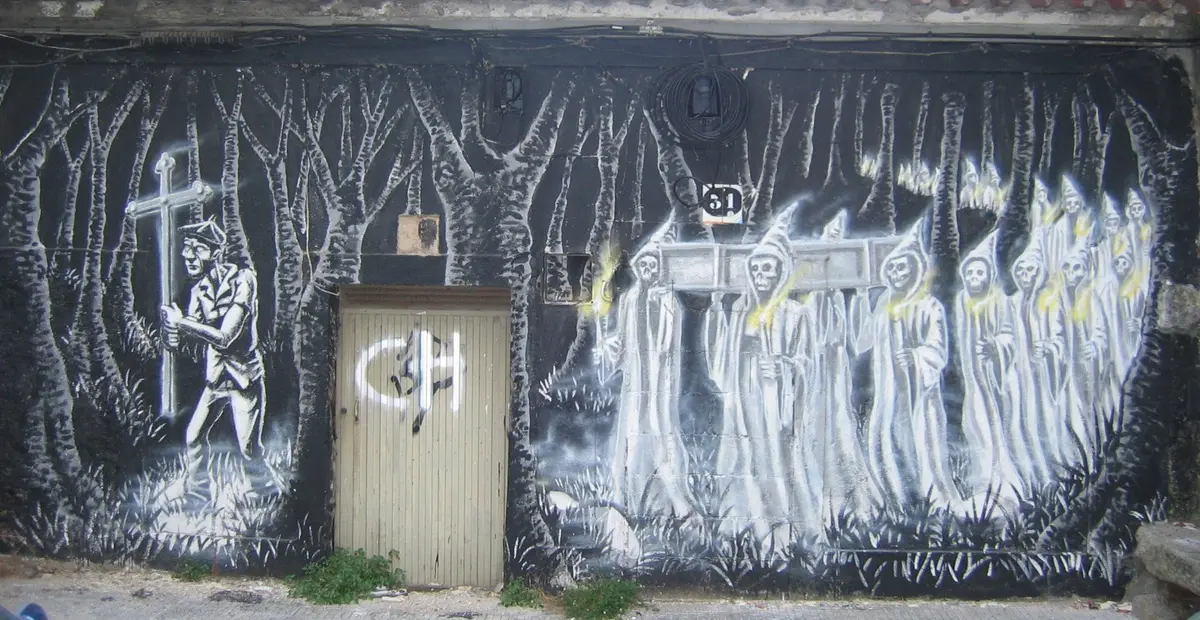
The Santa Compaña is the night procession of the dead of Galician folklore, known in western Asturias as the huestia or güestia.
Where does the legend of The Santa Compana come from?
- Location
- Galicia, Spain
- Kind of legend
- Ghost story
- Coordinates
- 42.878, -8.545
- Last updated
LOCATION
What is the legend of The Santa Compana?
In the classic description it is a line of souls carrying torches or candles and bearing the coffin of a neighbour whose death it announces. El Debate's account of 2024 adds that whoever meets it may be condemned to join it until someone takes their place, and that the person who opens the procession remembers nothing the next day and grows thin and pale. The advice recorded by the folklorist Manuel Alberro is to avoid looking at it and step quietly out of its way, to stand inside a circle drawn on the ground with Solomon's star, or, in an emergency, to lie face down until it has passed. The name estantigua comes from the clerical Latin hostis antiquus, the old enemy, and a similar procession of the dead was recorded in Normandy by Orderic Vitalis around 1135. Scholars disagree about its roots: Joan Corominas called the superstition Germanic, while Alberro argues for a Celtic origin.
What is the history of The Santa Compana?
In Galicia the Santa Compaña is told as a local belief; El Debate wrote in 2024 that for many Galicians it is "parte integral de su patrimonio cultural". A written analogue more than nine centuries old comes from Normandy.
At the beginning of January 1091, according to the chronicler Orderic Vitalis, a young priest named Walchelin, who served the church of Bonneval in the diocese of Lisieux, was walking home alone at night from a sick parishioner when he heard what sounded like a large body of troops on the march. He took it at first for the army of Robert of Bellême on its way to besiege the castle of Courcy. What passed him was a procession of the dead: a crowd on foot carrying plunder, bearers with biers, women on horseback, clergy and monks with their bishops and abbots, and finally an army of knights. Among them he recognised neighbours who had lately died, and in the end his own brother. He concluded that these were "Harlequin's people", the familia Herlechini. Orderic writes that he heard the story from Walchelin's own mouth and saw the mark on his face left by the hand of one of the knights.
Orderic recorded the account in Book VIII of his Historia Ecclesiastica, around 1135. The motif had other names elsewhere: Joan Corominas gives La Mesnie Hellequin for Old French and El Mal Caçador for Catalan, and traces the Castilian hueste antigua and estantigua to the same belief.
In the north-west of the Iberian Peninsula the procession collected a great many names. Manuel Alberro's list in the Revista de Folklore (2008) includes a compañía, a compañía das ánimas, a procesión das ánimas, estadea, estandaiña, estantiga, hoste, hueste, huestia, rolda, ronda, o enterro, as da noite and as luces, and he notes that in Asturias it is called huestia or güestia. He defines it as a night procession of souls or dead people carrying lights, torches or candles, who bear the coffin of a neighbour whose coming death they announce in this way. The version told by El Debate adds that whoever opens the procession remembers nothing the next day, and that their extreme thinness and pallor give them away.
Timeline: the documented record of The Santa Compana
- 1 January 1091 The Norman priest Walchelin claims to have seen an endless night-time procession of the dead, including recently deceased neighbours and his own brother. At first he believed they were real soldiers.
- c. 1135 Orderic Vitalis records Walchelin's account in Book VIII of his Historia Ecclesiastica and identifies it as the familia Herlechini. It is the founding written testimony of the European Wild Hunt.
- 1962 Vicente Risco publishes Etnografía: Cultura espiritual, within the Historia de Galiza directed by Otero Pedrayo — the reference work on Galician spiritual culture in which this universe of beliefs is documented.
- 2024 The legend remains fully alive in the Spanish press, described as the most deeply rooted in Galicia, with its classic features intact: the guide who remembers nothing, the extreme pallor and thinness.
Is there a rational explanation for The Santa Compana?
The name of the procession points outside Galicia. Joan Corominas, in his Diccionario crítico etimológico castellano e hispánico, derives estantigua from the Latin hostis antiquus, "the old enemy", which the Church Fathers applied to the devil; in Castilian the phrase became feminine because hueste, "army", is feminine. The oldest Castilian form he records, uest antigua, is in Berceo's Milagros. He traces the idea to the Germanic belief in the night ride of the god Wodan and his followers, and sums up the case in one line: "aunque la superstición sea germánica, el nombre es de procedencia latina clerical". For Galicia he cites estantiga and compaña, a "procesión de muertos que golpea a la puerta de los moribundos", from Father Sarmiento's catalogue of Galician words.
The opposite reading is also in print. Manuel Alberro, writing in the Revista de Folklore in 2008, concludes that the origins of the belief "son célticos", following a study by Alonso Romero (1996). His evidence is a set of parallels: the Irish Fairy Host, the Scottish sluagh, the Welsh toili, and a custom recorded on the island of Ons and in Scotland, Ireland, Wales and Brittany of treading on the left foot of someone who cannot see the procession so that they can. Alberro himself notes that Lisón Tolosana, in his 1998 monograph, suggests a Nordic-Germanic origin. On dating, Alberro gives as the first written mention of the Compaña George Borrow, who visited Galicia in 1835 and published his travels in 1842, followed by Francisco J. Rodríguez's Galician–Spanish dictionary of 1863. Orderic Vitalis had written his Norman account around 1135.
That account carries a natural reading of its own. Walchelin's first thought, on hearing the noise, was that it came from Robert of Bellême's army marching to besiege Courcy. And when he decided that he was looking at "Harlequin's people", he recalled that he had often heard of their being seen, "but I laughed at the stories". The witness took the procession first for soldiers and then for the dead he had heard about, in that order.
The condition that the guide remembers nothing the next day, recorded by Alberro for those who see the Compaña and by El Debate in 2024, also means that the one person who walked inside the procession can never describe it.
Can you visit The Santa Compana?
The Santa Compaña belongs to no single site. The belief is recorded across Galicia and, under the name güestia, in western Asturias; in the stories the procession of the dead walks the lanes at night and passes through crossroads and church forecourts. The map pin for this entry is in the historic centre of Santiago de Compostela, at 42.8782, -8.5448. It stands for the city through which, on the most cited account, the Camino carried the Wild Hunt into Galicia, and it marks no reported sighting.
The Museo do Pobo Galego, Galicia's ethnographic museum, occupies the former convent of San Domingos de Bonaval, about 700 metres north-east of the pin; a side chapel of the convent church houses the Panteón de Galegos Ilustres, where Rosalía de Castro and Castelao are buried. Santiago's official tourism site, consulted on 23 September 2026, gives the address as San Domingos de Bonaval s/n, 15703, and the hours as Tuesday to Saturday from 11:00 to 18:00 and Sundays and public holidays from 11:00 to 14:00, with the museum closed on Mondays and free to enter on Sundays. The same page lists sections on the sea, the traditional trades, the countryside, dress and vernacular architecture, which is the rural Galicia of scattered hamlets in which the belief was told.
The stone cruceiros are the trace of that world most easily seen from a road. Most stand at crossroads, beside lanes or in church forecourts. The University of A Coruña, which has been inventorying them municipality by municipality since 1993, estimates at least 12,000, densest in the provinces of A Coruña and Pontevedra and scarcer in Lugo and Ourense. After the Council of Trent many were raised to ask protection against epidemics and to intercede for the souls in purgatory.
Night walks built on the legend exist. El Debate's 2024 article on the Santa Compaña notes that some Galician municipalities organise staged night routes in which walkers follow the procession through the hills. One of them, the Ruta da Santa Compaña of Vilamartín de Valdeorras, in Ourense, held its second edition on 9 May 2026, according to the local news site Valdeorras de Cerca: 10.5 km from the castle of Arnao at 21:30, organised by the town council with the walking group Rutas Xanzá. These are recreations; the belief as fieldwork recorded it is in Vicente Risco's Etnografía: Cultura espiritual of 1962.
Sources consulted
- Orderico Vital, «Historia Ecclesiastica, libro VIII — visión de Walchelin y la familia Herlechini» — Normandía, c. 1135, 1135 book
- Joan Corominas y José A. Pascual, «Entrada «estantigua» — del latín hostis antiquus, «el viejo enemigo», nombre que los Padres de la Iglesia daban al demonio» — Diccionario crítico etimológico castellano e hispánico, vol. II, 1980 academic
- Vicente Risco, «Etnografía: Cultura espiritual (Historia de Galiza, dir. Otero Pedrayo) — enlace a su asiento en la «Bibliografía selecta sobre Vicente Risco» del Consello da Cultura Galega» — Editorial Nós, Buenos Aires, vol. I, 1962 book
- Manuel Alberro, «La Santa Compaña en el NO de la Península Ibérica y en otros países célticos como Irlanda, Escocia y Gales» — Revista de Folklore (Fundación Joaquín Díaz), n.º 336, pp. 183-187, 2008 academic
- Olaia González, «El origen de la Santa Compaña, la leyenda más arraigada de Galicia» — El Debate, 2024 newspaper archive
- Orderic Vitalis; translated by Thomas Forester, «The Ecclesiastical History of England and Normandy, vol. II, book VIII, ch. 17 — Walkelin's vision at the beginning of January 1091, which Orderic heard from the priest himself, having seen the mark on his face (English translation by Thomas Forester)» — Henry G. Bohn, London, 1853 book
Reviewed by V. Serrano on 2026-07-28 · How we verify our content
📎 Source: Enigma Atlas
💬 Field testimonies (0)
No testimonies yet. Add the first.
Add your testimony
🔒 Log in to add a testimony