📜 LEGEND · EXP. Nº3657
ACTIVE
San Andrés de Teixido
San Andrés de Teixido is a legend from Cedeira, A Coruña, Galicia, ES — a folk story passed down over generations. This file collects its origins, its meaning and how it has been retold.
Where does the legend of San Andrés de Teixido come from?
- Location
- Cedeira, A Coruña, Galicia, ES
- Kind of legend
- Myth
- Coordinates
- 43.74, -7.993
- Testimonies
- 0
- Last updated
LOCATION
What is the legend of San Andrés de Teixido?
On the wild Galician coast near Cedeira, in A Coruña, the tiny sanctuary of San Andrés de Teixido has drawn pilgrims for centuries, wrapped in one of Spain's most distinctive sayings: 'A Santo Andrés de Teixido vai de morto quen non foi de vivo' ('to San Andrés de Teixido goes dead whoever did not go while alive'). According to Galician folk belief, every living soul owes at least one visit to this remote shrine, and anyone who never manages it in life will be forced to make the pilgrimage after death, often traveling in the shape of small animals: snakes, lizards, or, most commonly, tiny creatures locals associate with 'meigas' in animal form. Travelers along the coastal paths are still told never to harm any small creature crossing their way near Teixido, since it might be someone's soul finally completing the journey it owed in life. The sanctuary itself is linked to the apostle Andrew, whose relics were supposedly rescued from a shipwreck and brought ashore here, but the pilgrimage's real power in local memory comes from this older belief in an obligatory journey of the dead, blending Christian devotion with pre-Christian ideas about souls, animals and unfinished duties.
What is the history of San Andrés de Teixido?
San Andrés de Teixido is a legend with an appointment attached, and people still keep it. The saying compresses it into one brutal line of Galician: «A Santo André de Teixido vai de morto quen non foi de vivo» — to San Andrés de Teixido goes dead whoever did not go alive. Galicia's official tourism site spells out the mechanism without softening it: nobody enters the kingdom of heaven without first passing through this church, and whoever fails to do it in life will do it dead, "reincarnated as a toad, a snake or a lizard".
That clause is what turns a belief into a rule of conduct. If the souls who defaulted are climbing the mountain inside an animal, then a pilgrim may kill nothing on the way — neither a lizard crossing the track nor a toad under a stone nor the most insignificant insect — and, as the tradition is told, people on the Capelada walk looking at the ground. Part of the same devotional fabric is that the parish today blesses pets at the sanctuary's main door at the end of mass.
The documentary record begins well after the legend. The earliest written references to the site are twelfth-century, when the monastery — under the protection of the Casa de Traba — passed around 1196 to the representatives of the Order of Saint John of Jerusalem, the future Order of Malta, at Portomarín. The pilgrimage itself does not appear in writing until the end of the fourteenth century. The oldest known mention is a testamentary bequest of 1391: the will of María Rodrigues, widow of Pedro López de Mañente, drawn up in the town of Viveiro on 27 October of that year, reads "Iten mando ir por min en romaría a Santo André de Teixido porque llo teño prometudo" — I order that someone go on pilgrimage to Santo André de Teixido on my behalf, because I promised it — and instructs that a candle be placed on the altar, as tall as a woman of her standing.
That document is more interesting than it looks. It does not prove the cult is immensely old. It proves something narrower and firmer: that by the late fourteenth century the pilgrimage was established enough to be delegated, commissioned and paid for. Going on someone else's behalf — fulfilling a vow for a third party who no longer can — is precisely what the modern saying inverts, making the dead walk for themselves.
The building is late for what the landscape suggests. The sanctuary visitors see today was begun in the sixteenth century in a plain seafaring Gothic; its oldest elements, the apse and the side door with its Isabelline ogee arch, belong to the Andrade period and served as the main entrance from the fifteenth century to the eighteenth. The eighteenth-century enlargement added the bell tower and the façade; the fonte do Santo, the three-spouted stone fountain that rises beneath the high altar, is dated 1781. The Baroque altarpiece holds an Italian reliquary containing a fragment of the apostle's bone, and in 1970, when the main altarpiece was moved, wall paintings of Saint Andrew's martyrdom nobody knew were there appeared behind it.
The pilgrimage also has a material culture of its own, made of things that can be carried away in the hand. The amilladoiros — cairns that each pilgrim feeds with one more stone — survive alongside "As Costas", the slopes dropping to the sanctuary: more than half a dozen of them, built from many thousands of accumulated stones. The sanandresiño is the hardened, hand-painted breadcrumb figurine bought in the village and carried as a charm: a basic flour-and-water dough with the texture of modelling clay, shaped with penknives and punches, dried for hours in a low oven and painted one by one. There are eight principal figures, each with its own commission — love, health, work, travel, study, food, peace, protection. The herba de namorar is the flower that finishes the posy: a sea thrift of the cliffs, identified on the Capelada as Armeria pubigera, an endemic of the Galician Atlantic coast and northern Portugal, flowering from April to July, which tradition says must be slipped into the pocket of the person desired without their noticing. At the fountain, Turismo de Galicia records, pilgrims drink from the three spouts without resting their hands on the stone; then they drop a crumb of bread into the water, and if it floats, the wish is granted.
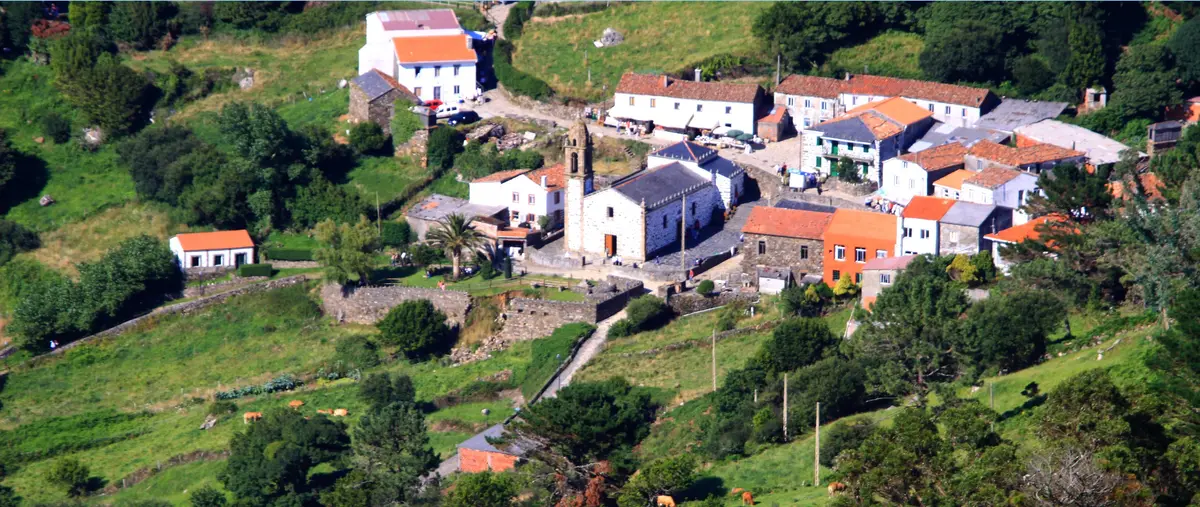
All of this happens on a balcony over the Atlantic. The hamlet, tiny, hangs off the Serra da Capelada inside the Cabo Ortegal UNESCO Global Geopark, below the Vixía Herbeira, whose cliffs reach around 615 metres and are reckoned the highest in continental Europe. The founding legend fits that geography: the boat in which the apostle arrived is said to have capsized off these cliffs and turned to rock.
And it is still alive, with numbers to prove it. Between December 2024 and the end of August 2025 the visitor-counting sensors installed by Cedeira town council recorded more than 94,000 people in the village, some 50,000 of them in summer alone: 12,677 in June, 32,489 in July and 37,390 in August, with 6,317, 11,809 and 18,592 vehicles respectively. Fifty-six per cent came from elsewhere in Spain, 33 % from Galicia and 10 % from abroad. The great romería is on 8 September; the saint's liturgical feast, quieter, falls on 30 November. In 2023 the geographers Sergio Muiño Freire and Xosé Manuel Santos Solla documented what that flow has done to the hamlet: its residents have shifted from farming and fishing to tourism, and the road has been the main engine of the change.
Timeline: the documented record of San Andrés de Teixido
- c. 1196 The monastery, protected until then by the Casa de Traba, passes to the representatives of the Order of Saint John of Jerusalem — the future Order of Malta — at Portomarín. References to the site itself go back to the twelfth century.
- 27 October 1391 The will of María Rodrigues, widow of Pedro López de Mañente, drawn up in Viveiro, orders that someone go on pilgrimage in her name — "Iten mando ir por min en romaría a Santo André de Teixido porque llo teño prometudo" — and place a candle on the altar as tall as a woman of her standing. It is the oldest known written record of the pilgrimage.
- 1755 The Benedictine scholar Friar Martín Sarmiento documents the old pilgrimage road from Narón to Teixido, the route known today as the Camiño Vello.
- 1781 The fonte do Santo is dated: a three-spouted stone fountain rising beneath the high altar, part of the eighteenth-century enlargement that also gave the sanctuary its bell tower.
- 1970 Wall paintings depicting the martyrdom of Saint Andrew are discovered behind the Baroque high altarpiece, which holds an Italian reliquary with a fragment of the apostle's bone.
- 30 November 2019 The Mancomunidade de Concellos da Comarca de Ferrol and the Xunta de Galicia hold a public session in Cedeira on the diagnosis and promotion of the pilgrimage route, with academics, the mayor of Cedeira and the town chronicler.
- 2023 Geographers Sergio Muiño Freire and Xosé Manuel Santos Solla publish a study showing how tourism has functionally transformed the hamlet: residents have moved from the primary sector to tourism, with the road as the main driver.
- October 2025 Cedeira town council releases the first sensor-based visitor counts: more than 94,000 people between December 2024 and late August 2025 — 12,677 in June, 32,489 in July and 37,390 in August — with 56 % arriving from elsewhere in Spain.
- May 2026 A report on the sanandresiños finds only four households in the village still making the breadcrumb amulets. Artisan Jorge Bellón, who learned the craft from his mother Fina, says of it: "I simply don't want it to disappear."
Is there a rational explanation for San Andrés de Teixido?
The scepticism this place needs concerns historiography. San Andrés de Teixido is a living devotion, with mass, a parish priest and people discharging vows; what deserves scrutiny is the story that circulates about where the devotion came from.
That story is almost always the same: that the pilgrimage is a pre-Christian cult — Celtic, druidic, prehistoric — barely disguised as Christianity. It draws on an attractive repertoire: the three-spouted spring, the stones heaped in the amilladoiros, the yew and hazel staffs, the journey of souls towards the end of the world. The problem is the asymmetry of the evidence. For the Christian layer there are documents: references to the site in the twelfth century, the transfer to the Knights of Saint John around 1196, and a 1391 bequest that names the pilgrimage outright. For the pagan substrate, the case rests on analogies.
The hypothesis has serious versions: in 2013 Antón Bouzas Sierra published in the Anuario Brigantino a geo-astronomical study of nine Galician Christian sanctuaries that reads their siting "as proof of their pagan origin", and, citing the folklorist Fernando Alonso Romero, placed the stone-boat legend — Saint Andrew's at Teixido, but also the Virxe da Barca at Muxía and Saint James's own — in a distribution area of six Atlantic countries: Galicia, Brittany, Cornwall, Wales, Ireland and Scotland. It is an argued piece of work, and its author also records a "controversy among specialists" over whether the Iron Age castro culture was fully Celtic at all, and states that the controversy does not affect his thesis. A legend shared across six Atlantic coasts shows contact between them; continuity from prehistory would need a witness older than the Christian ones, and the oldest written mention of the pilgrimage is the bequest of 1391. In Galicia itself, the stone boats of the other two legends in the same study carry the Virgin and Saint James.
There is also a bias of origin that is rarely declared. The Celtic reading of Galicia was born in nineteenth-century Romantic historiography, where it served to give the country a distinct identity, and its fit with what those historians set out to prove calls for more caution with it.
Two specific claims deserve a warning label. The first is that the amilladoiros go back to the Neolithic: Cedeira council's tourism page says the tradition goes back "possibly to the Neolithic", and a local craft blog places it "before the Neolithic", neither with a dating or a reference. By their nature these are heaps continually remade — every pilgrim adds a stone — so their bulk dates nothing. Second, that San Andrés de Teixido is the second pilgrimage centre in Galicia after Compostela. Turismo de Galicia puts it "just behind Santiago de Compostela in number of visitors", and Ferrol360 repeats "second" in the very article that reports the council's visitor counts; neither gives a figure for Santiago or for any other sanctuary to compare.
The figures that do have a stated method come from Cedeira town council's own sensor system: 94,000 visitors between December 2024 and the end of August 2025.
None of this diminishes the place: that the romería is medieval rather than Neolithic makes it no less extraordinary: it means people have been climbing this slope to keep promises for at least six hundred and thirty-five years, and that somebody wrote it down in 1391 because by then going was already an obligation.
Can you visit San Andrés de Teixido?
San Andrés de Teixido, Santo André in Galician, belongs to the parish of Teixido in the municipality of Cedeira (A Coruña), postcode 15358, and sits in the Serra da Capelada about 10 km (6 miles) north-north-east of the town of Cedeira in a straight line. The road climbs over the Capelada from Cedeira to a car park at the entrance to the hamlet. The pressure on it has been counted: Ferrol360 reported on 8 October 2025 that the council's sensors in the village recorded 18,592 vehicles and 37,390 visitors in August 2025, and more than 94,000 visitors between December 2024 and the end of that August.
Four signposted walking routes have technical sheets on caminosasanandresdeteixido.gal, consulted on 23 September 2026. The Ruta dos Peiraos leaves Cedeira from the Castelo da Concepción: 15 km, 5 hours, maximum altitude 388 m, technical difficulty 3, waymarking 4 and hazard 2 on the site's scale. The Camiño dos Cantís starts at Cariño and runs 20.5 km along the Ortegal cliffs, up to 612 m, in 5 hours; it has the highest hazard rating, 4, and the weakest waymarking, 2. The Camiño Vello, the route Friar Martín Sarmiento described in 1755, runs 40 km in 14 hours from the monastery of San Martiño de Xuvia in Narón, with 80 % of it on asphalt. The GR-55 Camiño de Santo André covers 75.9 km from Monfero in four stages of 18.67, 20.55, 21.54 and 15.24 km.
The council's tourism page lists the pilgrimage days as the Friday to Sunday of Pentecost, 24 June, the stretch from 16 August to 9 September, the third weekend of September, 29 September and 27 to 30 November, the saint's feast; on 8 September a mass is said for everyone who has left alms at the sanctuary. The parish, in the archpriestship of Ortegal of the diocese of Mondoñedo-Ferrol, gives mass on Sundays and holy days at 13:30 and on other days at 12:15, with 17:30 or other times when pilgrims come; its telephone is +34 608 89 54 26.
A council press note of 13 June 2026 announced a tourist information point in Teixido, staffed by the local guide Sergio Muíño, and a guided walk around the village at a reduced price co-funded by the council, with no booking needed. The Cedeira tourist office is on +34 981 482 187 and [email protected], open Monday to Friday 9:00 to 13:30 and 17:00 to 19:00 and on Saturday 9:30 to 13:00.
The council's page asks visitors not to pull up the herba de namorar, Armeria pubigera, which it describes as endangered. The breadcrumb figures called sanandresiños are still made by hand: COPE reported on 13 May 2026 that only four households in the village kept the craft. The same tourism page records the tradition of taking particular care over the living creatures met on the way.
Sources consulted
- María Elvira Lezcano González, «El Camino de San Andrés de Teixido (A Coruña): raíces históricas, gestión cultural y turismo» — Tesis doctoral, Universidade da Coruña, 2016 academic
- Rosario Luque Rodríguez, «La Romería de San Andrés de Teixido» — Narria: Estudios de artes y costumbres populares, n.º 59-60, pp. 51-56, 1992 academic
- Sergio Muiño Freire y Xosé Manuel Santos Solla, «Análisis del turismo como transformador funcional en San Andrés de Teixido (Cedeira)» — ROTUR. Revista de Ocio y Turismo, 17(2), pp. 83-96, 2023 academic
- Antón Bouzas Sierra, «Espacios paganos y calendario céltico en los santuarios cristianos de Galicia» — Anuario Brigantino, n.º 36, 2013 academic
- Juanma Couto, «San Andrés de Teixido: el pueblo adonde "vai de morto o que non foi de vivo"» — Quincemil (El Español), 2020 newspaper archive
- Redacción, «Santo André de Teixido se afianza como destino clave en Galicia con más de 94.000 visitantes» — Ferrol360, 2025 newspaper archive
- COPE Ferrol, «Jorge Bellón, uno de los cuatro artesanos que mantiene viva la magia de los Sanandresiños en Galicia» — COPE, 2026 newspaper archive
- Diócese de Mondoñedo-Ferrol, «Parroquia de Teixido, Santo André» — Directorio oficial de parroquias, 2026 archive
- Concello de Cedeira, «San Andrés de Teixido — información turística» — Turismo de Cedeira, 2026 web
- Turismo de Galicia (Xunta de Galicia), «Leyendas y mitos de San Andrés de Teixido» — Blog oficial de Turismo de Galicia, 2026 web
- Camiño a San Andrés de Teixido, «Camiños de peregrinación a Santo André de Teixido: fichas técnicas das rutas» — caminosasanandresdeteixido.gal, 2026 web
- Artesanía en A Capelada, «Los caminos de peregrinación (transcripción del testamento de 1391)» — artesaniacapelada.wordpress.com, 2015 web
- Concello de Cedeira, «El Ayuntamiento inaugura el punto de información turística de Teixido y activa el programa de paseos guiados» — Nota de prensa municipal, 2026 web
Reviewed by V. Serrano on 2026-07-29 · How we verify our content
📎 Source: Enigma Atlas
💬 Field testimonies (0)
No testimonies yet. Add the first.
Add your testimony
🔒 Log in to add a testimony