👻 HAUNTED PLACE · EXP. Nº9474
ACTIVE
Morgan House, Kalimpong
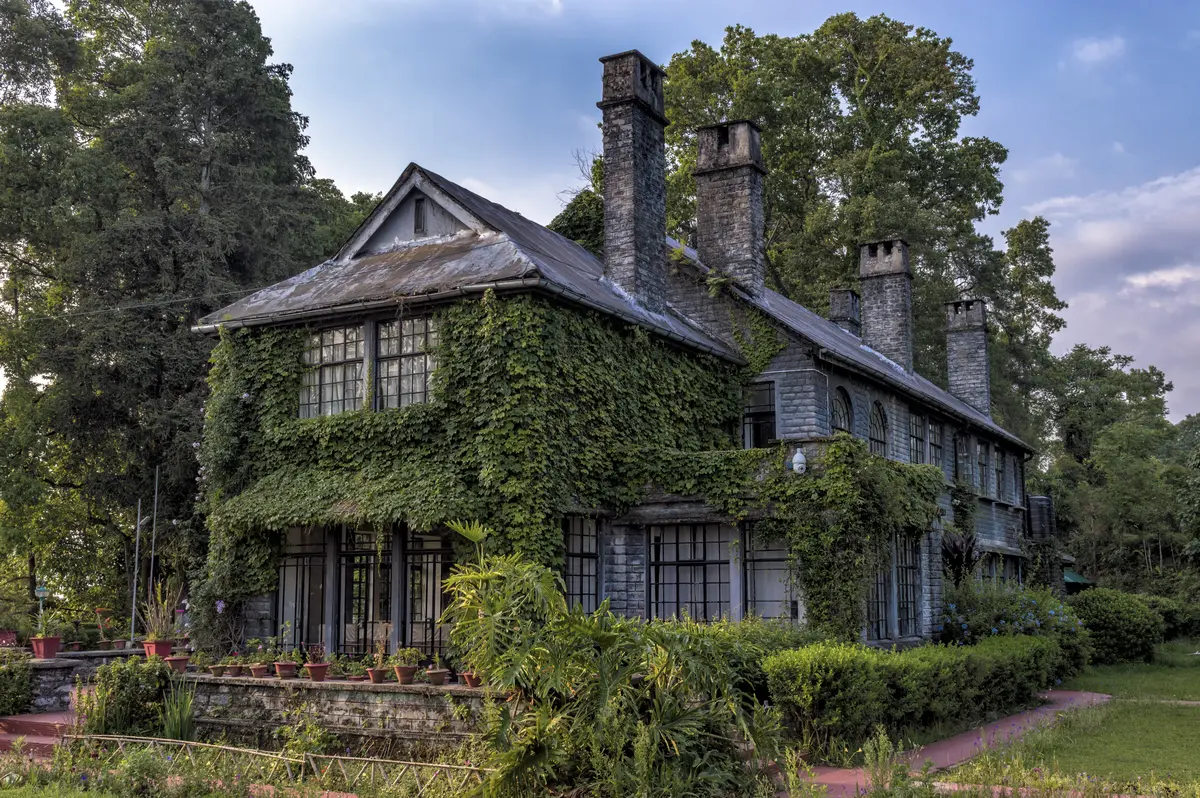
Morgan House is a grey stone bungalow, clad in ivy and set on sixteen acres of the Durpin ridge above Kalimpong, in the Himalayan foothills of West Bengal.
Where is Morgan House, Kalimpong?
- Location
- Kalimpong, West Bengal, India
- Type
- Hotel / inn
- Coordinates
- 27.045, 88.461
- Last updated
LOCATION
Why is Morgan House, Kalimpong said to be haunted?
An English jute merchant named George Morgan built it around 1930; since the mid-1960s it has belonged to the state, and the West Bengal Tourism Development Corporation still rents its rooms, from about 2,200 rupees a night. In the Indian travel press it is also a fixture of every list of the country's haunted hotels, always for the same figure - "Mrs Morgan", or "Lady Morgan" - and always for the same sound: heels on a wooden floor. That reputation is younger than the house makes it look. Three long features written about the place between 2004 and 2013, two of them by writers who stayed there, do not contain the word ghost; the oldest printed claim that can be dated is from August 2015. And in 2024 the lodge's own assistant manager told The Telegraph's t2 what she thinks the footsteps are: staff doing the night rounds, on floors and stairs made of wood.
What is the history of Morgan House, Kalimpong?
Kalimpong sits on a ridge between two hills, Deolo and Durpin, with the Teesta river in the valley below. On one of the commanding heights of Durpin, three kilometres out of town and inside what is today the army cantonment, an English jute merchant called George Morgan built himself a house at the beginning of the 1930s.
Two pieces of local journalism written seven months apart in 2004 are the closest thing to a first-hand account of what it was for. On 30 March 2004 The Telegraph of Calcutta reported that the house had been "built in the early thirties by jute baron George Morgan" and that "it passed into the hands of trustees after Morgan and his wife passed away". A longer feature by Mira Rahman, published in the Dhaka weekly Holiday on Friday 10 December 2004 and still hanging framed on the wall of the Morgan House lounge, adds the occasion: "It was built around 1930 to commemorate the wedding of the daughter of an Indigo owner with a jute baron Mr. Morgan. Since the couple died without heir, it was handed over to a Trustee Board and eventually given over to the Government of India and then to the West Bengal Government and was turned into a tourist lodge." Wikipedia's article on the house cites a photograph of that very clipping and then garbles the sentence into a wedding "of an indigo plantation owner with a jute baron", losing the daughter; it has carried a citation-needed tag since January 2018.
Rahman also measured the place: sixteen acres, three kilometres off the centre of Kalimpong, facing the Kangchenjunga range, in a quarter called Chandralok, "meaning the land of moon". And she described the fabric of the building, which matters later on: a "thick rectangular stone block wall to resist outside change of weather", with "wooden floors and steel-framed glass-paned windows".
On 1 September 2013 The Telegraph printed a stay-over piece contributed by a reader, Ayan Ghosh: "Built in the 1930s for a jute baron and his young wife, the six-bedroom house was designed for large parties." He describes a grey ivy-covered block with its original casement windows, which he compares to a Victorian rectory in the home counties. Bells in every room; French windows off the drawing room and the study; the master bedroom directly above the drawing room.
"After Independence, it was refurbished to receive Jawaharlal Nehru in 1962", the 2013 report says, and the prime minister never came. Nehru died on 27 May 1964, two years after the house had been got ready for him, and the framed 2004 clipping still points at what was left: "The empty flag post is still there, reminiscent of a past when the ailing Prime Minister of India Pandit Jawaharlal Nehru decided to spend a few days there to recuperate but could not make it due to sudden death." The flagpole is visible on the terrace in the photograph at the top of this file.
The state took the house instead. The tourism department took possession in 1965 and the West Bengal Tourism Development Corporation ten years later, in 1975; for years the signboard read Singamari or Durpin Tourist Lodge. What the state inherited with it was a guest list: Nargis, Sunil Dutt, Uttam Kumar, Supriya Devi, Om Prakash, Kishore Kumar and his son Amit Kumar, Utpal Dutt as a regular for many summers, and the American ambassador Chester Bowles. Their handwritten notes still hang framed in the lounge, and they are the reason for the sourest line in the 2004 Telegraph report: "Tourists complain about the rundown condition, especially after they see the list of celebrities who have stayed here", said the manager, Anil Gurung, who added that he had sent proposals for maintenance and received no reply. The paper counted fifteen years without repairs, and the newest thing it could find on the property was the garden wiring put up in 1998.
The house next door belongs to the story too. Tashiding was acquired by Raja Sonam Topgay Dorji, who married a daughter of the Maharaja of Sikkim, and passed to their eldest son Jigme Palden Dorji, the first prime minister of Bhutan, who kept it until he was assassinated at Phuntsholing on 6 April 1964. West Bengal acquired the property around 1980. Today the tourism corporation rents it as the Morgan House Annex. The Telegraph reported in 2013 that Sandip Ray's Brown Saheber Bari, a Satyajit Ray ghost story about a British gentleman's cottage, had been shot in Tashiding, and in 2024 t2 wrote that Bhooter Bhobishyot was filmed "in a separate wing but in the same compound".
Timeline: the documented record of Morgan House, Kalimpong
- c. 1930 George Morgan, an English jute merchant, builds a two-storey stone house on sixteen acres at Chandralok, on the Durpin ridge above Kalimpong. The Dhaka weekly Holiday, in 2004, says it went up "to commemorate the wedding of the daughter of an Indigo owner with a jute baron Mr. Morgan".
- 1962 The house is refurbished to receive Jawaharlal Nehru, who is ill and meant to convalesce there. He never comes; he dies on 27 May 1964, and the plan to make Morgan House a government rest house is abandoned.
- 6 April 1964 Jigme Palden Dorji, first prime minister of Bhutan and owner of Tashiding, the property next door, is assassinated at Phuntsholing. West Bengal acquires Tashiding around 1980; today it is rented as the Morgan House Annex.
- 1965 and 1975 The West Bengal tourism department takes possession of the house in 1965 and hands it ten years later to the West Bengal Tourism Development Corporation. For years the signboard reads Singamari or Durpin Tourist Lodge, not Morgan House.
- 30 March 2004 The Telegraph of Calcutta reports the house falling apart under "Neglect haunts heritage house": no maintenance for fifteen years, cracked walls, grubby carpets. Manager Anil Gurung says his repair proposals have gone unanswered. The word ghost does not appear; the only "haunting" is the neglect.
- 10 December 2004 Mira Rahman publishes "Far from the maddening crowd" in the Dhaka weekly Holiday after a sixteen-day stay: the wedding, the sixteen acres, Nehru's empty flagpost, the wooden floors and steel-framed windows, the celebrity guest book. No ghost in the whole page. The clipping still hangs framed in the lounge.
- 21 December 2012 Sandip Ray's anthology Jekhane Bhooter Bhoy opens in Kolkata. One of its three episodes is Satyajit Ray's ghost story Brown Saheber Bari, about a British gentleman's cottage; The Telegraph reports the following year that it was shot in Tashiding, inside the Morgan House compound.
- 1 September 2013 The Telegraph runs a stay-over feature by reader Ayan Ghosh: six bedrooms, bells in every room, the Nehru refurbishment, the Dorjis next door, the film shoot. Morgan is named ten times; ghost, haunt and spirit not once.
- August and 27 November 2015 The oldest datable printed claim that the house is haunted: a Kolkata directory blog offers "the tale of the scorned British lady (Mrs. Morgan)" with no witness or date. Three months later India Today puts it in the national press, adding the detail the story has kept ever since - "voices of someone walking in high-heels in the wooden passage".
- 26 June 2017 At 16:54 UTC the article's own creator adds Morgan House to the English Wikipedia's List of reportedly haunted locations in India; at 17:11 UTC, in a single 86-byte edit with no edit summary, he adds the categories "Reportedly haunted locations in India" and "Superstitions of India" to the article. The article's body has never contained the word ghost.
- 25 August 2024 t2 (The Telegraph) publishes a reported piece that puts the question to the lodge's own staff. Assistant manager Chunku Lama calls the stories "baseless" and explains the footsteps as staff on their night rounds over wooden floors and stairs; the staff blame the film shoots and viral Reels for the reputation, and say Mrs Morgan died of natural causes in hospital in Darjeeling in 1964.
- 18 June 2025 A Wikipedia editor deletes the article's single haunted sentence together with its blog and listicle references, as "unreliable and promotional blogspam". The two categories are left in place with nothing beneath them - and that orphaned label is what put this file in our catalogue thirteen months later.
Is there a rational explanation for Morgan House, Kalimpong?
The ghost of Morgan House is not old, and the people who work there say so on the record.
The oldest datable printed claim that the house is haunted is from August 2015, on a Kolkata directory blog, Kolkata Bengal Information, which offered "the tale of the scorned British lady (Mrs. Morgan) who is said to haunt unknowing tourists" with no witness, no date and no source, and linked to the state booking page in the same breath. Three months later, on 27 November 2015, India Today made it national: Arushi Chaturvedi wrote that Morgan "lived there till the death of Lady Morgan" and that "locals claim to have heard voices of someone walking in high-heels in the wooden passage". Everything the story is famous for is already there, and nothing else is.
What is not there is any earlier trace. Three long features about this house, written by people who had been inside it, contain no ghost at all. The Telegraph of 30 March 2004 runs to some 2,900 characters about the building, its decay and its guests: ghost, spirit, apparition, spook and paranormal appear zero times; haunt appears twice, in the headline "Neglect haunts heritage house" and in the picture caption "Neglect haunts Morgan house", both about the state of the roof. Control terms in the same text: Morgan 7, WBTDC 2, jute 1, Nehru 1. The Holiday feature of 10 December 2004, read in full off the framed clipping in the lounge, does not mention a ghost either, and its author stayed sixteen days. The Telegraph piece of 1 September 2013 gives Morgan 10 times and ghost, haunt and spirit zero.
The staff's own explanation is mechanical and it fits the building described in 2004. Chunku Lama, assistant manager, told t2 (The Telegraph) on 25 August 2024: "These are baseless. Tourists would often question the creaking sounds heard at night and attribute those to supernatural activities. While in reality, the on-duty staff members would make their rounds to close the windows, turn off the corridor lights and ensure that the property is secure at night." And: "The floors and stairs are made of wood, so it's natural to hear the echoes of footsteps all over the house located in such an isolated area." A guest attendant, Subhankar Sarkar, adds the sightings: "It's all about misperceptions or the play of light and shadow at night... someone must have spotted one of the staff members standing or doing some chores here and there in the property." A former employee who worked there from 1983 to 1987 and again from 2003 to 2008 said he had slept alone in the house on many night shifts: "No spirits ever came to say 'Hello' to me."
In the same report the staff name a cause that can be dated: the films. Morgan House and its annex have been used as a backdrop for horror and suspense shoots, and "the staff members believe that the eerie atmosphere created by these films has largely fuelled the common notion that the house is haunted". One of those shoots can be pinned down. On 1 September 2013 The Telegraph reported that Sandip Ray's Brown Saheber Bari - the Satyajit Ray ghost story about a British gentleman's cottage, filmed as one of the three episodes of the anthology Jekhane Bhooter Bhoy, released on 21 December 2012 - had been shot in Tashiding, in the Morgan House compound. Two and a half years later the ghost is in print. The dates run in the order the staff's explanation needs, shoot first and printed ghost second; the explanation is theirs, and the 2024 report gives it as their belief. The 2024 report adds a second, current engine: tourists who "come here, have their faces and hands painted in eerie colours and record Reels" that then go viral.
The story has also grown, which is the signature of a legend without an anchor. In 2015 Mrs Morgan is a scorned lady and a sound of heels. In June 2016 a Quora answer reprinted by a ghost blog turns Morgan into a nineteenth-century tea planter, gives the ghost the local name memsahib, and adds moans, shrieks and a face in a bathroom mirror. By 17 March 2022 a lifestyle site has her hanged or tortured to death in a sealed room, with laughter, weeping, singing and screaming, and Bibles handed out to guests. None of the added detail has a source, and the versions contradict each other about the one fact that would matter: how and when she died. The 2024 t2 report, which put the question to the lodge's own staff, says the opposite of all of them - that Morgan died in the early 1960s, that his wife outlived him in the house and died of natural causes at the district hospital in Darjeeling in 1964, and that the tourism department took possession in 1965. "Mrs Morgan died a natural death, that too, in a hospital and not here," the assistant manager said. The report attributes those dates to unnamed "sources" and calls her only "Mrs Morgan".
Two last measurements. The owner is not selling this. The West Bengal Tourism Development Corporation's booking site, consulted on 20 August 2026, lists three Morgan properties with room rates and telephone numbers and contains the words ghost, haunted and spirit zero times, with Morgan appearing 6 times and lodge 10 in the same page: there is no ghost tour, no night trail, no Halloween package. And the encyclopaedia entry that classifies the place as haunted has never said so in its own text. Across all 215 revisions of the English Wikipedia article, the only support the claim ever had was one sentence sourced to the 2015 blog, India Today and a travel-site listicle; an editor deleted it on 18 June 2025 as "unreliable and promotional blogspam", and the categories "Reportedly haunted locations in India" and "Superstitions of India" were left behind with nothing under them. Those two categories were added in a single 86-byte edit with no edit summary on 26 June 2017, at 17:11 UTC, by the same user who had created the article two days earlier, who had uploaded its photographs - including the one at the top of this page - and who, seventeen minutes before, at 16:54 UTC, had added Morgan House to the List of reportedly haunted locations in India. The article he wrote was trimmed twice by other editors as an advertisement for the hotel.
Can you visit Morgan House, Kalimpong?
Morgan House is run as a hotel by the West Bengal Tourism Development Corporation (WBTDCL), and a room booking is the way in. On 24 September 2026 the corporation's booking page listed three units under one lodge contact (+91 9733008776, [email protected]): Morgan House Tourism Property at 2,200-4,400 rupees per room per night, Morgan Cottages at a flat 3,200, and Tashiding (Morgan House Annex), at Chandraloke, at 1,400-3,300. The same page offers senior citizens 10 per cent off from Monday to Thursday and asks guests to "book through our official website only", adding that WBTDCL "will not be responsible for booking from any third party website". The corporation's toll-free line is 1800 212 1655 and its head office is at DG Block, Sector II, Salt Lake, Kolkata 700091; the postal address it gives for the two main units is PO Kalimpong, PIN 734301.
Mira Rahman, writing in the Dhaka weekly Holiday on 10 December 2004, placed the house on Durpindara, "now surrounded by the Kalimpong Cantonment area", three kilometres off the centre of Kalimpong, in a quarter called Chandralok that takes in the cantonment and the army golf course. A Kolkata directory page of 2015 put it "just opposite of Army Golf Club on the way to Durpin Monastery" and said that shared cars running from Kalimpong market to the monastery went past it. The Telegraph called it in March 2004 a "two-storied structure on Ring King Road", and a t2 feature of August 2024 says its floors and stairs are of wood.
Rahman's article hangs framed in the lounge, and a photograph of the frame taken on 19 May 2017 and published on Wikimedia Commons makes its text legible. It names guests who had stayed there, "Nargis, Sunil Dutt, Rajkumar, Om Prakash, Kishore Kumar, Uttam Kumar", and says that from the house the snow-capped Kangchenjunga range can be seen "from early morning till noon if the sky is clear". The corporation's booking page, read on 24 September 2026, lists the three Morgan units without using the words ghost or haunted.
Sources consulted
- Reza Pradhan, «Neglect haunts heritage house - Silver screen memories crumble with time» — The Telegraph (Calcutta), North Bengal & Sikkim, 2004 newspaper archive
- Mira Rahman, «Far from the maddening crowd (read off the clipping framed in the Morgan House lounge)» — Holiday (Dhaka), 10 December 2004, 2004 newspaper archive
- Ayan Ghosh, «Next weekend you can be at ... Morgan House» — The Telegraph (Calcutta), Metro on Sunday, 2013 newspaper archive
- Arushi Chaturvedi, «Dare to stay at these haunted hotels of India?» — India Today, 2015 newspaper archive
- S. Kumar, «Morgan House, Kalimpong Sightseeing Places - Haunted House in Kalimpong» — Kolkata Bengal Information, 2015 web
- Bitan Sikdar, «The enigmatic allure of Morgan House in Kalimpong» — t2ONLINE (The Telegraph), 2024 newspaper archive
- English Wikipedia contributors, «Revision history of "Morgan House, Kalimpong" (215 revisions, 2017-2026), and of "List of reportedly haunted locations in India"» — Wikimedia Foundation, 2026 archive
- West Bengal Tourism Development Corporation Ltd, «Morgan House, Morgan Cottages and Tashiding (Morgan House Annex): tariffs and contacts, consulted 20 August 2026» — wbtdcl.com, 2026 web
- unsigned, «A night In The Haunted Morgan House - Creepy Confession (a Quora answer reprinted)» — fearandyou.in, 2016 web
- Riya Sharma, «Spend A Night In This Haunted Scottish Mansion In West Bengal» — Homegrown, 2022 web
Reviewed by V. Serrano on 2026-08-20 · How we verify our content
💬 Field testimonies (0)
No testimonies yet. Add the first.
Add your testimony
🔒 Log in to add a testimony