👻 HAUNTED PLACE · EXP. Nº9474
ACTIVE
Shaniwar Wada
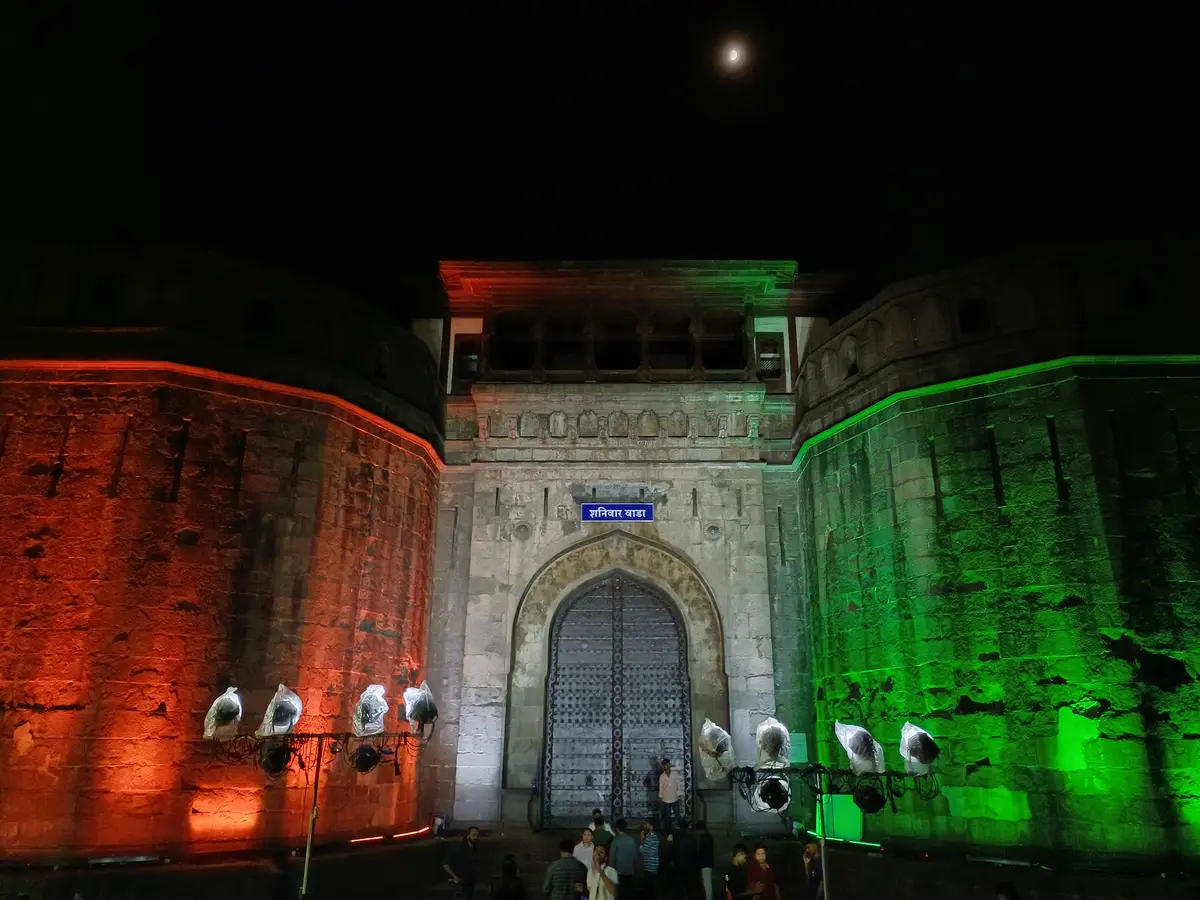
Shaniwar Wada in Pune is not a fort but the walled enclosure of a vanished palace: the seat of the Peshwas of the Maratha confederacy, founded by Baji Rao I on a Saturday — hence the name, "Saturday house" — and inaugurated in 1732.
Where is Shaniwar Wada?
- Location
- Pune, Maharashtra, India
- Type
- Fort / battlefield
- Coordinates
- 18.519, 73.855
- Last updated
LOCATION
Why is Shaniwar Wada said to be haunted?
On 30 August 1773 the young Peshwa Narayanrao was killed inside it, and the documented version is worse than the one usually told. No order was misheard. Mutinous Gardi infantry led by Sumer Singh came in through an unfinished door; Narayanrao ran to his uncle Raghunathrao, begged him to save him, and was cut down with an unarmed servant, Chapaji Telekar, who had run in to shield him. Six weeks later the judge Ram Shastri Prabhune recovered the written order: the word dharawe, seize, had been altered to marawe, kill. Who altered it was never proved. The palace burned in 1828 — on a date most sources get wrong — and only the ramparts and gates remain. As for the cry heard on full moon nights: the appeal for help is in the record of 1826; the ghost is not, and its arrival can be dated.
What is the history of Shaniwar Wada?
Shaniwar Wada is not a fort, and never was one. Wada is the Marathi word for a large courtyard mansion, and Shaniwar Wada means, literally, "Saturday house": Peshwa Baji Rao I laid the foundation of his residence on a Saturday, and the ward of Pune around it carries the same name. What a visitor walks into today — a rectangle of wall with bastions and five gateways, enclosing lawns and stone plinths — is the fortification his descendants wrapped around that mansion. The mansion itself has not existed since 1828.
The dates deserve a pause, because they only work in one calendar. The foundation is dated 10 January 1730 and the opening ceremony 22 January 1732, and both are described in every account as Saturdays. Read as Gregorian dates, both are Tuesdays. Read as Old Style (Julian) dates — the reckoning British India still used, since Britain did not adopt the Gregorian calendar until 1752 — both are Saturdays, and their Gregorian equivalents are 21 January 1730 and 2 February 1732. Since the building is named after the day of the week, the Old Style reading is the one that keeps the tradition self-consistent. The reported cost was Rs 16,110.
The 1885 Gazetteer of the Bombay Presidency adds a detail that explains the most-repeated fact about the place. Chhatrapati Shahu, of whom the Peshwa was still formally the servant, told Baji Rao not to put his main entrance on the north side, because facing Delhi meant war with the Mughal capital. Work on the gate stopped, and it was not finished until after Shahu's death in 1749, by the third Peshwa, Balaji Bajirao. That gate is the Delhi Darwaza, and its huge teak door is still set with iron spikes to turn a charging elephant.
Inside the wall stood a six-storey timber-and-stone palace organised around four large courts and several smaller ones, each named for its function — the granary court, the dairy court, the kitchen court, the sweetmeat court — and a series of halls named for their decoration: the Arse Mahal lined with mirrors, the Hastidanti Divankhana with an ivory ceiling, the Nach Divankhana for dancing, the Kacheri Divankhana where ministers and foreign agents were received, and a Narayanrao's Mahal built specially for the young Peshwa who would be killed in the building. There was a sixteen-petal lotus fountain, the Hazari Karanje, and iron chains hung down the walls to carry off lightning. In 1755 stone towers were raised over the gateways; in 1788 the granary court was rebuilt under Nana Fadnavis.
The murder, 30 August 1773. The version our own file used to carry — that guards misheard a shouted order — is wrong, and the documented version is a great deal worse. James Grant Duff, who wrote from Maratha manuscripts and from the report of Thomas Mostyn, the East India Company's envoy resident in Poona at the time, sets it out in his History of the Mahrattas (1826). That morning the Peshwa's regular infantry, the Gardis, were in uproar over arrears of pay. Narayanrao told Haripant Phadke to secure the palace before he went in to dine; Haripant went off to eat with a friend instead. At about two in the afternoon the infantry, led by Sumer Singh and Muhammad Yusuf, came in — not by the open north gate but through an unfinished doorway on the east side, opened shortly before precisely so that the household would have an entrance separate from the quarters where Narayanrao's uncle Raghunathrao was being held. Kharag Singh, who commanded the palace guard, joined them.
Woken by the noise, Narayanrao ran to his uncle's apartments, threw himself into Raghunathrao's arms and called on him to save him. Raghunathrao did ask them to spare him. "I have not gone thus far to ensure my own destruction," Sumer Singh answered; "let him go, or you shall die with him." Raghunathrao pulled free and got out onto the terrace. Narayanrao tried to follow and Tulaji Pawar, an armed household servant of Raghunathrao's, seized him by the legs and brought him down. At that instant one of Narayanrao's own servants, Chapaji Telekar, ran unarmed into the room; his master clung to his neck, and Sumer Singh and Tulaji Pawar killed them both with their swords. Chapaji Telekar has been quietly dropped from almost every retelling of this story, including ours. He should not be. Trimbakrao Mama carried the body out that night and performed the funeral.
The trial, and the word that was changed. Raghunathrao was suspected but there was no proof; the ministers, with the chief justice Ram Shastri Prabhune consulted and not objecting, accepted him as Peshwa while Ram Shastri investigated. About six weeks later the Shastri recovered the original written order sent to Sumer Singh and Muhammad Yusuf. Raghunathrao admitted he had written it, but insisted it had authorised them to seize his nephew, not to kill him — and examination of the paper bore him out: the word dharawe (seize) had been altered to marawe (kill). Grant Duff records the recovered document as fact and the culprit as opinion: "It is universally believed that the alteration was made by the infamous Anandibai." Believed, not proved. Asked what atonement he could make, Raghunathrao was told: "The sacrifice of your own life… neither you nor your government can prosper; and for my own part I will neither accept of employment nor enter Poona, whilst you preside in the administration." Ram Shastri kept his word and retired to a village near Wai. The sentence was never carried out. Tulaji Pawar was executed for the murder years afterwards, by Nana Fadnavis. Of Narayanrao himself Grant Duff wrote that he was killed "in the eighteenth year of his age" — seventeen or, by the birth date of 10 August 1755 usually given today, eighteen years and twenty days. Not the sixteen that popular retellings often print.
Two more deaths and a fire. In 1795 the seventh Peshwa, Madhavrao II, went off the top floor of the same building onto one of the fountains, broke both legs and died two days later; the gazetteer records it as a deliberate act. In 1811 an upper hall built by the last Peshwa burned down. In June 1818 Bajirao II surrendered his throne to Sir John Malcolm of the East India Company and went into exile at Bithoor, near Kanpur, and the palace passed to the British.
And then the fire — on a date worth checking. Almost every source, ours included, says the fire began on 27 February 1828 and burned for seven days. The oldest detailed account, the 1885 gazetteer, says something else: the palace caught fire on Thursday the bright sixth of Phalgun and "continued burning about a fortnight". The arithmetic decides it. 27 February 1828 was a Wednesday. The bright sixth of Phalgun that year fell on 20–21 February 1828, and 21 February 1828 was a Thursday. Almost the whole palace went; among the parts saved was the Mirror Hall, which was pulled down later. By 1885 the enclosure held the reserve force of the Poona city police, the hall over the Delhi gate was a record room, and the vegetable market that still trades there, the Mandai, had been laid out around the walls.
Timeline: the documented record of Shaniwar Wada
- 10 January 1730 (Old Style) Peshwa Baji Rao I lays the foundation of his residence in Pune on a Saturday, which is where the name comes from: Shaniwar Wada, "Saturday house". The date is Old Style; its Gregorian equivalent is 21 January 1730, and only the Old Style reading actually falls on a Saturday.
- 22 January 1732 (Old Style) The wada is inaugurated with Hindu rites, again on a Saturday. The reported cost is Rs 16,110. Chhatrapati Shahu forbids a north-facing main gate — facing Delhi meant war with the Mughals — and the Delhi Darwaza is only finished after his death in 1749.
- 30 August 1773 The Gardi infantry, in uproar over arrears of pay and led by Sumer Singh and Muhammad Yusuf, enter through an unfinished east doorway. Narayanrao runs to his uncle Raghunathrao and begs him to save him; Tulaji Pawar seizes him by the legs, and he and his unarmed servant Chapaji Telekar are cut down together. Grant Duff, writing from Maratha manuscripts and the report of the British envoy Thomas Mostyn, is the source.
- October 1773 About six weeks after the murder, the chief justice Ram Shastri Prabhune recovers the original written order. Raghunathrao admits writing it but says it authorised a seizure; the paper shows the word dharawe (seize) altered to marawe (kill). Grant Duff records the document as established and the author of the alteration — "universally believed" to be Anandibai — as opinion. Ram Shastri demands Raghunathrao's life in atonement, is refused, and retires near Wai.
- 1795 The seventh Peshwa, Madhavrao II, goes off the top floor of the palace onto one of the courtyard fountains, breaks both legs and dies two days later. The 1885 gazetteer records it as a deliberate act. It is the second violent death of a Peshwa inside this building, and almost no retelling of the haunting mentions it.
- June 1818 Bajirao II surrenders his throne to Sir John Malcolm of the East India Company and goes into exile at Bithoor, near Kanpur. The wada ceases to be the seat of the Maratha confederacy and passes into British hands.
- February 1828 Fire destroys almost the whole palace. The oldest detailed account, the 1885 gazetteer, dates it to "Thursday the bright sixth of Phalgun" and says it burned about a fortnight — that is 20-21 February 1828, and 21 February was indeed a Thursday. The date repeated everywhere, 27 February 1828 with a seven-day fire, was a Wednesday and has no source older than an unsigned edit of 2005.
- 1885 The Gazetteer of the Bombay Presidency describes the ruin in detail: the enclosure now houses the reserve force of the Poona city police, the hall over the Delhi gate is a record room, and the Mandai market has been laid out around the walls. The same volume prints pages on ghosts, spirits and Vetal's full-moon midnight procession — and not one word about Narayanrao's ghost.
- 1909 Krushnaji Prabhakar Khadilkar stages Bhaubandaki ("Family Feud"), written against the background of Tilak's deportation and carrying, in the Maharashtra gazetteer's phrase, "faint echoes of Macbeth". It fixes Anandibai in the public mind as the sole author of the murder — a step Grant Duff had declined to take.
- 1944 The Prabhat Film Company releases Ramshastri, with Gajanan Jagirdar as the judge and Lalita Pawar as Anandibai. It carries Khadilkar's version of the murder to a mass audience across Maharashtra.
- 9 June 2005 An unsourced edit to the English Wikipedia introduces the wording that our own file inherited: "an unexplained fire", started "on 27th February 1828", which "raged for seven days". None of it carries a citation, then or since.
- 4 June 2009 An anonymous IP adds the ghost to the same article, in one unsourced sentence: the spirit of Narayanrao "can be seen sometimes shouting kaka mala vachva". This is the oldest dated appearance of the haunting we have been able to fix. There is no full moon in it.
- 21 July 2015 The full-moon version arrives: the ghost "still calls for help on full moon nights", sourced to a Zee News top-ten slideshow, a Rediff travel piece published two days earlier and a Sakal Times Halloween feature of 31 October 2011 — the oldest printed mention anyone has attached to the claim.
- 5 June 2016 The sound-and-light show is inaugurated: laser and video projected onto a water screen of vertical jets, with LED washes on the ramparts. It is the only authorised way to be at Shaniwar Wada after dark, and it is watched from the forecourt.
- 29 September 2024 Mandai station opens on the Purple Line of the Pune Metro, under a kilometre from the Delhi Darwaza through the market; it is renamed Mahatma Phule Mandai in December 2025. It is now the easiest way to reach the monument.
Is there a rational explanation for Shaniwar Wada?
The cry is real. The ghost is recent, and its arrival can be dated almost to the day.
Start with what the near-contemporary record says. Grant Duff, writing in 1826 from Maratha manuscripts and the British envoy's report, states plainly that Narayanrao "threw himself into his uncle's arms, and called on him to save him". The appeal for help is history. The Marathi words attached to it — "Kaka mala vachva", uncle save me — are the natural rendering of that sentence, and no one needs a ghost to explain them.
Now the negative, with its control. The Gazetteer of the Bombay Presidency: Poona, published in 1885, gives the Shanvar Palace a long, affectionate entry: the hare that turned on the dog and decided the site, the live Mang said to have been buried in the foundations, the mason who secretly built a water duct and was rewarded with a village. It is not a source that is shy of local legend. Nor is it shy of ghosts: across the same volume "ghost" appears six times and "spirit" twenty-six, including a full page on Vetal, the Ghost King, who twice a month, "at midnight on the full-moon and on the no-moon", passes through the Deccan in ghostly state followed by crowds of bhuts and pishachs with torches. A gazetteer that will print a full-moon spectral procession, and that describes the palace where the murder happened room by room, says nothing whatsoever about Narayanrao's ghost or about a cry. That is the control, and the silence it produces is meaningful.
The English Wikipedia article — the ancestor of nearly every English retelling, ours included — makes the rest of the timeline exact, because its revision history is a dated public record:
- 9 June 2005. An editor adds, without a source, that "an unexplained fire" gutted the palace, that "the conflagration started on 27th February 1828 and raged for seven days". Every one of those words, including the ones that were in our own file, descends from this single unsourced edit. No ghost yet.
- 4 June 2009. An anonymous IP adds one unsourced sentence: "Common legend goes that the ghost of Narayan Rao peshwa who was murdered here can be seen sometimes shouting kaka mala vachva". The ghost is seen, and there is no full moon in it.
- 21 July 2015. A named editor adds the sentence in its familiar form — the ghost "still calls for help on full moon nights", and "various people, working around the area, have reported such cries" — and attaches sources: a Zee News slideshow, "Top 10 most haunted places in India"; a Rediff travel piece, "Pune and its ghosts", published two days earlier; and a Sakal Times feature, "Going ghost hunting", by Huned Contractor, dated 31 October 2011 — Halloween. That 2011 feature is the oldest printed mention anyone has attached to the claim. I could not retrieve its text, so I offer it as the earliest citation on the record rather than as something I have read.
So the full-moon detail — the single element that turns a sad story into a haunting with a schedule — enters the English-language record through a listicle, and reaches Wikipedia in July 2015.
The literary vector is older, and it is not about ghosts. In 1909 the playwright Krushnaji Prabhakar Khadilkar staged Bhaubandaki ("Family Feud"), which the Maharashtra State Gazetteer's own history of Marathi theatre describes as one of the most powerful plays in the language, written against the background of Tilak's deportation and carrying "faint echoes of Macbeth". Its lasting achievement was to fix Anandibai in the public mind as the sole author of the murder — a Lady Macbeth for the Maratha stage — where Grant Duff had recorded her guilt as universal belief and not as proof. The 1944 Prabhat film Ramshastri, with Lalita Pawar as Anandibai, carried that version to a mass audience. The popular story of Shaniwar Wada is downstream of a play, not of an archive.
Two physical facts finish the case, and neither requires anyone to be called a liar. First, the building where Narayanrao died has not existed since 1828. He was killed inside his uncle's apartments on an upper floor of a six-storey wooden palace; the sound is supposed to come from a lawn. Second, the monument closes before dark and there is no public access at night. Nobody is standing inside Shaniwar Wada on a full moon night, because the ASI does not let them. The people credited with the reports are, in Wikipedia's own wording, "working around the area" — that is, outside the wall, in the Mandai, one of the busiest market districts in Pune.
None of that makes the place less worth the visit. It makes the boy's actual last minutes — the mutiny over pay, the unfinished door, the servant who ran in unarmed and died with him, the altered word on a sheet of paper — the better story, and the true one.
Can you visit Shaniwar Wada?
Shaniwar Wada stands on Shivaji Road in the old city of Pune, where Kasba Peth meets Shaniwar Peth. It is a Centrally Protected Monument of the Archaeological Survey of India, carried in the ASI's own schedule under the flat title "Old citadel known as Shanwar Wada".
Three metro stations lie within walking distance. Measured in a straight line from the enclosure, PMC Bhavan on the Aqua Line is about 460 metres away; Kasba Peth on the Purple Line about 490 metres; Mahatma Phule Mandai, the station most listings name, about 690 metres. Mahatma Phule Mandai opened on 29 September 2024 as Mandai and took its present name in December 2025. The district administration puts Pune Junction railway station three to four kilometres away.
That same district administration page prints neither an opening time nor an entry fee. Travel listings give three different timetables — 08:00 to 18:30, 09:00 to 17:30, 09:30 to 17:00 — and tariffs that disagree with each other by a factor of five, none of them traceable to the ASI. All three timetables shut the enclosure before dark, which is the part that matters: no ticket on sale admits anyone here at night.
The palace is gone, and what survives is the fortified enclosure. The 1885 gazetteer counts eight bastions with five gateways, where most modern descriptions say nine bastions. The OpenStreetMap outline of the walls spans roughly 178 metres north to south by 158 metres east to west.
The five gates are where the sources part company. The 1885 gazetteer puts the Delhi Darwaza in the middle of the north wall; the elephant spikes and the nagarkhana drum chamber belong to it. It places a second, unnamed gate to the east of that one; the Ganesh and Jambhul gates in the east wall; the Mastani gate at the western end of the south wall. Modern descriptions move Mastani to the north, keep Khidki — identified with Jambhul — in the east, and call the south gate Narayan Darwaza, said to be the one Narayanrao's body was carried through. The names hold; the walls they are assigned to do not. Inside there are lawns and gravel paths; the exposed stone plinths of the vanished halls; the base of the sixteen-petal Hazari Karanje fountain. On-site interpretation is thin, and the ruins reward anyone who arrives knowing what stood where.
The evening programme is a sound-and-light presentation projected onto a water screen of vertical jets, with LED lighting on the walls. Premier World Technology installed it, and it opened on 5 June 2016. The district administration records it in the present tense: "A light and music show is conducted every day showing history of the Peshwas." The walls also serve the city: Pune Municipal Corporation ran a free light-and-sound programme, Punawadi Te Pune, at Shaniwar Wada from 19 to 24 September 2026, every evening from 7 to 10 pm.
Mahatma Phule Mandai, the city's main vegetable market, is about 690 metres to the south. Its Gothic building was begun in 1882 and inaugurated in 1886; under early British rule the open-air vegetable market was held outside Shaniwar Wada itself. The Kasba Ganpati temple, the presiding deity of the city, is a few minutes east. The Raja Dinkar Kelkar Museum, south of the market, holds the domestic objects of the world that burned here.
Sources consulted
- James Grant Duff, «A History of the Mahrattas, vol. II — el asesinato de Narayanrao (30 de agosto de 1773), la orden escrita alterada de «dharawe» a «marawe», el juicio de Ram Shastri Prabhune y la muerte de Chapaji Telekar» — Longman, Rees, Orme, Brown & Green (ed. S. M. Edwardes, Oxford University Press, 1921), pp. 4-7, 1826 book
- James M. Campbell (ed.), «Gazetteer of the Bombay Presidency, vol. XVIII: Poona — descripción del palacio de Shanvar, sus puertas y baluartes, el incendio del «jueves sexto día claro de Phalgun» que ardió «cerca de quince días», y el uso del recinto como cuartel de la reserva de policía» — Government Central Press, Bombay, 1885 book
- Archaeological Survey of India, «Centrally Protected Monuments/Sites: State-wise and Circle-wise — el monumento figura como «Old citadel known as Shanwar Wada», Pune» — Gobierno de la India, 2024 report
- Wikipedia en inglés, «Shaniwar Wada — historial de ediciones (2004-2026): rev. 14978635 del 9 de junio de 2005 introduce sin fuente «un incendio inexplicado», el 27 de febrero de 1828 y los siete días; rev. 294427070 del 4 de junio de 2009 añade el fantasma; rev. 672384029 del 21 de julio de 2015 añade «noches de luna llena»» — Historial público de revisiones, 2026 archive
- Gazetteers Department, Government of Maharashtra, «Gazetteer of India — Maharashtra State: Land and People, cap. VIII, «Marathi Theatre» — Bhaubandaki (1909) de K. P. Khadilkar, escrita al hilo de la deportación de Tilak y con «ecos tenues de Macbeth»» — Gobierno de Maharashtra, 2002 book
- Pune District Administration, «Shanivarwada — página oficial de la administración del distrito de Pune (no menciona ningún fantasma; da el incendio de 1828 y atribuye al palacio «13 plantas», cifra que no sostiene ninguna fuente antigua)» — Gobierno de Maharashtra, 2026 web
- Premier World Technology Ltd., «Sound & Light Show at Shaniwarwada, Pune — pantalla de agua, láser y LED; inaugurado el 5 de junio de 2016» — Ficha de proyecto del instalador, 2016 web
- OpenStreetMap contributors, «Shaniwar Wada — geometría del recinto y coordenadas (18,5194 / 73,8554; caja envolvente 18,5186-18,5202 / 73,8546-73,8561), etiquetado historic=fort» — OpenStreetMap / Nominatim, 2026 web
Reviewed by V. Serrano on 2026-08-13 · How we verify our content
💬 Field testimonies (0)
No testimonies yet. Add the first.
Add your testimony
🔒 Log in to add a testimony