👻 HAUNTED PLACE · EXP. Nº9474
ACTIVE
Jamali Kamali Mosque and Tomb
In 1528 a poet who wrote under the name Jamali built a mosque in the old village below the Qutb, and a room beside it to live in.
Where is Jamali Kamali Mosque and Tomb?
- Location
- Delhi, India
- Type
- Church / religious site
- Coordinates
- 28.563, 77.218
- Last updated
LOCATION
Why is Jamali Kamali Mosque and Tomb said to be haunted?
When he died on campaign in Gujarat eight years later his body was carried back and buried in that room. Beside his grave lies a second marble slab, and nobody has ever been able to say who is under it. In 1876 the surveyor Carr Stephen recorded the local answer, a brother called Kamali, and added that he could find no authority for it whatsoever; the Archaeological Survey of India still calls the occupant an unknown person. Since the twentieth century a different reading has circulated, that Kamali was Jamali's disciple and lover, and it has made the tomb a place of pilgrimage for Delhi's queer community. The site is also called one of the city's most haunted, on a chain of evidence that can be read end to end in an afternoon: a vanished television page from 2011, an unsigned newspaper listicle from 2013, and a Wikipedia category added in 2015 that carried no source and still carries none.
What is the history of Jamali Kamali Mosque and Tomb?
Jamali was a pen name. The man behind it was Shaikh Fazlullah, also known as Jalal Khan, and by the time he chose a burial place he had outlived four rulers of Delhi. The Archaeological Survey of India describes him plainly as "a saint and po[e]t who lived from Sikandar Lodi's reign to that of Humayun" — that is, from the last decades of the Lodi sultanate through Babur's conquest and into his son's reign. Carr Stephen, surveying Delhi's monuments in 1876, put it less plainly and more usefully: Jamali was "a great traveller, a man of literary fame and a poet whom kings delighted to honour", who was at the height of his reputation under Sikandar Lodi and still high in royal favour when he died.
The building dates are unusually firm for a Delhi monument. Carr Stephen gives the year of construction as 935 A.H., which he converts to 1528 and which in fact spans 15 September 1528 to 3 September 1529 — the reason modern sources write "c. 1529" and the ASI writes "about 1528-29". What Jamali built was a mosque and, beside it, a room. He lived in that room. It became his tomb only afterwards.
The death is where the record has quietly drifted. Carr Stephen gives a precise Islamic date — the 10th of Dhu al-Qa'da, 942 A.H. — and then glosses it, in brackets, as 1535. The gloss is wrong: 942 A.H. runs from July 1535 to June 1536, and the tenth of its eleventh month falls at the beginning of May 1536. The ASI's own conservation file hedges to "1535-36"; The Citizen, writing in 2016, says he "died fighting for Humayun in Gujarat in 1536". Jamali had gone south with Humayun's Gujarat campaign, which was still in the field in the spring of 1536. His body was carried back to Delhi and buried in the room he had been living in.
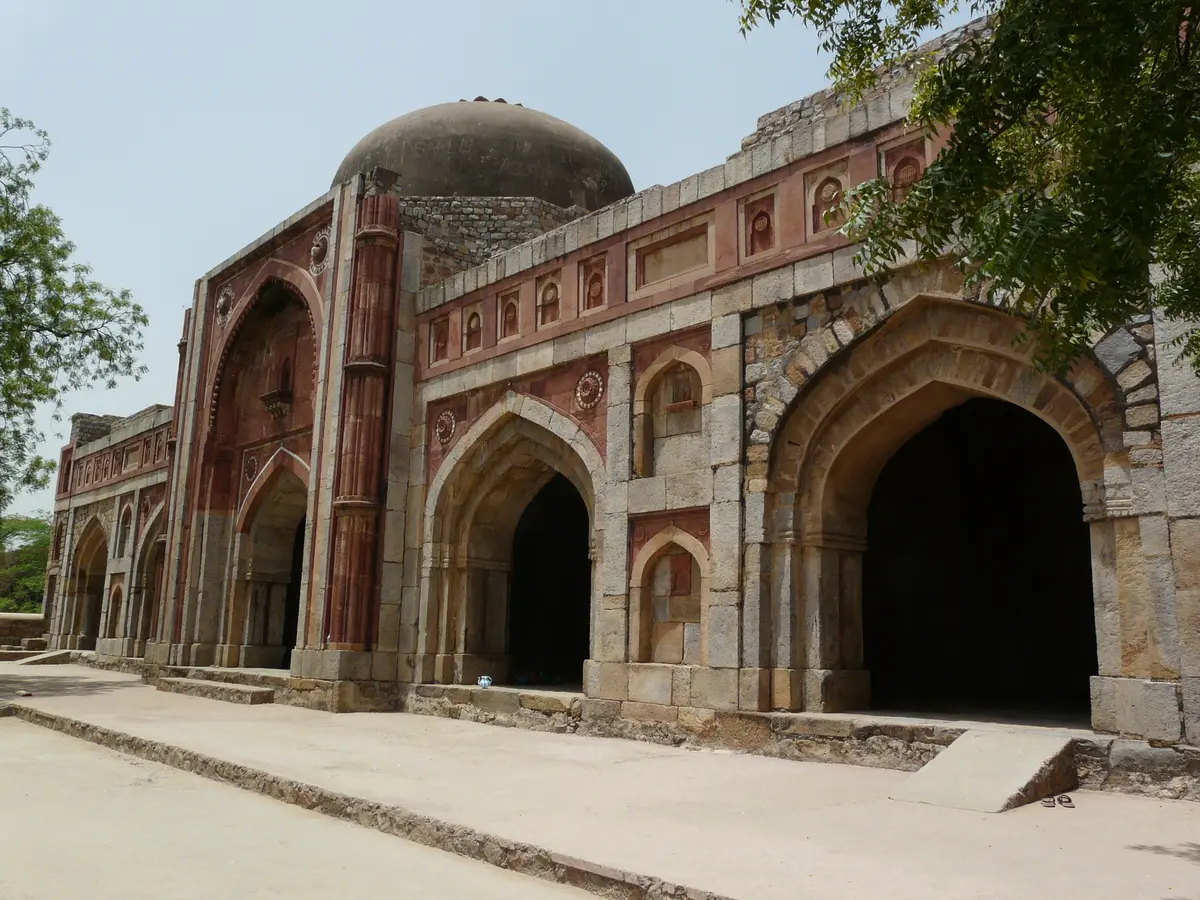
The mosque itself is a hinge in Indian architectural history rather than a curiosity. The ASI's assessment is that it "marks the transition from the Moth-Masjid to Sher Shah's mosque, with both of which it shares certain features". Carr Stephen made the same comparison a century earlier, noting that Jamali's mosque closely resembles Moth ki Masjid with one difference: one dome instead of three. It is red sandstone with marble, a prayer hall of five arches with the central one raised, recessed and flanked by fluted pilasters, Quranic inscriptions in the western niches, octagonal towers at the rear corners, pendant lotus buds below the parapet, and a narrow second-storey gallery running right around the building. The tomb next door is a small square chamber with a flat roof — no dome — whose ceiling and walls are covered in coloured tile and in verses that Jamali himself wrote.
And then there is the second grave. Two marble graves lie in that chamber, plain and uninscribed. One is Jamali's. Nobody has ever been able to document who is in the other. In 1876 Carr Stephen recorded the local answer and refused it in the same breath: the grave was "supposed to be that of one Kamali, a brother of Jamali, but for this statement I have not been able to find any authority". The ASI's file says only that the second occupant is "an unknown person" and that, because there are two graves, "the monuments go under a 'double-barrelled' name" — the plainest reading being that Kamali is simply a rhyme for Jamali. Since the twentieth century a different answer has circulated: that Kamali was Jamali's disciple and his lover, an argument built on the symbolic pen box carved on each grave and on how close together and how unusually aligned the two slabs are. That reading turned the tomb into a meeting place. The historian and author Sam Dalrymple, speaking to ThePrint in 2022, drew the line carefully: "The legend of the two lovers started in the 20th century and has been disproved many times. But the important thing is how it became a symbol for the LGBT community as a gathering point."
The complex has been under the Archaeological Survey of India as a Monument of National Importance for decades. Its most recent documented programme of works was drawn up ahead of the 2010 Commonwealth Games: two lines in an ASI proposal, ten lakh rupees for general conservation of the monuments within the complex and five for upgrading the open area around them.
Timeline: the documented record of Jamali Kamali Mosque and Tomb
- 935 A.H. (1528-29) Shaikh Fazlullah, alias Jalal Khan, writing under the pen name Jamali, builds a mosque and a room beside it in the old village of Qutb Sahib. He lives in the room; it becomes his tomb later. Carr Stephen gives the year as 935 A.H., which runs from 15 September 1528 to 3 September 1529.
- 10 Dhu al-Qa'da 942 A.H. (early May 1536) Jamali dies in Gujarat while accompanying Humayun's campaign. His body is brought back to Delhi and buried in the room he had used as a dwelling. Carr Stephen records the Islamic date and glosses it as 1535; the conversion actually falls in 1536, and the ASI's file hedges to "1535-36".
- 1876 Carr Stephen surveys the complex for his monumental catalogue of Delhi and records that the second marble grave is "supposed to be that of one Kamali, a brother of Jamali, but for this statement I have not been able to find any authority". The identity of Kamali has been undocumented ever since.
- 1885 A photograph of the mosque's main facade is taken for the Archaeological Survey of India collections and attributed to Henry Hardy Cole. The British Library, which holds it as Photo 1003/(868), notes that the attribution is probably wrong and suggests W. Caney.
- Ahead of the 2010 Commonwealth Games The ASI schedules the complex for works in its Commonwealth Games conservation proposal: ten lakh rupees for general conservation within the complex and five for upgrading the open area, fifteen in total. The document also calls Kamali "an unknown person".
- 28 October 2013 An unsigned listicle on Dainik Bhaskar's website, "Delhi's 5 most haunted locations", prints the claims that would define the site online: people slapped by invisible forces after sundown, and fakirs calling on jinns every Thursday after evening prayers. No witness, date or quotation is given.
- 21 July 2015, 07:31 UTC An editor copies the Bhaskar claims into the English Wikipedia article, citing the listicle and a 2011 television page. Eighteen seconds later the same editor files the article under "Reportedly haunted locations in India" — an edit of exactly fifty-one bytes, the length of the category line, with no source of its own.
- 27 November 2016 Indra Shekhar Singh writes up the tomb for The Citizen as a monument to queer love, describing the pen box carved on each grave and the unusual alignment of the two slabs, and quoting an unnamed Delhi heritage conservationist to that effect.
- 1 September 2018 The Hindustan Times publishes "The truth about 5 haunted places in Delhi". Govind Kumar of the Paranormal Society of India says his instruments "picked up certain vibrations" here, and elsewhere in the same article dismisses ghost names as "only stories which have been made up". The article also places the voices inside a central dome the tomb does not have.
- 14 November 2020 An anonymous editor deletes the article's entire mythology section, jinns and all, with the summary "removing pseudoscientific claims using unreliable references; does not belong in mythology". The body of the article has carried no paranormal claim since.
- 29 June 2022 In ThePrint, Sam Dalrymple sets out the position most historians hold: "The legend of the two lovers started in the 20th century and has been disproved many times. But the important thing is how it became a symbol for the LGBT community as a gathering point."
- 8 January 2025 An editor removes the djinns from the article's one-line description and leaves the haunted category in place with a question beside it, visible only in the source code: "Are there any citations to this claim?" It is still unanswered.
Is there a rational explanation for Jamali Kamali Mosque and Tomb?
The haunting has a paper trail, and it is short enough to read end to end.
The earliest citation anyone has produced is a Hindustan Times piece of 13 May 2011 filed under television and headlined "India's Most Haunted?" — a page that no longer exists and that the Internet Archive has never captured with content (five crawls, all 301 or 410). It cannot be read today by anybody, including the people who cite it.
The second and load-bearing source can be read. On 28 October 2013 Dainik Bhaskar's website ran an unsigned listicle, "Karbala graveyard to jinns of Jamali Kamali Mosque: Delhi's 5 most haunted locations". Its paragraph on the site is four sentences long: an unsettling feeling inside the tomb chamber, noises calling out from the nearby graves, and then the two concrete claims — "As the Sun goes down, people have complained of getting slapped by invisible forces. Every Thursday, after the evening prayers fakirs call upon Jinns." No witness is named. No date is given. Nobody is quoted.
On 21 July 2015, at 07:31:01 UTC, an editor copied that listicle's claims into the English Wikipedia article and cited it and the vanished television page. Eighteen seconds later, at 07:31:19, the same editor added the article to "Category:Reportedly haunted locations in India". The second edit added exactly fifty-one bytes, which is the length of that category line and a newline: the tag carried no source of its own and never has.
Wikipedia then took it apart. On 14 November 2020 an anonymous editor deleted the whole section with the summary "removing pseudoscientific claims using unreliable references; does not belong in mythology". On 8 January 2025 another editor stripped the djinns out of the article's one-line description and left the surviving category standing with an unanswered question beside it, visible only in the source code: "Are there any citations to this claim?" That comment is still there. The article's body has contained no paranormal sentence for six years.
The one piece of instrumented evidence deserves reading in full rather than in quotation. The Hindustan Times returned to the subject on 1 September 2018 under the headline "Malcha Mahal, Jamali Kamali and more: The truth about 5 haunted places in Delhi". Its named source is Govind Kumar, founder and chairman of the Paranormal Society of India, and across the article he is the sceptic: of one site he says his team went repeatedly and no spirit ever appeared; of another that his group does not classify what it detects as ghosts; and of a third, flatly, "It is people who give names like 'bhoot' or 'pret.' These are only stories which have been made up." Of this site he says only, "When we visited Jamali Kamali our instruments picked up certain vibrations there" — with a K2 EMF meter, a laser grid and a night-vision camera. The sentence that survived into Wikipedia is the one endorsement in an article whose argument runs the other way.
The same 2018 article places the voices "from the mazaar inside the central dome". The tomb chamber has no dome. Carr Stephen measured it in 1876 as a flat-roofed room and the ASI's file describes it the same way; the single dome in the complex sits over the mosque's central bay, in the other building.
What the chamber does have is acoustics. It is a small, hard, square stone box, plastered and tiled, with a flat ceiling. Time Out Delhi, describing the mosque without any interest in the supernatural, warns that "any attempts at conversation are met with echoes that can, depending on your stomach for the paranormal, start creeping you out pretty quickly", and adds of the haunting stories that "it's spooky, certainly, but we can't confirm if they're true". The graves whose voices supposedly call out are also documented: Carr Stephen recorded an open domed pavilion east of the tomb containing several graves, and The Citizen counted twelve disciples' graves in the courtyard. They are burials a few metres away, not an anomaly.
The older record is silent, and the silence has been controlled. Carr Stephen's 1876 survey runs to about 126,000 words and devotes three pages to this complex; "ghost", "haunt", "jinn" and "genii" appear zero times in the entire book, against 536 occurrences of "tomb" and 492 of "mosque". The ASI's own conservation file gives the same result: zero for all three, against 99 occurrences of "monument". The Indian government's own film-location listing for the site describes the mosque and the two graves and mentions nothing supernatural. Nor is there an obvious commercial motive here: unlike Delhi's ticketed monuments, this one charges nothing to enter, and the material circulates in newspaper listicles rather than in anybody's admission price.
Can you visit Jamali Kamali Mosque and Tomb?
The mosque and tomb stand inside the Mehrauli Archaeological Park in South Delhi, a wooded expanse of scattered monuments that is managed jointly by the Delhi Development Authority and the Archaeological Survey of India. The complex itself is an ASI-protected Monument of National Importance; the Indian government's own film-location register lists it under the ASI's Delhi Mini Circle. It sits roughly 300 metres south of Balban's tomb, and the nearest metro is Qutub Minar.
There is no ticket. Jamali Kamali is not among the monuments named in the schedules of the Ancient Monuments and Archaeological Sites and Remains Rules, 1959, which means two things at once. It is not a chargeable monument, so entry is free. And its hours are the statutory default set by rule 5(1): protected monuments not specified in the First Schedule "shall remain open from sunrise to sunset". That rule is worth stating plainly, because it is routinely reported as if it were a precaution against the site's reputation. It is not. It is the same rule that governs several thousand protected monuments across India, and it was in force long before anybody wrote about djinns here.
Published opening times disagree, and some of them are simply wrong — Time Out Delhi's listing gives "Daily. Open 24 hours" while its own review describes the tomb being shut before closing time. Treat daylight as the working answer and go in the morning.
The practical problem is the tomb chamber, which is the part worth coming for. It stands in its own walled enclosure and is normally kept locked; the key is with the ASI caretaker, who will usually open it and accompany visitors inside, but is not always to be found. Time Out puts it bluntly: the tomb "is mostly locked, sometimes before closing hours, even, so it's difficult to enter". The mosque next door is generally open, and often empty apart from a guard and a good deal of resident bat life in the vaults.
A few things to expect. The park is genuinely overgrown and the paths are informal; sturdy shoes help and so does going with company, less for supernatural reasons than because the woodland is isolated. There are no facilities at the monument itself. Photography of the tomb's painted ceiling is the reason most visitors come, and it needs the caretaker's door to be open, so it is worth asking at the gate before walking in. One point to be honest about: sources disagree on whether the mosque functions as a place of worship. English Wikipedia's infobox calls it active while its own text states the opposite, and the 2009 newspaper report it cites for that can no longer be retrieved. What is documented is that the ASI administers it as a protected monument, and that the government's film-location register treats it as a heritage site rather than a working mosque.
Sources consulted
- Carr Stephen, «The Archaeology and Monumental Remains of Delhi (pp. 171-173)» — Ludhiana Mission Press / Thacker, Spink & Co., 1876 book
- Archaeological Survey of India, «Jamali Kamali Tomb and Mosque, item 41, p. 59» — Commonwealth Games-2010: Conservation, Restoration and Upgradation of Public Amenities at Protected Monuments, 2010 report
- Government of India, «The Ancient Monuments and Archaeological Sites and Remains Rules, 1959 (rule 5)» — Archaeological Survey of India, 1959 report
- Archaeological Survey of India Collections, attributed to Henry Hardy Cole, «Close view of main facade of the Jamali Kamali Masjid, Delhi (Photo 1003/(868))» — British Library, Online Gallery, 1885 archive
- Bhaskar News (unsigned), «Karbala graveyard to jinns of Jamali Kamali Mosque: Delhi's 5 most haunted locations» — Dainik Bhaskar (daily.bhaskar.com), 2013 newspaper archive
- Kabir Singh Bhandari, «Malcha Mahal, Jamali Kamali and more: The truth about 5 haunted places in Delhi» — Hindustan Times, 2018 newspaper archive
- Indra Shekhar Singh, «#TCPride Jamali Kamali: Testimony to Love That Dared» — The Citizen, 2016 newspaper archive
- Gaurvi Narang, «Jamali Kamali, hijron ka khanqah, Sarmad's tomb - Delhi history's safe spaces for LGBTQ» — ThePrint, 2022 newspaper archive
- English Wikipedia contributors, «Revision history of the article Jamali Kamali Mosque and Tomb (revisions 672391782, 672391809, 988674468 and 1268262390)» — Wikimedia Foundation, edit history, 2025 archive
- Time Out Delhi, «Jamali Kamali Mosque and Tomb (review and visitor details)» — Time Out, 2025 web
- Government of India, India Cine Hub, «Jamali Kamali (filming location record)» — Ministry of Information and Broadcasting, 2026 web
Reviewed by V. Serrano on 2026-08-21 · How we verify our content
💬 Field testimonies (0)
No testimonies yet. Add the first.
Add your testimony
🔒 Log in to add a testimony