👻 HAUNTED PLACE · EXP. Nº9474
ACTIVE
Kuldhara
In the desert district of Jaisalmer, Rajasthan, Kuldhara is one of India's most famous abandoned villages, founded around the thirteenth century by Paliwal Brahmins who prospered there through trade, farming and their own water works, the khadin.
Where is Kuldhara?
- Location
- Jaisalmer, Rajasthan, India
- Type
- Ruin / ancient site
- Coordinates
- 26.87, 70.785
- Last updated
LOCATION
Why is Kuldhara said to be haunted?
The popular account says the inhabitants left in a single night in 1825, cursing the land, fleeing the minister Salim Singh, who wanted the headman's daughter. Contemporary sources say otherwise. James Tod, the British political agent, described the Paliwal community around 1822 — five thousand families across the state — as "nearly all in voluntary exile", the bankers not returning because the minister was holding their families; the 1909 Jaisalmer gazetteer confirms that Salim Singh drove the Paliwals out and left their villages deserted. In other words, the exodus was complete years before the famous night — and Salim Singh himself was poisoned in 1824. The date of 29 July 1825 comes from a community history published in 1998, not from any contemporary record. The site is protected today by the state Department of Archaeology and is open to visitors.
What is the history of Kuldhara?
Kuldhara is a roofless village of yellow limestone in the Thar desert, seventeen kilometres west of Jaisalmer on the road to the Sam dunes. Everyone who sells a ticket to it tells the same story, and the official page of Rajasthan Tourism tells it in exactly those words: one night in 1825 the Paliwal Brahmins of Kuldhara and eighty-three neighbouring villages walked out together, cursing the ground so that nobody could ever live there again, because the state's minister Salim Singh wanted the headman's daughter.
The striking thing is that the minister is real, the ruin is real, the ruin was caused by the minister — and almost every other element of the story is missing from the nineteenth-century record.
Start with who left. The Paliwal Brahmins take their name from Pali, in Marwar, which they held before the Rathors took Marwar at the end of the twelfth century. James Tod, the East India Company's Political Agent in the Western Rajput States from 1818 to 1822, gives the reason they came to the desert, and it is already a story about tax. During a Muslim invasion of Marwar a general war-contribution — dánd — was levied on the inhabitants; the Paliwals, being Brahmins, pleaded caste and refused. The Raja jailed their leading men. The community answered with a chándí, a mass act of ritual suicide-protest; the Raja answered that with a manifesto of banishment against every Paliwal in his dominions. Most of them crossed into Jaisalmer, where Rajasthan Tourism dates the founding of Kuldhara to 1291.
What they did there is the part the ghost tours skip. They turned a state with no perennial stream into farmland by building kharins (today usually spelled khadin): earth embankments thrown across the slope of gravelly upland so that the monsoon runoff ponds behind them, soaks the ground and is then sown with wheat or gram in the bed of the tank. Major K. D. Erskine, compiling the Jaisalmer gazetteer for the Government of India in 1909, records that the majority of the state's kharins were Paliwal work, that after the Paliwals were driven out they were entirely neglected and fell into disrepair until 1892, and that the Darbar had by then spent about Rs 82,000 putting some of them back into service.
Tod's account of their weight in the state is blunt: Next to the lordly Rajpoots, equalling them in numbers and far surpassing them in wealth, are the Palliwals. They were, he wrote, the Metayers of the desert, advancing money to cultivators against the crop and buying up the wool and clarified butter; the merchants of Jaisalmer traded abroad chiefly on Paliwal capital.
Now the villain. Salim Singh was the son of Sarup Singh, a Mahajan by caste and a Jain by religion, who had been minister to Rawal Mulraj II and was cut down in the Rawal's presence by the heir-apparent Rai Singh. Mulraj waited until the murdered favourite's son was old enough and then made him minister in his father's place. Erskine's summary of what followed is a catalogue: Zorawar Singh of Jhinjiniali, who had saved Salim Singh's life when exiled nobles captured him around 1793, was poisoned in return; Rai Singh and his wife were burned alive in their castle; their children were shut up at Ramgarh and poisoned there. Jaisalmer town, the gazetteer says, was depopulated by his cruelty. The state signed its treaty with the East India Company on 12 December 1818; on 17 December 1821 the British agent reported to his government that he considered the alliance disgraceful to our reputation, by countenancing the idea that such acts can be tolerated under its protection. In 1824 he was wounded by a Rajput; when it looked as though the wound might heal, his wife gave him poison.
And here is the documented exodus. Writing about the situation as it stood around 1822, Tod says of the Paliwals that this rich community, amounting to five thousand families, are nearly all in voluntary exile, that the bankers dared not come home with their earnings because the minister held their families as hostages, that merchants were constantly applying to the British agent for passports to get their families out, and that agriculture was almost unknown and commerce had ceased for want of security. Erskine, eighty-seven years later, closes the account: Salim Singh finally drove out the Paliwal Brahmans — whose solid well-built villages still stand, deserted, to mark an era of prosperity to which it will be difficult for the State ever again to attain. Erskine adds one detail that reads like the signature of the crime: the belief that irrigating was impious, and that one should let Providence supply the country's wants, was a superstition which was probably started by the notorious minister, Salim Singh, in order to ruin the Paliwal Brahmans.
What is not in Tod, and not in Erskine, is a girl, a single night, a curse, or the name Kuldhara. The minister's own house, however, is still there: six storeys of carved yellow limestone inside Jaisalmer town, which the 1909 gazetteer calls one of the finest buildings in the city, the house of the notorious Diwan who devastated the country about a hundred years ago with his extortions and cruelty.
Timeline: the documented record of Kuldhara
- 1291 Rajasthan Tourism dates the founding of Kuldhara by Paliwal Brahmins to this year. The 1909 Jaisalmer gazetteer is less precise: it says only that they came from Pali, in Jodhpur, in the thirteenth century.
- 13th century James Tod records why the Paliwals left Pali for the desert: a general war-contribution (dánd) was levied during a Muslim invasion of Marwar; the Paliwals pleaded caste and refused, their leaders were jailed, they answered with a mass ritual suicide-protest, and the Raja issued a manifesto of banishment against every Paliwal in his dominions. Most crossed into Jaisalmer.
- c. 1793 Salim Singh, son of the murdered minister Sarup Singh, is captured by the exiled nobles of Jaisalmer on his way back from Jodhpur and released unharmed. He repays Zorawar Singh of Jhinjiniali, who saved him, by having him poisoned. The Government of India gazetteer credits him with burning Rai Singh and his wife alive and poisoning their children at Ramgarh.
- 12 December 1818 Jaisalmer signs its treaty with the East India Company. Erskine calls it one of the last states to be taken under British protection — Tod says flatly the last — its isolation having spared it the Maratha raids. No tribute is demanded.
- 17 December 1821 The British agent reports to his government that he considers the alliance with Jaisalmer disgraceful to British reputation, for countenancing the idea that Salim Singh's acts could be tolerated under its protection. The minister responds by resuming his confiscations with redoubled severity.
- c. 1822 Tod, describing Jaisalmer as it then stood, reports the Paliwal community — five thousand families — as nearly all in voluntary exile, with the bankers afraid to return because the minister holds their relatives as hostages, merchants queueing for passports to get their families out, agriculture almost unknown and commerce stopped. This is three years before the night the legend assigns to the exodus.
- 1824 Salim Singh is wounded by a Rajput. When it appears the wound may heal, his wife gives him poison and he dies. Maharawal Gaj Singh, then twenty-three, takes over the administration in person.
- 29 July 1825 The date given for the 'great migration' from Kuldhara and 83 other villages — the full moon of Shrawan, 1882 VS. It is not a contemporary record: Bahadur, Pandya and Singh take it from Paliwal Itihas, a community history published in Jodhpur in 1998.
- 1892 The Jaisalmer Darbar begins repairing the khadin embankments, which had been entirely neglected since the Paliwals were driven out. By 1909 about Rs 82,000 has been spent and more than 500 exist, nearly 400 of them cultivable in a year of sufficient rain.
- 1909 Major K. D. Erskine's gazetteer of Jaisalmer, compiled for the Government of India, states that Salim Singh finally drove out the Paliwal Brahmans, 'whose solid well-built villages still stand, deserted, to mark an era of prosperity to which it will be difficult for the State ever again to attain'. It names no village, no girl and no curse.
- 1978 Arjun Singh Bhati, a Jaisalmer schoolteacher, dates the rediscovery of Kuldhara to this year, when tourism took off in Jaisalmer and the ruins turned out to lie on the road to the Sam dunes. Bollywood filming follows.
- 1994 The Jaisalmer Vikas Samiti is founded, a fifteen-member society for the conservation of monuments around Jaisalmer. It restores five model houses at Kuldhara to show how the Paliwal community lived.
- 20 July 2016 Gulf News publishes Chiranti Sengupta's report on Kuldhara. Gaurav Tiwari of the Indian Paranormal Society describes night campaigns producing disembodied voices, electromagnetic anomalies and a child's handprints on parked cars; in the same piece two officers of the local heritage society, who were there on those nights, say they experienced nothing at all.
- 25 January 2017 A. B. Roy, Harsh Bhu, Pankaj Sharma and Kishan Vaishnav argue in Current Science that the deserted Paliwal villages were destroyed by an earthquake rather than evacuated, citing collapsed roofs, joists and pillars in every house and the clustering of the ruins along active faults.
- 10 March 2018 Tej Bahadur, Aalok Pandya and Raghuveer Singh reply in Current Science: the recorded shocks at Jaisalmer are from 1819 and 1905, an earthquake could not have selectively hit only Paliwal villages across a 75 km radius, the walls are still in contact along whole streets, and a 1982 photograph from the Jaisalmer Fort Museum shows a Kuldhara house far better preserved than today. Roy and colleagues respond in the same issue that the exodus is 'a fabricated story'.
Is there a rational explanation for Kuldhara?
Kuldhara is a rare case where the debunking is not our invention: two teams of Indian academics fought it out in the pages of Current Science, and neither of them believes in the curse.
The dates do not line up. The single most repeated fact about Kuldhara is its date: the night of Raksha Bandhan, 1825. That precision comes from a modern source. When Tej Bahadur, Aalok Pandya and Raghuveer Singh set it down in Current Science in 2018 — the full Moon day of Shrawan month of 1882 VS, which correspond to Friday the 29th July 1825 — the authority they cite is Paliwal Itihas, a community history published by the Paliwal Sanskritik Dharohar Trust of Jodhpur in 1998, 173 years after the event. Set that against the two nineteenth-century witnesses. Tod, describing Jaisalmer as it stood around 1822, already reports the Paliwals nearly all in voluntary exile. And Salim Singh, the man whose ultimatum supposedly emptied the village, was poisoned by his wife in 1824 — the year before the night he is said to have caused.
'Overnight' is doing a lot of work. Tod's own itineraries, compiled in the same years, list Paliwal villages on the Jaisalmer roads that were still very much inhabited: Lathi with three hundred houses, Basunki-talao with a hundred, Chandan with fifty, Dholsirr with sixty. A community of five thousand families does not leave in one night; it drains away over a generation of confiscations, hostage-taking and passport applications, which is precisely what Tod describes and what Erskine, in 1909, summarises as the minister having driven out the Paliwal Brahmans. The single night is the shape a slow catastrophe takes once it becomes a story.
Nobody in the nineteenth century mentions the girl. Neither Tod, who loathed Salim Singh and itemised his murders, nor the Government of India's own gazetteer, which called him the incarnation of evil in print, says anything about a headman's daughter, a two-day ultimatum or a curse. They both say the same thing, and it is duller and worse: he took their money until there was no reason to stay.
Then there is the earthquake. In January 2017 A. B. Roy, Harsh Bhu, Pankaj Sharma and Kishan Vaishnav published a research communication in Current Science arguing that the Paliwal villages were not evacuated at all but flattened. Their evidence: collapsed roofs, fallen joists, lintels and pillars strewn inside every house, damage they compared to Latur, Bhuj and Mohenjo-Daro; the clustering of the ruined villages along active faults such as the Kanoi and the Manpiya-Ramgarh; terraced ground at Kuldhara and Khabha suggesting recent uplift. Their conclusion — there cannot be any other cause for the massive evacuation of the Paliwal villages, other than the destruction due to the incidence of earthquake — is where the paper overreaches: that is an argument from absence of imagination, not from a dated event.
And the rebuttal is better than the paper. Bahadur, Pandya and Singh answered in March 2018 with five objections that are hard to get around. The seismological record puts shocks at Jaisalmer on 16 June 1819 and 4 April 1905 — one well before the migration, one long after. An earthquake of magnitude 5-6 could not have damaged villages spread over a 75 km radius. It could not have hit only Paliwal villages while leaving the intermingled non-Paliwal villages standing. The walls at Kuldhara are still in contact with one another along whole streets, which collapse by shaking does not do. And the clincher: a file photograph from the Jaisalmer Fort Museum shows a Kuldhara house in 1982 in far better condition than today, so most of the ruin is recent — helped along, they note, by neighbours carrying off the wooden doors and window frames of an empty village. Roy and his colleagues replied in the same issue, doubling down and calling the exodus a fabricated story, which was imbibed in the folklore at a later period. The exchange has not been resolved. What it does establish is that the roofless houses are evidence of something ordinary — either seismic damage or a century and a half of scavenging and weather — and not of a curse.
The Raksha Bandhan detail collapses on inspection. Roy and his co-authors offer, as corroboration, that the Paliwal community does not celebrate Raksha Bandhan because it falls on the day the calamity struck. But Erskine's Marwar volume, published in 1909, had already recorded the same custom with a completely different cause: the Paliwals do not observe the festival of Rakhi on the full moon of the month of Sawan (July-August) because their ancestors are said to have been killed in large numbers by Muhammad Ghori on that day. Same abstention, a medieval massacre instead of a nineteenth-century flight. Either the taboo is much older than Kuldhara, or the story was later fitted to a date the community was already keeping in mourning.
The haunting is younger than the tourism. Arjun Singh Bhati, a Jaisalmer schoolteacher who grew up shutting his eyes when the bus passed the ruins, dates the site's revival to 1978, when tourism took off in Jaisalmer and Kuldhara turned out to be on the way to the Sam dunes. The paranormal layer is younger still. In 2016 Gaurav Tiwari, founder of the Indian Paranormal Society, told Gulf News that his teams' night campaigns at Kuldhara had produced disembodied whispers, screams, noises, responsive electromagnetic anomalies, temperature variations and, on one occasion, a child's handprints appearing on parked cars. In the very same article, Chandra Prakash Vyas — secretary of the Jaisalmer Vikas Samiti, the local heritage society that has restored houses in the village — said of those same nights: I cannot challenge science. I spent many nights in the village with Gaurav Tiwari but I didn't experience anything. His colleague Kamal Singh Bhati was equally flat: I have spent so many nights there but didn't see anything. Tiwari himself said the point of the trips was to dismantle the myths and get more people to visit.
Finally, the famous rule. Every account repeats that nobody can spend a night in Kuldhara. True — and it is a regulation, not a phenomenon: visitors are not allowed in the ruins after sunset. It is the same mechanism that made Bhangarh, four hundred kilometres east, the most haunted place in India: a closing time the public reads as a warning.
One correction we owe our own readers: this site previously stated flatly that roughly 1,500 residents had vanished overnight, and that the Rajasthan government had developed the site for tourism. The second half is right. The first is a legend repeated as fact, and no source we have been able to read supports either the number or the night.
Can you visit Kuldhara?
Kuldhara stands seventeen kilometres west of Jaisalmer according to the Rajasthan Tourism department, on the way out to the Sam sand dunes; the twenty kilometres quoted elsewhere is the road distance. The department's own advice is a hired taxi from Jaisalmer. There is no public transport worth planning around, and the site is a bare field of ruins with no shade and nowhere to buy a drink.
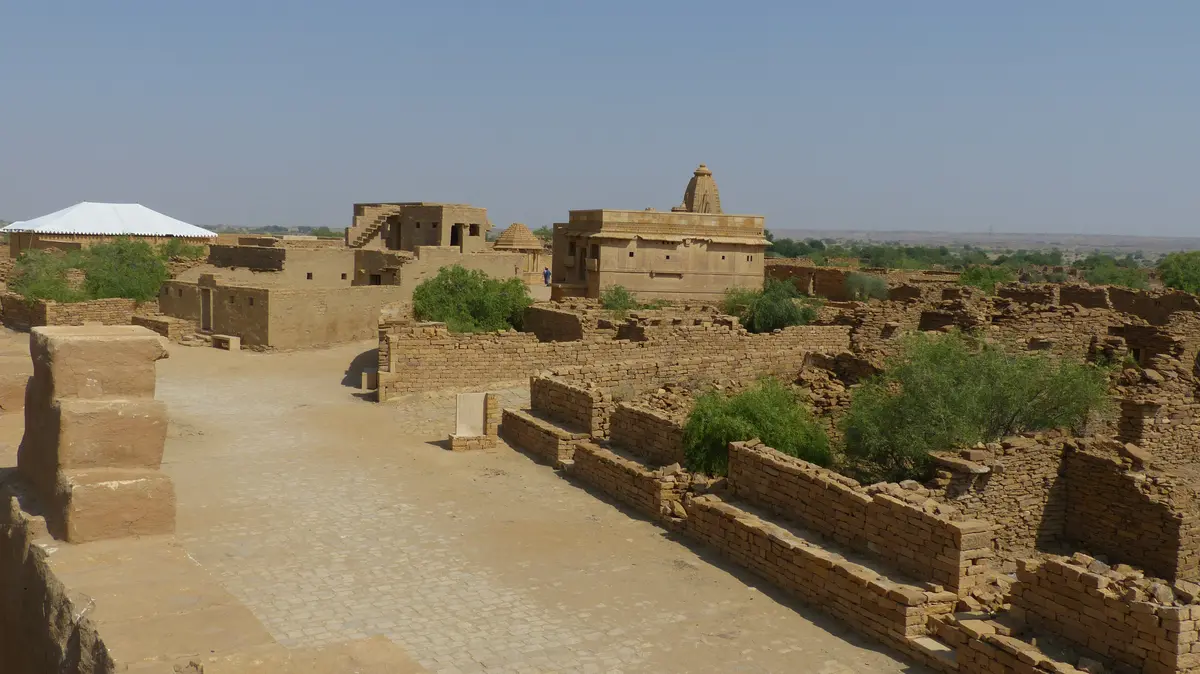
What survives is the plan of a village: parallel lanes of small stone houses with the roof timbers gone, a temple, and the wells and water works that were the reason for the settlement. The Jaisalmer Vikas Samiti, a fifteen-member local heritage society founded in 1994, has restored five model houses to show how a Paliwal household lived; its secretary Chandra Prakash Vyas described the project to Gulf News in 2016. The embankments in the surrounding low ground are the khadin system that made a Brahmin farming community prosperous in a place with no river.
Closing time is sunset, and it is enforced. Gulf News reported in 2016 that nobody is allowed to remain in the area after 6 pm or sunset, a condition imposed by tourism officials. Operators selling overnight ghost hunts at Kuldhara are selling access the site's managers do not grant.
The heat is the other constraint on the day. Kuldhara sits in the Thar, where the middle of the day from April to June is dangerous, and the yellow limestone throws the heat back off the walls.
The official Rajasthan Tourism page calls Kuldhara "a protected monument under State Archaeology Department" — the state department rather than the Archaeological Survey of India, although a great deal of what is written about the village, Gulf News included, attributes it to the ASI. No central ASI notification for Kuldhara has been traced. A small ticket is collected at the gate; as of 9 September 2026 the Rajasthan Tourism page publishes no tariff, and the figures circulating online contradict each other, so none is given here.
The minister of the Kuldhara story left a house of his own. Salim Singh ki Haveli, six storeys of carved yellow limestone, stands inside the walled town of Jaisalmer, and Erskine's 1909 gazetteer calls it one of the finest buildings in the city in the same breath as it names its owner the Diwan who "devastated the country about a hundred years ago with his extortions and cruelty".
Sources consulted
- Major K. D. Erskine, for the Government of India, «A Gazetteer of the Jaisalmer State (Rajputana Gazetteers Vol. III-A) — Salim Singh's ministry, the treaty of 1818, the expulsion of the Paliwal Brahmans, the kharins and the minister's six-storey house» — The Pioneer Press, Allahabad, 1909 archive
- Lieut.-Col. James Tod, Political Agent to the Western Rajput States 1818-1822, «Annals and Antiquities of Rajasthan, vol. II — Annals of Jaisalmer: the Paliwals' banishment from Pali, their weight in the desert economy, and the five thousand families 'nearly all in voluntary exile' around 1822» — Annals and Antiquities of Rajasthan, or the Central and Western Rajpoot States of India, 1829 book
- A. B. Roy, Harsh Bhu, Pankaj Sharma and Kishan Vaishnav, «Deserted nineteenth century Paliwal villages around Jaisalmer, western Rajasthan, India: historical evidence of palaeoseismicity» — Current Science, vol. 112, no. 2, pp. 402-405, 2017 academic
- Tej Bahadur, Aalok Pandya and Raghuveer Singh; with a reply by A. B. Roy, Harsh Bhu, Pankaj Sharma and Kishan Vaishnav, «Kuldhara devastation and the great exodus — rebuttal of the earthquake hypothesis, with the 1819/1905 seismic record, the 1982 photograph from the Jaisalmer Fort Museum, and the response by Roy et al.» — Current Science, vol. 114, no. 5, pp. 944-946, 2018 academic
- Department of Tourism, Government of Rajasthan, «Kuldhara Village History: A Haunted Village near Jaisalmer — official page: founding in 1291, the 1825 legend, and the status as a protected monument under the State Archaeology Department» — tourism.rajasthan.gov.in, 2026 web
- Chiranti Sengupta, «Kuldhara, an abandoned ghost town in India — interviews with Gaurav Tiwari (Indian Paranormal Society), Chandra Prakash Vyas and Kamal Singh Bhati (Jaisalmer Vikas Samiti) and the teacher Arjun Singh Bhati» — Gulf News (Weekend Review), Dubai, 2016 newspaper archive
- Major K. D. Erskine, for the Government of India, «Rajputana Gazetteers Vol. III-A, Marwar section — the Paliwal Brahmans of Marwar do not observe the festival of Rakhi on the full moon of Sawan because their ancestors are said to have been killed by Muhammad Ghori on that day» — The Western Rajputana States Residency and the Bikaner Agency, The Pioneer Press, Allahabad, 1909 archive
Reviewed by V. Serrano on 2026-07-31 · How we verify our content
💬 Field testimonies (0)
No testimonies yet. Add the first.
Add your testimony
🔒 Log in to add a testimony