📜 LEGEND · EXP. Nº0270
ACTIVE
The Ghost of Mae Nak Phra Khanong
The oldest line about Mae Nak that anyone has been able to point to is not a love story.
Where does the legend of The Ghost of Mae Nak Phra Khanong come from?
- Location
- Suan Luang (Phra Khanong), Bangkok, Thailand, Thailand
- Kind of legend
- Ghost story
- Coordinates
- 13.715, 100.607
- Last updated
LOCATION
What is the legend of The Ghost of Mae Nak Phra Khanong?
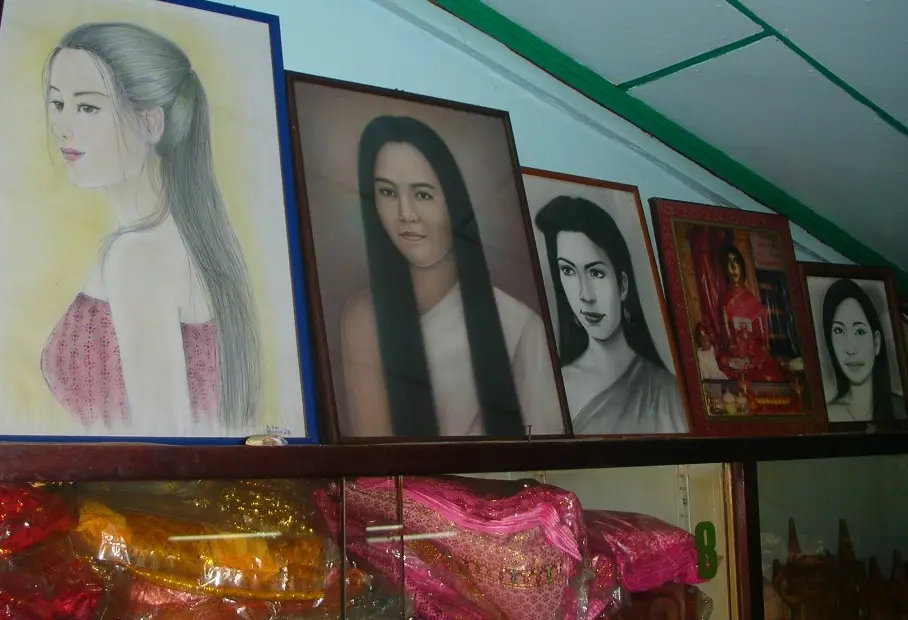
It sits inside a nineteenth-century Thai sung epic, where a ghost bows to an old ascetic and introduces herself: my name is Nak, I live at Bang Phra Khanong, the labour came on a Saturday, I died with the child still inside me, and I am a phrai. No soldier husband, no lime through the floorboards, no famous monk. Everything else arrived later and can be dated: a newspaper answer in 1900 by a writer whom a royal commission would convict a year later, over a different book, of citing texts that did not exist; a detective story by the future King Rama VI in 1904 whose plot is a faked ghost; a stage hit in 1911; the subduing monk in 1930, fifty-eight years after he died; and then roughly thirty films. Her shrine at Wat Mahabut in Bangkok is busy every day, and busiest the night before the lottery draw. This is the chain, link by link, and what each link added.
What is the history of The Ghost of Mae Nak Phra Khanong?
Almost everything the world knows about Mae Nak arrives through a screen. The documentary trail is thinner than the fame, but it is not empty, and it runs in a direction the popular version does not.
The oldest identifiable written trace of her is not a love story at all. It sits inside the sepha epic Khun Chang Khun Phaen, in the recension attributed to Khru Jaeng, in the episode called "Soi Fa tham sane" — Soi Fa makes a love charm. A neglected wife goes to a sorcerer-monk for magic, spirits answer, and one of them bows and states her case: "aiphrai krap thoen thao lao khadi / kraphom ni chue Nak yu Bang Phra Khanong / chep khan wan sao khao si mong / tai hong pai thang klom phom pen phrai". In our rendering: the phrai bows to the old ascetic and tells her story — my name is Nak, I live at Bang Phra Khanong; the labour pains came on a Saturday at the fourth hour; I died a bad death with the child still whole inside me, and I am a phrai.
The verse has a place, a day of the week, an hour, and a technical category: phrai, the spirit of a woman dead while still carrying. There is no soldier husband, no returning from the war, no lime rolling through the floorboards, and no famous monk laying her to rest. Of Khru Jaeng almost nothing is known — Baker and Pasuk record only that he lived close to Wat Rakhang — but Prince Damrong placed him among the celebrated phleng singers of the Third Reign (1824-1851), and Baker and Pasuk date the revision project he led to the Fourth Reign (1851-1868). The historian Nithi Eawsriwong, cited by Atit Pongpanit, points to that same poem as the evidence that the tale was already current in Siam by the late Third Reign or the early Fifth. That is roughly the period in which the events are supposed to have happened. The episode reached print exactly once, in a volume distributed at a royal kathin ceremony of the Royal Institute in 1935. There is also a coincidence, from which nothing follows: Wat Rakhang, the monastery Khru Jaeng lived beside, is the monastery of Somdet To, the monk who would be credited with laying Nak to rest — in a book written sixty years later.
The next link is a newspaper. In the March issue of Sayam Praphet dated the 10th, R.S. 118, K.S.R. Kulap replied to a correspondent who had asked whether the ghost was real. His answer was that the woman was: Amdaeng Nak, daughter of Khun Si, headman of tambon Phra Khanong, dead while pregnant, her husband called Chum rather than Mak. The haunting, he wrote, was staged by her own children, who dressed as their dead mother and made disturbances along the canal so that their widowed father would not remarry and split the inheritance. English sources render that issue as 10 March 1899. The Siamese official year began on 1 April between 1889 and 1941, so R.S. 118 ran from April 1899 to March 1900 and that March falls in 1900.
Kulap is a witness who needs his own file. Craig J. Reynolds reconstructed his career in the Journal of the Siam Society in 1973: born 1834, a commoner who acquired royal manuscripts and published them in his own journal from 3 December 1897. Between 5 and 27 March 1901 — within a year of the Mae Nak article — a royal commission chaired by Prince Wachirayan Warorot investigated his biography of the Supreme Patriarch Sa and found him blameworthy in seven ways, the second being that "he fabricated material, thereby deceiving others. For example, he composed passages which had no basis and cited this or that text which did not exist." Chulalongkorn thought the offence deserved prison and suspended the sentence because Kulap was sixty-eight. Reynolds is careful, and so are we: the court had its own reasons for destroying a commoner who wrote history, and both the king and Prince Damrong treated the errors as those of a misled man rather than a liar. But the earliest explanation of Mae Nak comes from that pen, and it has been repeated for a century as though it were an archive record.
From there the story belongs to authors with names and dates. Between 1904 and 1905 the Crown Prince, the future King Vajiravudh, published fifteen short stories in his own monthly Thawi Panya under the pen name Nai Kaeo Nai Khwan: Nithan Thong-In, held to be the first detective fiction written in Thai. The series opens with the case of "the second Nak Phra Khanong", in which the detective moves into the haunted household to find out what is really appearing there. In about 1911 Prince Narathip Praphanphong turned the same material into a sung drama, "I-Nak Phra Khanong", the inaugural production of his Prida Alai theatre, which ran twenty-four nights.
The monk arrives late. Somdet Phra Phutthachan (To Phrommarangsi) died in 1872; the episode in which he calls up Nak's spirit and binds it into a buckle cut from her forehead bone appears in Phraya Thipphakosa's biography of To, written in 1930, on the word of an unnamed nobleman. Anake Nawigamune, who found the Kulap article, traced that buckle: photographed in the newspaper Thai Mai of 25 November 1935, said to have reached Prince Chumphon through Phra Ajarn Pring of Wat Bang Pakok, out of sight after 1991, resurfacing in Manager Daily on 22 September 2005, and shown to Anake in 2006 by an owner who would not swear it was hers.
Then cinema took over. The first film was silent and premiered on 9 April 1933; the 1959 Mae Nak Phra Khanong, shot on 16 mm Kodachrome with Preeya Rungrueang, and Pee Mak of 2013 both sit in Thailand's National Film Heritage Registry, which counts around thirty versions. In between, on 1 December 1942, Prime Minister Plaek Phibunsongkhram used her in a newspaper column signed with a pen name to frighten his critics.
Timeline: the documented record of The Ghost of Mae Nak Phra Khanong
- Fourth Reign (1851-1868) Khru Jaeng leads a revision of the sepha epic Khun Chang Khun Phaen. In his version of the episode "Soi Fa tham sane" a spirit introduces herself as "Nak of Bang Phra Khanong", says her labour began on a Saturday and that she died with the child still inside her. It is the oldest identified written trace of the legend. Baker and Pasuk date the project to this reign and record that almost nothing is known of Khru Jaeng except that he lived near Wat Rakhang.
- 22 June 1872 Somdet Phra Phutthachan (To Phrommarangsi) dies. Anake Nawigamune traces his connection with Mae Nak to a biography written in 1930 and calls it unproven.
- Sayam Praphet, issue of 10 March, R.S. 118 K.S.R. Kulap replies to a reader asking whether the ghost is real. He answers that Amdaeng Nak, daughter of the Phra Khanong headman Khun Si, existed and died pregnant, that her husband was called Chum, and that her children faked the haunting to stop their widowed father remarrying. Because the Siamese year then began on 1 April, this March issue falls in 1900, although English sources render it 10 March 1899.
- 5-27 March 1901 A royal commission chaired by Prince Wachirayan Warorot investigates Kulap's biography of the Supreme Patriarch Sa and finds him blameworthy in seven ways, the second being that he fabricated material, composing passages with no basis and citing texts that did not exist. Chulalongkorn suspends the prison sentence on account of Kulap's age.
- 1904-1905 "Nak Phra Khanong thi song" (The second Nak Phra Khanong) opens Nithan Thong-In, fifteen stories published by the Crown Prince and future King Vajiravudh in his monthly Thawi Panya between 1904 and 1905 under the pen name Nai Kaeo Nai Khwan, and regarded as the first detective fiction in Thai. The detective Thong-In Rattananet moves into the household where the ghost is said to appear in order to establish what is really there.
- c. 1911 Prince Narathip Praphanphong adapts the legend of Amdaeng Nak into the sung drama "I-Nak Phra Khanong", the inaugural production of his Prida Alai theatre in Bangkok. It ran twenty-four consecutive nights.
- 1930 Phraya Thipphakosa (Sorn Lohanan) writes his life of Somdet Phra Phutthachan To. Anake Nawigamune traces to this book the episode in which the monk summons Nak's spirit and binds it into a buckle made from her forehead bone. His authority is an unnamed nobleman, and he is writing fifty-eight years after To's death.
- 9 April 1933 The first film adaptation, the silent black-and-white "Nang Nak Phra Khanong" produced by M.R. Anusak Hasadin's company, is released. The Film Archive's own count of adaptations starts from 1936, three years after this date.
- 1935 The "Soi Fa tham sane" episode in Khru Jaeng's version is printed for the first and only time, in a volume distributed at a royal kathin ceremony of the Royal Institute.
- 25 November 1935 The newspaper Thai Mai publishes a photograph of the buckle said to have been cut from Mae Nak's forehead bone. Anake Nawigamune reproduced it in his study of the legend; it is the earliest image of the object that we have seen dated.
- 1 December 1942 Prime Minister Plaek Phibunsongkhram, writing under a pen name in the newspapers Sri Krung and Prachachat, invokes Mae Nak against those spreading rumours: the ghost, he warns, will come and lie down beside anyone who speaks ill, and saying so much has already made him sweat. The column is printed in the simplified spelling his own government had decreed on 29 May 1942.
- 1959 "Mae Nak Phra Khanong", directed by Rangsi Thatsanaphayak with Preeya Rungrueang and Surasit Sattayawong, is shot on 16 mm Kodachrome with live dubbing and becomes a landmark hit. It is now inscribed in Thailand's National Film Heritage Registry, which counts around thirty versions of the story from 1936 onwards.
- Sunday 12 November 1978 Anake Nawigamune photographs the image of Mae Nak inside the shrine beside the cremation ground of Wat Mahabut, when it was still housed under a corrugated zinc roof.
- 1999 Nonzee Nimibutr's "Nang Nak" takes more than 100 million baht and resets the story for a generation.
- 2013 "Pee Mak", directed by Banjong Pisanthanakun, takes 559.59 million baht, the figure given by The101.world, and becomes the highest-grossing Thai film ever made; the Film Archive's registry entry estimates its nationwide total at more than a billion baht. It too is inscribed in the National Film Heritage Registry, whose entry names the 1959, 1999 and 2013 versions as the three that mattered.
Is there a rational explanation for The Ghost of Mae Nak Phra Khanong?
There is nothing to test here in the way a haunting is normally tested. No apparition attached to Mae Nak has ever been recorded under conditions that would allow anyone to check it. What can be tested is the chain of texts, and the chain has clear seams.
Four of the seams are elements of the popular story. The husband conscripted to war, the wife and baby waiting at home, the lime dropped through the floorboards and the arm that stretches after it: none of them appears in the Khru Jaeng verse. The arm is on screen by 1970: in Mae Nak Phra Nakhon, as Silpa Wattanatham summarised the film in 2025, Nak stretches her arm to catch Mak as he falls from a rooftop. The Associated Press account of 2024 tells the lime scene as the moment Mak learns the truth.
The monk can be dated, and the date matters: Somdet To died in 1872. Anake Nawigamune, as Silpa Wattanatham summarised him in 2025, traces the connection to Phraya Thipphakosa's biography of To, written in 1930, fifty-eight years later, on the word of an unnamed minor royal of the Wang Lang line, and calls it unproven. The relic said to prove it, the buckle cut from her forehead bone, was shown to Anake in 2006 by an owner who would not confirm what it was.
Kulap's rationalist explanation deserves the same treatment as the miracle. It is the story everybody now quotes as the historical core — the real Amdaeng Nak, the sons in disguise — and it rests on one article by a man whom a royal commission, within the year, convicted of composing passages with no basis and citing texts that did not exist. That does not make him wrong. It makes his article a claim by an author the court had just found inventing sources, repeated for a century as a record. It is also the earliest surviving explanation of the ghost, and that explanation is already a debunking.
One more correction concerns scale, and the category Thai belief has for what Nak is: phi tai thang klom, the spirit of a woman who died pregnant, feared across the country and guarded against with specific practices. Mae Nak is the famous individual case of that general belief. Reading her as a symbol of undying love is a modern reading, mostly cinematic; the Khru Jaeng verse puts her in a scene of love magic, answering a summons.
Even the shrine is younger than it looks: Anake Nawigamune photographed the image inside it on Sunday 12 November 1978, when it stood beside the temple's cremation ground under a corrugated zinc roof.
Can you visit The Ghost of Mae Nak Phra Khanong?
The shrine stands inside Wat Mahabut, which Time Out Bangkok, in a listing by Tita Honghirunkham published in April 2026, places at 749 On Nut 7 Alley (Soi On Nut 7, off Sukhumvit 77), On Nut, Suan Luang, Bangkok 10250, describing the shrine as "housed inside the large Wat Mahabut temple complex". A reverse lookup of the pin on this file in OpenStreetMap's Nominatim service, made on 24 September 2026, returns the temple itself on Soi On Nut 7, in On Nut subdistrict of Suan Luang district, so the place that carries Phra Khanong in its name is administratively in Suan Luang. BTS On Nut station, the stop that Time Out names in its directions, is about 1.2 km (0.8 miles) south-south-west of the temple in a straight line.
The same listing gives the opening hours as daily from 7.30am to 5.30pm and reports that "the temple opens all night for prayers one day before the lottery draw", when fortune tellers line the alley and fish and birds are released into the canal as merit-making offerings. It describes the shrine as "a small wooden structure by the canal, draped in clothes and offerings", with a television kept on in the corner "because Mae Nak, it is said, likes watching Thai dramas". Its visitors, according to Time Out, are pregnant women seeking an easy childbirth, men hoping to avoid the military draft and people looking for lucky lottery numbers. On the way through the complex stands a large Ton Takien tree wrapped in coloured cloth, whose bark people rub in the hope of receiving lucky numbers; the listing mentions no admission charge.
Sources consulted
- Craig J. Reynolds, «The Case of K.S.R. Kulap: A Challenge to Royal Historical Writing in Late Nineteenth Century Thailand» — Journal of the Siam Society, vol. 61, part 2, 1973 academic
- Chris Baker and Pasuk Phongpaichit, «The Career of Khun Chang Khun Phaen» — Journal of the Siam Society, vol. 97, 2009 academic
- Atit Pongpanit, «Queering Thai Masculinities and Sexualities in Phi Mak Phra Khanong» — Journal of Social Sciences, Naresuan University, 12(1), 101-123, 2016 academic
- Silpa Wattanatham, «Mae Nak khrossowoe cham nai sepha Khun Chang Khun Phaen chabap Khru Jaeng (Mae Nak crosses over into the Khru Jaeng recension of Khun Chang Khun Phaen)» — Silpa Wattanatham (Silpa-mag), 13 June 2023, 2023 newspaper archive
- Editorial board, Silpa Wattanatham, «Mae Nak Phra Khanong kiaokhong kap Somdet Phra Phutthachan To dai yangrai (How Mae Nak Phra Khanong came to be connected with Somdet Phra Phutthachan To)» — Silpa Wattanatham (Silpa-mag), 28 August 2025, 2025 newspaper archive
- Silpa Wattanatham, «Phi Mae Nak Phra Khanong: tamnan ubai khong but thi mi yak hai bida mi mia mai (The ghost of Mae Nak Phra Khanong: the trick of the son who did not want his father to remarry)» — Silpa Wattanatham (Silpa-mag), 14 April 2025, 2025 newspaper archive
- Thanakrit Kongweha, «Pan neng Mae Nak chak kraduk naphak: sapsun rue thuk kep ngiap? (Mae Nak's forehead-bone buckle: lost or quietly kept?)» — Silpa Wattanatham (Silpa-mag), 12 January 2026, 2026 newspaper archive
- Fine Arts Department of Thailand, «Rong lakhon Prida Alai khong Phra Chao Borommawongthoe Krom Phra Narathip Praphanphong (The Prida Alai theatre of Prince Narathip Praphanphong)» — finearts.go.th, 2021 report
- Fine Arts Department of Thailand, «Nithan Thong-In (the Thong-In tales)» — finearts.go.th, 2021 report
- Thai Film Archive (Public Organisation), «Mae Nak Phra Khanong (1959), National Film Heritage Registry entry» — fapot.or.th, heritage record 36, 2012 archive
- Naris Charaschanyawong, «Mue Chomphon Po. phut thueng Mae Nak Phra Khanong (When Field Marshal Phibun spoke about Mae Nak Phra Khanong)» — The101.world, 21 November 2022, 2022 newspaper archive
- Jintamas Saksornchai (Associated Press), «Mae Nak: How a Thai Ghost Story Became a Cultural Phenomenon» — Khaosod English, 31 October 2024, 2024 newspaper archive
- Tita Honghirunkham, «Wat Mahabut (Mae Nak Phra Khanong): address, hours and how to get there» — Time Out Bangkok, 8 April 2026, 2026 web
- Silpa Wattanatham, «Chakkrawan phapphayon Mae Nak: tamnan phi su nang khlasik Nang Nak 2542 (The Mae Nak film universe: from legend to the classic Nang Nak of 1999)» — Silpa Wattanatham (Silpa-mag), 12 July 2025, 2025 newspaper archive
- Thai Film Archive (Public Organisation), «Pee Mak Phra Khanong (2013), National Film Heritage Registry entry» — fapot.or.th, heritage record 200, 2019 archive
Reviewed by V. Serrano on 2026-08-16 · How we verify our content
📎 Source: Enigma Atlas
💬 Field testimonies (0)
No testimonies yet. Add the first.
Add your testimony
🔒 Log in to add a testimony