👻 HAUNTED PLACE · EXP. Nº9475
ACTIVE
Ratchaprasong (Erawan Shrine)
Ratchaprasong is the Bangkok crossroads where nine Hindu shrines stand within a few hundred metres, the oldest being the Erawan Shrine: a gilded plaster image of the four-faced Phra Phrom enshrined on 9 November 1956, the day the state-linked Erawan Hotel opened.
Where is Ratchaprasong (Erawan Shrine)?
- Location
- Bangkok, Thailand
- Type
- Memorial / disaster site
- Coordinates
- 13.744, 100.54
- Last updated
LOCATION
Why is Ratchaprasong (Erawan Shrine) said to be haunted?
Thai accounts say the hotel's construction had gone badly and that an astrologer, Rear Admiral Luang Suwichanphaet, prescribed the shrine as a remedy — and both of the Thai sources that tell that story mark it as hearsay. What is not hearsay is what happened afterwards at this crossing. A man with a documented history of mental illness broke the image apart with a hammer in March 2006 and was beaten to death; the intersection was the last stand of the 2010 red-shirt occupation, ending in arson and in six deaths in the temple next door; and on 17 August 2015 a pipe bomb in the shrine grounds killed 20 people and injured more than 120, the deadliest bombing in Bangkok's history, with a death sentence handed down in June 2026. The shrine is urban religion and the disasters are documented history, explained by the courts' findings rather than a curse.
What is the history of Ratchaprasong (Erawan Shrine)?
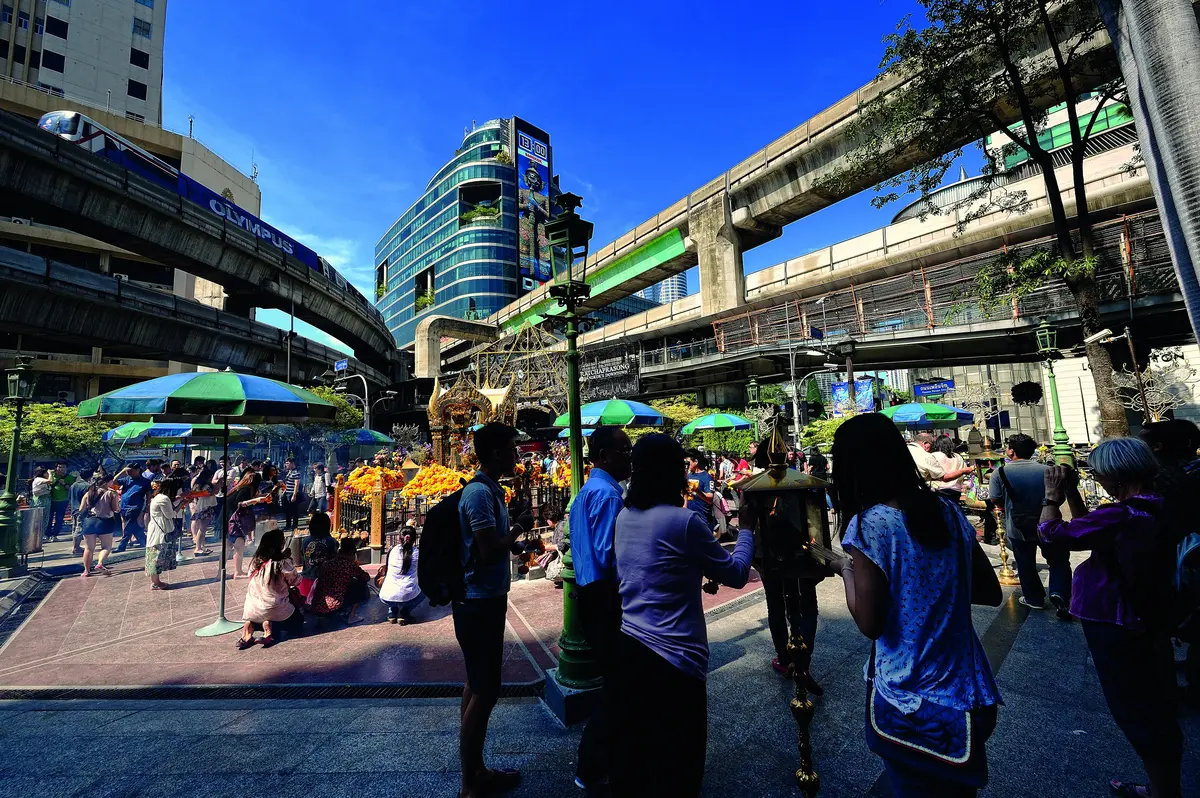
Ratchaprasong is not a building. It is the crossing where Ratchadamri Road meets Phloen Chit and Rama I in Pathum Wan district, central Bangkok, ringed today by CentralWorld, Gaysorn, Amarin Plaza, the Grand Hyatt Erawan and the elevated BTS walkways. Thais call it the intersection of the gods, because nine Hindu shrines stand within a few hundred metres of one another. The oldest and by far the most visited is the Thao Maha Phrom shrine, known in English as the Erawan Shrine, which houses a four-faced image of Phra Phrom, the Thai Brahma.
The shrine exists because of a hotel. According to the Thai history magazine Silpa Wattanatham, construction of the Erawan Hotel began in 1951 at the instigation of Police General Phao Sriyanond, the powerful police chief who was a founder of the state-linked Thai Hotels and Tourism Company, which needed rooms for foreign visitors. What happened next is told in Thailand as a story about misfortune, and both of the Thai sources that tell it flag it as hearsay. Silpa Wattanatham introduces it with the phrase 'it is said that', and Thairath with 'they say that'. On that telling, the first two or three years of work went badly: equipment arrived in the wrong sizes and could not be used, work had to be redone because labourers departed from the drawings, and there were repeated accidents in which workers were injured, until morale collapsed.
The remedy was astrological. Silpa Wattanatham says a senior figure advised Phao to consult Rear Admiral Luang Suwichanphaet, the Royal Thai Navy's surgeon-general, whom it calls an expert in astrology; Thairath, which calls him an adept of inner sight, adds that the operating company approached him late in 1956 to fix an auspicious date for the opening. His diagnosis, as Thairath reports it, had three parts: no rite had been performed to notify the sacred powers of the site before building started, the moment chosen for laying the hotel's foundation stone had been wrong, and the name Erawan — Indra's elephant — was itself a sacred name that demanded proper propitiation. His prescription was to ask Brahma's protection and to erect a shrine to him the instant the hotel was finished.
The object that resulted is documented. The shrine pavilion was designed by Chuearawi Chomseri — Thairath gives the name as Rawi Chomseri — and M.L. Pum Malakul, both of the Fine Arts Department; the image was designed and modelled by Chit Phimkowit, a craftsman of the department's Handicraft Division, in gilded plaster. It was enshrined in front of the hotel on 9 November 1956, the day the hotel opened, and 9 November has been kept ever since as the shrine's anniversary, popularly called Brahma's birthday. The original hotel is gone: the Erawan Group's own corporate timeline records that the Grand Hyatt Erawan Bangkok, built on the site, opened in 1991.
The shrine outgrew the hotel. Silpa Wattanatham describes it as the starting point of the Thai practice of installing Brahma shrines at private houses and large commercial buildings. It is administered by the Thao Maha Brahma Erawan Hotel Fund Foundation, which turns the offerings into hospital equipment: Krungthep Turakij reported in November 2022 that the foundation had received 1,085 million baht from 1,026 donors between 1993 and 2021 and had disbursed 2,469 million baht over 54 years, including some 96 million baht of medical equipment to 112 hospitals and institutions in 2021 and 377 ventilators worth 55 million baht for Covid-19 patients.
Three violent events have since attached themselves to this crossing, and none of them is folklore. Shortly after midnight on 21 March 2006 a 27-year-old man, Thanakorn Pakdeepol, climbed the railing and broke the plaster image apart with a hammer; bystanders chased him and beat him, and he died. Two men were arrested for the killing, described variously as street cleaners, shrine cleaners and refuse collectors employed by the Pathum Wan district office. On 19 May 2010 the crossing was the last stand of the red-shirt occupation and the epicentre of the army operation that ended it, followed by the arson of CentralWorld and by six deaths in the temple compound of Wat Pathum Wanaram, a few hundred metres away. On 17 August 2015 a pipe bomb left in a backpack inside the shrine grounds killed 20 people and injured more than 120: the deadliest bombing in Bangkok's history. On 11 June 2026, after nearly eleven years of proceedings, the Bangkok South Criminal Court sentenced two men to death for it.
Timeline: the documented record of Ratchaprasong (Erawan Shrine)
- 1951 Construction of the state-linked Erawan Hotel begins at the Ratchaprasong intersection at the instigation of Police General Phao Sriyanond, a founder of the Thai Hotels and Tourism Company. Silpa Wattanatham says the first two or three years went badly, and marks the account as hearsay: wrong-sized materials, work redone, repeated injuries to labourers.
- Late 1956 The operating company consults Rear Admiral Luang Suwichanphaet, the navy's surgeon-general and a reputed astrologer, to fix an auspicious opening date. Thairath reports his three objections: no rite had notified the site's sacred powers, the moment of laying the foundation stone had been wrong, and 'Erawan' was a sacred name needing propitiation. His remedy: a shrine to Brahma the moment the hotel was finished.
- 9 November 1956 The Erawan Hotel opens and the gilded plaster image of Phra Phrom is enshrined in front of it. The pavilion was designed by Chuearawi Chomseri and M.L. Pum Malakul of the Fine Arts Department; the image was modelled by Chit Phimkowit of its Handicraft Division. 9 November is still kept as the shrine's anniversary.
- 1991 The Grand Hyatt Erawan Bangkok opens on the site of the demolished original hotel. The Erawan Group's own corporate timeline records the opening and never mentions the shrine.
- 21 March 2006 Shortly after midnight Thanakorn Pakdeepol, 27, climbs the railing and smashes the plaster image with a hammer. The garland seller Wandee Vichai told The Independent: 'I saw him climb over the fence and use a hammer to hit the statue. I started to scream and two sweepers chased after the man. When I caught up with them, he was lying on the pavement.' He was found comatose 100 m away and died. Two men were arrested for the killing — described in different reports as street cleaners, shrine cleaners or district refuse collectors; police Colonel Suphisal Pakdinarunaj confirmed the arrests.
- 22 March 2006 His father, Sayan Pakdeepol, tells reporters his son had been treated for mental illness for years and had fled the house at midnight after a breakdown, and rejects any other motive. Charles F. Keyes writes that the destruction, two weeks before the 2 April election, 'immediately led both anti- and pro-Thaksin supporters to interpret the act as an omen'.
- 21 May 2006 Exactly two months after the attack the replacement image is installed at 11.39 a.m., as heavy rain begins. It left the Fine Arts Department at 7.29 a.m. and was paraded to the City Pillar Shrine, the Temple of the Emerald Buddha and the Brahman temple. Prime Minister Thaksin Shinawatra attended with the culture minister and the Bangkok governor; more than 1,000 people crowded the shrine, some noting the transport vehicle's registration number in hope of lottery numbers. Officials said a nine-metal copy was cast from the same mould and kept at the National Museum in case of another attack.
- 3 April – 19 May 2010 The United Front for Democracy Against Dictatorship occupies Ratchaprasong as its main camp. Human Rights Watch records that at least 90 people died and more than 2,000 were wounded across the 2010 protests; the People's Information Centre counts 94 dead and almost 2,000 injured, some 80 % of them civilians.
- 19 May 2010 The army retakes the intersection, the protest leaders surrender, arson attacks follow across Bangkok — including CentralWorld, on this crossing, and the Stock Exchange — and six people are shot dead in the compound of Wat Pathum Wanaram, which had been designated a safe zone. Among them was Kamonked Akhad, a volunteer nurse working in the temple's medical tent, wearing a red-cross vest, who was found to have been shot at least ten times.
- August 2013 An inquest at the Bangkok South Criminal Court finds that the six died from military rifle fire, matching ammunition issued to soldiers positioned on the BTS tracks and on Rama I Road. In May 2019 the military prosecutor declined to indict the eight soldiers concerned, citing lack of evidence and witnesses.
- 17 August 2015 At about 19.00 an improvised pipe bomb — 3 kg of TNT in a pipe wrapped in white cloth, left in a backpack on a bench inside the shrine grounds — is detonated. Twenty people are killed, twelve of them at the scene, and more than 120 injured; the Nation Thailand later gives the toll as fourteen foreign nationals and six Thais. It is the deadliest bombing in Bangkok's history.
- 19 August 2015 The shrine reopens for worship two days after the blast. The crater has been filled with concrete but is still cordoned off; only minor damage is visible on one of the Brahma's faces, and Bangkok residents leave candles, flowers and messages.
- 4 September 2015 The repaired image is unveiled and reconsecrated. The Fine Arts Department of the Ministry of Culture had restored a chin blasted out of one of the four faces plus eleven other damaged areas; the rite was performed by the head of the court Brahmins.
- March 2018 The Thao Maha Brahma Erawan Hotel Fund Foundation stops allowing incense sticks, candles and joss paper to be lit at the shrine, when Bangkok's PM2.5 pollution first became acute. Thailand's Public Relations Department reported on 28 January 2025 that the measure was still in force, in its seventh year.
- 11 June 2026 The Bangkok South Criminal Court sentences Bilal Mohammed (also known as Adem Karadag) and Yusufu Mieraili to death for the 2015 bombing, after nearly eleven years — first before a military court, transferred to the civilian court in 2019 — with more than 400 prosecution witnesses and some 10,000 pages of testimony. The court rejected their claims of torture and of not knowing each other. Their lawyer, Choochat Kanpai, said they would appeal within a month.
Is there a rational explanation for Ratchaprasong (Erawan Shrine)?
The interesting question here is not whether spirits take revenge at Ratchaprasong. It is what kind of religion this crossing actually practises, and the answer is documented by named scholars.
Phra Phrom is not a vengeful ghost and the shrine is not a haunting. It is a case study in urban Thai religion, in which a Hindu creator god is worshipped inside a Buddhist and animist framework as a guardian of a specific plot of ground. Silpa Wattanatham cites two Thai academic works on exactly this. Aphaphirat Wallibhodom, in a thesis on the worship of chao, thep and phra phrom among city dwellers, argues that the Erawan Brahma originally stood for 'Than Pho Ketsaro' — Luang Suwichanphaet himself venerated King Pinklao as a Brahma — and that a cult of Thao Maha Brahma grew out of that, until the sanctity migrated from the theological figure to the statue itself. Suchada Kittitrakunkan devoted a 1997 Thammasat University thesis to the shrine as ritual performance in the age of globalisation, which is the right frame for what a visitor sees: a resident dance troupe hired by worshippers whose prayers were answered, garland and wooden-elephant sellers, and a crowd that peaks on Chinese New Year.
The founding story deserves the same scepticism its own Thai sources apply to it. Neither Silpa Wattanatham nor Thairath asserts the construction accidents as fact; both hedge. The published versions are also mutually incompatible. The Thai accounts name Rear Admiral Luang Suwichanphaet and give three causes; Jan McGirk, writing in The Independent in 2006, has the owners consulting 'a high priest' after cost overruns, maimed labourers and a shipload of Italian marble for the lobby sinking offshore; English-language guidebooks and encyclopaedia articles reduce it to a foundation stone laid on the wrong date. No contemporaneous document from 1951-56 is cited by any of them. In OpenLibrary's full-text index of digitised books, 'Suwichanphaet' and 'Suwichan Phaet' return zero hits, repeated; the same corpus returns 443 for 'Erawan Shrine' and 22 for 'Thao Maha Brahma', so the search works. The name circulates in Thai, not in the English-language book record, and the earliest mentions of the shrine I could date in that corpus are travel-writing: a 1977 Insight Guide to Thailand and volume 326 of Blackwood's Magazine, 1979, neither of which tells the misfortune story in the passages returned. The earliest datable passage that does tell it, a Bangkok guide published by Times Editions in 1990, attributes the diagnosis not to a naval astrologer but to 'a Brahmin priest'. The honest formulation is that the story is old in Thai oral and journalistic tradition and that its first printed telling has not been fixed.
One negative result is worth stating plainly, because it cuts against the shrine's own commercial interest. The Erawan Group, the listed company that owns the hotel on the site, does not mention the shrine in its corporate history at all: its Company Milestones page, 13,200 characters long, contains 'Erawan' 27 times, 'Hyatt' 5, and 'shrine', 'Brahma', '1956' and '1987' zero times each. The proprietor is not selling the miracle.
As for the three catastrophes, each has a named cause established by a court, and that matters more than any curse. The 2006 attack was made by a man whose father, Sayan Pakdeepol, told reporters he had been treated for mental illness for years and had run out of the house at midnight after a breakdown; The Independent described him as a former soldier and a Muslim, and his father rejected any motive other than illness, calling the beating an overreaction. What is documented about the reaction is political, not supernatural: Charles F. Keyes, in the abstract of a paper he presented at the University of Washington in November 2006, writes that the destruction 'immediately led both anti- and pro-Thaksin supporters to interpret the act as an omen', two weeks before the 2 April election. The 2010 deaths at Wat Pathum Wanaram were attributed by an August 2013 inquest at the Bangkok South Criminal Court to military rifle fire from the BTS tracks; in May 2019 the military prosecutor declined to indict the eight soldiers concerned. The 2015 bombing produced a verdict on 11 June 2026. Reading these as a curse on a crossroads displaces named perpetrators, named soldiers and named victims, and that is why this file does not do it.
Two things we could not verify, and they are as important as what is above. There is no published, signed testimony we could locate from vendors or soldiers reporting a lingering unease at the intersection; the earlier version of this file asserted one and it is withdrawn. And the prosecution of the two street cleaners arrested in March 2006 has no traceable outcome: repeated searches in Thai, using the attacker's name and the words for street sweeper and court sentence, returned nothing on the case, while the same searches returned abundant Thai coverage of the 2026 bombing verdict. As of August 2026, we do not know what happened to them.
Can you visit Ratchaprasong (Erawan Shrine)?
The Erawan Shrine stands at the corner of Ratchadamri and Phloen Chit roads, on the plot of the Grand Hyatt Erawan Bangkok: 494 Ratchadamri Road, Lumphini subdistrict, Pathum Wan, Bangkok 10330. It is open to the air behind a low railing, at pavement level, with the elevated walkway of the BTS Sukhumvit Line running over the intersection above it. Chit Lom station is about 330 metres east along Phloen Chit Road. Siam station is one stop west and can be reached along the walkway without coming down to the street.
Thairath states that the shrine can be visited every day, with no closing days and no admission charge. It publishes no closing time.
One restriction is official. Lighting incense sticks or candles before the image of Thao Maha Brahma is prohibited. NBT Connext, the news service of Thailand's Public Relations Department, reported in 2025 that the shrine was keeping the measure for a seventh consecutive year, and gave two reasons for it: the danger of open flame, and the PM2.5 dust that the smoke adds to Bangkok's air. Thairath's account of the worship sets out what is owed to each of the four faces, which are approached in turn around the plinth.
A bomb killed twenty people at this crossing on 17 August 2015, six of them Thai and fourteen foreign, and injured more than 120. The crater was filled with concrete within two days and the shrine reopened on 19 August 2015. The repaired image was reconsecrated on 4 September 2015. Judgment came eleven years later: on 11 June 2026 a Bangkok court of first instance sentenced two Uyghur defendants to death for the bombing. Wat Pathum Wanaram, some 380 metres west-north-west along Rama I towards Siam, is the temple compound where six people were shot dead on 19 May 2010, among them the volunteer nurse Kamonked Akhad. Their families and their supporters gather at Ratchaprasong every 19 May to light candles.
Sources consulted
- เสมียนอารีย์ (Samian Ari), «กำเนิด “ศาลพระพรหม” ณ โรงแรมเอราวัณ สี่แยกราชประสงค์ (The birth of the Brahma shrine at the Erawan Hotel, Ratchaprasong intersection)» — ศิลปวัฒนธรรม / Silpa Wattanatham (Matichon), archived via the Wayback Machine, 2022 newspaper archive
- ไทยรัฐออนไลน์ (Thairath Online), «เปิดประวัติ “พระพรหมเอราวัณ” ที่มาแห่งศรัทธาของชาวไทยและต่างชาติ (The history of the Erawan Brahma)» — Thairath, 2022 newspaper archive
- Jan McGirk, «Attack on Thai statue seen as bad omen for beleaguered Thaksin» — The Independent (archived, Wayback Machine), 2006 newspaper archive
- Chatrarat Kaewmorakot, «Erawan Shrine statue restored» — The Nation (archived, Wayback Machine), 2006 newspaper archive
- Agence France-Presse / Associated Press wire report, «Deranged man killed after destroying famous statue» — Taipei Times, 2006 newspaper archive
- Al Jazeera, «Shrine attacker beaten to death» — Al Jazeera, 2006 newspaper archive
- Charles F. Keyes, «The Destruction of a Shrine to Brahma in Bangkok and the Fall of Thaksin Shinawatra: The Occult History of the Coup in Thailand in September 2006 (abstract of a paper presented at the Southeast Asia Center, 8 November 2006)» — Jackson School of International Studies, University of Washington, 2006 academic
- Human Rights Watch, «Descent into Chaos: Thailand's 2010 Red Shirt Protests and the Government Crackdown» — Human Rights Watch, 2011 report
- Anna Lawattanatrakul, «Justice delayed is justice denied: remembering the 19 May 2010 killing of 'red shirt' protestors» — Prachatai English, 2019 newspaper archive
- BBC News, «Bangkok bomb: What do we know?» — BBC News, 2015 newspaper archive
- BBC News, «In pictures: Bangkok shrine reopens» — BBC News, 2015 newspaper archive
- Associated Press, «Thailand unveils restored statue at blast site amid growing questions about Turkish link» — Fox News, 2015 newspaper archive
- iLaw (Internet Law Reform Dialogue), «ศาลชั้นต้นพิพากษาประหารชีวิต 2 จำเลยชาวอุยกูร์ คดีวางระเบิดศาลท้าวมหาพรหม แยกราชประสงค์ (Court of first instance sentences two Uyghur defendants to death over the Thao Maha Brahma shrine bombing) — courtroom observation report» — iLaw, 2026 report
- The Nation Thailand, «Court sentences two defendants to death over 2015 Erawan Shrine bombing» — The Nation Thailand, 2026 newspaper archive
- Al Jazeera, «Thailand court sentences two men to death for 2015 Bangkok bombing» — Al Jazeera, 2026 newspaper archive
- NBT Connext, «ศาลท้าวมหาพรหมเอราวัณ คงมาตรการเดิมต่อเนื่องมาเป็นปีที่ 7 คือห้ามจุดธูปเทียนในการกราบไหว้บูชาท้าวมหาพรหม (Erawan Shrine keeps its ban on lighting incense and candles for a seventh year)» — Public Relations Department, Government of Thailand, 2025 report
- กรุงเทพธุรกิจ (Krungthep Turakij / Bangkok Biznews), «“ท้าวมหาพรหม” โรงแรมเอราวัณ ยอดบริจาคพันล้าน! นำเงินไปทำอะไรบ้าง? (The Erawan Hotel's Thao Maha Brahma: a billion baht in donations — where does the money go?)» — Bangkok Biznews, 2022 newspaper archive
- The Erawan Group Public Company Limited, «Company Milestones» — theerawan.com, 2026 web
Reviewed by V. Serrano on 2026-08-13 · How we verify our content
💬 Field testimonies (0)
No testimonies yet. Add the first.
Add your testimony
🔒 Log in to add a testimony