👻 HAUNTED PLACE · EXP. Nº1189
ACTIVE
Teochew Cemetery (Bangkok)
Teochew Cemetery (Bangkok) is a location reputed to be haunted in Bangkok, TH. Its reputation comes from reported apparitions, unexplained phenomena and eyewitness accounts gathered over time.
Where is Teochew Cemetery (Bangkok)?
- Location
- Bangkok, TH
- Type
- Cemetery
- Coordinates
- 13.714, 100.525
- Testimonies
- 0
- Last updated
LOCATION
Why is Teochew Cemetery (Bangkok) said to be haunted?
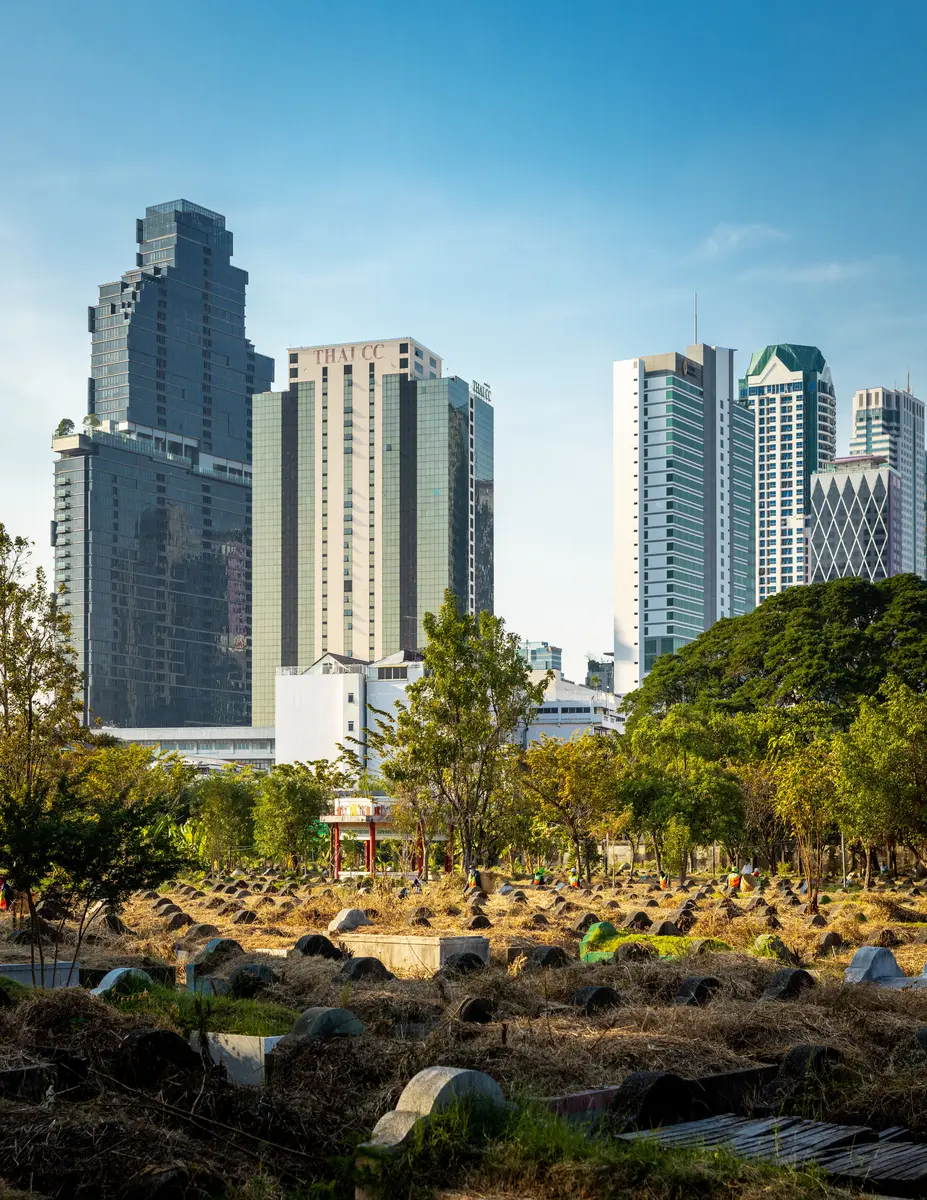
Bangkok's Teochew Cemetery, on Chan Road in Sathon District, was for most of a century the address every Thai ghost story used. Nikhom Waiyaratchaphanit, then director of Sathon District, wrote in the Journal of Health that a whining child would stop crying the instant a parent invoked the ghosts of the Wat Don graveyard, and that taxi drivers shook their heads at a night fare to the gate. Part of the reason was material: the ground outside the wall was a hollow flooded all year round where, in the district director's own words, most of the corpses lay soaking in water, while neighbours tipped rubble on top of them and muggers worked the unlit lane. Founded by the Teochew community in 1899 and opened for burial in 1900, it was the largest of three adjacent Chinese cemeteries covering some 150 rai. On 3 April 1996 the district began planting trees among the tombs. The Teochew ground is now a private health park, open daily from four in the morning; of the two neighbouring cemeteries, one moved out of Bangkok and the other is leased to a restaurant and to builders' huts.
What is the history of Teochew Cemetery (Bangkok)?
The cemetery on Chan Road began as a burial problem. Junporm's account of the founding starts there: the Chinese of the time did not favour cremation, the temples of Siam offered little else, so a city with a large Chinese population needed ground to bury in. Khai Sin Lee, working from the Tio Chew Association's own yearbooks for her 2017 master's thesis at Chulalongkorn University, dates it: “The earliest historical records in Tio Chew Association's yearbook note that Tio Chew cemetery existed in 1899 and was officially opened for use as a burial ground in 1900.” The opening, she adds, “originated from donations of public and individuals, especially wealthy Chinese merchants”, and the plot measured “90 rais, approximately 144,000 square meters at Chan Road, Sathorn District in Bangkok”. An 1896 map of the city shows paddy field there; the 1910 map already marks the land use as a Chinese cemetery.
The register says who lies underneath: Kanokwarn Junporm, in her 2017 Thammasat University thesis on the site, reports that six years after the founding the burial list already held 4,267 names, that fewer than 8 per cent were women, and that about 70 per cent were men between twenty and thirty. They were labourers who arrived to build a country and died of its public health. Junporm quotes the proverb the old men taught the generations after them: “ดื่มน้ำต้องไม่ลืมบุญคุณคนที่ขุดบ่อน้ำ” — whoever drinks the water does not forget the debt owed to whoever dug the well.
Lee records the buildings that went up among the graves: the Tio Chew Ancestral Hall 潮州公祠 in 1901 as the first structure on the site, an Office of Cemetery Affairs in 1933 and the Tio Chew Cemetery Hall 潮州義山禮堂 in 1936. Junporm records that in 1942 the cemetery was renamed “แต้จิ๋วซัวจึง” from its earlier “หงี่อังกุ๋ยหงี่ซัว”, because most of those buried were Teochew, and that non-Teochew were accepted for burial all the same. The association took over the administration entirely in 1944. In the 1960s a crematorium pavilion was raised beside the two halls and enshrined with a statue of the god Dafeng Gong. By the entrance sits what Lee calls “an elaborate grave or 万人公墓”, which on the association manager's account “served as a public grave where the deceased without families were buried together in the past”.
The graveyard that frightened Bangkok was larger than this. Nikhom Waiyaratchaphanit, director of Sathon District, described a Wat Don burial ground of more than 150 rai running from Soi Charoen Krung 57 to Saint Louis Soi 3 and split among three bodies: the Teochew Association of Thailand, the Poh Teck Tung Foundation and the Hainan Dan Family Association. The Teochew section alone, he wrote, held 7,961 coffin graves, some 1,800 urn burials and more than ten thousand kinless dead in a common grave.
Lee dates the second phase of the Sirat Expressway to 1990, after which graves were cleared, the cemetery was cut into an eastern and a western half and the main gate moved to Soi Charoen Rat 3, and the Teochew medical centre followed in 1995. On 3 April 1996 the district started planting trees among the tombs; Charoon Meethanathaworn, then director of Sathon, told the magazine Dhammaleela that “ทางเขตสาธรมีโครงการสวนสวยในป่าช้า ซึ่งเริ่มต้นขึ้นตั้งแต่วันที่ 3 เมษายน 2539” — the district's beautiful-garden-in-the-graveyard project began on 3 April 1996. Lee gives the association two reasons of its own: better walking and access for families at Qingming, and requests from neighbours for somewhere to jog.
The other two grounds took separate exits. Aran Totuad, operations manager of the Poh Teck Tung Foundation, told BBC News ไทย that four of its thirteen rai were expropriated for Charoen Rat Road, that the foundation moved its burial ground to Ban Phaeo in Samut Sakhon and grew from four thousand plots to seven thousand, and that “แล้วเราก็เปลี่ยนพื้นที่ 9 ไร่ที่เหลืออยู่ มาเป็นสวนเฉลิมพระเกียรติ” — the remaining nine rai became a public park. The Hainan association took the other road: its manager Yanyong Kaiwikai said it leases out its eight rai on three-year contracts at 70,000 to 100,000 baht per rai per month. The tenants at the time were a restaurant plus huts for construction workers. No member, he said, has ever proposed selling the land for fear of the charge of “ขายที่ดินบรรพบุรุษ”, selling the ancestors' land.
Timeline: the documented record of Teochew Cemetery (Bangkok)
- 1899 The Tio Chew Association's yearbook, cited by Khai Sin Lee, records the cemetery as existing on Chan Road, then on the edge of paddy fields outside the city. Its original extent is given as 90 rai, about 144,000 square metres.
- 1900 The ground is officially opened for burial. Lee attributes the opening to donations from the public and from wealthy Chinese merchants.
- 1901 The Tio Chew Ancestral Hall 潮州公祠 is built, the first structure inside the cemetery. It appears on the 1910 map of Bangkok, linked to Soi Charoen Krung 57. A renovation was completed in 2011.
- by 1905–1906 Six years after the founding the burial list holds 4,267 names, according to Kanokwarn Junporm. Women are under 8 per cent of them and about 70 per cent are men aged twenty to thirty.
- 1936 The Tio Chew Cemetery Hall 潮州義山禮堂 is built for funeral ceremonies, three years after an office of cemetery affairs went up on the site.
- 1942 The cemetery is renamed แต้จิ๋วซัวจึง, replacing หงี่อังกุ๋ยหงี่ซัว, because most of the dead are Teochew. Junporm notes that non-Teochew were buried there all the same, and that locals went on using the older name.
- 1944 The Tio Chew Association takes over the full administration of the cemetery, which until then it had not run alone.
- 1990 The second phase of the Sirat Expressway clears and relocates graves, splits the cemetery into an eastern and a western half and moves the main entrance to Soi Charoen Rat 3. Lee cites the association's seventieth anniversary publication of 2008.
- 3 April 1996 Sathon district begins the สวนสวยในป่าช้า project, planting trees among the tombs on Teochew Association land. Charoon Meethanathaworn, director of the district, gives the date to Dhammaleela.
- April 2007 Dhammaleela reports the cemetery closed to new burials, with Chinese families burying instead in Saraburi or Chonburi, and about a thousand people a day exercising on the site. It also records the older reputation for muggings.
- 31 October 2012 The Bangkok Post publishes Wiwat Sirijittanon's report on the site, with the shopkeeper Kowit Bunyarit and the retired officer Chuwit Ket-Khuea-Mat named as witnesses. Both of their accounts turn on a lavatory.
- 2016 Wat Borom Sathon completes its white meditation hall. The assistant abbot Phra Maha Adisak Apipanyo tells BBC News ไทย that nine bodies came up when the piles were drilled.
- February and October 2018 Kanokwarn Junporm counts users on the site over a week in February and arrives at about 2,050 a day. In October BBC News ไทย finds runners arriving at four in the morning under floodlights among the graves.
- 2 April 2021 The Poh Teck Tung Foundation performs its Qingming rite for the kinless dead at what it calls its old cemetery in Sathon, having moved its burial ground to Ban Phaeo in Samut Sakhon.
Is there a rational explanation for Teochew Cemetery (Bangkok)?
The fear had an address and a physical cause, and the man who ran the district put both in print. Nikhom Waiyaratchaphanit described the Teochew graves outside the wall, along Soi Charoen Krung 57, as dilapidated ruins their heirs had abandoned, on ground that was a hollow flooded all year round, so that “ศพส่วนใหญ่จึงนอนแช่น้ำ” — most of the corpses lay soaking in water. Neighbours tipped rubbish and cement rubble on top of them. Almost nobody walked past after dark, and the district director drew the conclusion himself: “จึงเหมาะที่พวกมิจฉาชีพ จะใช้เป็นสถานที่ก่ออาชญากรรม”, the place suited criminals for committing crime. Dhammaleela made the same point in 2007: the graveyard was known for muggings. The thing people met in the dark at Wat Don was frequently a robber.
The second cause was access: the compound was fenced and the public entered only at Qingming, which left a walled, unlit, flooded field in the middle of a city with nobody inside it to report what was actually there. Wiwat Sirijittanon set the folklore beside the burial practice in the Bangkok Post: the Poh Teck Tung section held the road-accident dead and the kinless, and “Given the belief that corpses without kin, dying from accidents or pandemic turn to ghosts with a lingering attachment to the physical world, the sighting of (or hearing) the dead comes as no surprise.” The reputation follows the Thai category ตายโหง, the violent death, and it attached to the section that had those dead in it.
Two people who spent their lives inside the place are on record. Arunothai Kroekkraiphaet, undertaker at Wat Borom Sathon for more than thirty years, told BBC News ไทย he had handled well over ten thousand bodies since childhood and had never met anything supernatural. Chuwit Ket-Khuea-Mat, a retired officer who walks in the park daily, opened his account to the Bangkok Post with “Sometimes people just imagine things” before describing a lavatory that flushed by itself.
The measured silence is the strongest piece of it: Kanokwarn Junporm's 2017 thesis is 18,483 words about this cemetery and nothing else. The word สุสาน (cemetery) appears 413 times in it; ฮวงซุ้ย (Chinese grave) 41 times; ออกกำลังกาย (exercise) 108 times. Meanwhile ตำนาน (legend), เฮี้ยน (haunted) and หลอน (spooky) appear zero times each. Assistant abbot Phra Maha Adisak Apipanyo, who tells BBC News ไทย that nine bodies came up when the piles were drilled for the temple's meditation hall in 2016, gave the shortest version of what happened to the ghosts of Wat Don: “ทางด่วนมาผีก็หาย ใครล่ะจะไปสู้เสาเข็มได้” — the expressway came and the ghosts went; who can fight a pile driver.
Can you visit Teochew Cemetery (Bangkok)?
The site is on Chan Road at Soi Wat Prok 1, in the Thung Wat Don subdistrict of Sathon. Junporm lists its boundaries: Soi Rong Nam Khaeng 5 with the Muslim burial ground to the north; Soi Wat Prok 1 with Soi Yen Chit 12 to the south; the Kuson Thong community with Assumption primary school to the east; Wat Prok to the west. North Sathon Road runs along its northern edge, eight lanes wide, with the BTS skytrain line on the median. Kanokwarn Junporm, who spent a week counting users on site in February 2018, records the ground as roughly 84 rai and gives the hours as “มีเวลาทำการ 04.00 – 20.00 น. เปิดให้บริการทุกวัน” — four in the morning to eight at night, every day. Her count came to about 2,050 users a day, and she notes that the owner keeps no visitor statistics at all, which is why she counted them herself. The Bangkok Post had put the figure at “about 1,000 visitors daily” in 2012.
The land belongs to the Teochew Association of Thailand and the park is run by its runners' club together with the Sathon district office, so this is a private open space lent to public use rather than a Bangkok municipal park. Khai Sin Lee found at the Sathon district office that under the zoning plan “the land can be used for public recreation and community purposes, but commercial uses are restricted”, and that the open space plan makes the cemetery the largest such area in Sathon after Lumphini Park. There is no gate fee on any account consulted.
The rules on the site come from the graves. Charoon Meethanathaworn told Dhammaleela that the district bars teenagers from playing football on the site, “เนื่องจากยังมีบริเวณฮวงซุ้ยเดิมตั้งอยู่”, because the old Chinese tombs are still standing and could be damaged. Around the running track are two basketball courts, a takraw court, a badminton court, two playgrounds, an indoor gym built in 2004 and areas for aerobics and yoga; the 1936 ceremonial hall is let as a taekwondo training room, which Lee describes as its function “in the present”. By the cemetery office sit six small shops, three toilet blocks and parking for fifteen to twenty cars.
The graves are not decoration and the place is still in use. At Qingming, in early April, the undertaker Arunothai Kroekkraiphaet told BBC News ไทย, “เวลาเช็งเม้งที คนมาเต็มสวนเลย เพื่อมาไหว้บรรพบุรุษ แต่คนอื่นก็ออกกำลังกายตามปกติ” — the park fills with families paying respects while everyone else exercises as usual. On the neighbouring Poh Teck Tung plot the foundation still holds its own rite for the kinless dead at what its 2021 notice calls “สุสานวัดดอนกุศล (สุสานเก่าของมูลนิธิ)”, the foundation's old cemetery, with offerings of savoury and sweet food, gold and silver joss paper and scented flowers.
Sources consulted
- Khai Sin Lee, «Revitalizing Tio Chew Chinese Cemetery Through a Design of an Elderly Center» — Faculty of Architecture, Chulalongkorn University, 2017 academic
- กนกวรรณ จันทร์พรหม (Kanokwarn Junporm), «การจัดการพื้นที่สาธารณะในเขตเมือง: กรณีศึกษาสุสานแต้จิ๋ว กรุงเทพมหานคร (Managing Urban Public Space: A Case Study of Teochew Cemetery, Bangkok)» — Faculty of Architecture and Planning, Thammasat University, 2017 academic
- นิคม ไวยรัชพานิช (Nikhom Waiyaratchaphanit), director of Sathon District, «ยุทธศาสตร์เมืองน่าอยู่ กับการพัฒนาป่าช้าวัดดอน (Healthy-city strategy and the development of the Wat Don graveyard)» — Journal of Health, vol. 20 no. 3, Department of Health, Ministry of Public Health report
- จรินทร์ คำชัย (Charin Khamchai), «ป่าช้าวัดดอน จาก 'สุสาน' สู่ 'สวนสวย' (Wat Don graveyard, from cemetery to beautiful garden)» — Dhammaleela no. 77, republished by MGR Online, 2007 newspaper archive
- Wiwat Sirijittanon, «In good spirits» — Bangkok Post, 2012 newspaper archive
- ทศพล ชัยสัมฤทธิ์ผล (Tossapol Chaisamritpol), «ฮาโลวีน: ป่าช้าวัดดอน ลดทอนความหวาดกลัว ด้วยสวนสุขภาพในสุสานกลางกรุง (Halloween: the Wat Don graveyard cuts its fear down with a health park)» — BBC News ไทย, 2018 newspaper archive
- มูลนิธิป่อเต็กตึ๊ง (Poh Teck Tung Foundation), «พิธีเซ่นไหว้ดวงวิญญาณไร้ญาติ เทศกาลเช็งเม้ง ณ สุสานวัดดอนกุศล (สุสานเก่าของมูลนิธิ) เขตสาทร กรุงเทพฯ» — pohtecktung.org, 2021 report
Reviewed by V. Serrano on 2026-09-07 · How we verify our content
💬 Field testimonies (0)
No testimonies yet. Add the first.
Add your testimony
🔒 Log in to add a testimony