👻 HAUNTED PLACE · EXP. Nº9475
ACTIVE
Wat Kudi Dao
Wat Kudi Dao is the big Ayutthaya ruin that the tour circuit drives past.
Where is Wat Kudi Dao?
- Location
- Ayutthaya, Thailand
- Type
- Temple / shrine
- Coordinates
- 14.363, 100.59
- Last updated
LOCATION
Why is Wat Kudi Dao said to be haunted?
It stands off the city island to the east, in Phai Ling, directly across the road from Wat Maheyong, and it falls outside the 289-hectare World Heritage boundary drawn in 1991 — which is why it has no ticket booth and, most days, no visitors. Its documented history is royal: the Royal Chronicles record that in 1711 the heir apparent, younger brother of King Thai Sa and the future King Borommakot, had the monastery rebuilt and came out to watch the work a month or two at a time, exactly as his elder brother was doing across the road. Its famous history is a treasure story: Thai accounts, none of them contemporary, place a racing-driver prince here in December 1960 digging for gold marked on an old manuscript and meeting a headless warrior instead. The ghost half dates from the internet rather than from 1960, and in 2020 the provincial tourism officer called a televised version of it a lie, on the record and by name.
What is the history of Wat Kudi Dao?
Wat Kudi Dao is not in Ayutthaya. It is just outside it, and that is the first thing to understand about the place.
The royal capital sat on an island ringed by the Chao Phraya, the Pa Sak and the Lopburi. Wat Kudi Dao stands off the island to the east, in Phai Ling sub-district, on ground that Thai historians have long argued held an older town — Ayothaya — before Ayutthaya was founded in 1351. Excavation has turned up foundations of earlier buildings under the standing ruins, dated to the early Ayutthaya period, but nobody knows who built the first monastery here. The Chronicle of the North credits a Phraya Thammikarat in the year 671 of the Chulasakarat era, which would be 1309; the testimony known as Khamhaikan Khun Luang Ha Wat credits a different king altogether; the main royal chronicles do not mention its founding at all.
What they do record is the rebuilding, and they record it in detail. In 1711 the Uparat — the Front Palace, the heir apparent, younger brother of the reigning King Thai Sa — put artisans to work on what the chronicles call the Monastery of the Large Star Dormitory. The translation by Richard Cushman and David Wyatt is worth quoting because it explains the shape of the site: he "went to watch the work at that monastery with His holy eyes, sometimes for one month, sometimes for two months, just like the Holy Older Brother of the King". The older brother was doing the same thing at Wat Maheyong, directly across the road; Thai writers still call the two the elder and younger sibling temples. To lodge the prince during those months a two-storey brick residence was raised north of the monastery wall, the Tamnak Kammalian, with pointed-arch windows that architectural historians read as Persian influence and two rows of ten octagonal piers inside. It took more than three years. In 1715 the finished monastery was dedicated with a seven-day festival.
That prince became King Borommakot in 1733, and this is where the ficha's old wording went wrong: the restoration was not King Thai Sa's. It was his brother's, carried out during his reign.
The monastery stayed close to the crown. The Uparat was ordained here in 1727. Its abbot held the title Phra Thep Muni, and in 1758, when the succession to Borommakot nearly came to blows, King Uthumphon summoned five senior monks to mediate with his three half-brothers; Phra Thep Muni of Wat Kudi Dao was the eldest of them. In July 1766 the Supreme Patriarch died and King Ekathat promoted him to the office — by then he was living inside the city walls, because the monks of every temple outside them had moved in ahead of the advancing Burmese. He held the post six or seven months and died too. Neither body was cremated, the chronicles note, "because fighting still enveloped the Holy Metropolis". In April 1767 Ayutthaya fell and the monastery was abandoned.
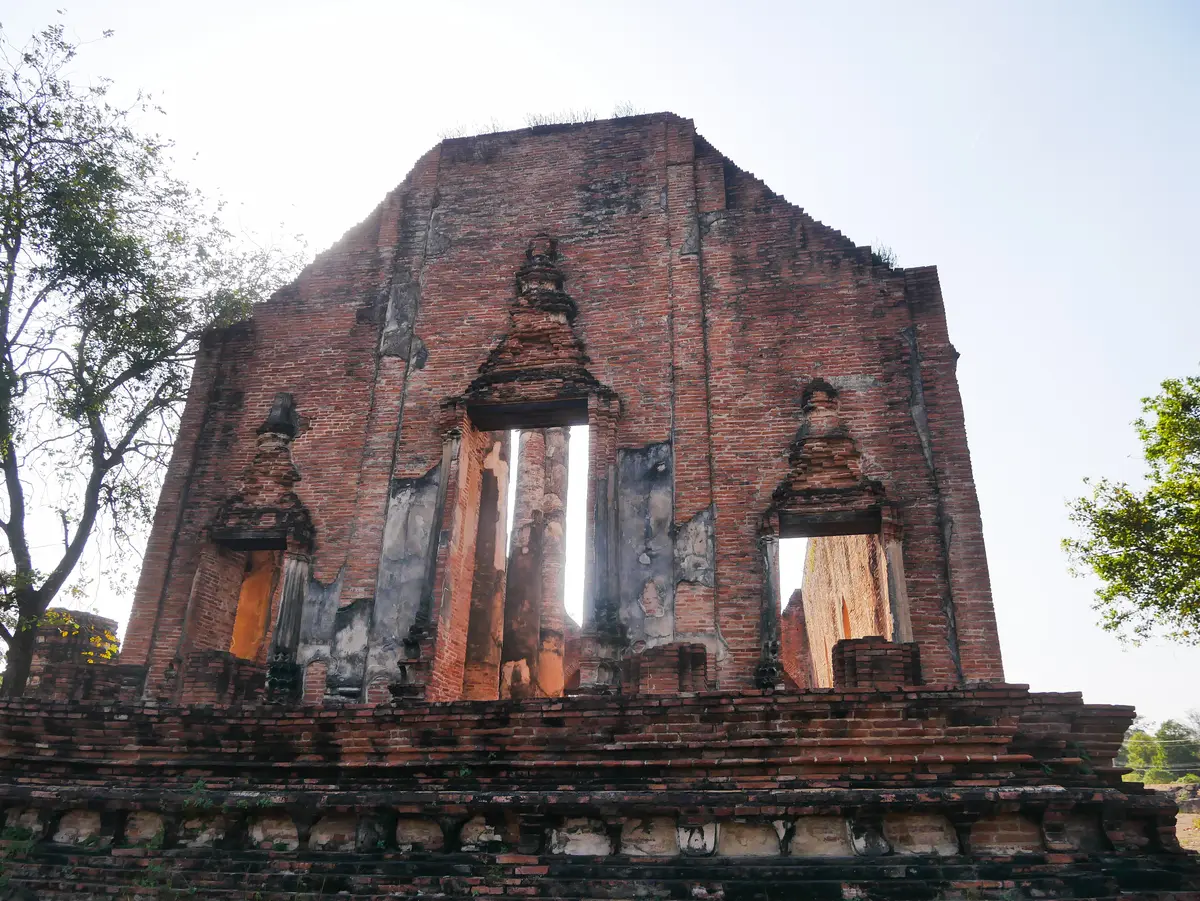
It has been a ruin ever since. The Fine Arts Department registered it as a national ancient monument in 1936 and has consolidated it more than once; the bell-shaped chedi, Sri Lankan in type and set on a twelve-indented base with fourteen satellite stupas around the compound, lost its upper spire, which lies on the ground beside it. Long cracks on all four sides of the base show it went down through subsidence.
Timeline: the documented record of Wat Kudi Dao
- June 1690 Engelbert Kaempfer, physician to the Dutch East India Company embassy, walks from Wat Pradu to Wat Samana Kottharam past this spot and sketches the neighbouring monastery but not this one. Tricky Vandenberg reads the omission as evidence that nothing stood above the scrub here before the rebuilding of 1711.
- 1711 The Royal Chronicles record that the Uparat — the heir apparent and younger brother of King Thai Sa, the future King Borommakot — sets artisans to restore the Monastery of the Large Star Dormitory, and comes to watch "sometimes for one month, sometimes for two months, just like the Holy Older Brother of the King", who was rebuilding Wat Maheyong across the road.
- 1715 After more than three years of work the monastery is dedicated. The chronicles record alms and offerings "in great amounts" and a festival staged for seven days.
- 1727 With King Thai Sa gravely ill, his younger brother the Uparat is ordained at Wat Kudi Dao. Six years later he takes the throne as Borommakot.
- 1758 On Borommakot's death the succession nearly breaks into fighting. King Uthumphon summons five senior monks to mediate with his three half-brothers; the eldest of them is Phra Thep Muni, abbot of Wat Kudi Dao. The three princes pledge loyalty that same night.
- July 1766 The Supreme Patriarch dies and King Ekathat promotes Phra Thep Muni to the office. He is already living inside the walls, because the monks of every temple outside them have moved into the besieged city. He dies six or seven months later; the chronicles note that neither body was cremated "because fighting still enveloped the Holy Metropolis".
- 1767 Ayutthaya falls to the Burmese and the monastery is abandoned. Nothing in the record suggests it was fought over: it stood outside the island, away from the walls the siege guns were aimed at.
- 8 March 1936 The Fine Arts Department registers Wat Kudi Dao as a national ancient monument, the legal status it still holds.
- 23 September 1957 Weeks after Fine Arts Department archaeologists found gold at Wat Maha That, looters break into the crypt of Wat Ratchaburana. The result, in Vandenberg's summary, is an uncontrollable spree of treasure hunting across the whole ruined area of Ayutthaya — the climate in which the Wat Kudi Dao treasure story is set.
- Mid-December 1960 (claimed) The date given by Thai online accounts for Prince Birabongse Bhanudej's licensed dig at the ruin, with a mine detector, sixteen marked caches and a headless warrior blocking his way. The fullest version is a 2016 forum post; no source contemporary with 1960 has been located, and the newspaper that reported the tale in 2022 attributed the ghost half to unnamed websites.
- 26 December 1961 The Chao Sam Phraya National Museum opens in Ayutthaya to hold the gold recovered from Wat Ratchaburana and Wat Maha That, part-funded by selling votive tablets found in the crypt.
- 1972 Thommayanti's novel Phit Sawat appears in book form after serialisation in Sakul Thai around 1969-71. Its protagonist Ubon is a beheaded woman bound to guard state treasure since the fall of Ayutthaya; Manager Online later traced the frame to Marie Corelli's Ziska (1897). Adaptations in 2007 and 2016 put the headless treasure guardian back in circulation each time.
- 13 December 1991 The Historic City of Ayutthaya is inscribed on the World Heritage List under criterion (iii). The property is 1,810 rai (289 ha) on the city island, with no buffer zone; Wat Kudi Dao, outside the island, is not inside it — which is why it stays off the ticketed circuit.
- 30 May 2020 After a paranormal channel filmed here and claimed the ghosts of a mother and child died when Burmese artillery hit the chedi, Kritsada Buarangsi of the provincial tourism and sports office publicly rejects it: there was "no way, a million percent" the Burmese shelled a temple outside the island, and the chedi's ringed spire broke only about a hundred years ago. Offerings left on the monument by viewers are cleared away.
- 3 April 2022 Thai Rath's columnist Zoom writes the temple up after a history tour and reports the treasure legend without naming the prince, attributing the headless-warrior part to "some websites that Google has collected". He also recounts how historians demolished the 2020 television claims.
Is there a rational explanation for Wat Kudi Dao?
The ghost story attached to this ruin is not, in its Thai form, a story about someone strolling past at dusk. It is a treasure story, and it has a documented shape.
As told on Thai forums, a royal prince famous as a racing driver in Europe obtained an old khoi-paper manuscript from a monk in Nonthaburi. One face carried a drawing of the ubosot and chedi of Wat Kudi Dao with riddles marking sixteen buried caches around the ordination hall, plus 303 more elsewhere in Ayutthaya, and a written curse. He applied to the Fine Arts Department for a permit on a ninety-ten split with the state, imported a mine detector, and arrived at the ruin in mid-December 1960 with his consort, a Mr Harrison, another friend and fifteen labourers. The detector read gold in front of the ubosot; six or seven feet down they found decorated roof tiles. Later a tall headless figure in dark blue, dressed as an ancient Thai warrior, is said to have blocked him, and the sound of digging followed him home until a monk performed a rite.
Every link in that chain is recent. The fullest version circulating is a 2016 Pantip post whose companion thread opens by saying it is riding the wave of the current television adaptation of Phit Sawat. Phit Sawat is Thommayanti's novel, serialised in Sakul Thai around 1969-71 and published as a book in 1972, whose protagonist Ubon is a beheaded woman condemned to guard state treasure since the fall of Ayutthaya; Manager Online reported in 2023 that Thommayanti built her on the frame of Marie Corelli's 1897 novel Ziska. The alleged sighting is dated nine years before the novel and told half a century after it.
When Thai Rath's columnist Zoom wrote the temple up in April 2022 he kept a hedge our old text had dropped: he never named the prince — only "a royal of Phra Ong Chao rank, a very famous racing driver in Europe" — and he attributed the headless-warrior half not to any archive but to "some websites that Google has collected". A detail in the forum version does not check out either: the consort named as accompanying him in December 1960 matches no wife published biographies place him with on that date.
A control search inside the Internet Archive's book corpus returns 35 hits for "Kudi Dao" and 31 for the neighbouring "Wat Maheyong", so the corpus indexes these temples. "Kudi Dao" combined with Bira returns zero; combined with ghost, zero; combined with treasure, four, none printed before 2012.
There is a plainer explanation for why a treasure dig at an Ayutthaya ruin in 1960 sounds plausible: one was happening. The government set up a Committee for the Restoration of Ayutthaya in July 1956; in August 1957 Fine Arts Department archaeologists found gold at Wat Maha That, and on 23 September 1957 looters broke into the crypt of Wat Ratchaburana. What followed, in Tricky Vandenberg's summary of the episode, was an uncontrollable spree of treasure hunting across the whole ruined area. The recovered gold opened as the Chao Sam Phraya National Museum on 26 December 1961.
The modern chapter is better documented than the old one. In 2020 a paranormal channel filmed here and its medium said she saw the ghosts of a mother and child at the broken top of the chedi, killed when Burmese artillery struck it, and that King Ekathat had built the temple. Viewers began leaving garlands, red drinks, food and toys on the monument. On 30 May 2020 Kritsada Buarangsi, head of the tourism section at the Phra Nakhon Si Ayutthaya provincial office of tourism and sports, said publicly that there was "no way, a million percent" that the Burmese shelled a temple outside the island, that the chedi's ringed spire had broken only about a hundred years ago, and that the temple predated Ekathat by centuries. The offerings were cleared away. In July 2020 the independent scholar Wara Chanmani asked the broadcasting regulator, the digital economy ministry, the religious affairs department and the Fine Arts Department to act.
The prince at the centre of the older story, Birabongse Bhanudej, died of a heart attack at Barons Court underground station in London on 23 December 1985, carrying no identification; he was identified from a note in Thai in his pocket. Retellings offer that as the curse arriving twenty-five years late. It is the standard way a curse story is confirmed: afterwards.
Can you visit Wat Kudi Dao?
Wat Kudi Dao is an abandoned monastery in Phai Ling sub-district, east of the island of Ayutthaya, and it lies outside the World Heritage property. The Fine Arts Department's record places it east of Ayutthaya railway station, about one kilometre north of the junction at the Chedi Wat Sam Pluem roundabout and on the left-hand side of the road, whose far side is the entrance to Wat Maheyong; Tricky Vandenberg identifies that road as Mueang Ayothya Municipality Road No. 3058. In a straight line the pin on this file lies about 1 km north-east of the railway station, about 1.1 km north of the roundabout and about 0.5 km west of Wat Maheyong, a few metres from the point that OpenStreetMap gives the ruin. The Historic City of Ayutthaya, inscribed in 1991, covers 1,810 rai (289 hectares) on the island, according to the Thai Office of Natural Resources and Environmental Policy and Planning.
The Fine Arts Department registered Wat Kudi Dao as a national ancient monument by a notice in the Royal Gazette, volume 52, part 75, dated 8 March 2478 in the Thai calendar of the time, whose year began in April; the date corresponds to 8 March 1936. The provincial government's tourism page, published on 3 May 2021, gives the site as open daily from 08:30 to 16:30 with no admission charge. Vandenberg writes that visitors once took a boat from the railway station along Khlong Ban Bat, turned into canals navigable only in the rainy season and walked the rest through scrub, and that the road made the journey easier.
The department's description gives the measurements of what stands. The ordination hall, 15.4 by 27.80 metres, keeps its front wall and both side walls, and six of its fourteen round columns with lotus-bud capitals. The bell-shaped main chedi behind it survives to a height of 14.50 metres with its spire broken off; Vandenberg notes that the spire lies on the ground below and that long cracks on the four sides of the base show the chedi subsided. Eight satellite chedis stand on its terrace. The outer wall has indented corners and two gates on each side, and both sources give it as about 63 metres wide and 256 metres long. The Tamnak Kammalian, a two-storey brick residence that Vandenberg and the provincial page measure at 30 by 14.6 metres, stands outside the wall to the north.
The broken chedi is where a paranormal television channel filmed in 2020. Kapook reported that people then brought garlands, red drinks, food and toys to the spot as offerings, and that on 30 May 2020 Kritsada Buarangsi, head of the tourism section of the provincial office of tourism and sports, said publicly that there was "no way, a million percent" that the Burmese had shelled a temple outside the island and that the spire had broken only about a hundred years ago. The provincial tourism page retells the legend of Pu Som Fao Sap, the ghost that guards buried treasure, as part of its invitation to visit.
Sources consulted
- Richard D. Cushman (trans.) & David K. Wyatt (ed.), «The Royal Chronicles of Ayutthaya» — The Siam Society, Bangkok, 2006 book
- Tricky Vandenberg, «Wat Kudi Dao» — Ayutthaya Historical Research, 2024 web
- «ซูม» (Zoom), «แวะเยี่ยม “วัดกุฎีดาว” ตำนาน “ปู่โสมเฝ้าทรัพย์” (A visit to Wat Kudi Dao and the legend of Pu Som Fao Sap)» — Thai Rath, 2022 newspaper archive
- «ช่องส่องผี โดนแฉ อ้างเห็นผีแม่ลูกถูกพม่ายิงตายที่ยอดเจดีย์ วัดกุฎีดาว (Ghost channel exposed over claim of a mother and child killed by Burmese fire at the Wat Kudi Dao chedi)» — Kapook Hilight, 2020 newspaper archive
- «นักวิชาการ วอนหน่วยงานตรวจสอบรายการผีลวงโลก บิดเบือนประวัติศาสตร์ (Scholar asks agencies to investigate ghost show for distorting history)» — MGR Online / Manager, 2020 newspaper archive
- Office of Natural Resources and Environmental Policy and Planning (ONEP), «วัดกุฎีดาว (ร้าง) — official cultural environment record» — Thai Ministry of Natural Resources and Environment, 2019 report
- Phra Nakhon Si Ayutthaya Province, «วัดกุฎีดาว อยุธยา — provincial tourism entry» — 2021 web
- user JoTwins, «อาภรรพ์ขุมทรัพย์วัดกุฎีดาว! พระองค์เจ้าพีระพงษ์ภานุเดช เผชิญผีปู่โสมเฝ้าทรัพย์! (The curse of the Wat Kudi Dao treasure)» — Pantip forum, thread 35472390, 2016 web
- ««ทมยันตี» ยืมพล็อต Ziska สร้างรูป «อุบล» ผีหัวขาดเฝ้าสมบัติ! (Thommayanti borrowed the plot of Ziska to build Ubon, the headless treasure ghost)» — MGR Online / Manager, 2023 newspaper archive
- Tricky Vandenberg, «Wat Ratcha Burana — the 1957 crypt looting and the Ayutthaya treasure spree» — Ayutthaya Historical Research, 2024 web
- Office of Natural Resources and Environmental Policy and Planning (ONEP), «นครประวัติศาสตร์พระนครศรีอยุธยา — Historic City of Ayutthaya, World Heritage property record» — Thai World Heritage information system, 2023 report
- Fine Arts Department, Ministry of Culture (Information Technology Centre for Cultural Heritage), «วัดกุฎีดาว — national ancient monument record» — 2018 report
Reviewed by V. Serrano on 2026-08-14 · How we verify our content
💬 Field testimonies (0)
No testimonies yet. Add the first.
Add your testimony
🔒 Log in to add a testimony