👻 HAUNTED PLACE · EXP. Nº1189
ACTIVE
Wat Samian Nari
Wat Samian Nari — the temple of the lady clerk — stands in Chatuchak, in northern Bangkok, with the Khlong Prem Prachakon canal along its western wall and the northern railway along its eastern one.
Where is Wat Samian Nari?
- Location
- Chatuchak, Bangkok, Thailand
- Type
- Temple / shrine
- Coordinates
- 13.84, 100.556
- Last updated
LOCATION
Why is Wat Samian Nari said to be haunted?
Its name honours two women. Than Samian Kham, a clerk of the royal treasury and a daughter of the third governor of Songkhla, founded it in 1857 as Wat Khae Rai; her daughter, later titled Thao Phanthasaranurak, kept it up through six reigns and lived to ninety-four. Since December 2011 it has been a third-class royal monastery. It is also the address of one of Bangkok's best-known ghost stories: two women in black who flag down a taxi after midnight, ask for Wat Samian Nari and are gone when the driver turns round at the gate, said to be sisters cut in half by a train sometime in the 1990s. In 2016 a Khao Sod reporter, Chayanit Itthipongmaetee, went looking in her own paper's archive for the front page the story invokes, and found no such story there. In 2020 the abbot, then forty-seven years in office, told the state news agency that neither he, nor his monks, nor the neighbours across the road had ever seen anything.
What is the history of Wat Samian Nari?
Wat Samian Nari means "the temple of the lady clerk", and the name is the history. According to the records of the Department of Religious Affairs, quoted both by the temple itself and by the Thai temple directory dhammathai, the monastery was founded in 1857 under the name Wat Khae Rai (วัดแคราย) by a woman of the inner palace who held a clerkship in the royal treasury — ท่านเสมียนขำ, Than Samian Kham. Her own family is on record: she was a daughter of Phraya Wiset Phakdi (Thian Chong Na Songkhla), the third governor of Songkhla, and of a woman named Than Sut. The sources differ slightly on the title of her post, which appears as เสมียนพระคลังข้างที่ and as เสมียนฝ่ายพระคลังใน; both mean a clerk of the royal purse. (The temple's own history page places 1857 in "the late reign of Rama V". Rama V did not come to the throne until 1868, so the founding falls in the reign of his father, Rama IV.)
The post, and the temple with it, passed to her daughter: Chao Chom Phoem Rattanathatsani (เจ้าจอมเพิ่ม รัตนทัศนีย์), a court poet who served King Chulalongkorn as a lady-in-waiting for fifty-five years and, in the Year of the Pig, R.E. 130 (1911–12), received from King Vajiravudh the patent of Thao Phanthasaranurak (ท้าวภัณฑสารนุรักษ์), of the Inner Treasury. The temple records that she lived to ninety-four, served under six reigns, and kept up her mother's monastery to the end — travelling out to it by boat along Khlong Prem Prachakon with officials of the court to make the kathina offering, and handing out alms money to those who came. It was in 1979 that Wat Khae Rai was renamed Wat Samian Nari, in honour of the two of them together. Our earlier text credited a single anonymous "royal treasury clerk" with funding a restoration; the mother founded it and the daughter maintained it, and neither of them is anonymous.
The two things that frame the temple physically both belong to King Chulalongkorn's modernisation. Khlong Prem Prachakon, which runs along the western wall, was begun in 1869 and finished in 1872, some fifty kilometres of new canal cut to shorten the water journey between Bangkok and the old capital at Ayutthaya; Thairath's account of the dig lists thirteen marker posts along it, and the third stands at the Wat Samian Nari community. In 1877 the temple received its visungkhamsima, the royal grant of consecrated ground for an ordination hall. On the eastern side runs the northern railway.
Of the modern temple, the Department of Religious Affairs of the Ministry of Education named it a model development monastery (วัดพัฒนาตัวอย่าง) of Bangkok in 1988; a three-storey preaching hall, twenty metres by fifty-seven, went up in 1989; relics of the Buddha brought from Sri Lanka were enshrined on 22 January 2006 and moved permanently into the Phra Borommathat Chedi Si Thammarat on 26 May 2022. On 5 December 2011, the eighty-fourth birthday of King Bhumibol, Wat Samian Nari was raised from a people's temple to a third-class royal monastery of the ordinary kind; the National Office of Buddhism published the list of the twenty temples so raised on 8 June 2012, with Wat Samian Nari third on it. The English-language description of the place as a "civil temple" has been out of date for more than a decade.
Timeline: the documented record of Wat Samian Nari
- 1857 According to the records of the Department of Religious Affairs, a woman of the inner palace who held a clerkship in the royal treasury, Than Samian Kham, founds the monastery under the name Wat Khae Rai. She was a daughter of the third governor of Songkhla.
- 1869–1872 King Chulalongkorn has Khlong Prem Prachakon dug, some fifty kilometres of canal towards Ayutthaya, paid from his privy purse. Of its thirteen marker posts, the third stands at the Wat Samian Nari community.
- 1877 The temple receives its visungkhamsima, the royal grant of consecrated ground for an ordination hall. English-language sources have turned this date into a "restoration" funded by the founder; the Thai records call it the grant.
- 1911–12 (R.E. 130) Chao Chom Phoem Rattanathatsani, daughter of the founder and for fifty-five years a lady-in-waiting to King Chulalongkorn, receives the patent of Thao Phanthasaranurak. She lived to ninety-four, served under six reigns and maintained her mother's temple.
- 1973 Phra Thep Worasitthachan (Uthai Uthayo) becomes the ninth abbot, according to the list of abbots published by the temple. He is still in office more than fifty years later.
- 1979 Wat Khae Rai is renamed Wat Samian Nari, "the temple of the lady clerk", in honour of the two women — mother and daughter — who built it and kept it up.
- 1988 The Department of Religious Affairs of the Ministry of Education names Wat Samian Nari a model development monastery of Bangkok.
- 4 December 1998 Kamphaeng Phet 6, the "Local Road" laid beside the northern railway after the Hopewell contract was cancelled, opens to traffic — with a concrete wall between carriageway and track. It is the road on which the sightings are set.
- 2004 Channel 7's programme ชั่วโมงพิศวง, which Khao Sod English renders as Horror Hour, brings on two taxi drivers who say they carried the women; police sketches are drawn from their descriptions, one woman with short hair and one with long.
- 5 December 2011 On King Bhumibol's eighty-fourth birthday the temple is raised from a people's temple to a third-class royal monastery. The National Office of Buddhism published the list of the twenty temples so raised on 8 June 2012, with Wat Samian Nari third.
- 9 May 2014 A Thai forum thread, copying a post from the modxtoy.com message board, sets out the chain: the story told on the radio programme The Shock, then a text message from a monk giving the spirits the names Chuli and Suli, and only then the alleged Khao Sod front page carrying the same names.
- 31 October 2016 Chayanit Itthipongmaetee, a reporter at Khao Sod, searches her own paper's archive for the front page the legend invokes and reports that no such story is in it. She states the archive's limit: it goes back to 1997.
- 26 June 2020 The state news agency MCOT puts the question to the abbot, then forty-seven years in office. He states that he, the monks and the neighbours across the road have never encountered anything, and asks people not to believe what is merely repeated.
- 2 August 2021 The Red Line commuter railway opens to the public, free for its first months. Wat Samian Nari station stands elevated on the viaduct in front of the temple gate: the trains no longer run at street level where the story places them.
- 1 November 2022 The State Railway opens the road underpass beneath the elevated Red Line between Bang Sue, Chatuchak and Wat Samian Nari. It had been finished in 2020 and left unused for two years after flooding, dumped rubbish and cable theft.
- 26 June 2024 Thairath Studio publishes an interview with Somkiat Sapchalerm, a Pathum Thani reporter whom it presents, in its own words, as "the first person to bring out the story of the two women in black of Wat Samian Nari" — a claim of origin that competes with the one Khao Sod recorded in 2016.
Is there a rational explanation for Wat Samian Nari?
The story has a shape that can be dated, and every step of it is somebody's word rather than a record.
Start with the man who is supposed to be inside the temple. Phra Thep Worasitthachan (Uthai Uthayo) has been abbot since 1973 — the temple publishes its own list of abbots, and he is the ninth of the people's temple and the first of the royal monastery. When the state news agency MCOT came to ask him about the two women in June 2020, he had been in office forty-seven years, and what he said was flat: "I have been at this temple for more than fifty years. I have heard the stories of the two sisters' ghosts haunting people here all along, but I can confirm that neither I nor the monks of this temple, old or new, has ever met anything; nor have the neighbours across the road, who have walked past at all hours for decades, ever come to me or to any monk with a single complaint." He finished by asking his listeners not to believe things merely because "they say so" (translation mine, from the Thai). The English-language summary that circulates of that interview says the abbot had heard the tale "since taking office 30 years ago": the sentence is not in the Thai, and the temple's own record makes it arithmetically wrong.
Then the newspaper. The version everybody repeats holds that Khao Sod ran a front page headlined ตายขาดสยอง (tai khat sayong, roughly "horrific death, cut apart") naming the dead women as Chuli and Suli Thipsuksri, with photographs of their faces. On 31 October 2016 a Khao Sod reporter, Chayanit Itthipongmaetee, went and looked in the archive of her own paper and wrote, in one parenthesis, that no such story could be found there and that the archive goes back to 1997. That parenthesis is worth reading exactly: what was searched for was the alleged front page, and the search window opens in 1997, while the legend puts the deaths somewhere "in the 1990s". Years before 1997 were never in the archive that was checked, and nobody who has repeated the finding since has said so.
Where the names came from can be traced further back than the newspaper claim. A Thai forum thread of 9 May 2014, which itself copies a post from the message board of modxtoy.com, tells it in order: the story was told on the radio programme The Shock by a driver; the production team then received a text message from a monk giving the two spirits names, Chuli and Suli, and saying they were sisters; and only afterwards did somebody produce the Khao Sod front page with the same names on it. The identification precedes the document that is supposed to prove it, and the document is the part nobody has ever produced.
The ground has changed too, and in a way that dates the scene. The road that runs in front of the temple, Kamphaeng Phet 6 — the "Local Road" built beside the northern railway after the Hopewell contract was cancelled — was opened on 4 December 1998, and it was built with a concrete wall between the carriageway and the track. Since 2 August 2021 the railway itself has been up on the Red Line viaduct with a station, Wat Samian Nari, standing in front of the temple gate, and since 1 November 2022 road traffic passes underneath through an underpass. The level-crossing scene the story needs is not there any more; the abbot had already made the joke in 2020, saying no ghost would be waiting to haunt people under an elevated railway.
Finally, what is not here. Nobody sells this. There is no ghost tour, no ticket, no night opening and no gift shop; the temple's own website sets out its history, its relics and its nine abbots and does not mention the two women at all. The commercial incentive that explains so many haunted sites is simply absent, and what is left is a working funeral temple with eleven cremation pavilions, a very dark stretch of road, and a railway that has in fact killed people — Khao Sod has reported an unidentified man decapitated by a train in front of these gates. A place where people are burned and where trains kill is enough to generate a ghost without anyone inventing one.
Can you visit Wat Samian Nari?
The temple is at 32 Kamphaeng Phet 6 Road, Lat Yao subdistrict, Chatuchak district, Bangkok 10900, and it publishes its own telephone number, 02 580 2729, and its own website, watsamiennaree.com — worth noting, because the English Wikipedia article gives a Facebook page as the official site. Its grounds are eighteen rai and ninety square wa, about 2.9 hectares, bounded on the north by Wat Samian Nari School, on the south by Thetsaban Songkhro Road, on the east by Kamphaeng Phet 6 and the railway, and on the west by Khlong Prem Prachakon. Note the address: the postal form used by older sources is Vibhavadi Rangsit Road, which is the far side of the tracks; the gate is on Kamphaeng Phet 6.
Getting there is now easy in a way it was not before 2021. Wat Samian Nari station (RN03) on the SRT Dark Red Line stands elevated over Kamphaeng Phet 6 directly in front of the temple; the line opened to the public on 2 August 2021, free for its first months, with full commercial service from November of that year, and it runs from Krung Thep Aphiwat Central Terminal (Bang Sue) towards Rangsit.
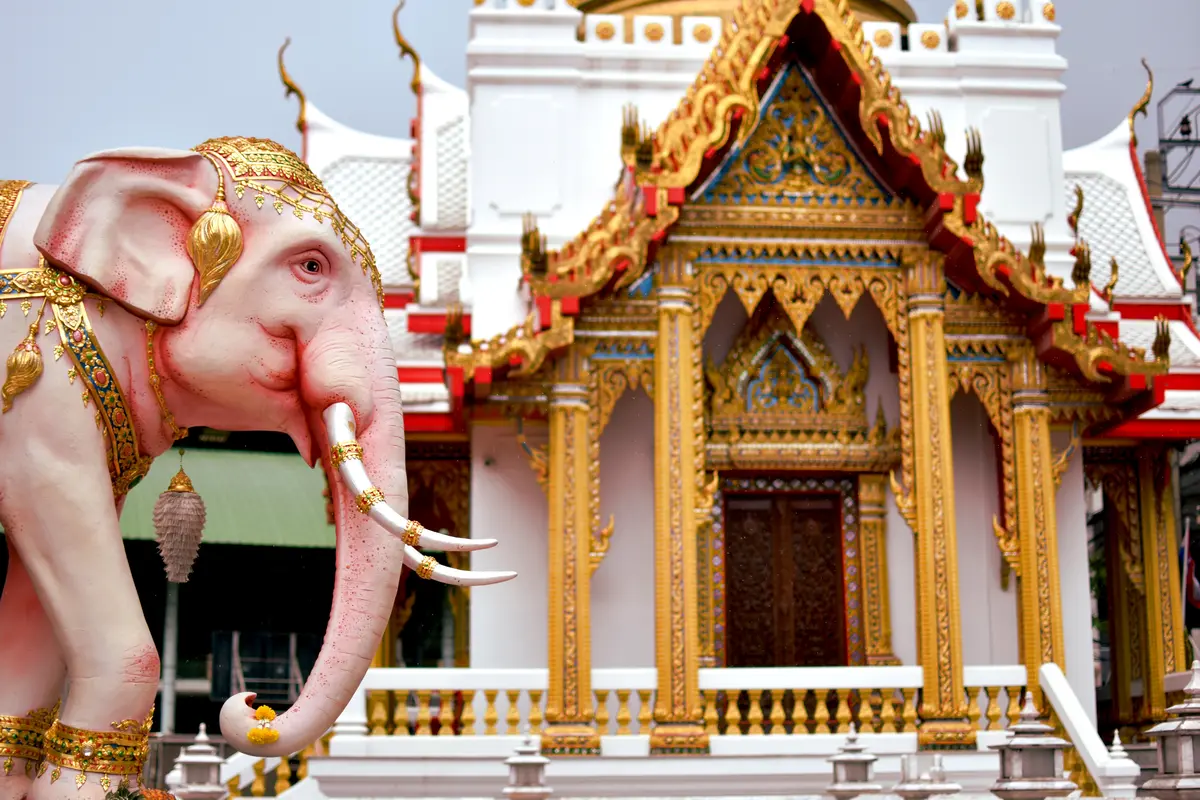
What there is to see: the new ordination hall, ten by thirty metres and faced entirely in marble, whose principal image is Phra Si Sakkaya Phutthawong Muni, a copy of the Phra Phuttha Chinnarat with a lap width of four sok nine nio; the older hall with the Sukhothai-style Luang Pho Phuttha Sukho Aphirochana; the Phra Borommathat Chedi Si Thammarat, where relics brought from Sri Lanka in 2006 have been permanently enshrined since 26 May 2022; and, in front of the vihara, the statue of Luang Pho Prong, abbot from 1952 to 1973. The votive elephants at the gate, garlanded with marigolds, are offerings left by people whose wishes were granted.
This is a living royal monastery and, above all, a funeral temple: the temple directory dhammathai counts eleven pavilions for funeral rites, and on most days that is what a visitor will walk into. Dress and behave accordingly — covered shoulders and knees, shoes off indoors, no photographs of mourners. There is no admission charge, and I could find no published opening hours; there is also nothing to buy, no ghost tour and no night visit. Anyone who comes hoping to see two women in black will be standing at the roadside of a busy commuter railway, in front of a working crematorium, and should have the decency to be quiet about it.
Sources consulted
- Chayanit Itthipongmaetee, «Cut Into Pieces: The Haunting of Wat Samian Nari» — Khaosod English, 2016 newspaper archive
- «ตำนานผู้หญิงชุดดำสุดหลอน แห่งวัดเสมียนนารี (The terrifying legend of the women in black of Wat Samian Nari)» — สำนักข่าวไทย อสมท (Thai News Agency, MCOT), 2020 newspaper archive
- «ประวัติวัดเสมียนนารี พระอารามหลวง (History of Wat Samian Nari, royal monastery)» — วัดเสมียนนารี พระอารามหลวง — official site of the temple web
- «วัดเสมียนนารี (Wat Samian Nari), entry in the Thai temple directory, quoting the records of the Department of Religious Affairs» — ธรรมะไทย (dhammathai.org) web
- «คลองเปรมฯ ถนนการค้า ที่มาเขตหลักสี่...หลักหก (Khlong Prem, road of trade: where the districts of Lak Si and Lak Hok get their names)» — ไทยรัฐ (Thairath), print edition, 2019 newspaper archive
- «“ในหลวง” โปรดเกล้าฯ ยก 20 วัดราษฎร์เป็นพระอารามหลวง (The King raises twenty people's temples to royal monasteries)» — MGR Online, 2012 newspaper archive
- «เปิดเส้นทางใหม่ สถานีรถไฟบางซื่อ-วัดเสมียนนารี หลังอุโมงค์รถไฟเปิด 1 พ.ย.นี้ (New route Bang Sue–Wat Samian Nari as the railway underpass opens on 1 November)» — MGR Online, 2022 newspaper archive
- «เปิดแล้ว! รถไฟฟ้าสายสีแดง บางซื่อ-รังสิต และบางซื่อ-ตลิ่งชัน ประชาชนใช้ฟรี 4 เดือน (Red Line opens, free for four months)» — The Bangkok Insight, 2021 newspaper archive
- Thairath Studio, «“สาวชุดดำวัดเสมียนนารี” กับคนต้นเรื่องที่ปลุกตำนานความสยอง — สถานีผีบอก EP.13 (interview with Somkiat Sapchalerm)» — ไทยรัฐ (Thairath), 2024 interview
- «ย้อนตำนานความน่ากลัวของสาวชุดดำวัดเสมียนนารี (Looking back at the legend of the women in black of Wat Samian Nari), forum thread reproducing a post from modxtoy.com» — MThai Talk, 2014 web
- «ลำดับเจ้าอาวาสวัดเสมียนนารี (List of the abbots of Wat Samian Nari)» — วัดเสมียนนารี พระอารามหลวง — official site of the temple web
- «ตายสยอง! รถไฟขยี้ร่างหนุ่มนิรนามหัวขาดกระเด็นหน้าวัดเสมียนนารี (Gruesome death: train mangles unidentified man, head severed, in front of Wat Samian Nari)» — ข่าวสด (Khaosod) newspaper archive
Reviewed by V. Serrano on 2026-08-21 · How we verify our content
💬 Field testimonies (0)
No testimonies yet. Add the first.
Add your testimony
🔒 Log in to add a testimony