👻 HAUNTED PLACE · EXP. Nº9475
ACTIVE
Government House (Thailand)
Government House in Bangkok is the working seat of the Thai prime minister and cabinet, and it began life as a private mansion.
Where is Government House (Thailand)?
- Location
- Bangkok, Thailand
- Type
- Public building
- Coordinates
- 13.763, 100.512
- Last updated
LOCATION
Why is Government House (Thailand) said to be haunted?
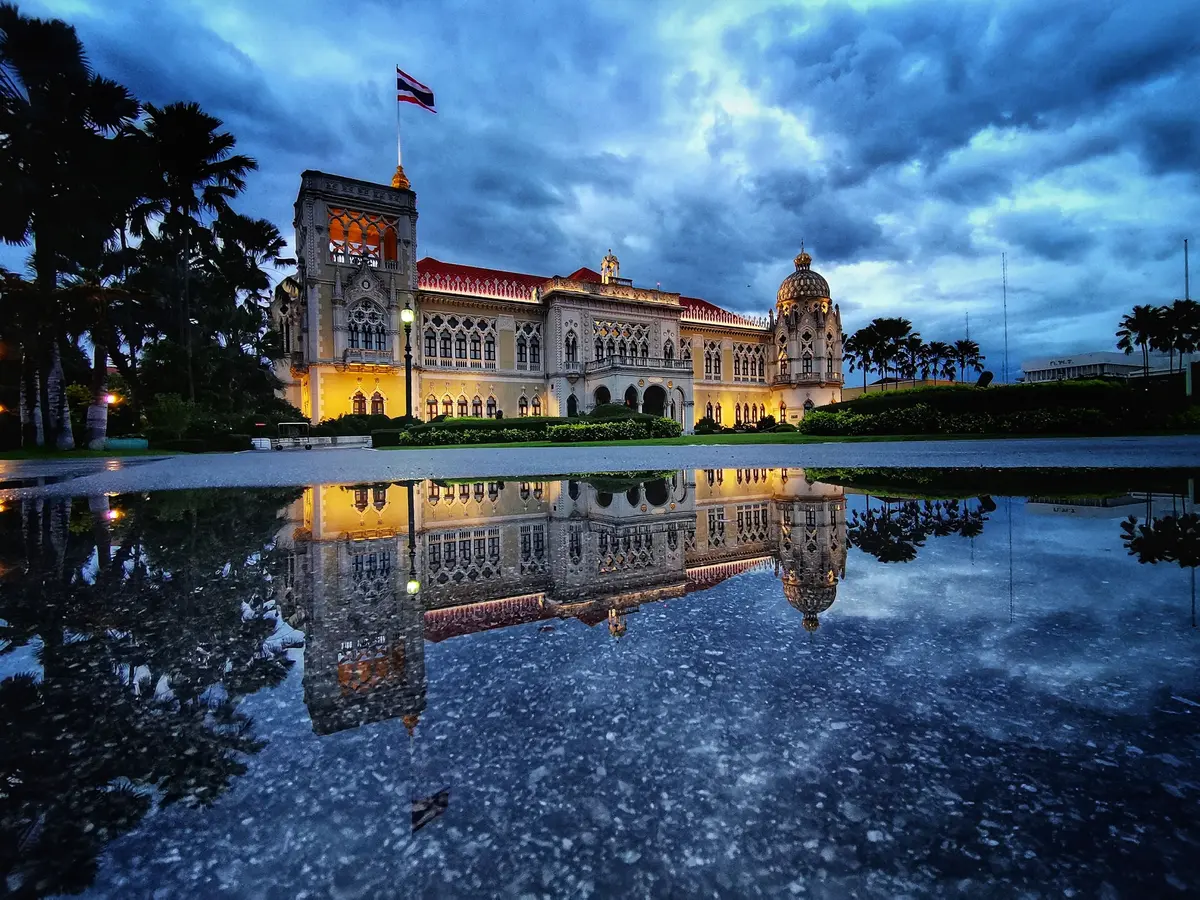
Baan Norasingh was built from 1923 to designs by the Italian architect Annibale Rigotti for Chao Phraya Ram Rakop, the son of King Vajiravudh's wet nurse and the closest of his attendants. Its main pavilion, the Thai Khu Fah building, is neo-Venetian Gothic with a gilded dome and a facade modelled on the Ca' d'Oro on the Grand Canal, and since 1964 it has carried a four-faced Phra Phrom on its roof. The government bought the house in 1941 and has worked there ever since. Its ghost stories are quieter than the ones told in its name: a 2010 Post Today feature collected anonymous night-shift accounts of a man in Sixth Reign court dress and a boy with a topknot, all of them in the Nari Samosorn press building. The famous tales - the cleaner in a trance, the guardian spirit, the two prime ministers who dared - belong to Ban Phitsanulok, the residence a few hundred metres east that Vajiravudh built for Ram Rakop's brother.
What is the history of Government House (Thailand)?
Government House was never designed to be a seat of government. It was a private mansion called Baan Norasingh, and the reason it exists is a wet nurse.
Chao Phraya Ram Rakop, born Mom Luang Fuea Phueng Bun on 5 October 1890, was the son of Phra Nom That, wet nurse to King Vajiravudh (Rama VI). He entered the future king's service in 1908, carried the sword of state at the coronation in 1910, and spent the reign closer to the monarch than almost anyone else. In 1923 Vajiravudh commissioned a mansion for him on Phitsanulok Road in Dusit and gave the work to Annibale Rigotti, the Italian architect who had already worked on the Ananta Samakhom Throne Hall and who served as chief architect of the Public Works Department during his second Bangkok stay of 1923 to 1926. Rigotti and his colleagues called it Villa Norasingh.
The name is not decorative. Narasingha is Vishnu in the form of the man-lion who tears open the demon Hiranyakashipu, and it was the emblem of the Department of Entertainment that Ram Rakop commanded. A full statue of the man-lion once stood on the lawn in front of the main building; nobody now records where it went.
The king died in 1925 with the house unfinished, and Rigotti went home to Italy. Corrado Feroci - the sculptor Thailand knows as Silpa Bhirasri - and the architect Ercole Manfredi finished it. The result is the Thai Khu Fah building: two storeys of neo-Venetian Gothic with Byzantine detailing and fresco secco, its facade taken from the Ca' d'Oro on the Grand Canal in Venice, a gilded dome over the south tower, and, from 26 April 1964, a four-faced, four-armed Phra Phrom installed on a plinth on the roof terrace.
Ram Rakop could not afford it. In March 1941 he wrote to the finance minister, Pridi Banomyong, offering the house to the state for two million baht because it was grander than his station and cost too much to keep. The ministry refused. That September the prime minister, Field Marshal Plaek Phibunsongkhram, decided the government should have it as a state guest house, and the sale went through at one million baht, paid from the Privy Purse with the approval of the regents acting for the boy king Ananda Mahidol. Phibunsongkhram moved the prime minister's office onto the site on 30 March 1942. The compound was renamed Thamniap Samakkhi Chai and then, simply, Thamniap Ratthaban - Government House. The cabinet resolved to buy the property outright from the Crown Property Bureau on 29 November 1963 for 17,780,802.36 baht, and the title was finally transferred on 1 October 1969.
Vajiravudh had built a second Venetian Gothic mansion a few hundred metres east, Baan Banthom Sin, designed by Mario Tamagno, for Ram Rakop's younger brother, Major-General Phraya Aniruthdeva. That house is today Ban Phitsanulok, the prime minister's official residence. The two mansions on Phitsanulok Road are brothers' houses, and almost every ghost story attached to Government House actually belongs to the other one.
Timeline: the documented record of Government House (Thailand)
- 1923 King Vajiravudh commissions a mansion on Phitsanulok Road for Chao Phraya Ram Rakop, son of his own wet nurse, and gives the design to the Italian architect Annibale Rigotti, who is in Bangkok as chief architect of the Public Works Department. Rigotti's circle call it Villa Norasingh.
- 1925 Vajiravudh dies with the house unfinished and Rigotti returns to Italy. The sculptor Corrado Feroci and the architect Ercole Manfredi complete the Thai Khu Fah building, whose facade copies the Ca' d'Oro in Venice.
- March and September 1941 Ram Rakop writes to finance minister Pridi Banomyong offering the house to the state for two million baht because he cannot maintain it; the ministry refuses. That September Field Marshal Plaek Phibunsongkhram decides the government should buy it, and the sale closes at one million baht.
- 30 March 1942 Phibunsongkhram moves the prime minister's office onto the site. The compound is renamed Thamniap Samakkhi Chai and then Thamniap Ratthaban - Government House.
- 26 April 1964 A four-faced, four-armed image of Phra Phrom is installed on a plinth on the roof terrace of the Thai Khu Fah building. It is the figure whose eyes protesters would later smear with wax.
- 1 October 1969 Title to the property passes to the state at the Phra Nakhon land office, completing a purchase from the Crown Property Bureau agreed by the cabinet on 29 November 1963 for 17,780,802.36 baht.
- 1989 The Association of Siamese Architects under Royal Patronage gives the Thai Khu Fah building its award for outstanding architectural conservation.
- 26 August to December 2008 The People's Alliance for Democracy occupies Government House in an action it names Operation Thai Khu Fah. Post Today later reports black yantra cloths pinned at more than ten points across the compound and the roof Brahma found with wax over its eyes.
- 16 March 2010 Supporters of the United Front for Democracy Against Dictatorship pour donated blood over the gates of Government House as a political ritual. Human Rights Watch documents the episode in its 2011 report on the protests.
- 15 October 2010 Post Today publishes the only substantial account of Government House's own ghost stories, by Nitiphan Suk-arun. Every episode is set in the Nari Samosorn building, no witness is named, and the article states that there is no record of who the man in Sixth Reign dress and the boy with a topknot are supposed to be.
- 21 November 2022 The director-general of the Fine Arts Department, Phanombutr Chantrachoti, signs the announcement registering Government House as an ancient monument under section 7 of the 1961 Act, with a protected area of about 52 rai 1 ngan 93 square wah. It is published in the Royal Gazette on 25 January 2023, together with a parallel registration of Ban Phitsanulok.
- 10 September and 31 October 2023 Matichon publishes General Fuangchaloey Aniruthdeva's flat denial that Ban Phitsanulok is haunted. Seven weeks later The Nation publishes the feature about that same house - the cleaner in a trance, the two prime ministers, the guardian spirit - which is the origin of the ghost stories now told about Government House.
- 14 February 2024 An editor adds the category "Reportedly haunted locations in Thailand" to the English Wikipedia article on Government House, with no edit summary and no source. The change is 54 bytes. In 143 revisions the body of that article has never mentioned a ghost.
- 10 January 2026 Government House opens for National Children's Day. Prime Minister Anutin Charnvirakul presides, 58 public and private bodies take part, and children are let into the Thai Khu Fah building to sit in the prime minister's chair. It is the one regular occasion on which the public is let inside.
Is there a rational explanation for Government House (Thailand)?
Start with the question nobody asks: why is Government House filed as a haunted place at all?
The English Wikipedia article has existed since September 2008 and has been edited 143 times. In its current 7,095-byte source the word "haunted" appears exactly once, in a category line; ghost, spirit, apparition and supernatural appear zero times, while Rigotti, Vajiravudh and Phitsanulok appear as expected. A binary search across the 143 revisions puts the first appearance of that word at a single edit of 14 February 2024, made without an edit summary, which added one line - the category "Reportedly haunted locations in Thailand". The whole change weighs 54 bytes. No source was attached to it, then or since. The Thai Wikipedia list of reportedly haunted places in Thailand gives Government House one unsourced sentence beginning "there is a rumour that".
The stories that circulate in English are worse than unsourced: they are about a different building. A feature published by The Nation on 31 October 2023, written by Chanapat Komlongharn, describes a cleaner who dropped to her hands and knees and scrubbed the floor muttering in an ancient tongue until her colleagues sprinkled her with holy water; says that only two prime ministers ever dared live in the house; and names its guardian spirit as Tao Hirunpanasoon. Every word of that article is about Ban Phitsanulok, the prime minister's residence several hundred metres away. It does not mention Government House once. Thao Hiran Phanasun is not a ghost of this compound either: it is the personal guardian deity of Rama VI, and the silver image the king gave to Phraya Aniruthdeva was enshrined in a small shrine on the wall of Baan Banthom Sin - that is, at Ban Phitsanulok.
The family who actually lived in that house denies the whole thing. General Fuangchaloey Aniruthdeva, a descendant of Phraya Aniruthdeva who lived in the house as a boy and whom Matichon describes as the family's only surviving male heir, told the paper on 10 September 2023: "There are no ghosts in Ban Phitsanulok. If there were, I would have met them. I lived there a long time and never met one." The former deputy prime minister Wissanu Krea-ngam has given the mundane explanation for why prime ministers do not sleep there: the house is acoustically transparent, so the traffic and noise of the city arrive inside undiminished and a nervous occupant hears ghosts. A senior journalist quoted by ReadTheCloud gave a duller reason still - the house is empty, with no furniture to live with.
Government House does have accounts of its own, and they are more modest than the imported ones. The fullest account I have been able to find is a Post Today feature of 15 October 2010 by Nitiphan Suk-arun, which places them all in the Nari Samosorn building, the press-briefing block where Phibunsongkhram once kept a bedroom because he worked late: officials on night shift describing the shadow of a man in chong kraben and a closed-collar shirt, the dress of a Sixth Reign courtier, at around one in the morning; one who saw a boy with a topknot beckoning him to come and play; otherwise footsteps and doors. No witness is named and no date is given, and the article itself says there is no record establishing who the man and the boy are meant to be.
The occult traces at Government House, by contrast, are documented - and they were brought in from outside. During the People's Alliance for Democracy occupation that began on 26 August 2008 under the name "Operation Thai Khu Fah", Post Today reports black yantra cloths pinned to Banchakan 1 and 2, Santi Maitri and Thai Khu Fah at more than ten points, and the Brahma image on the Thai Khu Fah roof found with wax smeared over its eyes and gold leaf pressed on top. On 16 March 2010, in a separate protest, United Front for Democracy Against Dictatorship supporters poured donated blood over the gates. Whatever else those are, they are political ritual with a date and a purpose, not a haunting.
One test that usually decides these cases does not apply here, and it is worth saying why. Government House sells nothing. As of August 2026 I can find no ticket, no tour operator, no ghost walk and no Halloween event attached to it, and no commercial page that trades on its reputation. Nobody makes money from calling it haunted, which is exactly why nobody has bothered to check whether it is.
Can you visit Government House (Thailand)?
Government House occupies a compound at 1 Phitsanulok Road in the Dusit district of Bangkok, postcode 10300. Phitsanulok Road runs along its northern side and Luk Luang Road along its southern one, with the front of the compound facing east towards Nakhon Pathom Road and the Khlong Prem Prachakon.
The compound is a working seat of government and its gates are guarded. Entry is by accreditation or by invitation, and there is neither a ticket office nor a visitor centre.
The Fine Arts Department registered the whole compound as an ancient monument on 21 November 2022, under section 7 of the Ancient Monuments Act B.E. 2504; the announcement, headed «ขึ้นทะเบียนและกำหนดเขตที่ดินโบราณสถาน», was published in the Royal Gazette on 25 January 2023 and fixed the protected area at 52 rai 1 ngan 93 square wa, some 8.4 hectares.
The one regular opening is National Children's Day, the second Saturday in January. The Government Public Relations Department announced the 2026 edition for Saturday 10 January. Activities were run by 58 government and private bodies, the ceremony was opened by Prime Minister Anutin Charnvirakul, and children were let into the Thai Khu Fah building to sit in the prime minister's chair for a photograph.
Ban Phitsanulok, where the best-known stories are set, stands on the same road. It was registered in the same announcement and serves as a state residence and guest house.
Sources consulted
- นิติพันธุ์ สุขอรุณ (Nitiphan Suk-arun), «เรื่องเล่าลี้ลับ "ทำเนียบรัฐบาล" (Mysterious tales of Government House)» — Post Today, 2010 newspaper archive
- Komchadluek, «ราชกิจจาฯ ประกาศกรมศิลปากร ขึ้นทะเบียน เขตที่ดินโบราณสถาน "ทำเนียบรัฐบาล" — transcription of the Fine Arts Department announcement of 21 November 2022 registering Government House as an ancient monument» — คมชัดลึก (Komchadluek), 2023 newspaper archive
- Khaosod, «กรมศิลปากร ประกาศขึ้นทะเบียน ทำเนียบรัฐบาล-บ้านพิษณุโลก เป็นโบราณสถาน» — ข่าวสด (Khaosod), 2023 newspaper archive
- Matichon, «'ถ้ามี (ผี) ผมต้องเจอ' เปิดถ้อยคำทายาทพระยาอนิรุทธเทวา 'บ้านพิษณุโลก' ฉากสำคัญ ปวศ.การเมืองไทย» — มติชนออนไลน์ (Matichon Online), 2023 interview
- Thai PBS News, «ส่องตำนาน "บ้านนรสิงห์" ถึง "ทำเนียบรัฐบาล" (citing the official volume หนังสือทำเนียบรัฐบาล พ.ศ. 2563)» — Thai PBS, 2023 newspaper archive
- กรมประชาสัมพันธ์ (Government Public Relations Department), «นายกฯ อนุทิน เตรียมเปิดงานวันเด็ก 2569 ที่ทำเนียบฯ ชวนน้องๆ ร่วมเปิดประสบการณ์นั่งเก้าอี้นายกฯ พร้อมกิจกรรมจาก 58 หน่วยงานรัฐ-เอกชน» — prd.go.th, 2026 report
- English Wikipedia revision history, «Government House (Thailand): revision 1207480708 of 14 February 2024, adding Category:Reportedly haunted locations in Thailand (54 bytes, no edit summary, no source)» — Wikipedia, 2024 archive
- Thai Wikipedia, «ทำเนียบรัฐบาลไทย — history of Baan Norasingh, the Thai Khu Fah building and the installation of the Phra Phrom image on 26 April 1964» — วิกิพีเดีย, 2026 web
- Human Rights Watch, «Descent into Chaos: Thailand's 2010 Red Shirt Protests and the Government Crackdown» — Human Rights Watch, 2011 report
- Springnews, «เจ้าพระยารามราฆพ เจ้าของบ้านนรสิงห์ ก่อนเปลี่ยนเป็นทำเนียบรัฐบาล» — สปริงนิวส์ (Springnews), 2024 newspaper archive
- Chanapat Komlongharn, «The haunting legacy of Ban Phitsanulok - Thailand's very own White House» — The Nation Thailand, 2023 newspaper archive
- อนันต์ ศรีสุข (Anan Srisuk), «บ้านพิษณุโลก อายุร้อยปีที่ทุกนายกฯ มีสิทธิ์อยู่แต่ไม่กล้าพัก — includes Wissanu Krea-ngam's acoustic explanation» — ReadTheCloud, 2026 web
- Thai Wikipedia, «ท้าวหิรัญพนาสูร — origin of Rama VI's personal guardian deity and the four silver images, including the one enshrined at Baan Banthom Sin (today Ban Phitsanulok)» — วิกิพีเดีย, 2026 web
Reviewed by V. Serrano on 2026-08-20 · How we verify our content
💬 Field testimonies (0)
No testimonies yet. Add the first.
Add your testimony
🔒 Log in to add a testimony