👻 HAUNTED PLACE · EXP. Nº9475
ACTIVE
Lumphini Park
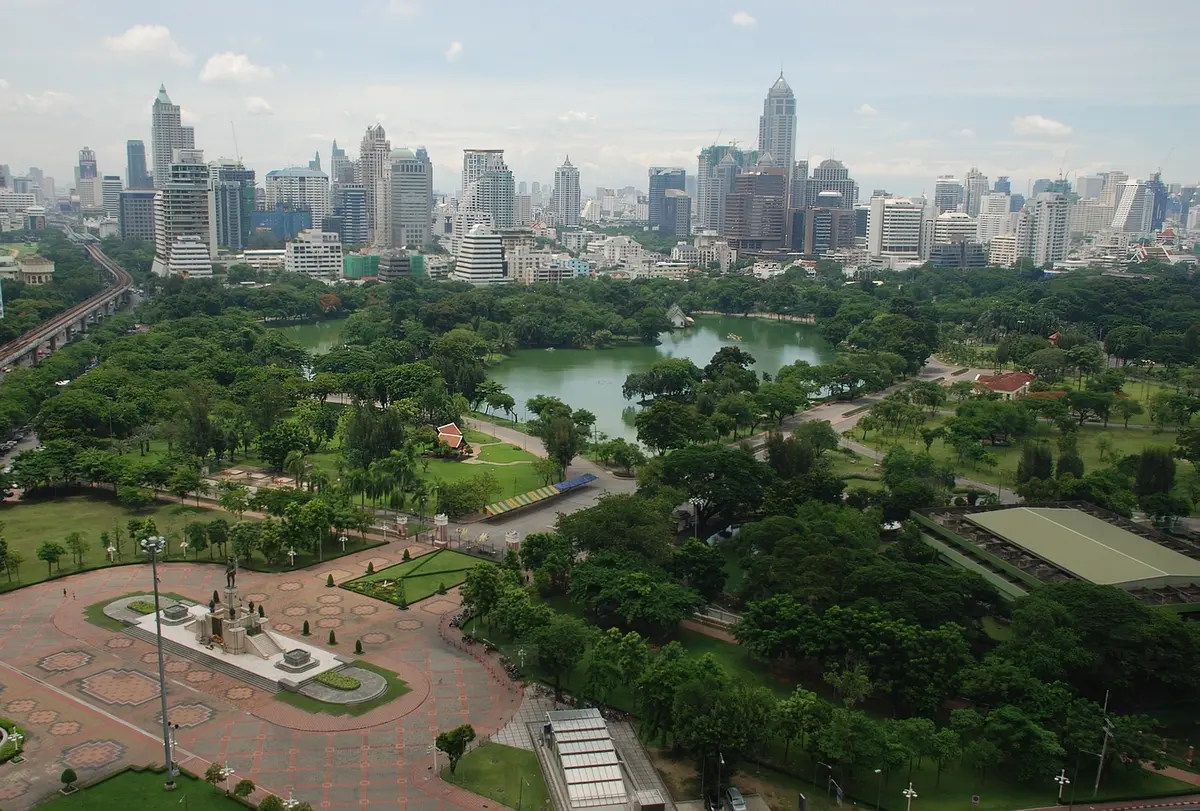
Lumphini Park is Bangkok's first public park: 57 hectares of lake and rain trees that King Vajiravudh (Rama VI) set aside for the city in 1925.
Where is Lumphini Park?
- Location
- Bangkok, Thailand
- Type
- Park
- Coordinates
- 13.731, 100.542
- Last updated
LOCATION
Why is Lumphini Park said to be haunted?
English-language blogs now credit it with a White Lady seen at dusk by joggers and cyclists, searching for something lost when the park was founded — a figure that appears in no Thai source of any kind. The ghost story Bangkok actually tells about Lumphini is stranger, and it can be dated to the day. On 18 June 2014 the broadcaster Thakerng Somsap, of the Bluesky channel that had been the anti-government movement's own television, published what protesters said had happened to them while they camped in the park for 71 days: an elderly couple in traditional chong kraben glimpsed inside an old wooden house, a two-year-old calling grandma at its door, and a volunteer guard who emptied a revolver into a rain tree at four in the morning. From that single post the story reached English Wikipedia in 2017 and this catalogue after that. Here is the documented park, the documented camp, and exactly how far the haunting can be traced.
What is the history of Lumphini Park?
The 360 rai (57.6 ha) between Rama IV, Ratchadamri, Witthayu and Sarasin roads were once Thung Sala Daeng, 'Sala Daeng field', the private property of King Vajiravudh (Rama VI). In 1925, his fifteenth year on the throne and with the Siamese economy still flat after the First World War, the king set aside what was left of the land after Chulalongkorn University had been carved out of it and announced a trade and natural-resources exhibition, the Siamrat Phiphitthaphan, modelled on Western expositions. He put up his own money for the groundworks, and said that when the fair closed the site should become a botanical garden where the public could study and rest. A lake was dug, an island raised in the middle of it, roads cut and permanent structures built, among them a clock tower designed by the Italian architect Mario Tamagno. The king gave the place the name Lumphini, after Lumbini in Nepal, the Buddha's birthplace. The fair was to open on 23 January of the Siamese year 2468 — January 1926 by modern reckoning. Vajiravudh died on 26 November 1925 and it was cancelled.
What followed was three decades of neglect that the park's own centenary literature does not dwell on. The structures were dismantled and the ground left to scrub. From 1927 the Interior Ministry's municipal works department began carting Bangkok's rubbish into the large pond at the north-east corner; the water rotted, mosquito larvae bred, and the drainage to the canal was blocked. Chao Phraya Bodindecha Nuchit and the European residents around the park petitioned against it. The tipping continued until the pond was full in 1929 and the complainants moved away. Prince Boriphat, the interior minister, explained that the smell affected only 'a minority of noses, which happen to be Chao Phraya Bodindecha's and the foreigners''.
In 1928 Phraya Khathathorn Bodi Siharat Balamueang, a former police inspector-general close to the late king, leased 90 rai on the south side and turned it into an amusement ground, Suan Sanuk (in Lumpini), with kite fights, cattle races, swings and a carousel for ten to twenty-five satang. King Prajadhipok (Rama VII) opened it himself on 7 November 1929. When it closed, the park went back to waste ground — and, according to the Thai record, to a place where murders were frequent. Improvements resumed in 1935; the Singapore Tiger Balm magnate Aw Boon Haw paid for a children's sports ground. During the Second World War the park was a Japanese army camp. The monument to Rama VI at the south-west corner, modelled by Silpa Bhirasri (the Italian sculptor Corrado Feroci), was inaugurated in 1942, on the king's birthday. Between 1952 and 1956 the Constitution Celebration fair moved here from Saranrom Park, bringing beauty contests and Western ballroom dancing; the Lumphini Sathan hall was finished in 1953 to house the dancing.
The episode that produced the ghost story is recent and very well documented. On 2 March 2014 the People's Democratic Reform Committee (PDRC) ended its 'Bangkok Shutdown' of the city's main intersections and consolidated its entire occupation inside Lumphini Park. Thousands of protesters lived there for 71 days, in six zones organised as 'villages' — Lat Phrao village, Pathum Wan village and others — sleeping in tents, with field kitchens, showers and latrines of bamboo and blue plastic sheeting. Suthep Thaugsuban gave his last Lumphini speech on the night of 11 May 2014 and the camp moved to Ratchadamnoen Nok; on 13 May some 300 park staff and district cleaners started clearing the rubbish, and where the tents had stood the grass came up pale from months without sun. Ten days later the army seized power.
The park turned a hundred in 2025. The Bangkok Metropolitan Administration had been preparing for the anniversary since 2015: restoration of the Rama VI monument and its plaza, the clock tower, the Lumphini Sathan hall, the Chinese pavilion, the public library, the fences and the playgrounds, plus a skywalk to Benjakitti Park, a dog park and a hawker centre. King Vajiralongkorn and Queen Suthida presided over the opening day of the centenary celebrations on 25 April 2025.
Timeline: the documented record of Lumphini Park
- 1925 King Vajiravudh sets aside Thung Sala Daeng for the Siamrat Phiphitthaphan exhibition, funds the groundworks himself and names the future park Lumphini, after the Buddha's birthplace. A lake, an island and Mario Tamagno's clock tower go up.
- 26 November 1925 Vajiravudh dies two months before the fair is due to open on 23 January 2468 (January 1926). The exhibition is cancelled and the site is left to scrub.
- 1927–1929 Bangkok's rubbish is tipped into the park's north-east pond until it is full. Chao Phraya Bodindecha Nuchit and the European neighbours petition; the interior minister replies that the stench bothers only 'a minority of noses'.
- 7 November 1929 King Prajadhipok opens Suan Sanuk (in Lumpini), the amusement ground leased on 90 rai of the south side. After it closes the park returns to waste ground, and Thai accounts describe it as a place where murders were frequent.
- 1942 The monument to Rama VI, modelled by Silpa Bhirasri, is inaugurated at the south-west corner. During the war the park serves as a Japanese army camp — the fact later used to explain the supposed bones under the lawns.
- 2 March 2014 The PDRC ends its 'Bangkok Shutdown' and moves its whole occupation into Lumphini Park, laying out six zones organised as villages.
- 11–13 May 2014 Suthep Thaugsuban gives his last Lumphini speech on the 11th and the camp leaves for Ratchadamnoen; on the 13th some 300 staff begin the clean-up. The Bangkok Post puts the occupation at exactly 71 days — the same figure the ghost account gives.
- 18 June 2014 The Bluesky broadcaster Thakerng Somsap publishes the account of the camp's hauntings, told to him that lunchtime by PDRC leader Sathit Wongnongtoey: the old couple in chong kraben inside the wooden house, the toddler calling 'grandma', and the guard 'Son' firing six shots into a rain tree at four in the morning. This is the earliest telling of the Lumphini ghost story that can be dated.
- 20 November 2017 The story crosses into English: the Wikipedia list of reportedly haunted locations in Thailand is created with a Lumphini Park entry citing Thakerng Somsap's post, and describing a 'haunted wooden house', a 'shrill cry' at night and a guard 'possessed at dawn'.
- 2018 A visitor asks a Bangkok travel forum whether the park is haunted, citing that Wikipedia entry. Residents reply that they have never heard of it and explain that in local slang 'Lumpini ghosts' means the sex workers who work the railings after midnight.
- 14 February 2024 An editor adds the category 'Reportedly haunted locations in Thailand' to the foot of the Lumphini Park article, with no edit summary, no source and no change to the text. That invisible line is what feeds the park into scraped haunted-place datasets, this catalogue included.
- 25 April 2025 King Vajiralongkorn and Queen Suthida preside over the opening of the park's centenary celebrations, after a decade of restoration works on the monument, the clock tower, the Chinese pavilion and the library.
- 15 September 2025 The Guardian reports that about 400 Asian water monitors live in the park, counted by the city, most visible at first light — the same hour to which the ghost accounts keep returning.
Is there a rational explanation for Lumphini Park?
Start with what is not there. The 'White Lady of Lumphini' — the figure in white glimpsed at dusk by joggers and cyclists, searching for something lost when the park was founded — is a Western ghost-story template, and it does not appear in any Thai-language account of the place that I could find. In the only substantial Thai text about ghosts in Lumphini, Thakerng Somsap's of 18 June 2014, the word phi (ghost) appears twelve times and yai (grandmother) fourteen; 'white', 'dressed in white', 'jogger' and 'cyclist' appear zero times each. The version in English-language blogs, in which she is a beautiful girl who fell in love with a foreigner and killed herself over an arranged marriage, has no archived life at all: the page carrying it has never been captured by the Wayback Machine.
The story that does exist is anonymous where it matters. Thakerng Somsap heard it at lunch on 18 June 2014 from Sathit Wongnongtoey, a PDRC leader and former minister, who was in the park looking for a site for a PDRC museum, and wrote it up that night from Sathit's brother Sathorn and from an aide to a Bangkok deputy governor he calls only 'X'. Every witness is a first name or a nickname: 'Win', the young man from Songkhla who saw an elderly couple in chong kraben inside the wooden house; 'Tangton', a boy of not quite two who called 'grandma' at its door; 'Son', the volunteer guard who woke under the rain tree, saw one man and two women in antique dress sitting on the branches with their legs hanging down, and emptied his revolver into them. The teller was a presenter on Bluesky, the satellite channel aligned first with the Democrat Party and then with the PDRC itself — the movement's own broadcaster reporting a marvel from the movement's own camp, six weeks after the camp had gone and four weeks after the coup. His closing line is the Thai formula for exactly this kind of material: 'If you don't believe it, that's all right — but please don't scoff.'
Some of it can be tested. Six pistol shots at four in the morning inside a fenced public park held by thousands of people is not a small event, and the Bangkok Post was covering the camp closely enough to interview the cleaners about the rubbish; I have found no report of the shooting, and after it, by the account itself, 'Son' was never seen in the camp again. The claim that the park's name replaced an older one, Suan Khrang, 'the moaning garden', because people heard groaning there, is contradicted by the documented naming: the ground was Thung Sala Daeng and Vajiravudh chose Lumphini for the Buddha's birthplace. The claim that bones dug up in the park are kept at its Chinese pavilion is harder to test, but that pavilion carries a modern dedication to a royal seventy-second birthday, and neither the park's own illustrated map of twenty-eight numbered features nor the Thai encyclopaedic description of its contents lists the century-old wooden house at all — though the same map does list the Chinese pavilion, so the absence is not for want of looking.
There is also a plain physical answer for shapes moving in the undergrowth at dawn. About four hundred Asian water monitors live in Lumphini, the second-largest lizard in the world, up to two metres long; the Bangkok authorities count them and try to keep the number below four hundred, and dozens were caught and relocated in 2016. They are most visible exactly at first light, the hour the story keeps returning to. In Thai the animal's name, hia, is a serious insult, and it has long been treated as a creature of ill omen — which does not make an apparition of it, but does mean that the park's night belongs to something large, dark and quick that daytime visitors rarely see, because the gates do not open until half past four in the morning — and the PDRC campers were among the very few people ever to spend their nights inside.
Finally, the reason this entry exists at all is traceable. The story reached English on 20 November 2017, in the first version of the Wikipedia list of reportedly haunted locations in Thailand, cited to Thakerng Somsap's post. The Lumphini Park article itself carried no ghost material and no such category until 14 February 2024, when an editor added 'Reportedly haunted locations in Thailand' to the bottom of the page with no edit summary, no reference and no change to the text. That silent category is what put Lumphini Park into scraped 'haunted places' datasets, this one included. Meanwhile, when a visitor asked on a Bangkok travel forum in 2018 whether the park was haunted, the residents who answered had never heard of it, and one pointed out that in Bangkok slang 'Lumpini ghosts' means the sex workers who work the park's railings after midnight.
Can you visit Lumphini Park?
Lumphini Park is a public park in Pathum Wan district, Bangkok, bounded by Rama IV, Ratchadamri, Witthayu and Sarasin roads. The main entrance is Gate 4, at the south-west corner, where the monument to King Vajiravudh (Rama VI), unveiled on 27 March 1942, stands. The Thai Wikipedia article on the park, read on 24 September 2026, gives its opening hours as 04:30 to 22:00 every day and names the MRT stations Si Lom and Lumphini and the BTS stations Sala Daeng and Ratchadamri as the nearest.
The same article records the centenary works that were completed in stages by April 2026. They renewed the fences, the playground and the exercise areas and refurbished the public library and the Green Bridge. A dog park built on part of the car park opened on 7 February 2026 and a hawker centre in April 2026. The library opens from 08:00 to 20:00, Tuesday to Sunday. The Green Bridge, a raised walkway with a cycle lane, leaves the north-east corner for Benjakitti Park. On the lake the Bangkok Metropolitan Administration runs a pedal-boat service.
The Guardian reported in September 2025 that about 400 Asian water monitors live in the park, a species that grows to about two metres. The city counts them because large reptiles cause "fear and disturbance during rest or exercise" and can be a hazard on the roads. Wildlife officials captured and relocated dozens of them in 2016. The same report describes joggers on the paths and weightlifters at the outdoor gym shortly after dawn.
The 2014 ghost account points to no signposted place. Its wooden house is not among the 28 numbered features on the park map published on lumpinipark.com (archived copy of 4 March 2016), a map that does show the clock tower, the Chinese pavilion and Lumphini Sathan hall. The only location ever offered for the house is a comment of 19 June 2014 under the OKnation repost of the story, in which the blogger who reposted it answered a commenter that it was "probably near the Witthayu Road side". The clock tower is Mario Tamagno's work of 1925 and Lumphini Sathan hall dates from 1953; the Thai Wikipedia article lists both, with the Chinese pavilion, among the centenary restorations.
Sources consulted
- Thakerng Somsap, reposted by the blogger 'Singh Nok Rabop', «อาถรรพ์...สวนลุมพินี เรื่องผีระหว่างการชุมนุม กปปส. (The curse of Lumphini Park: ghost stories during the PDRC rally)» — OKnation (archived, Wayback Machine), 2014 archive
- Apinya Wipatayotin and Supoj Wancharoen, «Lumpini Park clean-up starts» — Bangkok Post (archived, Wayback Machine), 2014 newspaper archive
- Aekarach Sattaburuth and Lamphai Intathep, «PDRC ends Lumpini stronghold» — Bangkok Post (archived, Wayback Machine), 2014 newspaper archive
- Gloria Dickie, «'You're going about your day and suddenly see a little Godzilla': Bangkok reckons with a giant lizard boom» — The Guardian, 2025 newspaper archive
- lumpinipark.com, «ประวัติสวนลุมพีนี (History of Lumphini Park), with the park's illustrated map of 28 numbered features» — Archived site (Wayback Machine, 4 March 2016), 2016 archive
- Thai Wikipedia contributors, «สวนลุมพินี (Lumphini Park)» — Thai Wikipedia, 2026 web
- Wikipedia editor AHI-3000, «Revision 1207480899: the edit that added the category 'Reportedly haunted locations in Thailand' to Lumphini Park» — English Wikipedia page history, 2024 archive
- Wikipedia editor Torpido, «List of reportedly haunted locations in Thailand, first version» — English Wikipedia page history, 2017 archive
- Bangkok forum contributors, «Is lumpini park haunted?» — Tripadvisor Bangkok forum, 2018 web
Reviewed by V. Serrano on 2026-08-13 · How we verify our content
💬 Field testimonies (0)
No testimonies yet. Add the first.
Add your testimony
🔒 Log in to add a testimony