📜 LEGEND · EXP. Nº0270
ACTIVE
The Pied Piper of Hamelin
Everybody knows the version with the rats in it. Hamelin's own oldest monuments do not.
Where does the legend of The Pied Piper of Hamelin come from?
- Location
- Hamelin, Lower Saxony, Germany
- Kind of legend
- Folk tale
- Coordinates
- 52.104, 9.356
- Last updated
LOCATION
What is the legend of The Pied Piper of Hamelin?
The town on the Weser keeps three things that point back to whatever happened: a stained-glass window that once stood in the market church and no longer exists, known only from people who saw it and wrote it down; an inscription cut in stone in 1556 for one of the town gates, which counts backwards rather than forwards — two hundred and seventy-two years since a sorcerer took a hundred and thirty children out of the town; and a verse on the Renaissance house now called the Rattenfängerhaus, saying that in the year 1284 a hundred and thirty children born in Hamelin were led astray by a piper and lost near the Koppen, remembered in the nineteenth century as the town's gallows hill. Read the three in order and something is missing. A sorcerer, a piper, a hill — and no rats anywhere.
What is the history of The Pied Piper of Hamelin?
Hamelin, on the Weser in Lower Saxony, keeps three monuments of the story. The first is a stained-glass window of the Marktkirche, the market church, which the public broadcasters' portal Planet Wissen dates to 1300; the original is lost, and the copy in the town museum was made in 1650 from eyewitness descriptions. The second is a gate stone of 1556 whose Latin inscription, transcribed by the Brothers Grimm, dates the founding of the gate 272 years after a magus, a sorcerer, led 130 children out of the town. The third is an inscription on the Rattenfängerhaus, the rat-catcher's house on the Osterstrasse, which Hermann Hoffmeister placed in 1881 on the wall facing the Bungelosenstrasse.
Planet Wissen transcribes the old inscription on a carved beam in that street: in the year 1284, on the day of Saints John and Paul, 26 June, 130 children born in Hamelin were led away by a piper dressed in many colours and lost at the Calvary by the Koppen. Hoffmeister dated the house, like the Hochzeitshaus on the same street, to the beginning of the seventeenth century, and quoted the verse on the Hochzeitshaus: "Nach Christi Geburt 1284 Jahr / Gingen bei den Koppen unter Verwahr / Hundertdreissig Kinder, in Hameln geboren, / Von einem Pfeifer verführt und verloren." He identified the Koppen as the town's gallows hill.
Bunge is an old word for a drum, and the Bungelosenstrasse is the drumless street. The Grimms wrote in 1816 that it still bore that name in the middle of the eighteenth century because no dancing took place in it and no stringed instrument might be played there, and that when a bride was taken to church with music the musicians fell silent as they crossed it. Planet Wissen reports that no music may be played in the street today and that bands stop playing there during processions.
Hoffmeister thought two explanations worth attention, the flagellant processions and St Vitus's dances of the late thirteenth century and the children's crusades, and credited a garrison preacher of Hamelin named Fein with a step forward in 1749. Fein linked the story to the battle of Sedemünder of 28 July 1259, in which the town's young fighting men fell against Bishop Wedekind of Minden or were taken prisoner, and the road to Sedemünder ran out of the Ostertor and over the Koppen. Planet Wissen lists plague, murder and recruitment by territorial lords for settlement in Moravia, East Prussia or Pomerania, along with the theory of a retired teacher, Gernot Hüsam, that the counts of Spiegelberg had the young people killed near the Koppenberg.
Timeline: the documented record of The Pied Piper of Hamelin
- c. 1300 A stained-glass window in Hamelin's Marktkirche is said to have shown the piper and the children. It is lost, and nothing survives of it directly: everything known comes from people who described it, and from a later reconstruction.
- 1556 An inscription cut for one of the town gates dates itself by the event: two hundred and seventy-two years since a sorcerer led a hundred and thirty children out of the town. A sorcerer, not a rat-catcher — and no rats.
- c. 1565 The Zimmerische Chronik of Count Froben Christoph von Zimmern gives the earliest version consulted here that has the rats in it: several hundred gulden are agreed for driving the vermin into a mountain, the fee is withheld, and the children go instead.
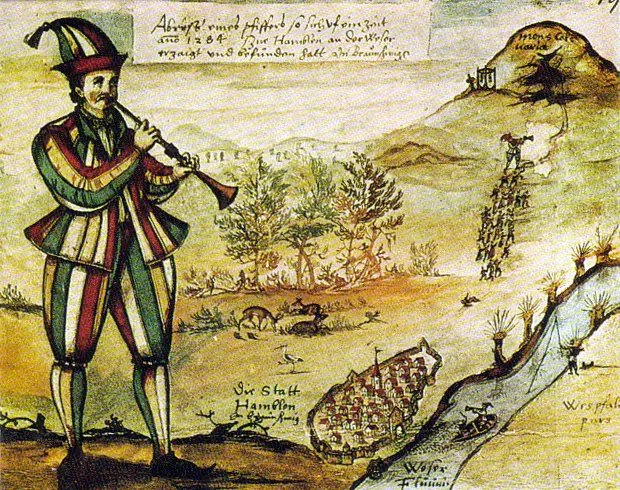
- 1592 A detailed coloured illustration of the piper and the children is made — one of the earliest surviving pictures of the scene, and the sort of image that fixed the story visually long before it was fixed textually.
- 1605 Richard Verstegan prints the first English account, in A Restitution of Decayed Intelligence. He keeps the hundred and thirty children but dates the event to 22 July 1376 — ninety-two years off Hamelin's own reckoning.
- c. 1650 The lost church window is reconstructed from descriptions handed down by those who had seen it. The image everybody now reproduces as the oldest depiction is therefore a copy made from memory, not the medieval original.
- 1749 Fein, a garrison preacher in Hamelin, proposes the first historical explanation to gain traction: the battle of Sedemünder of 28 July 1259, in which the town's young men fought the Bishop of Minden, some killed and others taken prisoner.
- 1816 Jacob and Wilhelm Grimm publish "Die Kinder zu Hameln" in Deutsche Sagen. Here a man in a coat of many colours, said to have been called Bundting, passes himself off as a rat-catcher, the fee is agreed, the rats and mice drown in the Weser and he returns dressed as a hunter, with a strange red hat. This is the version the world inherited.
- 1881 Hermann Hoffmeister surveys the town's evidence in Die Gartenlaube: the church window standing until a renovation in 1527, the verse on the Rattenfängerhaus facing the drumless street, the Koppen as Hamelin's gallows hill, and the Jesuit Athanasius Kircher as the man who first sent the children to Transylvania.
Is there a rational explanation for The Pied Piper of Hamelin?
The town's oldest inscriptions name a sorcerer and a piper, and neither mentions rats. The gate stone of 1556 speaks of a magus in its Latin, rendered "der Zauberer" in the German translation Planet Wissen prints, and the inscription on the Rattenfängerhaus speaks of a piper in many colours.
In writing, the rats are present by about 1565: in the Zimmerische Chronik, Count Froben Christoph von Zimmern tells of a stranger who offered to rid Hamelin of its rats for "several hundred gulden", drove them into the nearest mountain, was refused payment and led away the young children under eight or nine years old in their place. Hoffmeister, in 1881, described the stages from the town's own sources: the oldest verses quoted by Erich, a Hamelin pastor around 1650, said only that 130 children vanished on the Koppen, the gallows hill; a "Sachsenchronik" added a brightly dressed travelling musician; and a rhymed chronicle that Erich dated to 1589 made the piper a rat-catcher and set the year 1284.
The date moved with the teller: Richard Verstegan, printing an English account in 1605, kept the hundred and thirty children and set the event on 22 July 1376, ninety-two years after Hamelin's 1284. The Grimms noted that Seyfried read 22 June in the town book where others read 26 June.
The Grimms printed the full sequence in 1816: a strange man in a coat of many colours, said to have been called Bundting, who passed himself off as a rat-catcher, an agreed fee, rats and mice drowned in the Weser, a refusal to pay, and his return on 26 June dressed as a hunter, with a strange red hat.
The sources also disagree about the window: Hoffmeister wrote that the abductor and his victims were shown on a window of the market church until 1527, when it was renovated; the Grimms wrote that the mayor had the story portrayed in the church windows in 1572; and Planet Wissen dates the lost original to 1300 and the surviving reconstruction to 1650. Planet Wissen ends its survey of the theories by noting that other historians are sceptical of all of them, since there is no solid evidence for any.
Can you visit The Pied Piper of Hamelin?
Hameln lies on the Weser in Lower Saxony, about 40 km (25 miles) south-west of Hannover in a straight line. The tourist information office, run for the town by Hameln Marketing und Tourismus, is in the Infocenter at the eastern entrance to the old town, beside the Bürgergarten. The town's page for it, last updated on 30 June 2025 and read on 24 September 2026, gives its hours as Monday to Friday from 10am to 4pm and Saturday from 9.30am to 1pm, closed on Sundays and public holidays, with the telephone number +49 5151 957823.
The Rattenfängerhaus stands on Osterstrasse. Hermann Hoffmeister, writing in Die Gartenlaube in 1881, called it the "so-called" Rattenfängerhaus and dated it, like the Hochzeitshaus on the same street, to the late Renaissance at the beginning of the seventeenth century, more than three hundred years after the 1284 of the legend. He placed its inscription about the piper on the wall facing the Bungelosenstrasse, which he glossed as the "drumless" street. The public broadcasters' portal Planet Wissen reports that no music may be played in the Bungelosenstrasse and that bands fall silent there during processions. The verse on the Hochzeitshaus, as Hoffmeister transcribed it, reads: "Nach Christi Geburt 1284 Jahr / Gingen bei den Koppen unter Verwahr / Hundertdreissig Kinder, in Hameln geboren, / Von einem Pfeifer verführt und verloren."
Museum Hameln is at Osterstrasse 8-9, 31785 Hameln, in the pedestrian zone of the old town. Its permanent exhibition, "Hameln – Die Stadt des Rattenfängers", gives a section of its own to the legend, on which the museum says it holds "die wohl größte Sammlung weltweit", probably the largest collection in the world. The section ends in a Mechanical Pied Piper Theatre whose shows last about twelve minutes and usually run every hour. The museum's visit page, read on 24 September 2026, gives opening from Tuesday to Sunday, 11am to 6pm, with Mondays closed. Admission is 6 euros for adults (5 reduced) and 3 euros for children aged 6 to 17, and a family ticket for two adults and up to three children costs 12 euros; children up to 5 enter free. The exhibition floors are served by a central lift, platform lifts and a stair lift.
The Rattenfänger-Freilichtspiel, the open-air play given by an amateur company on the terrace of the Hochzeitshaus, lasts 30 minutes and is free. The town's page, updated on 22 September 2026, records that the 2026 season, the company's seventieth year, ended on 20 September, and that the 2027 season is planned from 16 May to 19 September, every Sunday at noon. The same page states that the play is entered on Germany's list of intangible cultural heritage.
Sources consulted
- Jacob and Wilhelm Grimm, «Die Kinder zu Hameln» — Deutsche Sagen, vol. 1, no. 244, pp. 330-333, Nicolaische Buchhandlung, Berlin (transcription of the 1816 edition), 1816 book
- Froben Christoph von Zimmern, «A Miracle of God at Hameln» — Zimmerische Chronik (c. 1565), ed. K. A. Barack, vol. 3, pp. 274-275, Litterarischer Verein, Tübingen 1869; English translation in D. L. Ashliman's source collection, University of Pittsburgh, 1565 book
- Richard Verstegan, «The Pide Piper» — A Restitution of Decayed Intelligence in Antiquities (first published 1605); text reprinted from the London 1628 edition, pp. 85-87, in D. L. Ashliman's Pied Piper source collection, University of Pittsburgh, 1605 book
- Hermann Hoffmeister, «Die Heimstätte der Rattenfängersage» — Die Gartenlaube, no. 23, pp. 372-375, Ernst Keil, Leipzig, 1881 newspaper archive
- Planet Wissen (WDR, SWR and ARD-alpha), «Der Rattenfänger von Hameln» — planet-wissen.de, German public-service knowledge portal (consulted 2026), 2026 web
- Museum Hameln, «Museum Hameln — Ihr Besuch» — museumhameln.de, official museum site (prices and hours consulted 2026), 2026 web
- Stadt Hameln, «Rattenfänger-Freilichtspiel: Story und Termine - 30 minutes, free, Sundays at noon; 2026 season ended 20 September, 2027 planned 16 May to 19 September» — hameln.de, official town portal (updated 22 September 2026), 2026 web
- Stadt Hameln / Hameln Marketing und Tourismus GmbH, «Tourist-Info - Infocenter beside the Bürgergarten, opening hours» — hameln.de, official town portal (updated 30 June 2025), 2025 web
- Museum Hameln, «Ausstellungen - permanent exhibition «Hameln – Die Stadt des Rattenfängers» and the Mechanical Pied Piper Theatre» — museumhameln.de, official museum site, 2026 web
Reviewed by V. Serrano on 2026-07-29 · How we verify our content
📎 Source: Enigma Atlas
💬 Field testimonies (0)
No testimonies yet. Add the first.
Add your testimony
🔒 Log in to add a testimony