👻 HAUNTED PLACE · EXP. Nº9475
ACTIVE
Frankenstein Castle
Frankenstein Castle is the most famous German ruin that almost certainly has nothing to do with the book it seems to be named after.
Where is Frankenstein Castle?
- Location
- Hesse (Mühltal, cerca de Darmstadt), Germany
- Type
- Castle
- Coordinates
- 49.793, 8.668
- Last updated
LOCATION
Why is Frankenstein Castle said to be haunted?
It stands above Mühltal, south of Darmstadt, and its documented history begins with a charter of 1252 naming Konrad Reiz von Breuberg. The one link to the novel is a coincidence of birth: Johann Conrad Dippel, alchemist, radical theologian and inventor of a foul animal oil that accidentally produced the first Prussian blue, was born inside these walls on 10 August 1673, because his parents had fled up the hill from the armies of Louis XIV. The claim that he robbed graves here, and that Mary Shelley heard the story while sailing down the Rhine in 1814, was assembled by a historian in 1975 and marketed by the press officer of the castle's Halloween festival. The Shelleys' own travel journal never mentions the place, and the state administration that owns the ruin now says as much on its website. The real castle is stranger: a knight on a tomb slab, a dragon reasoned backwards out of the carving, and an alchemist who tried to buy the castle with a secret.
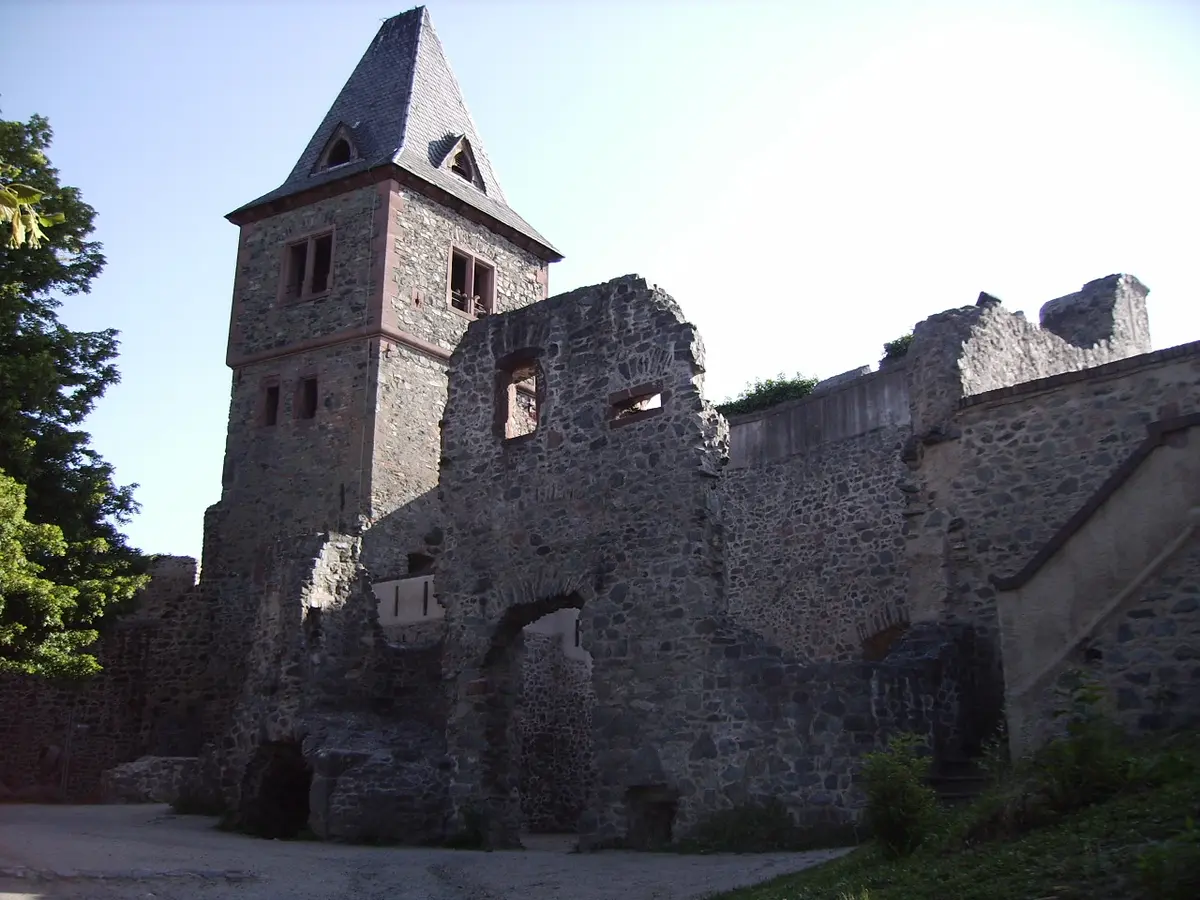
What is the history of Frankenstein Castle?
The documented history of Burg Frankenstein starts in 1252, in a charter held today by the Hessisches Staatsarchiv Darmstadt. It names the castle and its presumed builder, Konrad Reiz von Breuberg, who with his wife Elisabeth von Weiterstadt founded a small lordship here and, with it, the family von Frankenstein. A second charter, issued by Elisabeth as a widow in 1266, shows that Konrad was already being called a Frankensteiner in his lifetime; the descent of the family from the lords of Breuberg is not in dispute among historians. Around 1400 the castle was enlarged northwards with an outer bailey holding farm buildings and servants' quarters, and in 1402 it became an imperial fief. It was never besieged and never stormed.
What ended the castle was a sale, not a siege. After years of quarrels with the landgraves of Hesse-Darmstadt over confession and over the exercise of sovereign rights, the family sold castle and lordship in 1662 to Landgrave Ludwig VI for 109,000 gulden and bought a new seat at Ullstadt in Middle Franconia, where their descendants still live. The abandoned castle was then put to the uses that finish buildings off: it served as a prison and as quarters for military invalids, and it decayed while its stone was carried away.
It was in that half-empty state that the castle acquired the one man who would later be attached to it. In 1672-73 the villages below sought shelter behind its walls from the armies of Louis XIV, and among those who fled up the hill was Johann Philipp Dippel, the Lutheran pastor of Nieder-Beerbach. The Nieder-Beerbach parish register records what happened next, and the entry is worth reading because almost everything written about Dippel departs from it: on 10 August 1673, between nine and ten in the morning, a son Johann Conrad was born to the pastor and his wife Anna Eleonora "auf dem Schloss Franckenstein, dahin wir wegen der französischen Völcker geflohen wahren" — at Frankenstein Castle, whither we had fled on account of the French troops. He was baptised an hour later, "weil es kranck war", because the child was sick. The witnesses named are a pastor from Nieder-Ramstadt and the castle bailiff of Darmstadt.
Dippel was therefore born at the castle by accident of war, and he grew up elsewhere. He took a master's degree in theology at Giessen in 1693 and spent the rest of his life a long way from the Odenwald. Writing as Christianus Democritus he became one of the most abrasive radical Pietists in Germany, was pursued for heresy and served a long imprisonment on Bornholm. He practised medicine, distilled an evil-smelling animal oil from bone and blood which he promoted as something close to an elixir of life, and around 1706, in his Berlin laboratory, the pigment maker Johann Jacob Diesbach used potash that Dippel's oil had contaminated and obtained, instead of a red lake, the first Prussian blue. That accident, and not any monster, is Dippel's real mark on the world.
He did come back to the castle once, on paper. In 1732 he sent the Landgrave of Hesse-Darmstadt a draft agreement, preserved in the Darmstadt state archive and transcribed by the church historian Wilhelm Diehl in 1908. Its first clause asks, for himself and his siblings and their descendants, to receive and buy "das in dem Anfang der Bergstraase gelegene freye adeliche guth und Schloss Franckenstein" — the free noble estate and castle of Frankenstein at the head of the Bergstrasse — as a feudum bonum. The second clause states what he offers in exchange: he "verspricht... ein Arcanum chymicum zu crediren", promises to advance a chemical secret which, with three or four helpers and no dangerous labour, would yield revenues equal to the whole purchase price. The Landgrave, whose house had only acquired the lordship seventy years earlier, and to whom a fief implied ennobling a pastor's son, declined. A cash settlement was discussed instead and was still unfinished when Dippel died at Berleburg on 25 April 1734.
The ruin was rescued in the nineteenth century by Grand Duke Ludwig III of Hesse and by Rhine, who had the surviving fabric secured and the two towers rebuilt to the taste of the day; the late Gothic chapel was restored around 1850 and the tower of the core castle was raised in 1892. Nearly everything that makes the silhouette photogenic today is therefore younger than Mary Shelley's novel. In the 1960s the historic farm buildings of the outer bailey were replaced by a modern restaurant with a large terrace — the contract was advertised in the Darmstädter Echo in July 1965 and the building opened in September 1970. And in the mid-1970s, after the American Forces Network broadcast live from the ruin and recommended it as "the real home of the monster", soldiers stationed at the Cambrai-Fritsch barracks in Darmstadt moved their Halloween party up the hill with the help of the restaurant's manager, Mathias Bührer. Fifty guests were expected; five hundred came. The state castles administration dates that first Gruselspektakel to 1976. It grew into one of the largest Halloween events in Germany and ran until 2023.
Timeline: the documented record of Frankenstein Castle
- 1252 The earliest charter naming the castle, held in the Hessisches Staatsarchiv Darmstadt, records Konrad Reiz von Breuberg, its presumed builder. With his wife Elisabeth von Weiterstadt he founds the lordship and the family von Frankenstein; a charter issued by Elisabeth as a widow in 1266 shows the name was already in use in Konrad's lifetime.
- 1531 Georg von Frankenstein dies and is buried in the church at Nieder-Beerbach under a carved tomb showing him in armour standing over a dragon, its tail curling towards his knee — the standard iconography of his name saint, Saint George.
- 1662 After years of quarrels over confession and sovereign rights, the family von Frankenstein sells castle and lordship to Landgrave Ludwig VI of Hesse-Darmstadt for 109,000 gulden and moves to Ullstadt in Middle Franconia. The empty castle becomes a prison and quarters for military invalids.
- 10 August 1673 Johann Conrad Dippel is born at the castle between nine and ten in the morning, his parents having fled up the hill from the troops of Louis XIV. The Nieder-Beerbach parish register notes that he was baptised an hour later because the child was sick.
- c. 1706 In Dippel's Berlin laboratory the pigment maker Johann Jacob Diesbach uses potash contaminated by Dippel's animal oil and obtains, instead of a red lake, the first Prussian blue.
- 1732 Dippel sends the Landgrave a draft contract asking to receive castle and lordship as a fief in exchange for an 'Arcanum chymicum' that would earn back the purchase price. The Landgrave refuses; a cash settlement is discussed instead and is still unfinished when Dippel dies at Berleburg on 25 April 1734.
- 1813 Karl Philipp Fohr draws the castle from the west, one year before the Shelleys' Rhine voyage. His towers have neither upper storeys nor roofs: the silhouette recognised today is a nineteenth-century restoration.
- 2 September 1814 Mary Godwin, Percy Shelley and Claire Clairmont sail from Mannheim towards Mainz. Mary's journal records a three-hour walk ashore that evening; Claire's names the landing place as Gernsheim, some 23 km from the castle. Neither mentions the castle, and the party reaches Gravesend on 13 September.
- 1816 The Brothers Grimm print the castle's dragon legend for the first time in Deutsche Sagen, taken down orally from a farmer of Ober-Beerbach. In their text the knight is called Hans, not Georg, and the tomb in the village church is cited as the reason for the story.
- 1818 Frankenstein; or, The Modern Prometheus is published. It contains no castle; Victor is Swiss and works at Ingolstadt. Its single Rhine passage has the travellers stay a day at Mannheim and reach Mainz on the fifth day, adding that the river below Mainz 'becomes much more picturesque'.
- 1892 The tower of the core castle is raised, completing the securing and Romantic rebuilding of the ruin begun under Grand Duke Ludwig III, which had restored the late Gothic chapel around 1850.
- 1975 Radu Florescu publishes In Search of Frankenstein, the first book to link the castle, Dippel and Mary Shelley. From 1996 the Darmstadt journalist Walter Scheele — castle guide and for years press officer of the Halloween festival — carries the argument into the German media.
- 23 July 2007 The Bodleian Library replies to an enquiry about the alleged Jacob Grimm letter: no such letter appears in its catalogues or in the Abinger collection of Shelley and Godwin papers, and Florescu's page 34 merely speculates that Mary Jane Godwin was 'probably familiar with the compilations of the Brothers Grimm'.
- 2018 The Geschichtsverein Eberstadt-Frankenstein publishes a booklet of statements from named historians and archivists against six claims about the castle. Kurt Andermann and Werner Paravicini dismiss the tenth-century knight Arbogast; Peter Engels writes that Rüxner 'cannot be cited'; Dippel's biographer Stephan Goldschmidt calls a laboratory at the castle out of the question.
- October 2023 The restaurant closes as its lease expires and the last Halloween festival is held at the castle. Organiser and state cannot agree terms; the event moves permanently to Burg Königstein in the Taunus.
- 1 January 2024 Burg Frankenstein enters a Nutzungspause. The Landesbetrieb Bau und Immobilien Hessen strips the restaurant building to its shell and repairs the curtain walls; the state castles administration gives the end of 2028 as the completion date.
Is there a rational explanation for Frankenstein Castle?
The chain everyone repeats — Dippel was born here, dug up corpses here, and Mary Shelley heard about it while sailing down the Rhine in 1814 — has a traceable starting point. It was put together by the Romanian-born historian Radu Florescu in In Search of Frankenstein (1975), fresh from his bestseller on Dracula, and it was carried into German media from 1996 onwards by Walter Scheele, a Darmstadt crime reporter who wrote the castle's popular guidebook, gave tours as the self-appointed "Burgschreiber", and was for years the press officer of the Halloween festival. Scheele's own book contains a chapter titled "Frankenstein und Halloween. Eine Legende wird geboren" — a legend is born. It is not a hostile reading to call this marketing; it is the chapter heading.
The primary sources are accessible and they do not cooperate. Mary and Percy Shelley published their 1814 journal in 1817 as History of a Six Weeks' Tour. Searching the full text of that book gives zero hits for Frankenstein, zero for Darmstadt, zero for Odenwald and zero for Dippel. Those zeros only mean something with a control, so here is one from the same file: Rhine 9, castle 10, Geneva 10, Switzerland 13, ruin 17, Mayence 2, Cologne 3. The book is not silent about the journey — it is silent about this place. Of the whole stretch between Mannheim and Mainz, the leg that passes closest to the castle, it says only: "We saw on the shores few objects that called forth our attention, if I except the town of Manheim."
The manuscript journals add the detail the printed book left out, and it cuts the same way. Mary's journal for Friday 2 September 1814 records that the boatman put in towards evening and that "Mary & Shelley walk for three hours"; Claire Clairmont's journal for the same day names the place, "a Village where Shelley & I seek Provisions — It was rather a Town & was called Gernsheum". The two accounts do not even agree on who walked with whom. Gernsheim lies roughly 23 km from the castle by road. The local historian Michael Müller made the obvious subtraction: three hours at a brisk 6 km/h is 18 km, not enough to cover one leg of that walk, let alone both, at night, in a country whose language Mary Shelley barely spoke.
Nor could she have seen it. Müller photographed the Odenwald from the southern edge of Gernsheim in daylight: the Melibokus stands out, the castle does not appear at all without a telephoto lens, and even then it is a dot on a wooded ridge. The objection that the ruin was barer in 1814 makes things worse rather than better. Karl Philipp Fohr drew the castle from the west in 1813, one year before the voyage, and his towers have no upper storeys and no roofs; those were added in the nineteenth century, the chapel restored around 1850 and the tower raised in 1892. The bright terrace that helps pick the castle out of the trees today was built in the 1960s.
The novel itself is the awkward witness. Frankenstein contains no castle of any kind — Victor is Swiss, the laboratory is in Ingolstadt — and its one Rhine passage runs: "We stayed a day at Mannheim, and on the fifth from our departure from Strasburgh, arrived at Mainz. The course of the Rhine below Mainz becomes much more picturesque." The ruined castles Mary Shelley then describes at length are the ones below Mainz, in the gorge. The only stretch of river in her book that passes the Bergstrasse is the stretch she explicitly calls the less picturesque one.
The documents produced to close the gap cannot be examined. Scheele quoted a passage from an "authentic and unabridged" Mary Shelley diary said to be locked away by a Swiss banking family: "The Frankenstein castle: a monumental building, full of darkness; broken walls, mysterical-mighty in the sobering Novembermist..." Two things sink it without any need for the manuscript. Mary Shelley was not in Germany in November 1814: the Six Weeks' Tour ends with the party reaching "Gravesend on the morning of the 13th of September". And "mysterical" is not an English word, in 1814 or now; the compounds read like German. A letter from Jacob Grimm to Mary Shelley's stepmother, supposedly describing a Frankenstein horror story, has fared no better. The Bodleian Library, asked in July 2007, replied that no such letter appears in its catalogues or in the Abinger collection of Shelley and Godwin papers, and identified the origin of the idea precisely: Florescu, at page 34 of the 1999 reprint, merely speculates that Mary Jane Godwin was "probably familiar with the compilations of the Brothers Grimm", and mentions no letter at all. Bernhard Lauer of the Brothers Grimm Society calls the whole construction a dubious trick; Donald F. Glut, named by Scheele as a witness who had seen the letter, wrote in 2008 that he had never heard of the story, and had already stated in print in 2002 that "although there has been much speculation that Mary was aware of and even visited this castle in Darmstadt, Germany, there is no concrete proof of this".
Dippel's laboratory in the castle is equally undocumented, and here the archive can say something positive rather than merely fail to say something. A complete run of administrative files on the castle covering 1690 to 1745 survives in Darmstadt, full of tenancy correspondence, building-maintenance orders and petitions from residents raised over trifles. A tenant occupying rooms for a laboratory, still less one blowing up a tower, would have generated paper. There is none. Stephan Goldschmidt, Dippel's biographer, puts it flatly: there is no evidence Dippel had anything to do with the castle in later life, and a laboratory there he considers "völlig ausgeschlossen", entirely out of the question. Dippel's own writings say he bought an estate near a glassworks in one of the surrounding valleys to do his chemistry; his documented dissections of animal carcasses belong to his years as a physician in the Netherlands, in Danish Altona, on Bornholm and in Sweden, long after he had left Hesse. The story that he blew a tower apart with nitroglycerin is an anachronism of the plainest sort: Ascanio Sobrero first made nitroglycerin in 1847, 113 years after Dippel died. "Konrad Dippel von Frankenstein", the noble alchemist, is a mistranslation: the school register of the Darmstadt Pädagog enters him as "Conradus Dippelius franckensteinensis", exactly as the boys beside him are entered "Zwingenbergensis" and "Auerbachensis" — a place of origin, not a title. Dippel himself wrote that he came on both sides from a family that had followed one another in the ministry since the Reformation. Even the parish register entry cited as proof of his corpse-robbing says nothing of the kind. The marginal note added by the Nieder-Beerbach pastor Moritz Scriba beside the baptism accuses Dippel of religious scandal and records that he died at Berleburg on 25 April 1734, "da man ihn wider alles Vermuthen todt im Bett gefunden" — found dead in bed against all expectation. There is not a word about bodies.
Even the castle's genuine legend has been misread from an object. The dragon of Frankenstein first appears in print in 1816, in the Brothers Grimm's Deutsche Sagen, taken down "orally from a farmer of Oberbirbach" — Ober-Beerbach, the village below. In the Grimms' text the knight is called Hans, not Georg; he beheads the Lindwurm at the village spring, is stung behind the right knee by its tail at the one point his armour leaves open, and dies of the venom. What the story is describing is a carving. The church at Nieder-Beerbach, the burial church of the lords of Frankenstein, holds the richly worked tomb of Georg von Frankenstein, who died in 1531, showing the armoured knight standing over a dragon whose tail curls up towards his knee. The image came first and the image has an ordinary explanation: it is the iconography of Saint George, the dead man's name saint, who is conventionally shown fighting a dragon. The legend was reasoned backwards out of the stone, and the vulnerable knee is simply where the tail happens to be.
The most useful sceptic here is the building's own owner. The Staatliche Schlösser und Gärten Hessen, which administers the castle for the state, has carried the disclaimer on its website since at least April 2021 under the heading "Die Romanautorin Shelley war nie da" — the novelist Shelley was never here — and the sentence is still there in 2026: the claim that Mary Shelley visited the ruin during her 1814 Rhine journey and was inspired to her novel there, historians today assign "in das Reich der Fantasie", to the realm of fantasy. In a 2018 booklet in which the Eberstadt-Frankenstein history society collected statements from named academics and archivists, the same administration was blunter: the fuss around Burg Frankenstein "ist geschicktem Marketing geschuldet", is owed to clever marketing, and is declared authentic by dubious researchers. The other claims attached to the castle collapsed in the same booklet. The tenth-century knight Arbogast von Frankenstein comes from Georg Rüxner's tournament book of 1566: Kurt Andermann of Freiburg notes that Rüxner's early tournaments "sind allesamt erfunden", are invented one and all, and Peter Engels, director of the Darmstadt city archive, writes simply "Rüxner ist nicht zitierfähig" — Rüxner cannot be cited.
None of which makes the ruin less worth the climb, and one modest claim survives everything above: of all the places in Europe called Frankenstein, this is the one Mary Shelley came nearest to. She passed some twenty kilometres from it, in the dark, and never mentioned it. When she travelled the Bergstrasse again by carriage in 1840, closer still, she wrote that pleasant excursions might be made among the hills to her left but that she could not indulge in extraneous rambles. She did not name the castle then either.
Can you visit Frankenstein Castle?
Burg Frankenstein stands above the village of Nieder-Beerbach in the municipality of Mühltal, 64367, a few kilometres south of Darmstadt on the northernmost spur of the Odenwald. It is state property, administered by the Staatliche Schlösser und Gärten Hessen, and there is no admission charge: the way in is from the visitors' car park through the west gate. Entry to the grounds has always been free, and the ruin has never had a ticketed tour.
The castle is a building site with a castle inside it. The restaurant closed in October 2023 when its lease expired, and on 1 January 2024 the site entered a Nutzungspause while the Landesbetrieb Bau und Immobilien Hessen strips the restaurant building back to its shell and repairs the historic curtain walls. The two published end dates do not agree: the phased plan the Landesbetrieb presented in November 2022 finished the work at the end of 2027, while the state castles administration's own page says the works run until 2028.
That plan also has the whole site sealed off through the second and third quarters of 2026 — and it has not happened. On 22 September 2026, inside that window, the administration's visitor page gave the castle as open from 07:30 to 19:30, warned only that construction may cause temporary closures and that not all areas are reachable, and described the outer grounds as accessible with restrictions.
There is something to drink on the hill. The kiosk was let to the Pfungstadt restaurateur Christoph Herrmann from 1 August 2024 on a lease written only to the end of 2025, and the municipality of Mühltal stated on 22 September 2026 that the main catering remains closed and "das Team vom Burgkiosk ist weiterhin vor Ort" — the kiosk team is still there. The state administration says the restaurant will return once the renovation ends.
The Halloween festival has moved. Its last edition at Burg Frankenstein was in 2023, after forty-six years; the organiser and the state could not agree terms, and since 2024 the Frankenstein Halloween brand has run at Burg Königstein in the Taunus, where the 2026 edition is announced for 16 October to 1 November.
The chapel is still working. The late Gothic chapel, restored around 1850, is a branch office of the Mühltal register office, and weddings are being offered there through 2026 and 2027; from 1 January 2026 the slots are two Saturdays a month between 11:00 and 15:00, and the castle can be booked only from late March to late October. Free guided tours of about forty minutes, in German or English, are given by historians of the Geschichtsverein Eberstadt-Frankenstein e.V., recognised by the state castles administration and booked in advance with the society by telephone or e-mail; the society also sells a printed castle guide in Darmstadt bookshops. The fifth stage of the Alemannenweg, 19 kilometres from the castle to Fischbachtal, starts here, on a waymarked circuit of 144 kilometres in seven stages.
Accessibility is poor and will not improve until the works end: a hilltop ruin reached by woodland roads, with uneven ground, cobbles, steps and a spiral stair in the tower, and no lift. The chapel and the courtyard are the most manageable parts. Nieder-Beerbach church, in the village below, holds the 1531 tomb of Georg von Frankenstein with its dragon.
Sources consulted
- Michael Müller, «Any Monsters at home? Die Burg Frankenstein a.d. Bergstr. und der Roman von Mary Shelley» — Archiv für hessische Geschichte und Altertumskunde (2009); published version of the study issued by the Geschichtsverein Eberstadt-Frankenstein e.V. Quotes the Darmstadt archive files, the Bodleian Library statement of 23 July 2007, Donald F. Glut's letter of 11 August 2008 and the visibility tests from Gernsheim., 2009 academic
- Geschichtsverein Eberstadt/Frankenstein e.V., ed. Erich Kraft, «Behauptungen und Irrtümer zum Frankenstein — und was Historiker dazu sagen» — Darmstadt-Eberstadt, 2018. Collects signed statements from Kurt Andermann (Freiburg), Rainer Eisfeld (Osnabrück), Peter Engels (Stadtarchiv Darmstadt), Markus Frauenreuther (Bayerisches Hauptstaatsarchiv), Stephan Goldschmidt, Bernhard Lauer (Brüder-Grimm-Gesellschaft), Werner Paravicini (Kiel) and Max Plassmann (Stadtarchiv Köln), with transcriptions from the Nieder-Beerbach parish register., 2018 report
- Mary Wollstonecraft Shelley and Percy Bysshe Shelley, «History of a Six Weeks' Tour through a part of France, Switzerland, Germany, and Holland» — London: T. Hookham Jun. and C. and J. Ollier, 1817. Full text searched for this entry; the castle, Darmstadt, the Odenwald and Dippel are absent., 1817 book
- Mary Wollstonecraft Shelley, «Frankenstein; or, The Modern Prometheus» — First published London, 1818; text consulted, 1831 revised edition. The Rhine passage is in volume 3., 1818 book
- Jacob and Wilhelm Grimm, «Der Lindwurm am Brunnen, no. 218 in Deutsche Sagen, vol. 1, pp. 300-301» — Berlin: Nicolai, 1816. Source note: 'Mündlich von einem Bauer aus Oberbirbach'., 1816 book
- Parish of Nieder-Beerbach, «Kirchenbuch Nieder-Beerbach Nr. 2: baptismal entry for Johann Conrad Dippel, 10 August 1673, with the marginal note added by Pfarrer Moritz Scriba» — Pfarrarchiv Nieder-Beerbach; transcribed verbatim in Geschichtsverein Eberstadt/Frankenstein, Behauptungen und Irrtümer zum Frankenstein (2018), pp. 5-6. Consulted here in that transcription, not in the register itself., 1673 archive
- Johann Konrad Dippel, «Prospectirte puncta Conventionis: Dippel's draft contract with the Landgrave of Hesse-Darmstadt, 1732» — Hessisches Staatsarchiv Darmstadt, Best. E 6 B Nr. 5/3, microfiche 45-48; transcribed by Wilhelm Diehl, Neue Beiträge zur Geschichte Johann Konrad Dippels, Beiträge zur hessischen Kirchengeschichte, Ergänzungsband III (Darmstadt, 1908), pp. 161-163 and 183-184. Consulted here in the passages reproduced by Müller (2009)., 1732 archive
- Staatliche Schlösser und Gärten Hessen, «Burg Frankenstein — Geschichte und Besucherinformation» — schloesser-hessen.de, official site of the state castles administration; consulted 12 August 2026, and compared with the version archived on 17 April 2021., 2026 web
- Landesbetrieb Bau und Immobilien Hessen (LBIH), «Burg Frankenstein geht ab 2024 in eine Nutzungspause» — Press release, 18 August 2022, with the phased renovation plan and a statement by branch head Sabina Freienstein., 2022 web
- Landesbetrieb Bau und Immobilien Hessen (LBIH), «Burg Frankenstein: Kiosk ist wieder vermietet» — Press release, 18 July 2024, listing which parts of the castle are open during the works and the term of the kiosk lease., 2024 web
- hessenschau (Hessischer Rundfunk), «Nach Burg Frankenstein: Halloween-Spektakel erstmals auf Burg Königstein» — hessenschau.de; records that the last Halloween at Burg Frankenstein was in 2023 and that the festival moved permanently to Burg Königstein., 2024 web
- Radu R. Florescu, «In Search of Frankenstein» — Boston: New York Graphic Society, 1975; reprinted London: Robson Books, 1999. The origin of the castle-Shelley claim. Not consulted directly for this entry: cited here from the passages and page references quoted by Müller (2009) and by the Bodleian Library statement of 23 July 2007., 1975 book
Reviewed by V. Serrano on 2026-08-12 · How we verify our content
💬 Field testimonies (0)
No testimonies yet. Add the first.
Add your testimony
🔒 Log in to add a testimony