📜 LEGEND · EXP. Nº0270
ACTIVE
The Lorelei
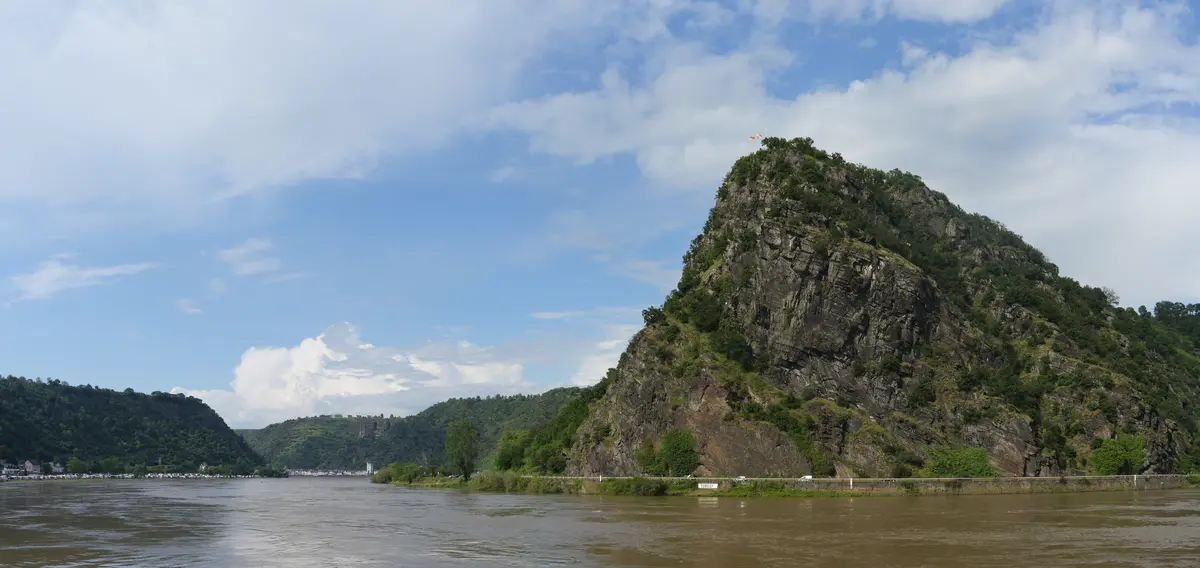
The Loreley is a slate cliff 132 metres high on the Rhine at Sankt Goarshausen, where the river narrows, deepens and has been drowning boatmen for as long as there have been boats.
Where does the legend of The Lorelei come from?
- Location
- St. Goarshausen, Rhine Gorge, Germany
- Kind of legend
- Creature legend
- Coordinates
- 50.139, 7.729
- Last updated
LOCATION
What is the legend of The Lorelei?
The golden-haired maiden who sits on top of it, combing her hair and singing sailors onto the reef, is a great deal younger. The rock carried its name — der Lurlei, masculine — for six hundred years before anyone put a woman on it: a thirteenth-century poem hides the hoard of the Nibelungs inside it, and travellers explained its famous echo with dwarfs. She was invented in 1801 by Clemens Brentano inside a novel, moved into a forest by Eichendorff, sold to Rhine tourists as folklore by a guidebook in 1818, seated on the cliff by Otto von Loeben in 1821 and given her golden hair and golden comb by Heinrich Heine in 1824. The Brothers Grimm, friends of Brentano, left her out of the Deutsche Sagen they published in 1816. The echo was already a disappointment in 1895, the bronze statue stands on the harbour mole below the rock, and the famous story that the Nazis reprinted Heine's poem as the work of an unknown author has no known book behind it.
What is the history of The Lorelei?
The rock had a name for six hundred years before anybody put a woman on it.
The Loreley is a slate cliff about 132 metres high on the right bank of the Rhine at Sankt Goarshausen, at the point where the river squeezes from roughly three hundred metres wide to about a hundred and forty and reaches its greatest depth. Until the nineteenth century the name took a masculine article — der Lurlei, der Lorley, der Lurleberch — because it belonged to the cliff and not to a person. The ending -ley is the Rhenish word for a slate rock, from a Celtic root. The first syllable is usually traced to Middle High German lorren or lurren, to howl or to shriek, or to luren, to lurk. Either way it names a noise, and the noise was the point: the gorge threw back a celebrated echo, and the old local explanation for it was dwarfs living inside the stone.
What the rock carried before 1801 can be listed on one hand. A strophe attributed to the thirteenth-century Sangspruch poet known as Der Marner reports that the hoard of the Nibelungs lies in the Lurlenberg, a story about buried treasure with no woman in it. Around 1500 the humanist Konrad Celtis noted forest spirits, perhaps dwarfs, in its caves; in 1612 the Palatine antiquary Marquard Freher had wood or mountain nymphs living there. From 1395 the counts of Katzenelnbogen are documented working vineyards on its slopes. There were supernatural beings in all of this, but no woman with a name.
She arrives in the autumn of 1801, inside a novel. Clemens Brentano wrote the ballad "Zu Bacharach am Rheine" in Jena in 1800 and printed it in the second volume of Godwi oder Das steinerne Bild der Mutter, published by Friedrich Wilmans in Bremen. His Lore Lay lives in the town of Bacharach, about nine and a half kilometres upstream of the cliff in a straight line, and her beauty destroys the men who look at her. A bishop summons her to be judged for sorcery, falls under the same spell, and sends her to a convent with three knights as escort. From the height above the Rhine she sees a boat, believes her faithless lover is aboard, and goes over the edge; the three knights die with her, and it is their voices that the rock repeats. Brentano had taken a place name, split it into a Christian name and a surname, and given the halves a biography.
Everything else was added by named men over the following twenty-three years. In 1811 the Rhine historian Niklas Vogt retold the ballad in prose and presented it as a Sage, an old local legend, explaining the echo as the voice of the dead woman. In 1815 Joseph von Eichendorff published "Waldgespräch" in his novel Ahnung und Gegenwart: his Lorelei is a witch met on horseback in a forest — "Jetzt kenn ich dich - Gott steh mir bei! / Du bist die Hexe Lorelei" — with a castle that looks down on the Rhine, and there is not a boatman in it. In 1818 Aloys Schreiber slipped "Die Jungfrau auf dem Lurley" into the appendix of the second edition of his Handbuch für Reisende am Rhein, the guidebook British travellers carried, where she has become a water nymph who bewitches men with her singing. In the almanac Urania for the year 1821 Otto Heinrich Graf von Loeben finally sat her down on the cliff itself: "Da wo der Mondschein blitzet / Um's höchste Felsgestein, / Das Zauberfräulein sitzet, / Und schauet auf den Rhein." She sings, she lures, and the poem warns a boy not to look up at her. Her locks fall loose under a wreath of pearls — but they are not gold, and there is no comb.
Both of those arrive in 1824, in twenty-four lines by Heinrich Heine. "Sie kämmt ihr goldnes Haar. / Sie kämmt es mit goldnem Kamme": the gold, the comb, the last sun on the summit, the boatman who looks up instead of at the reef and drowns for it. Friedrich Silcher set the lines to music in 1837, and from then on people sang the Loreley without needing to know that anyone had written her.
Timeline: the documented record of The Lorelei
- 13th century A strophe attributed to the Sangspruch poet known as Der Marner places the hoard of the Nibelungs inside the Lurlenberg. This is the oldest story attached to the rock, and it is about buried treasure: there is no woman in it.
- 1395 The counts of Katzenelnbogen are documented working vineyards on the rock. Through the whole medieval record the name is masculine — der Lurlei, der Lurleberch — because it names the cliff and not a person.
- c. 1500 The humanist Konrad Celtis records forest spirits, perhaps dwarfs, living in the rock's caves; in 1612 the Palatine antiquary Marquard Freher has wood or mountain nymphs there. Supernatural inhabitants, plural and unnamed — no maiden and no song.
- Autumn 1801 Clemens Brentano prints the ballad "Zu Bacharach am Rheine", written in Jena in 1800, in the second volume of his novel Godwi (Friedrich Wilmans, Bremen). His Lore Lay lives at Bacharach, is tried for sorcery by a bishop, and throws herself from the height; the echo is the voices of the three knights who die with her. It is the first time the rock's name belongs to a woman.
- 1811 The Rhine historian Niklas Vogt retells Brentano's ballad in prose and presents it as a Sage — an old legend of the country — explaining the rock's echo as the voice of the dead woman. According to Katrin Kober he corrected himself years later, once he realised Brentano had invented her.
- 1815 Joseph von Eichendorff publishes "Waldgespräch" in his novel Ahnung und Gegenwart. His Lorelei is a witch met in a forest — "Du bist die Hexe Lorelei" — with a castle over the Rhine. She has left the cliff altogether, and there is no boatman in the poem.
- 1816-1818 Jacob and Wilhelm Grimm publish the two volumes of Deutsche Sagen. Neither volume contains the Loreley under any spelling, although both contain Rhine legends — including bishop Hatto and the mouse tower at Bingen, twenty kilometres upstream.
- 1818 Aloys Schreiber puts "Die Jungfrau auf dem Lurley" into the appendix of folk legends in the second edition of his Handbuch für Reisende am Rhein (Heidelberg), the guidebook that Rhine tourists carried. Here Brentano's invention is a water nymph and is labelled, for the first time in print, as folklore.
- 1821 In the almanac Urania for 1821, Otto Heinrich Graf von Loeben seats her on the cliff for the first time: "Das Zauberfräulein sitzet, / Und schauet auf den Rhein." She sings to lure, and the poem warns a boy not to look up — but her loose hair is under a wreath of pearls, not golden, and there is no comb.
- 1824 Heinrich Heine writes "Die Lore-Ley". He adds the two details everyone now repeats — "Sie kämmt ihr goldnes Haar. / Sie kämmt es mit goldnem Kamme" — plus the evening sun and the drowning. Collected in Buch der Lieder in 1827 and set to music by Friedrich Silcher in 1837, it becomes a song sung as if it had no author.
- 1895 Franz Magnus Böhme reports that the celebrated echo is already a disappointment: nothing is heard from the steamers, and it answers only to mortar fire or to walkers on foot at dawn and dusk. This is decades before any blasting.
- 1930s Rocks in the riverbed below the cliff are blasted to widen and deepen the passage, and the narrows lose much of their old danger. Traffic through the bend is now regulated by signal lights between Bankeck at Sankt Goar and Oberwesel.
- 1982-1983 The sculptor Natascha Alexandrovna Princess Jusupov casts the bronze Loreley and gives it to the town of Sankt Goarshausen. By her contract with the town it stands on the mole of the Loreley harbour, below the rock.
- 13 January 2011 The tanker Waldhof, carrying about 2,400 tonnes of concentrated sulphuric acid, capsizes under the rock. Two of its four crew are rescued and the other two die; three floating cranes right the hull on 13 February, a month later. The same year, Anja Oesterhelt publishes the study reporting that no known Nazi-era schoolbook or anthology credits a Heine poem to an unknown author.
Is there a rational explanation for The Lorelei?
Three claims travel with this rock, and each of them can be checked against a document.
The first claim is that the maiden is ancient, and the cleanest test of it is the Brothers Grimm. Jacob and Wilhelm published Deutsche Sagen in 1816 and 1818, fifteen years after Brentano's ballad, and Brentano was their friend. In the full text of both volumes of the third edition of 1891, digitised at the Internet Archive (201,536 words), a search on 8 October 2026 for Lurlei, Lurley, Loreley, Lorelei or Lore Lay returns no hits in any spelling. The same files contain the word Rhein eighteen times, Jungfrau (maiden) ninety-one times and Hatto thirteen times: the collection has Rhine legends and maidens, and it has the bishop and the mouse tower at Bingen, some twenty-two kilometres upstream in a straight line, but it has no Loreley. Allen Wilson Porterfield made the same argument in Modern Philology in 1915: that the ballad "was invented by Brentano is proved, not so much by his own statement to that effect as by the fact that the erudite and diligent Grimm brothers, the friends of Brentano, did not include the Lorelei-legend in their collection". He also dismissed the one older witness then on offer, a manuscript of 1650 that Hermann Bender said contained the essentials of the ballad and that, Porterfield wrote, "cannot be produced, not even by Bender who claims to have found it".
Before 1801 the rock already had supernatural inhabitants: dwarfs in the caves for Celtis, nymphs for Freher, a buried hoard for Der Marner. What Brentano added was a woman with a name.
The second claim concerns the famous echo. Franz Magnus Böhme, writing in 1895, decades before any blasting, already found it disappointing: "Das Echo in dem bezeichneten Bergkessel ist nicht so bedeutend als sein Ruf." From the steamer, he wrote, "hört man natürlich nichts"; something is heard only when mortars are fired, and walkers late in the evening or in the morning would not try in vain to wake the multiple echo. Katrin Kober adds that from 1853 the Köln-Düsseldorf steamship company employed a man in the caves of the rock to set the echo off with pistol shots and a horn. Rocks in the riverbed were blasted in the 1930s to widen and deepen the passage, which may have changed the acoustics again, but the echo was already less than its reputation while Bismarck was alive.
The danger of the passage is documented. Traffic through the narrows is still regulated by signal lights between Bankeck at Sankt Goar and Oberwesel. On 28 September 2003 the Köln-Düsseldorf passenger ship Loreley ran aground here in extreme low water, and according to the Rheinische Post 41 of the roughly 350 people on board were hurt, three of them seriously. On 13 January 2011 the tanker Waldhof, carrying some 2,400 tonnes of concentrated sulphuric acid, capsized under the rock; two of its four crew were rescued and the other two died, and three floating cranes righted the hull on 13 February, a month later.
The third claim is the one repeated most of all: that under National Socialism Heine's poem stayed in print with its author given as "unknown", because he was a Jew. The claim begins with the exiled scholar Walter A. Berendsohn in 1935 and was passed on as established fact by Otto Flake in 1947, Hannah Arendt in 1948, Ludwig Marcuse in 1951 and Theodor W. Adorno in 1956. Bernd Kortländer in 1998, Hartmut Steinecke in 2008 and Anja Oesterhelt in 2011 went looking for the actual book. Oesterhelt's study, published in the collection Anonymität und Autorschaft, reports that more than a hundred schoolbooks and poetry anthologies printed between 1933 and 1945 have now been examined and that there is no known case of a Heine poem being credited to an unknown author. What did happen is bleaker: in printed song settings only the composer Silcher was named, Heine's name simply dropped, and from 1937 he vanished from books published in Germany altogether.
The bronze Loreley stands below the cliff rather than on top of it. The sculptor Natascha Alexandrovna Princess Jusupov made her in 1982 and gave her to Sankt Goarshausen the following year, and the town's own page records that a contract between the town and the sculptor, made at her wish, fixed her place on the mole of the Loreley harbour.
Can you visit The Lorelei?
There are two visits here, one on top of the cliff and one down at the waterline.
The upper one is the Loreley plateau above Sankt Goarshausen. The rock is a slate cliff 132 metres above the river, its top at 193.14 metres above sea level, at Rhine kilometre 555, where the channel narrows to about 160 metres and runs up to 25 metres deep. The Kultur- und Landschaftspark around the viewpoint opened in April 2019 and costs nothing; the terrace at its end looks straight down on the bend, and the valley opposite is the UNESCO World Heritage site of the Upper Middle Rhine Valley, inscribed in 2002. The Loreley Besucherzentrum, opened in 2000, stands by the plateau car park at Loreley 7, 56346 Bornich, with an exhibition on the rock and the gorge and a 3D film about the valley (06771 599093, [email protected]). Beside it are a restaurant and the Loreley-Bob summer toboggan run with its play park, open daily from 10:00 and at least until 17:00, or until 18:00 during the Hesse and Rhineland-Palatinate school holidays, shut through the winter and shut whenever the track is wet. Dogs are welcome on a lead but not on the run itself, and parties of fifteen or more have to register. The run's own opening-hours page, last updated on 17 September 2026, gives its season twice and differently: "ENDE MÄRZ BIS ANFANG NOVEMBER" in the season panel, "Mitte März bis Mitte November" in the timetable footnote and again in the FAQ.
The open-air theatre on the same plateau was built between 1934 and 1939 to Hermann Senf's design as a Nazi Thingstätte, and since 1976 has been used mainly for rock concerts.
The lower visit is the bronze statue at the foot of the rock. The bronze Loreley was made in 1982 by Natascha Alexandrovna Prinzessin Jussupow, then living at Saint-Paul in France, who chose the site herself under her contract with the town: the tip of the mole of the Loreley harbour, below the cliff on the Sankt Goarshausen side, free and at any hour. It is the one place that stands out in the water the poem is about.
Sankt Goarshausen is on the right-bank Rhine railway. The Loreley ferry crosses to Sankt Goar on the left bank from 05:30 to 21:00 Monday to Friday, from 06:20 on Saturdays and from 07:20 on Sundays and public holidays; faehre-loreley.de now redirects to the operator FRS, whose page on 22 September 2026 also carried a low-water notice limiting vehicle weights.
Nothing on the rock is older than the poem: the terrace, the theatre, the visitor centre and the bronze woman are all twentieth century or later. The river below them is older and still takes ships. The passenger vessel RheinVision grounded here on 28 September 2003 with 349 passengers and 11 crew aboard, injuring 41 people, and on 13 January 2011 the tanker Waldhof capsized carrying 2,400 tonnes of sulphuric acid, killing two of its crew.
Sources consulted
- Clemens Brentano, «Zu Bacharach am Rheine (Die Lore Lay)» — Godwi oder Das steinerne Bild der Mutter, vol. 2, Friedrich Wilmans, Bremen (ballad written in Jena, 1800); text consulted at the Volksliederarchiv, 1801 book
- Joseph von Eichendorff, «Waldgespräch» — Ahnung und Gegenwart, J. L. Schrag, Nuremberg 1815; text consulted in the comparative anthology of Romantic Loreley poems published by ZUM, 1815 book
- Aloys Schreiber, «Die Jungfrau auf dem Lurley» — Handbuch für Reisende am Rhein, 2nd, enlarged edition, Heidelberg 1818, appendix "Volkssagen aus den Gegenden am Rhein und am Taunus", legend no. 16; digitised copy, Bayerische Staatsbibliothek, 1818 book
- Otto Heinrich Graf von Loeben, «Loreley (Der Lurleyfels)» — Urania. Taschenbuch auf das Jahr 1821; text consulted in the ZUM anthology of Romantic Loreley poems, 1821 book
- Heinrich Heine, «Die Lore-Ley (Ich weiß nicht, was soll es bedeuten)» — Written 1824; collected in Buch der Lieder, Hoffmann und Campe, Hamburg 1827; set to music by Friedrich Silcher in 1837. Text consulted in the ZUM anthology, 1824 book
- Jacob and Wilhelm Grimm, «Deutsche Sagen» — 3rd edition ed. Herman Grimm, Nicolaische Verlags-Buchhandlung, Berlin 1891, 2 vols.; full text of both volumes searched at the Internet Archive (201,536 words), 1891 book
- Franz Magnus Böhme, «Volksthümliche Lieder der Deutschen im 18. und 19. Jahrhundert» — Breitkopf & Härtel, Leipzig 1895; entry on the Lorelei, reproduced in the Volksliederarchiv lexicon, 1895 book
- Allen Wilson Porterfield, «Graf von Loeben and the Legend of Lorelei» — Modern Philology, vol. XIII, October 1915, pp. 65-92, 1915 academic
- Anja Oesterhelt, «»Verfasser unbekannt«? Der Mythos der Anonymität und Heinrich Heines Loreley» — In Stephan Pabst (ed.), Anonymität und Autorschaft. Zur Literatur- und Rechtsgeschichte der Namenlosigkeit, De Gruyter, Berlin/Boston, pp. 325-358, 2011 academic
- Katrin Kober, «Zur Loreley-Sage» — regionalgeschichte.net, Institut für Geschichtliche Landeskunde an der Universität Mainz (essay dated 18 May 2020), 2020 web
- Loreleystadt St. Goarshausen, «Loreleystatue» — sankt-goarshausen.de, official municipal site (consulted 2026), 2026 web
- German Wikipedia, «Loreley» — Article on the rock: etymology, echo, 1930s blasting, shipping accidents of 2003 and 2011 (consulted 2026), 2026 web
- Loreley Touristik / Loreley-Bob, «Loreley Besucherzentrum und Loreley-Bob — Öffnungszeiten» — Official visitor information for the Loreley plateau: opening season, hours, car park and facilities (consulted 2026), 2026 web
- «Unglücks-Schiff „Loreley“ wird in Köln untersucht – 41 Menschen wurden verletzt» — Rheinische Post, 29 September 2003, 2003 newspaper archive
- Philipp Strauch, «Über Marners Leben und Dichtungen (on the strophe placing the Nibelung hoard in the Lurlenberg)» — Karl J. Trübner, Strasbourg, 1876 book
Reviewed by V. Serrano on 2026-08-15 · How we verify our content
📎 Source: Enigma Atlas
💬 Field testimonies (0)
No testimonies yet. Add the first.
Add your testimony
🔒 Log in to add a testimony