📜 LEGEND · EXP. Nº0270
ACTIVE
The Pact of Doctor Faust
The Faust legend has a documented core. A wandering astrologer and alchemist called Georg Faustus is recorded across Germany between 1507 and about 1540: the abbot Johannes Trithemius dismissed him as a vagabond and a babbler in a letter of 1507, the humanist Mutianus Rufus heard him boasting in an Erfurt inn in 1513, the prince-bishop of Bamberg paid him for a horoscope in 1520, and Ingolstadt expelled him as a soothsayer in 1528.
Where does the legend of The Pact of Doctor Faust come from?
- Location
- Staufen im Breisgau, Germany
- Kind of legend
- Curse
- Coordinates
- 47.88, 7.729
- Last updated
LOCATION
What is the legend of The Pact of Doctor Faust?
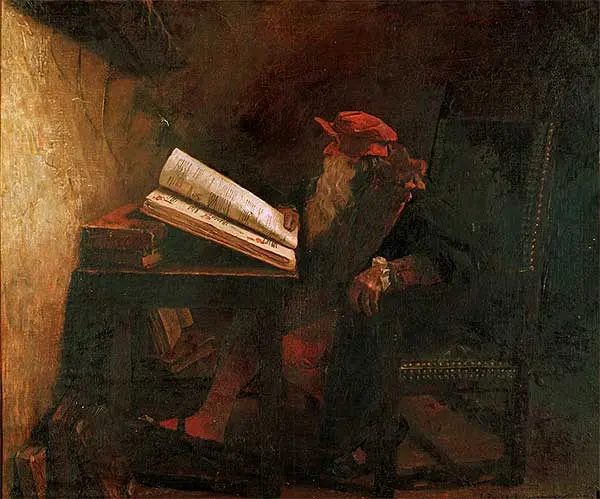
No document from his lifetime gives him the forename Johann, and none mentions a pact. The pact was published at Frankfurt in 1587, in an anonymous book printed by Johann Spies, which fixed the details now taken for granted: the name Johann, Wittenberg, a contract signed in blood with a spirit calling itself Mephostophiles, a term of twenty-four years, and the conjuring of Helen of Troy. In that book Faust is beaten to death by the devil in a village near Wittenberg and his body left beside a dungheap. Christopher Marlowe kept the damnation; Goethe reversed it, and in the second part of his Faust, published in 1832, angels carry Faust upward. One sixteenth-century chronicle places the historical Faust's death at, or not far from, Staufen im Breisgau, where an old inn still shows a Faust room.
What is the history of The Pact of Doctor Faust?
Faust is the rare legend whose central character can be checked against paperwork. He existed — and the men who actually met him did not describe a tragic seeker after forbidden knowledge. They described a nuisance.
The earliest surviving notice is a letter dated 20 August 1507, written at Würzburg by the Benedictine abbot Johannes Trithemius to the Heidelberg mathematician and astrologer Johannes Virdung, who had written asking about a wonder-worker he was eager to meet. Trithemius's reply, printed in his Epistolarum familiarium libri duo (Hagenau, 1536) and reprinted in Robert Petsch's critical edition of the Faust book, is a page and a half of contempt. The man "who has dared to name himself the prince of necromancers", he writes, "is a vagabond, a babbler and a vagrant, fit to be corrected with a whipping" — gyrovagus, battologus et circumcellio est, dignus qui verberibus castigetur. Then Trithemius copies out the calling card that had been sent on to him: "Magister Georgius Sabellicus, Faustus iunior, fons necromanticorum, astrologus, magus secundus, chiromanticus…" — the fountain of necromancers, second magus, palm-reader. "See the man's stupid rashness," he adds, "what madness carries him along."
Note the name. Not Johann. Georg.
The rest of the letter is a list of sightings. The previous year, returning from the March of Brandenburg, Trithemius had found this same man at the town of Gelnhausen, where he was told "many frivolous things" about him at the inn; as soon as the man heard the abbot was there "he fled the lodging, and no one could persuade him to present himself to my sight". Priests in the town reported that he had said in front of many people that "he had attained such knowledge and memory of all wisdom that, if all the volumes of Plato and Aristotle with their whole philosophy had utterly perished from human memory, he by his own genius, like a second Hebrew Ezra, could restore them all, and with greater elegance". At Würzburg he was said to have declared that "the miracles of Christ the Saviour are not to be wondered at, since he too could do everything Christ did, as often and whenever he wished". In the last Lent of that year he reached Kreuznach, boasted that in alchemy he was "the most perfect of all who ever were", and, on the recommendation of Franz von Sickingen — "the bailiff of your prince, a man very greedy for mystical things" — was given the vacant post of schoolmaster; whereupon, Trithemius writes, he began abusing the boys, and when this came to light "he escaped by flight the punishment prepared for him". The letter ends: "When he comes to you, you will find not a philosopher, but a foolish man driven by excessive rashness."
Six years later he surfaces again. In a letter of October 1513 the Erfurt humanist Conrad Mutianus Rufus — friend of Melanchthon — wrote to Heinrich Urbanus: "Eight days ago a certain palm-reader came to Erfurt, by name Georgius Faustus, Helmitheus Hedebergensis [the demigod of Heidelberg], a mere show-off and fool. His profession, and that of all diviners, is empty… The ignorant marvel at him. I heard him boasting at the inn. I did not rebuke his bragging; what is another man's madness to me?"
Two more documents are municipal, and they cut in opposite directions. In February 1520 the account book of Hans Müller, chamberlain to the prince-bishop of Bamberg, Georg Schenk von Limburg, records gulden "given and presented to Doctor Faustus, philosopher, as an honorarium", because "he made a nativity or indicium for my gracious lord". A German prince-bishop paid him for a horoscope. Eight years later, in 1528, the Ingolstadt council minutes for the Wednesday after St Vitus order that "the soothsayer be commanded to leave the town and spend his pennies elsewhere", and the parallel register of expulsions names him: "a man who called himself Dr Jörg Faustus of Heidelberg", who "promised not to avenge such a demand upon the authorities".
Trithemius, Mutianus, Ingolstadt: Georgius, Georgius, Jörg. Johann appears nowhere in the lifetime record. It arrives only with Melanchthon's remarks as reported by Johannes Manlius in 1563 — where the man is "Ioannes Faustus" — and then, definitively, on the title page of 1587. Karl Kiesewetter, writing in 1893, flagged the point plainly: both the earliest witnesses give the forename Georg, "departing from all later accounts". The composite "Johann Georg Faust" that circulates today is a nineteenth-century reconciliation, not a name anyone called him.
The death is worse. Three sixteenth-century accounts give three different places. Melanchthon, as reported by Manlius, says Faust — "of Kundling, which is a small town near my homeland", that is Knittlingen — spent his last day gloomy in a village of the Duchy of Württemberg, told his host "do not be frightened tonight", and was found at midday lying beside the bed with his face turned round, "thus killed by the devil". Johannes Gast, in his Sermones convivales (Basel, 1548), writes that he dined with Faust in the Great College at Basel, that Faust travelled with a dog and a horse "which I believe were devils", and that "the wretch met a deplorable end, for he was strangled by Satan, and his corpse on the bier kept staring at the ground even when it was turned on its back five times". And the Zimmern Chronicle, compiled in the following decades, is the only source that mentions Staufen: "It was also about this time that Faustus died at, or at any rate not far from, Staufen, the little town in the Breisgau… He became an old man and, as they say, died wretchedly. Many, from all kinds of signs and conjectures, supposed that the evil spirit — whom in his lifetime he called only his brother-in-law — had killed him. The books he left behind came into the hands of the lord of Staufen, in whose lordship he died." One further witness, Philipp Begardi's Index Sanitatis (Worms, 1539), does not say where he died but says what he was: a man who had travelled "through nearly every land, principality and kingdom", who "himself confessed and did not deny that he was, and was called, Faustus, and signed himself Philosopher of Philosophers", and of whom "a great number" complained that they had been cheated. He was never slow, Begardi adds, in taking money.
That is the whole historical file. There is no pact in it.
The pact was written in Frankfurt, in 1587. On Monday 4 September 1587 the printer Johann Spies dated the dedication of the Historia von D. Johann Fausten. The book is anonymous; Spies presents himself only as its printer. He explains that the stories had long been told in Germany "at feasts and in company", that he had often wondered why nobody had set them down in order, and that at last "a good friend from Speyer" had sent him the text with the request that he publish it "as a terrible example of the devil's deceit". The first complete Faust legend is therefore not folklore collected in the field: it is an anonymous manuscript that arrived at a Lutheran press in time for the autumn book fair.
What Spies printed fixed nearly everything the world now knows. Chapter six reproduces the contract itself: "I, Johannes Faustus, doctor, confess publicly with my own hand… having resolved to speculate upon the Elements, and finding no such aptitude in my head, nor able to learn it from men, I have submitted myself to the spirit sent to me, who calls himself Mephostophiles, a servant of the hellish prince in the Orient… and in return I promise and vow that, 24 years having run from the date of this letter, he shall have full power to deal, rule, govern and carry me off after his own manner and pleasure, with everything, be it body, soul, flesh, blood and goods, and that for all eternity." He opened a vein in his left hand with a sharp knife, and the book says a bloody inscription was seen in that hand: O homo fuge — O man, flee.
And then the ending, which is the part that has been quietly replaced. The 24 years run out; the spirit hands back the contract; Faust takes his students out to a village called Rimlich, half a mile from Wittenberg, eats a last meal with them and confesses everything in the Oratio Fausti ad studiosos. He begs them not to be alarmed by any noise and not to get out of bed. Between twelve and one a violent wind wraps the house; the students hear a hideous hissing, "as if the house were full of serpents and adders"; Faust's door flies open and he screams for help, "but scarcely with half a voice". In the morning "they saw Faustus no more, and nothing but the room sprayed full of blood. The brain stuck to the wall, because the devil had beaten him from one wall to the other. His eyes and several teeth were lying there as well, a horrible and dreadful spectacle." His body was found outside, by the dungheap. The same day Helena — the shade of Helen of Troy he had conjured — and the son she had borne him vanished. He is buried in the village. There is no reprieve.
From there the chain runs outwards. An English version, The Historie of the damnable life and deserued death of Doctor Iohn Faustus, "translated into English by P. F. Gent." from "the true Copie printed at Franckfort", survives in a London edition of 1592 whose own title page describes it as "newly imprinted, and in convenient places imperfect matter amended" — meaning an earlier English edition is lost. It keeps the German spelling of the demon: Mephostophiles. That translation is what Christopher Marlowe dramatised. Marlowe keeps the terms — "four and twenty years" — and keeps the damnation: the clock strikes twelve, devils enter, and the Chorus closes "Faustus is gone: regard his hellish fall." The earliest surviving printed text of the play is the quarto of 1604, whose title page records that it had been acted by the Earl of Nottingham's Servants and was “written by Ch. Marl.”
The play then came back to Germany with travelling English players. The first firm record of a Faust performance, in Wilhelm Creizenach's 1878 history of the German folk play, is a Dresden list of pieces given by the English Comedians in 1626: "Julius 7 — Ist eine Tragödia von Dr. Faust gespielt worden" — and Creizenach takes it to be Marlowe's. From those troupes the story dropped into German fairgrounds and puppet booths, where it lived for a century and a half.
That is where Goethe found it — and this is the hinge of the whole story. Creizenach's argument is that the young Goethe almost certainly never read the 1587 book at all: that first version had been forgotten and was only made accessible again by nineteenth-century reprints, and Marlowe was unknown in eighteenth-century Germany. Goethe knew the marionette comedy and the later, blander prose retellings. Describing his Strasbourg years he wrote that "the significant puppet-play fable rang and hummed in me again in many tones. I too had driven myself about in all kinds of knowledge, and had been shown its vanity early enough."
What he then wrote reversed the machinery twice. In Faust. Eine Tragödie (Tübingen, Cotta, 1808) there is no twenty-four-year term: Faust proposes a wager — "if ever I say to the moment, stay, thou art so fair! then you may clap me in irons, then I will gladly go under." And in Faust. Der Tragödie zweyter Theil, completed in the summer of 1831 and published only after his death, in 1832, the stage direction reads: "Angels (hovering in the higher atmosphere, bearing Faust's immortal part)", and they sing: "Saved is the noble member of the spirit world from evil: whoever strives, ever striving, him can we redeem." The devil is cheated. The soul goes up.
The ending nearly everyone can summarise is that one — and it is the exact opposite of the ending in the book where the pact was first written down.
Timeline: the documented record of The Pact of Doctor Faust
- 20 August 1507 Abbot Johannes Trithemius writes to Johannes Virdung about a man calling himself “Magister Georgius Sabellicus, Faustus iunior, fons necromanticorum”, and calls him a vagabond and babbler fit to be whipped. It is the earliest surviving mention of the historical Faust.
- October 1513 Conrad Mutianus Rufus writes from Erfurt that eight days earlier a palm-reader had arrived, “Georgius Faustus, the demigod of Heidelberg, a mere show-off and fool”, whom he heard boasting at the inn. The forename is again Georg, not Johann.
- February 1520 The account book of the prince-bishop of Bamberg records gulden paid “to Doctor Faustus, philosopher” because “he made a nativity or indicium for my gracious lord”. A German prince-bishop is paying him for a horoscope.
- 1528 — expelled The Ingolstadt council orders the soothsayer to leave the town and spend his pennies elsewhere. The register of expulsions names “one who called himself Dr Jörg Faustus of Heidelberg”.
- 1539 Philipp Begardi's Index Sanitatis reports that the man “himself confessed and did not deny that he was, and was called, Faustus”, signing himself Philosopher of Philosophers, and that “a great number” complained of having been cheated by him.
- c. 1540 — the death The Zimmern Chronicle, in an entry following one dated 1539, is the only sixteenth-century source to mention Staufen: Faustus died “at, or at any rate not far from, Staufen, the little town in the Breisgau”, an old man, and his books passed to the lord of Staufen. Melanchthon, reported by Manlius, places the death instead in a village of the Duchy of Württemberg.
- 1548 Johannes Gast recalls dining with Faust at the Great College in Basel, and writes that he ended “strangled by Satan”, his corpse turning its face to the ground even when righted five times.
- Monday 4 September 1587 Johann Spies dates the dedication of the anonymous Historia von D. Johann Fausten at Frankfurt am Main. It fixes the forename Johann, Wittenberg, the twenty-four years, the blood signature, the demon Mephostophiles — and an ending in which Faust is beaten from wall to wall and found dead by a dungheap.
- 1592 — into English The Historie of the damnable life and deserued death of Doctor Iohn Faustus, “translated into English by P. F. Gent.”, survives in a London edition describing itself as newly imprinted and amended — so an earlier English edition is lost. It keeps the spelling Mephostophiles.
- 1597 — a contemporary calls it a lie Augustin Lercheimer devotes a chapter of his Christlich Bedencken to the Faust book: “All this is wickedly and knavishly invented and lied.” He shows there was no Schergasse and no outer gate at Wittenberg, and no village called Rimlich.
- 1604 — Marlowe in print The earliest surviving quarto of Christopher Marlowe's Doctor Faustus, acted by the Earl of Nottingham's Servants. It keeps the twenty-four years and the damnation: “Faustus is gone: regard his hellish fall.”
- 7 July 1626, Dresden A list of plays given by the English Comedians at Dresden records “July 7 — a tragedy of Dr Faust was played”. Creizenach takes it to be Marlowe's play, returning to Germany with travelling players; from those troupes the story passed into the puppet booths.
- 1808 — the wager Goethe publishes Faust. Eine Tragödie at Tübingen. There is no twenty-four-year term: Faust offers a wager — “if ever I say to the moment: stay, thou art so fair! then you may clap me in irons”.
- 1832 — the ending reversed Faust. Der Tragödie zweyter Theil, finished in the summer of 1831, appears posthumously. “Angels (hovering in the higher atmosphere, bearing Faust's immortal part): Saved is the noble member of the spirit world from evil — whoever strives, ever striving, him can we redeem.” Damnation has become redemption.
Is there a rational explanation for The Pact of Doctor Faust?
There is nothing supernatural in the historical file, and the honest way to say it is that the sceptical case here does not need much building: the sixteenth century built it first.
The documented Faust is a fortune-teller who annoyed clever people and took money from credulous ones. He cast a horoscope for a prince-bishop of Bamberg and was paid for it. He was thrown out of Ingolstadt as a Wahrsager, a soothsayer, and told to spend his pennies somewhere else. Trithemius thought him a fraud and a danger to boys; Mutianus thought him a bore; Begardi, a physician, recorded that "a great number" of people said he had cheated them and that he was never slow to take a fee. Nobody who met him left a record of anything he did that a competent conjuror and a confident manner could not produce.
The 1587 book was already being called a fabrication in the sixteenth century. Augustin Lercheimer, an author with close knowledge of Wittenberg, devoted a chapter of his Christlich Bedencken und Erinnerung von Zauberei (third edition, Speyer, 1597) to demolishing it. He lists what the book claims: that Faust was born near Weimar and Jena, was educated at Wittenberg, was made Master of Arts and Doctor of Theology there, kept a house and garden by the outer gate in the Schergasse, and was strangled by the devil on Good Friday in a village called Rimlich half a mile from Wittenberg. His verdict: "All this is wickedly and knavishly invented and lied." His grounds are checkable ones. The book puts Faust among the counts of Anhalt, who "have been princes and not counts for over 500 years". At Wittenberg there was never a suburb by the outer gate, "and therefore no outer gate either; nor was there ever a Schergasse". There is no village of that name. As for the doctorate in theology, "who believes that?" — it would be an eternal disgrace to the degree. Lercheimer's own account of the man matches Trithemius's letter of 1507 almost point for point, and he is unlikely to have had that letter in front of him: Faust came from Knütling in Württemberg near the Palatinate border, was for a time a schoolmaster under Franz von Sickingen near Kreuznach, had to run "on account of sodomy committed", and was tolerated at Wittenberg only until they moved to arrest him.
The Staufen claim rests on one sentence, and that sentence hedges. The Zimmern Chronicle says Faust died "at, or at any rate not far from, Staufen". It gives no year, no building, no room and no employer. It says the lord of Staufen came into possession of Faust's books after his death. It is also outvoted: Manlius, reporting Melanchthon, puts the death in a village of the Duchy of Württemberg — Staufen was not in Württemberg — and the 1587 book puts it half a mile from Wittenberg. Three sixteenth-century sources, three different places.
What has been built on that one sentence is a hotel room. The Löwen's own pages, archived in 2024, advertised "Faustzimmer Nr. 5 — where the famous Dr Faust once stayed", explaining that "in our famous room no. 5, the so-called Faust room, Dr Faust lived", available from €106 a night; and elsewhere: "for centuries there has been magic at the Löwen in Staufen — it probably began with the famous alchemist Dr Johann Faust. He was fetched by the lords of Staufen to make gold out of silver." The room number, the alchemical commission and the forename Johann are all absent from the only sixteenth-century source that puts Faust anywhere near the town. This is not an accusation of bad faith; it is the ordinary process by which a hedged chronicle entry becomes a bookable room in four and a half centuries.
The demon's name is a smaller but sharper test. It is not a later invention: the spirit is named in the 1587 contract itself, and in the book's table of contents. But it is spelled Mephostophiles there, and the English translation of 1592 keeps that spelling. The printed Marlowe, as edited from the 1604 quarto, has Mephistophilis. Mephistopheles — the form everyone writes — is Goethe's. No sixteenth-century source spells it the modern way.
And the pact itself has been swapped out. In 1587 Faust sells his soul outright for a fixed term of twenty-four years, and the transaction is honoured: the devil takes him, violently, and the last page of the book tells the reader exactly what lesson to draw. Goethe's Faust signs no such thing. He offers a wager he believes he cannot lose, and he wins it — or rather, the wager is set aside altogether when the angels carry his immortal part into the higher atmosphere, "whoever strives, ever striving, him can we redeem". Damnation became redemption between 1587 and 1832, and the author who performed the reversal had read neither the German book of 1587 nor Marlowe.
Two things do survive contact with the sources, and they should be said. First, the man died, and he died in a way that frightened people: Gast (1548) and Melanchthon-via-Manlius, writing independently of the 1587 book, both report a violent end and a disturbance in the night. Second, the disgust is real and consistent across forty years and half a dozen writers who had no reason to coordinate. A boastful traveller who told a prince-bishop's court his fortune, who was expelled from a university town, who bragged that he could redo the miracles of Christ, and who left a trail of people claiming they had been swindled, is a perfectly ordinary early-modern figure. The devil that killed him was supplied by the people who wrote him down — and the pact, the twenty-four years and the blood were supplied, in September 1587, by an author whose name we do not know.
Can you visit The Pact of Doctor Faust?
There is no tomb, no ruin and no verified site. What exists is a museum in the town with the best claim to be his birthplace, a small town in the Black Forest that has made him its own, and a set of primary documents anyone can read for free.
Knittlingen — the Faust-Museum and Faust-Archiv. This is the Kundling that Melanchthon called "a small town near my homeland", and it holds the oldest claim on Faust's birth. The museum is at Kirchplatz 2, 75438 Knittlingen (tel. 07043 373-450; archive 373-453). Published hours are Tuesday to Friday 11:00–16:30 and Saturday, Sunday and public holidays 12:00–17:30, last admission 30 minutes before closing. Admission is €8 for adults, €4 for children and young people aged 6–18 and for concessions, €3 per pupil for school groups without a guide, and free under 6. Check before you travel: the museum has been closed since 8 June 2026 for fire-safety work and the renewal of its lighting system; the Faust-Archiv remains accessible, and guided tours can be booked from October 2026. Buses stop at "ZOB / Schule Knittlingen" on lines 143 (Knittlingen–Flehingen), 700 (Bretten–Mühlacker), 706 (Maulbronn–Knittlingen) and 734/735 (Pforzheim–Knittlingen/Maulbronn). The museum publishes material in German sign language and in easy-read German.
Staufen im Breisgau — the death town. The Tourist-Information is in the town hall at Hauptstr. 53, 79219 Staufen i. Br. (tel. 07633 805-36, [email protected]). April to October it opens Monday–Thursday 9:00–12:30 and 14:00–17:30, Friday 9:00–12:00 and 13:00–16:00, Saturday 10:00–13:00; from November to March, Monday and Wednesday 9:00–12:00 and 14:00–16:30, Tuesday and Thursday 9:00–12:00, Friday 9:00–14:00, closed Saturday.
In the same building is the Stadtmuseum im Rathaus, which is free and open Monday to Friday during the tourist office's hours — currently closed at weekends because of work on the stairwell. Faust is one of its highlights, presented there as "the figure of the legendary sorcerer Johannes Faust".
Two guided options are worth knowing. A guided walk through the historic old town runs on Wednesdays at 16:30 from April to October, meeting at the town hall on the marketplace; register with the tourist office. And the "Mephisto-Tour" with the OutdoorTheater is a walk with performed scenes about the historical Faust legend: €24 for adults, Prosecco included, €12 for children aged 6–12, bookable through the tourist office or the OutdoorTheater on +49 7632 82 88 515.
The building the tradition points to is the Gasthaus zum Löwen, Hauptstraße 47, in the old-town pedestrian zone. Do not plan a meal or a night in the "Faust room" without checking first. The operators announced on their own website that after twenty years they are leaving the house and have moved a reduced team to the Goethe Schwarzwald Boutiquehotel at Hauptstraße 3 (tel. 07633 9089390), where hotel guests with bookings at the Löwen were told to check in. The façade, on a pedestrian street in a very pretty old town, can be looked at from outside at any hour, and the walk from the tourist office takes two minutes.
Wittenberg is not worth the detour for this. The addresses given in the 1587 book — a house and garden by the outer gate in the Schergasse, a death in a village called Rimlich half a mile out of town — were already being denied in the sixteenth century by a writer who knew the town: there was no such suburb, no such gate, no such street and no such village. There is nothing to find.
Reading the file yourself is free. Robert Petsch's critical edition of the 1587 Historia, which also prints the contemporary documents about the historical Faust — the Trithemius letter, Mutianus, the Bamberg accounts, the Ingolstadt expulsion, the Zimmern Chronicle — is on the Internet Archive. So are the 1592 English translation and Creizenach's history of the German Faust play. Goethe's Faust of 1808 and the second part of 1832 are in the Deutsches Textarchiv, in the original printings.
Sources consulted
- Anonymous; ed. Robert Petsch, «Historia von D. Johann Fausten, dem weitbeschreyten Zauberer und Schwartzkünstler — editio princeps, Frankfurt am Main, Johann Spies, 1587 (with Spies's dedication dated Monday 4 September 1587, the pact of chapter 6 and the death chapter 67)» — Das Volksbuch vom Doctor Faust (nach der ersten Ausgabe, 1587), Neudrucke deutscher Litteraturwerke 7/8, Max Niemeyer, Halle a. S.; Internet Archive, 1587 book
- ed. Robert Petsch, «Anhang III, 'Die wichtigsten Berichte der Zeitgenossen über den historischen Doctor Faust', pp. 236–243, and Anhang IV, Lercheimer's judgement on the Faust book, pp. 244–245 — the Trithemius letter of 20 Aug 1507, Mutianus 1513, the Bamberg account book 1520, the Ingolstadt council and expulsion records 1528, Melanchthon via Manlius, Begardi 1539, Gast 1548 and the Zimmern Chronicle» — Das Volksbuch vom Doctor Faust, Max Niemeyer, Halle a. S.; Internet Archive, 1911 archive
- Karl Kiesewetter, «Faust in der Geschichte und Tradition — the Trithemius and Mutianus testimonies, with the observation that both give the forename Georg, 'departing from all later accounts'» — Verlag von Max Spohr, Leipzig; Internet Archive, 1893 book
- P. F. Gent. (translator), «The Historie of the damnable life, and deserued death of Doctor John Faustus — 'newly imprinted and in conuenient places imperfect matter amended', translated from the Frankfurt copy by P. F. Gent.» — London, printed by Thomas Orwin; Internet Archive, 1592 archive
- Christopher Marlowe; ed. Alexander Dyce, «The Tragical History of Doctor Faustus, from the Quarto of 1604, collated with the quartos of 1616, 1624 and 1631 — 'four and twenty years' and the closing Chorus, 'Faustus is gone: regard his hellish fall'» — Project Gutenberg eBook 779, 1604 book
- Wilhelm Creizenach, «Versuch einer Geschichte des Volksschauspiels vom Doctor Faust — the 1626 Dresden record of the English Comedians, and the argument that Goethe knew the puppet play but neither the 1587 book nor Marlowe» — Max Niemeyer, Halle a. S.; Internet Archive, 1878 book
- Johann Wolfgang von Goethe, «Faust. Eine Tragödie — first complete edition; the wager, 'Werd' ich zum Augenblicke sagen: Verweile doch! du bist so schön!'» — J. G. Cotta'sche Buchhandlung, Tübingen; Deutsches Textarchiv, 1808 book
- Johann Wolfgang von Goethe, «Faust. Der Tragödie zweyter Theil in fünf Acten (vollendet im Sommer 1831), in Goethe's Werke, Vollständige Ausgabe letzter Hand, vol. 41 — the stage direction 'Engel (schwebend in der höhern Atmosphäre, Faustens Unsterbliches tragend)' and 'Wer immer strebend sich bemüht, den können wir erlösen'» — J. G. Cotta'sche Buchhandlung, Stuttgart und Tübingen; Deutsches Textarchiv, 1832 book
- Faust-Museum / Faust-Archiv Knittlingen, «Faust-Museum Knittlingen — Öffnungszeiten und Eintrittspreise, and the notice of closure from 8 June 2026 for fire-safety and lighting work» — faustmuseum.de, 2026 web
- Faust-Museum / Faust-Archiv Knittlingen, «Faust-Museum Knittlingen — Anfahrt: Kirchplatz 2, 75438 Knittlingen, and the bus lines serving ZOB / Schule Knittlingen» — faustmuseum.de, 2026 web
- Stadt Staufen im Breisgau, «Stadtführungen — the Wednesday old-town walk and the Mephisto-Tour with the OutdoorTheater, with prices and booking» — staufen.de, 2026 web
- Stadt Staufen im Breisgau, «Stadtmuseum im Rathaus — free admission, hours, and Faust among the exhibits as 'die Figur des legendären Schwarzkünstlers Johannes Faust'» — staufen.de, 2026 web
- Stadt Staufen im Breisgau, «Tourismus — Tourist-Information Staufen: address, telephone and summer and winter opening hours» — staufen.de, 2026 web
- Der Löwen, Staufen im Breisgau, «Historie + Persönliches — 'Faustzimmer Nr. 5', the claim that Faust was fetched by the lords of Staufen to turn silver into gold, and the room rate (archived 6 February 2024)» — loewen-staufen.de via the Internet Archive Wayback Machine, 2024 web
- Der Löwen, Staufen im Breisgau, «Der Löwen in Staufen — the operators' notice that after twenty years they are leaving the house, with guests redirected to the Goethe Schwarzwald Boutiquehotel at Hauptstraße 3» — loewen-staufen.de, 2026 web
Reviewed by V. Serrano on 2026-08-01 · How we verify our content
📎 Source: Enigma Atlas
💬 Field testimonies (0)
No testimonies yet. Add the first.
Add your testimony
🔒 Log in to add a testimony