🦶 CRYPTID SIGHTING · EXP. Nº6501
ACTIVE
Wolpertinger
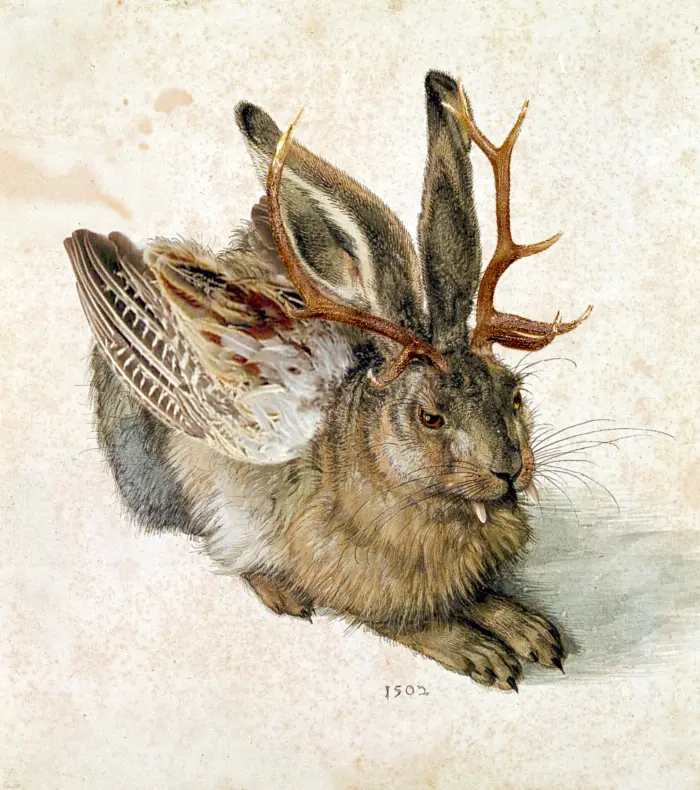
The Wolpertinger is Bavaria's horned hare: a taxidermy chimera of hare, antlers, wings and fangs, sold in inns and souvenir shops and displayed in a case at Munich's German Hunting and Fishing Museum.
Where and when was Wolpertinger sighted?
- Location
- Bavaria, Germany
- Date sighted
- Unknown
- Coordinates
- 48.138, 11.572
- Last updated
LOCATION
What is Wolpertinger?
Two things get sold as one here. The horned hare itself is a genuine European natural-history error, argued over in German print since at least 1719 and exposed by Johann Friedrich Blumenbach, who examined the famous specimen supposedly shot in 1621 and reported that its head was made of wood. The Bavarian name is another matter. It is absent from Grimm's dictionary, absent from the Deutsches Textarchiv corpus, and absent from the German National Library catalogue before 1968, where the oldest entry is a joke hunting book. Nobody claims the animal is real. What it is, is an errand: a hoax hunt in which the newcomer is sent into the woods after dark with a sack and a light — the Bavarian cousin of the American snipe hunt, and, on the evidence, a good deal younger than it looks.
What is the history of Wolpertinger?
Two different animals are sold as one, and separating them is the whole story. The first is the horned hare, and it is genuinely old. The second is the word Wolpertinger, and its paper trail is startlingly recent.
Begin with the hare, because the German printed record on it is unusually good and almost none of it is Bavarian. In 1719 the Saxon hunting writer Hans Friedrich von Fleming devoted a passage of Der Vollkommene Teutsche Jäger to a hare's skull he had split open: the nasal cavities curved back towards the throat, and above them the braincase was, he wrote, barely the thickness of a knife-back — from which he concluded that it was "unmöglich, und wider die Natur, daß es gehörnte Hasen geben könne", impossible and against nature that horned hares could exist. Two years later Nicolas Lémery's Vollständiges Materialien-Lexicon (Leipzig, 1721) said the opposite in one line: "Unterweilen finden sich gehörnte Hasen: iedoch sehr selten" — horned hares are found now and then, though very rarely. In his own second volume, in 1724, Fleming passed on Jenisius's report that horned hares had been caught more than once around Annaberg, in Saxony.
The naturalist who took the thing seriously and then took it apart was Johann Friedrich Blumenbach, and because every edition of his textbooks is digitised the retreat can be read year by year. In the first volume of the Handbuch der Naturgeschichte (Göttingen, 1779) the horned hares are "ein ungemein merkwürdiges Phänomen, was alle Aufmerksamkeit der Naturforscher und Physiologen verdient" — a most remarkable phenomenon deserving the full attention of naturalists and physiologists. For pictures he cites Gesner's Icones ... quadrupedum in the 1560 edition, to Gassendi's life of Peiresc, to Bartholin's medical letters and to the Museum Besleranum, and notes that Martin Elias Ridinger had engraved two horned hares after his father's drawing "nach dem Leben", from life.
From the fifth edition of 1797 the tone changes. Blumenbach explains that the reason he still writes about them doubtfully is that, for all his years of asking, nobody has ever shown him a reliable specimen — one in which, and he marks the point with an emphatic NB, the little horns were still attached to the hare's own skull. From the 1814 edition onwards the horned hare has become "die wundersame, von so vielen braven Naturforschern für wahr angenommene Sage", the marvellous tale that so many worthy naturalists took for true. And in the comparative anatomy — second edition 1815, third edition 1824 — he says what he found when he finally got at the famous specimen said to have been shot in 1621: the head is wooden, and the antlers on it are nothing but small roe-deer tines. (He locates that specimen in the "akademischen Museum" in 1815 and in the "Cassler Museum" in 1824; the wording changed between editions.)
That is the date that matters for anyone tracing the Bavarian craft. A German professor had picked up a manufactured horned hare, examined it and published the fraud by 1815 at the latest, long before the Bavarian name appears in print. The popular press carried on regardless: Das Heller-Blatt, a penny weekly in Breslau, ran a picture on 19 April 1834 under the headline "Der gehörnte Hase" and explained that such hares are found occasionally, "aber keinesweges als eine eigene Gattung, sondern blos einzeln" — never as a species of their own, only as individuals.
Now the word. It appears in none of that. Grimm's Deutsches Wörterbuch has no entry for Wolpertinger or Wolperdinger, while it does have entries for Hase and Wilderer. The Deutsches Textarchiv, whose extended corpus runs from the fifteenth century into the twentieth, returns not one genuine occurrence — its single hit is a lemmatiser error on the peasant surname Walpertinger in a 1907 schoolbook from Kempten — where Hase returns 46,208 and Wilderer 1,328. The German National Library catalogue holds no publication of any kind containing the word before 1968, against 250 titles containing Hase and 94 containing Wilderer in the same pre-1968 window. In the German Google Books corpus the word registers in 52 of the 320 years between 1700 and 2019, the earliest of them 1957; Hase registers in 315 of those years and Wilderer in 254.
What the national catalogue does show is where the Wolpertinger comes from as a commercial object. Its oldest record is Der Wolpertinger lebt: (Warum die Bayern mehr Haare haben.) Ein Beitrag zur Jagdkunde, by Peter Kirein with drawings by Fritz Köhler, Munich: Lipp, 1968, 88 pages, 5.80 marks, filed under belles-lettres. Then a dance band called Wolpertinger Tanzlmusi in 1975; Hannes Burger's reportage Bayern braucht Wolpertinger, reprinted every year from 1977 to 1983; and from 1982 a steady output by Alfons Schweiggert, who has done more than anyone else to keep the animal in print. In the national catalogue, the Wolpertinger as a commercial title begins in 1968 and multiplies through the 1970s.
Timeline: the documented record of Wolpertinger
- 1719 Hans Friedrich von Fleming, in Der Vollkommene Teutsche Jäger, describes splitting a hare's skull and concludes that it is "impossible, and against nature, that horned hares could exist". The German debunking is older than the Bavarian legend it is usually said to explain.
- 1721 Nicolas Lémery's Vollständiges Materialien-Lexicon (Leipzig) tells German readers the opposite in a single line: horned hares are found now and then, though very rarely.
- 1779 Johann Friedrich Blumenbach's Handbuch der Naturgeschichte calls the horned hares "a most remarkable phenomenon deserving the full attention of naturalists and physiologists", and cites Gesner's Icones in the 1560 edition, Gassendi, Bartholin and the Museum Besleranum as sources of pictures.
- 1797–1807 Across three editions Blumenbach explains that he still writes doubtfully because, after years of asking, nobody has shown him a specimen in which the horns were still attached to the hare's own skull.
- 1815, repeated 1824 In the comparative anatomy Blumenbach reports that the celebrated horned hare said to have been shot in 1621 has a wooden head with small roe-deer tines fixed to it. A manufactured Wolpertinger had been examined and exposed in print a century before the craft is usually dated.
- 19 April 1834 Das Heller-Blatt, a penny weekly in Breslau, prints a picture of a horned hare and assures readers that such animals are found occasionally, though never as a species of their own.
- 31 October 1933 Richard E. Shope and E. Weston Hurst publish "Infectious Papillomatosis of Rabbits" in the Journal of Experimental Medicine. The disease belongs to the American cottontail, not the European brown hare, and it arrives four centuries after the European motif it is often said to explain.
- 16 October 1938 The Deutsches Jagdmuseum opens in the north wing of Nymphenburg Palace, four years after being founded by a circle of National Socialist officials around Christian Weber. It moves to the former Augustinian church on Neuhauser Straße on 3 November 1966, where the Wolpertinger collection is displayed today.
- 1957 The first year in which the German Google Books corpus registers the word Wolpertinger at all. It appears in 52 of the 320 years covered between 1700 and 2019; Hase appears in 315 of them and Wilderer in 254.
- 1968 Der Wolpertinger lebt, by Peter Kirein with drawings by Fritz Köhler (Munich: Lipp, 88 pages, 5.80 marks), is the oldest item containing the word in the German National Library catalogue, which holds nothing at all with it before that year.
- 1983 Peter Sloterdijk, in Kritik der zynischen Vernunft, describes the Wolpertinger as the Bavarian hare with roe antlers that local jokers used to hunt "when the summer visitors from Prussia had grown a shade too clever and deserved a lesson".
- 1999 The Duden Großes Wörterbuch der deutschen Sprache defines the Wolpertinger as a Bavarian fabulous beast with supposedly very valuable fur, to catch which the credulous are sent out with a sack and a burning candle. Grimm's Deutsches Wörterbuch has no entry for it at all.
- 2005 Rainer Zenz uploads to Wikipedia a digital montage of Albrecht Dürer's Young Hare of 1502 with antlers, a wing and fangs added. It illustrates this page, and it is not a photograph of anything.
- October 2008 Last archived capture with content of the Wolpertinger-Museum in Mittenwald, a museum and tavern in a brewery ice cellar. By December 2010 its domain served an empty directory; the museum is now listed as permanently closed.
Is there a rational explanation for Wolpertinger?
There is no creature to debunk here. Nobody in Bavaria claims a Wolpertinger walks the woods, and the museum that owns the best collection files it, in its own words, among the "neuzeitlichen Geschöpfen" — the modern-era creatures — as against the pre-Christian nature goddesses and the Christian legendary figures shown alongside it. What deserves scepticism is the age it is usually given.
That age rests on pictures. Horned hares were drawn and engraved long before anyone printed the word: in 1779 Blumenbach cited a 1560 edition of Gesner's Icones for them. None of those pictures is Bavarian and none of them is called a Wolpertinger. The name itself has no printed trace before the middle of the twentieth century: none in the Deutsches Textarchiv, none in the German National Library catalogue before 1968, and none in the German Google Books corpus before 1957. The horned hare is a pan-European natural-history error with a German literature from at least 1719; the Bavarian brand name is recent.
The Shope explanation needs the same arithmetic. Richard E. Shope and E. Weston Hurst published "Infectious Papillomatosis of Rabbits" in the Journal of Experimental Medicine on 31 October 1933; the virus produces hard keratinised growths that at a distance pass convincingly for horns. That cannot be the origin of a European motif already illustrated by 1560 and already exposed as a wooden fake by 1815, and the host is a different animal. Shope found the papilloma in wild cottontails, the American genus Sylvilagus. In 2015 a team from the Complutense University of Madrid and the University of Kansas examined the 1,395 rabbits and hares of the Kansas natural history museum for the virus: twenty specimens were symptomatic, all of them cottontails, while the hares of the genus Lepus — the genus of the European brown hare from which a Bavarian mount is made — showed no growths, and the authors found their results "consistent with SfPV specificity to genus Sylvilagus". Shope explains American horned rabbits; the dates rule him out as the source of the Wolpertinger.
What the Wolpertinger really is, is a hoax hunt. The Duden's Großes Wörterbuch der deutschen Sprache defines it in 1999 as a Bavarian fabulous beast with supposedly very valuable fur, to catch which the credulous are sent out with a sack and a burning candle. Peter Sloterdijk, writing in 1983, gives its social use precisely: the Wolpertinger, he says, is the hare with roe antlers that lives in Bavaria and that Bavarian jokers used to hunt "wenn die Sommerfrischler aus Preußen gar zu gescheit geworden waren und eine Lektion verdienten" — when the summer visitors from Prussia had grown a shade too clever and deserved a lesson. The American snipe hunt is the same errand, played on the same newcomer.
The picture that illustrates this file is not a museum specimen either. It is a digital montage that the Wikipedia contributor Rainer Zenz uploaded in April 2005: Albrecht Dürer's watercolour Young Hare of 1502, with antlers, a wing and fangs added. Dürer's date is still legible at the foot of the image, and Wikimedia Commons files it under "Parodies of Albrecht Dürer's Young Hare".
Can you visit Wolpertinger?
Wolpertingers are on permanent display in Munich, at the Deutsches Jagd- und Fischereimuseum, Neuhauser Straße 2, 80331 München, on the pedestrian street between Karlsplatz and Marienplatz. The building is the former Augustinian church, secularised in 1803; the museum has occupied it since 3 November 1966, when mayor Hans-Jochen Vogel opened it, and by its own account it shows almost 1,000 mounted animals across some 3,000 m². The museum's page for Anne Blaich's exhibition "Wesen der Alpen", now in its exhibition archive, describes the permanent display as presenting "unterschiedliche Wolpertinger" together with formerly sacred animals such as chamois and ibex.
The museum's history page, written by A. Heusler in 2016, sets out the institution's Nazi-era origins. The Verein Deutsches Jagdmuseum was founded in Munich in 1934 by a circle of National Socialist officials around Christian Weber, whose plans prevailed over those of Hermann Göring; the antler collection of Count Arco, bought that year, became its core. The museum opened on 16 October 1938 in the north wing of Nymphenburg Palace, three weeks before the November pogroms. It was refounded in 1949 on the initiative of the Social Democrat mayor Thomas Wimmer and became a foundation in 1960. The museum sells a chronicle of its own history by Cornelia Oelwein, in a short and a long version, and has belonged since 2013 to the Munich initiative "Kunst und Kultur für Respekt".
The museum's pages, consulted on 24 September 2026, give the opening hours as daily from 09:30 to 17:00, with last admission at 16:15. Admission is €7 for adults, €5 reduced, €3.50 for children aged 3 to 16 and €14 for a family ticket covering two adults and up to three children. Groups of nine or more pay €3.50 a head, groups with children under three pay a flat €12, and annual passes can be ordered. Payment is cash only. The museum states that it is not barrier-free, because its departments can be reached only by several steps; its home page says that dogs are welcome.
A second Wolpertinger-Museum, at Innsbrucker Straße 40 in Mittenwald, occupied the former ice cellar of the Mittenwald brewery; the museum directory museen.de lists it as permanently closed. Its own website, in the Wayback Machine capture of 23 October 2008, advertised "eine sagenhafte Ausstellung von einmaligen Exemplaren dieser extrem scheuen und legendären urbayerischen Geschöpfe" (a fabulous exhibition of unique specimens of these extremely shy and legendary old-Bavarian creatures) together with a "gemütliche Wirtschaft", a tavern. The same page gave the hours as Tuesday to Friday from 14:00 to 01:00 and Saturday and Sunday from 11:00 to 01:00, closed on Mondays, and offered to send Wolpertingers and T-shirts on request; it was signed "Christian und Traudi". In the capture of 16 December 2010 the domain serves an empty directory index, and in December 2013 it carries a page offering the domain for sale.
Sources consulted
- Hans Friedrich von Fleming, «Der Vollkommene Teutsche Jäger, Bd. 1» — Leipzig, p. 239 (Deutsches Textarchiv), 1719 book
- Nicolas Lémery, «Vollständiges Materialien-Lexicon» — Leipzig, p. 336 (Deutsches Textarchiv), 1721 book
- Johann Friedrich Blumenbach, «Handbuch der Naturgeschichte, Bd. 1» — Göttingen, pp. 111–112 (Deutsches Textarchiv), 1779 book
- Johann Friedrich Blumenbach, «Handbuch der vergleichenden Anatomie, 3. Auflage» — Göttingen, pp. 56–57 (Deutsches Textarchiv), 1824 book
- Das Heller-Blatt, Nr. 16, «Der gehörnte Hase» — Breslau, 19 April 1834, p. 4 (Deutsches Textarchiv), 1834 newspaper archive
- Deutsche Nationalbibliothek, «Catalogue search for "Wolpertinger" (SRU interface, 14 August 2026): 77 title records, 106 in any field, none published before 1968; controls in the same catalogue for the same period, Hase 250 and Wilderer 94» — German National Library catalogue, 2026 archive
- Digitales Wörterbuch der deutschen Sprache, «Wolpertinger (dictionary entry; definition from Duden, Großes Wörterbuch der deutschen Sprache, 1999) and Deutsches Wörterbuch of the Brothers Grimm, which has no entry for the word» — Berlin-Brandenburgische Akademie der Wissenschaften, 1999 book
- Peter Sloterdijk, «Kritik der zynischen Vernunft, Bd. 1» — Frankfurt: Suhrkamp; passage located in the DWDS Kernkorpus des 20. Jahrhunderts, 1983 book
- Richard E. Shope and E. Weston Hurst, «Infectious Papillomatosis of Rabbits; with a Note on the Histopathology» — The Journal of Experimental Medicine 58(5): 607–624, 1933 academic
- Deutsches Jagd- und Fischereimuseum, «Wesen der Alpen: Arbeiten von Anne Blaich — exhibition page describing the permanent display and classing the Wolpertinger among "neuzeitliche Geschöpfe"» — Official museum website, 2026 web
- Deutsches Jagd- und Fischereimuseum, «Die Geschichte des Museums (text by Dr. A. Heusler), with opening hours, prices and accessibility notice» — Official museum website, 2016 web
- Internet Archive Wayback Machine, «Wolpertinger-Museum Mittenwald, archived site (capture of 23 October 2008)» — wolpertinger-museum.de, 2008 archive
- museen.de, «Wolpertinger-Museum, Mittenwald — listed as permanently closed» — German museum directory, 2024 web
- Rainer Zenz, «File:Wolpertinger.jpg — digital montage, categorised under "Parodies of Albrecht Dürer's Young Hare"» — Wikimedia Commons, 2005 web
- C. Escudero Duch, R. A. Williams, R. M. Timm, J. Pérez-Tris and L. Benítez, «A Century of Shope Papillomavirus in Museum Rabbit Specimens — 1,395 lagomorphs in the University of Kansas collection; symptomatic specimens only in Sylvilagus, none in Lepus» — PLoS One 10(7): e0132172, 2015 academic
- Google Books, «Google Books Ngram Viewer, German corpus 2019, 'Wolpertinger', 'Hase' and 'Wilderer', 1700-2019: non-zero in 52, 315 and 254 of 320 years; first year for Wolpertinger 1957 (checked 1 October 2026)» — Google Books Ngram Viewer, 2026 web
Reviewed by V. Serrano on 2026-08-14 · How we verify our content
📎 Source: Enigma Atlas
💬 Field testimonies (0)
No testimonies yet. Add the first.
Add your testimony
🔒 Log in to add a testimony