👻 HAUNTED PLACE · EXP. Nº1189
ACTIVE
Inverlochy House
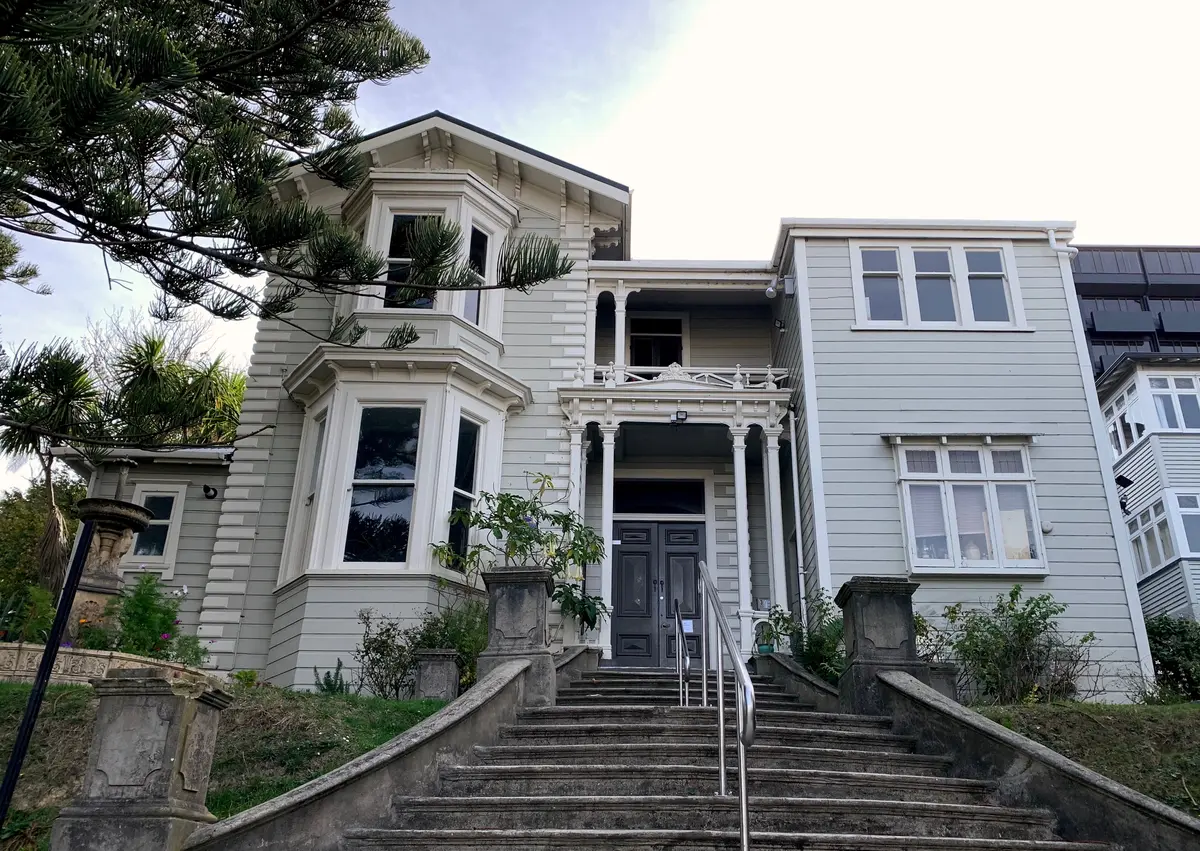
Inverlochy House is a two-storey Italianate timber mansion at 3 Inverlochy Place, in Te Aro, Wellington, built for the auctioneer and politician Thomas Kennedy Macdonald - "Kennedy Mac" - who occupied it from about 1878 and lost it in a mortgagee auction on 20 January 1893, bidding 3,100 pounds for his own house before the Colonial Bank bought it in at 3,200.
Where is Inverlochy House?
- Location
- Wellington, New Zealand
- Type
- House / mansion
- Coordinates
- -41.294, 174.77
- Last updated
LOCATION
Why is Inverlochy House said to be haunted?
Subdivided into nine flats in the early 1920s, saved from demolition by its tenants in 1980 and given away by the developer, it has housed an art school since 1987 and is a Category 2 historic place on the Heritage New Zealand List. Its ghost is solid as a reputation and thin as a record. The art school says the house has been called haunted since the 1970s, that objects are usually reported moving rather than figures seen, and that the rumour tying the apparition to a woman who died in a fire has "no solid evidence to support this idea". A sweep of 872 digitised Papers Past items mentioning the house between 1865 and 1945 found no fire, no such death, and the word Māori nowhere near it - but it did find the servants, and one real death, with a name.
What is the history of Inverlochy House?
The ground under Inverlochy House has a first owner in the record, and he is not the man the house is named for. On 17 October 1865 a Crown grant for sections 111, 109 and 113 of the town of Wellington was issued to the rangatira Te Ropiha Moturoa. Section 111 passed in 1866 to the merchant Edward Pearce, who kept a paddock and built a stable on it, and the land was cut up and sold through the 1870s.
Thomas Kennedy Macdonald bought part of section 111 on 5 December 1876 and the remainder from a clerk named Samuel Costall on 22 August 1877. Wellington knew him as "Kennedy Mac". Born at Boulogne-sur-Mer in 1847 to Scottish parents and schooled in Dundee and Adelaide, he reached Wellington in 1871 carrying a letter of introduction from Sir Donald McLean, worked as a clerk at the Mount Cook barracks, opened an accountancy business in 1873 and built it into the auction and land-agency firm that a contemporary paper said held "a practical monopoly" on the capital's accounting work. He sat for the Te Aro ward on the city council in 1877-78, stood for mayor in 1889, won the Wellington City seat in 1890, was chief Government Valuer for Lands from 1895 to 1901 and sat in the Legislative Council from 1903 to 1911. He was also a council member of the New Zealand Academy of Fine Arts, the body that would end up owning his house a century later.
Nobody has found the building date. Heritage New Zealand's report notes that the Te Aro Rating Book first records a house worth 120 pounds on Macdonald's land in the entry for 1878-79, and that the family occupied the house from 1878. Macdonald himself, giving evidence on oath in March 1893, said he had removed to "Inverlochie House" in 1877, taking about thirty loads of furniture over a week. It was a fourteen-room, two-storey Italianate timber house; he later added two wings that turned the plan into a T. Inverlochy Place was its carriage drive, and was known as The Avenue.
The fall is better documented than the rise. Macdonald was bankrupted in December 1891 and resigned his parliamentary seat; his discharge came on 3 March 1892. On 10 December 1891 his own firm advertised the house in the Evening Post: over an acre of ground, private entrances from three streets, a first-class orchard, a concrete tennis court, vinery, stable, greenhouse and fernery. It did not sell. Title to the house had been put in his wife's name, so it was Frances Rossiter Macdonald whom the Colonial Bank sued. The bank entered into possession on 15 August 1892, and on 21 December the Registrar of the Supreme Court received the application to sell under the mortgages.
The auction was held at J. H. Bethune and Co's rooms in Featherston Street on Friday 20 January 1893. The auctioneer told the court two months later that there had been a good attendance, that Macdonald bid 3,100 pounds for his own house, that it was knocked down at 3,200 against a reserve of 3,250, and that both lots went to "Mr Chapman for the Colonial Bank". Bethune added that he would not be surprised to learn the house was insured for 4,500 pounds, that it "was a house which very few people could afford to keep", and that a tenant at 150 pounds a year for five years had slipped away over a delay in signing the lease. On 10 June 1893 the Chief Justice held that Mrs Macdonald had divested herself of her remaining property to defeat the bank, and noted in passing that the furniture was being sold "with a view to buying a smaller house on The Terrace". They moved to 192 The Terrace, itself now a listed building under the name Somerled House.
Afterwards the house went down the social scale a step at a time. James McLellan, manager of the iron manufacturer Lysaght, lived there from the late 1890s to 1920. Around 1900 it became two luxury flats; in the early 1920s it was cut into nine, and from February 1922 the Evening Post's to-let columns advertise it as the Inverlochy Flats, 144 Upper Abel Smith Street. Absentee landlords let it decay. By the 1970s it held students and young workers sharing maintenance and a single telephone, and in 1979 the city council served a clean-up notice on rubbish "likely to harbour rats and other vermin".
That year the site reached the developer Frank Renouf, who opened negotiations with Williams Development Holdings. Williams wanted the house down and a motel up: six storeys and seventy units in the narrative of the heritage report, seven storeys and ninety rooms in the summary at the head of the same entry. Tenants were served with eviction notices in March 1980. They ran garden parties and market days, formed an Inverlochy Preservation Trust in May, published a newsletter, lost their injunctions and put 2,000 signatures on a petition. On 24 November 1980 the mayor confirmed a compromise: the motel would be built next door instead. The following day Williams called a press conference to announce that it would give the house away. It stood empty until March 1986, the Academy of Fine Arts restored it, and Mayor Jim Belich opened the art school in December 1987. The Academy voted to close the school in October 1994; the school's management incorporated separately as the Williams School of Art at Inverlochy, which trades today as Inverlochy Art School.
Timeline: the documented record of Inverlochy House
- 17 October 1865 A Crown grant for sections 111, 109 and 113 of the town of Wellington - the ground the house would later stand on - is issued to the rangatira Te Ropiha Moturoa. He is the first owner the record names, and the only Māori person documented in connection with this site.
- 22 August 1877 Thomas Kennedy Macdonald completes his purchase of the land, having bought the first part on 5 December 1876 and the remainder from a clerk named Samuel Costall. No building date has been found: he swore in 1893 that he moved in during 1877, while the Te Aro Rating Book first records a house worth 120 pounds on the land in the entry for 1878-79.
- December 1891 Macdonald is declared bankrupt and gives up his parliamentary seat; he is discharged on 3 March 1892. He states both dates himself, under cross-examination, in the Supreme Court in March 1893.
- 10 December 1891 His own firm advertises the house for sale in the Evening Post: over an acre, private entrances from three streets, orchard, concrete tennis court, vinery, stable, greenhouse and fernery. There is no buyer.
- 18 January 1893 The auction advertisement runs in the New Zealand Times; the same text had been in the Evening Post since at least 3 January. It ends: 'The whole property constitutes an unrivalled family residence.' The school's history page cites this text as of 20 January, which is the date of the sale, not of the paper - and Wikipedia copied the error, while its own external link gives the right date.
- 20 January 1893 The mortgagee auction is held at J. H. Bethune & Co's rooms in Featherston Street. The auctioneer later tells the Supreme Court that Macdonald bid 3,100 pounds for his own house, that it was knocked down at 3,200 against a reserve of 3,250, and that both lots went to 'Mr Chapman for the Colonial Bank'. The house found no outside buyer: the mortgagee bought it in.
- 10 June 1893 The Chief Justice gives judgment in Colonial Bank v. T. K. Macdonald and Wife, holding that Frances Macdonald had transferred her remaining property to her husband to defeat the bank. The judgment notes that the furniture was being sold 'with a view to buying a smaller house on The Terrace'.
- 17 April 1909 Charlotte Rennie, wife of James McLellan, dies 'at her residence, Inverlochy, 144 Abel Smith Street', as the Evening Post's death column records two days later. Her husband is the owner the heritage report places in the house from the late 1890s to 1920. This is the only death in the house documented in the digitised press, and no source links it to the ghost story.
- 15 February 1922 The first advertisement located under the name 'Inverlochy Flats' appears in the Evening Post, matching the heritage report's dating of the subdivision into nine self-contained flats to the early 1920s. Between this date and 1945 the digitised press carries 475 items using that exact name, and only two are not classified advertisements.
- 5 March 1924 A Mrs Ladin advertises in the Evening Post for 'a maid for all work in small flat, two in family' at Inverlochy Flats, 144 Abel Smith Street. There were indeed maids at Inverlochy in the 1920s; what the same corpus does not contain is any fire or any death there.
- March to November 1980 Tenants are served with eviction notices in March so that Williams Development Holdings can demolish the house for a motel. They form an Inverlochy Preservation Trust in May and gather 2,000 signatures. On 24 November the mayor confirms that the motel will be built next door instead, and on 25 November Williams announces it will give the house away.
- 1994 The print studio, fitted out in 1993 with surplus equipment from the City Gallery, Wellington Polytechnic and the College of Education, opens on the first floor. The landing outside it is where the apparition would later be placed - the room is younger than the fire that is supposed to have happened in it.
- 7 July 2011 Laura Walters publishes 'Art School's ghostly reputation' in The Wellingtonian, the earliest dated and bylined ghost account of the house located here. It introduces the 1920s fire and the Māori maid, quotes the school's manager Mark Marriott calling his own group's electromagnetic-field results 'very tenuous', and notes that the school sells a T-shirt with a Casper-like cartoon.
- 8 January 2022 André Chumko's feature in Stuff repeats the story of the Māori maid who died in a fire in the 1920s and then adds the sentence that undoes it: there is 'little evidence to support this with no newspaper reports from the time'. A sweep of 872 Papers Past items from 1865 to 1945 mentioning the house confirms it.
Is there a rational explanation for Inverlochy House?
This entry used to say that accounts of what is seen or heard here "rarely make it into print". That was false, and it was checkable from the Wikipedia article the entry was built on. Ghost material about Inverlochy has been published at least four times: a Documentary New Zealand item screened on TV One in 2001, according to the school, which links to a private YouTube copy rather than to a broadcaster's archive; a feature by Laura Walters in The Wellingtonian on 7 July 2011; an investigation written up in Spooked: Exploring the Paranormal in New Zealand (Jo Davy and James Gilberd, Random House NZ, 2011), a book this entry has not been able to consult, so what it says about Inverlochy is untested here; and a long piece by André Chumko in Stuff on 8 January 2022. What is missing is not the telling. It is the event.
The origin story is that a woman died in a fire in the house. Three sources that copy one another date it three different ways. The school's own history page says "around the turn of the last century" and adds that there is "no solid evidence to support this idea". Walters in 2011 puts it in the 1920s, at the back of the house, and makes the woman a Māori maid. Chumko in 2022 repeats the 1920s and the Māori maid, and then reports the finding that matters: there are "no newspaper reports from the time".
That can be measured. Papers Past, as indexed by DigitalNZ, holds 872 items from 1865 to 1945 that mention Inverlochy or Inverlochie, roughly 815,700 words of scanned text. Not one reports a fire at the house. As controls in the same sweep, the word "fire" appears in 526 of those 872 items, "flat" in 594 and "Wellington" in 554, so both the corpus and the search are working; the string "maori" appears within 200 characters of the building's name exactly nought times (the scans are lower-case and unmacronised). The building is certainly indexed for the decade in question: the exact phrase "Inverlochy Flats" returns 475 items between February 1922 and 1945, and only two of them are anything other than a classified advertisement. Two limits are worth stating. The sweep covers the titles DigitalNZ indexes, thirty-five papers dominated for Wellington by the Evening Post, and not the New Zealand Times, which could only be reached by direct link; and Papers Past's newspaper coverage largely stops in 1945.
The geography of the legend is younger than the legend. The apparition is placed on the first-floor landing outside the Print Studio, and the fire "in this room" - but that print studio was fitted out in 1993 with surplus equipment from the City Gallery, Wellington Polytechnic and the College of Education, and opened in 1994. Before that the room was the caretaker's, and before that Macdonald's billiard room. Nor did the servants live in "the back half of the house": the heritage inspection records the servants' quarters as the separate out-building on the Abel Smith Street side. The other candidate offered for the apparition, Frances Macdonald, left in 1893 and died in 1921.
There were servants here, and there was a death; neither is the one in the story. The Evening Post carries advertisements for a general servant at "Inverlochy, Abel Smith Street" placed by Mrs John Ross in January and April 1898, and a want-ad of 5 March 1924 in which a Mrs Ladin asks for "a maid for all work in small flat, two in family" at Inverlochy Flats. And on 19 April 1909 the paper's death column records that Charlotte Rennie, wife of James McLellan, had died two days earlier "at her residence, Inverlochy, 144 Abel Smith Street" - the wife of the owner the heritage report names. No source connects her to the apparition and this entry does not connect her either. She is simply the death the archive actually holds, and she has a name and a date, which is more than the maid has.
The commercial reading applies here only at the margin. Inverlochy charges nothing to see its gallery, and for years the only merchandising on record was a T-shirt with a Casper-style cartoon, noted in 2011. By 2026 the ghost had reached the programme: as of 23 September 2026 the school's course list offers a Halloween "Heritage tour at the Haunted Inverlochy House", two sessions on Sunday 25 October at NZ$25 each (details under Visiting). It is one Sunday in the calendar of an art school whose income comes from its courses and room hire. The Heritage New Zealand list entry runs to about 14,500 words and contains no instance of ghost, haunt, apparition or paranormal. The investigators are the most sceptical voices on the record: Mark Marriott, then the school's manager and a member of the group Strange Occurrences, called their electromagnetic-field results "very tenuous" and said "maybe I'm completely and utterly insensitive to ghosts", and the group's leader James Gilberd told the same reporter that "a sceptic will look at evidence before they proclaim it to be true".
One thing has moved the wrong way. The school's history page, as archived on 25 March 2016, ended its ghost section by saying that many at Inverlochy believe the events "are just in our imagination or made up by pranksters" and that nobody has ever been really frightened; it also described a caretaker's experiences in the late 1990s and two blessings, one by a Catholic priest and one by a local kaumātua. Those paragraphs are absent from the capture of 26 January 2022 and from the live page. What survives is the sentence saying there is no solid evidence, which is still the best sentence anyone has written about this house. A further story, of a child drowning in one of the entrance fountains "during the time it was flats", is reported in 2022 with no date, no name and no source, and is left out here for that reason.
Can you visit Inverlochy House?
Inverlochy House stands at 3 Inverlochy Place, Te Aro, Wellington 6011, a lane off Abel Smith Street about 200 metres north-west, in a straight line, of the junction of Abel Smith Street and Willis Street. The lane was the carriage drive, known as The Avenue. Heritage New Zealand's list entry no. 1398, a Historic Place Category 2 entered on 26 May 2006, gives the access status as "Private/No Public Access". The extent of the registration takes in the house with its fixtures and fittings, the out-building, the fountains and stone entrance stairway, and the land in certificate of title WN598/276; the report adds that the fountains on either side of the steps are no longer in use, and that two listed heritage trees, a Norfolk Island pine and a London plane, stand outside the entrance.
The building is the Inverlochy Art School, and the way in is the school's own programme. As published on inverlochy.org.nz on 23 September 2026, the IAS Community Gallery, in the school's gallery and foyer, is open Monday to Friday from 10 am to 2 pm and on Saturdays from 11 am to 3 pm; the show on the wall is "Between the Trees" by Laura Round, from 21 September to 16 October 2026. The school office is open Monday to Friday, 9 am to 5 pm, except public holidays, on 04 939 2177. Courses run for adults, with holiday programmes for children and teenagers.
The school also sells a ghost-themed visit. Its course list carries two sessions of a "Heritage tour at the Haunted Inverlochy House" on Sunday 25 October 2026, from 2 to 3.30 pm and from 4 to 5.30 pm, at NZ$25; the booking page calls it a Halloween tour "with a cuppa", says it runs for about an hour, and showed 25 places left on 23 September. The same page states that wheelchair access to the school is at the top of the driveway, to the left of the main house, and that the print studio and the upstairs front studio are reached only by internal stairs.
The rooms can be hired. The venue-hire page lists the print studio, which the school describes as one of the few public-access print studios in New Zealand and which holds a Bendini etching press with a 700 by 1600 mm bed; it rents at NZ$35 per person per half day, as do the darkroom and the West Studio. The forty-seat lecture hall averages NZ$100 a day; Heritage New Zealand records that it was the original dining room. The upstairs room and the downstairs front room are NZ$80 per person per day.
Sources consulted
- J. H. Bethune & Co., auctioneers, «Important Sale of Freehold and Leasehold Property in Wellington (advertisement, Page 3 Advertisements Column 9)» — New Zealand Times, vol. LIV, issue 9812, p. 3, 1893 newspaper archive
- T. Kennedy Macdonald & Co. Limited, «For Sale: Inverlochy House, Abel Smith Street (advertisement)» — Evening Post, 10 December 1891, p. 3, 1891 newspaper archive
- «Supreme Court (Colonial Bank v. Macdonald: evidence of the Registrar and of the auctioneer J. H. Bethune on the sale of Inverlochie House)» — Evening Post, 24 March 1893, 1893 newspaper archive
- «Supreme Court (Colonial Bank v. T. K. Macdonald and wife: Macdonald's evidence on the move to Inverlochie House and on his bankruptcy)» — Evening Post, 28 March 1893, 1893 newspaper archive
- «Supreme Court. Colonial Bank v. T. K. Macdonald and Wife (judgment of the Chief Justice)» — Evening Post, 10 June 1893, 1893 newspaper archive
- «Wanted: a general servant, apply to Mrs John Ross, Inverlochy House, Abel Smith Street (advertisement)» — Evening Post, 22 January 1898, p. 1, 1898 newspaper archive
- «Deaths: McLellan, at her residence Inverlochy, 144 Abel Smith Street, Charlotte Rennie, wife of James McLellan» — Evening Post, 19 April 1909, 1909 newspaper archive
- «To let, Inverlochy Flats (earliest advertisement under that name located in the digitised press)» — Evening Post, 15 February 1922, 1922 newspaper archive
- «Wanted: maid for all work in small flat, two in family... Mrs Ladin, Inverlochy Flats, 144 Abel Smith Street (advertisement)» — Evening Post, 5 March 1924, 1924 newspaper archive
- James Taylor, «Inverlochy House, 3 Inverlochy Place, Te Aro, Wellington: List entry no. 1398, Historic Place Category 2 (report completed 12 December 2005; entered on the List 26 May 2006)» — New Zealand Heritage List / Rarangi Korero, Heritage New Zealand Pouhere Taonga, 2005 report
- Laura Walters, «Art School's ghostly reputation» — The Wellingtonian / Stuff, 7 July 2011, 2011 newspaper archive
- André Chumko, «The renaissance of Wellington's history-filled Inverlochy Art School» — Stuff, 8 January 2022, 2022 newspaper archive
- «The History of Inverlochy House (including the section 'The Ghost'; compared with the Wayback Machine captures of 25 March 2016 and 26 January 2022)» — Inverlochy Art School, 2026 web
- «Venue Hire and Contact Us (opening hours, room hire rates and gallery hours, consulted 21 August 2026)» — Inverlochy Art School, 2026 web
Reviewed by V. Serrano on 2026-08-21 · How we verify our content
💬 Field testimonies (0)
No testimonies yet. Add the first.
Add your testimony
🔒 Log in to add a testimony