👻 HAUNTED PLACE · EXP. Nº9475
ACTIVE
Whatipu
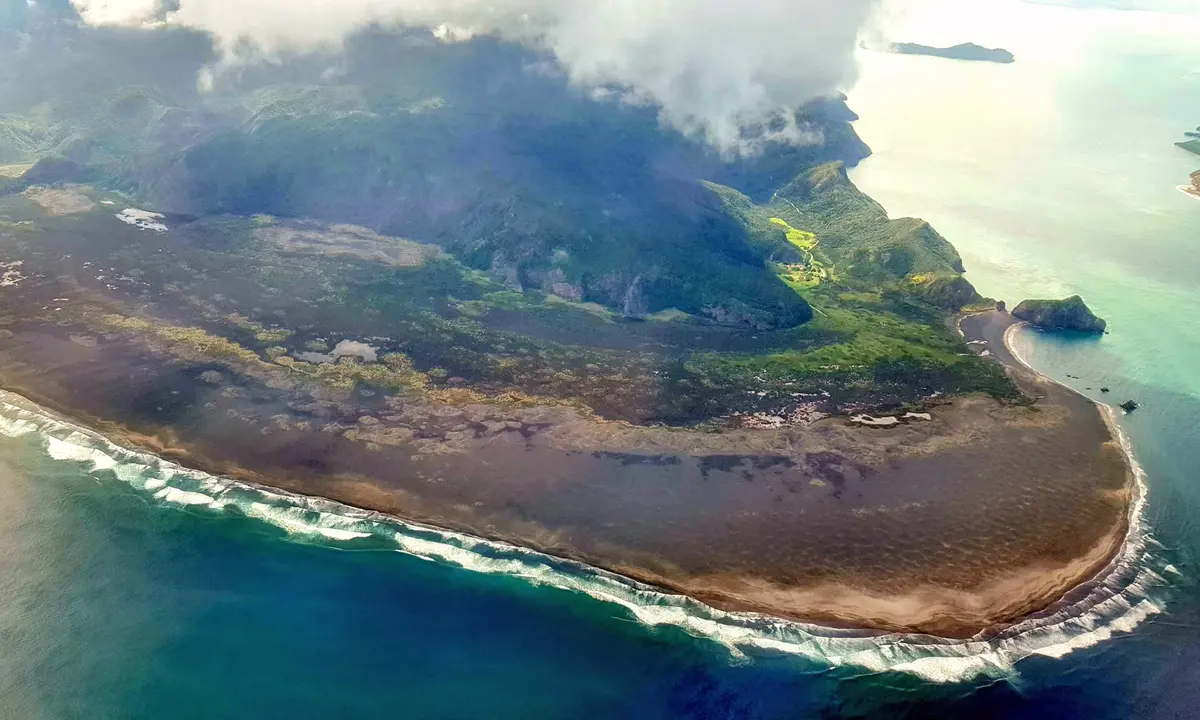
Whatipu is the black-sand toe of the Waitākere Ranges, on the north side of the Manukau Harbour entrance, and the water offshore is why anyone remembers it.
Where is Whatipu?
- Location
- Auckland, New Zealand
- Type
- Park
- Coordinates
- -37.039, 174.508
- Last updated
LOCATION
Why is Whatipu said to be haunted?
At about 1.20 pm on 7 February 1863, in fine weather and moderate seas, the Royal Navy corvette HMS Orpheus struck the Middle Bank of the Manukau Bar; 189 of a complement usually given as 259 died, and it is still New Zealand's worst maritime disaster. Bodies came ashore along this coast for weeks. Three years later the Gibbons family began milling kauri here, and the homestead Nicholas Gibbons built in 1870 is still the heart of Whatipu Lodge, which takes guests to this day; a kauri dance floor once laid in the giant sea cave up the beach lies buried under the sand. The haunting is far younger than any of it. The oldest telling we can date is a television episode broadcast in 2005, which already names the Pink Lady of the lodge; a long 1989 magazine feature on Whatipu's legends and the regional council's 24-page heritage booklet of 2007 mention no ghost at all. The documented place needs no invention.
What is the history of Whatipu?
Whatipu is not a village and never quite was. It is the black-sand toe of the Waitākere Ranges on the northern side of the entrance to the Manukau Harbour, and almost everything that has happened here happened because of the water immediately offshore: the Manukau Bar, a shifting mass of iron sand at the mouth of a harbour Māori know as Te Manukanuka ā Hoturoa, "the anxiety of Hoturoa", named for the misgivings of the captain of the Tainui canoe as he set out through it.
Te Kawerau ā Maki hold mana whenua here, and the landscape is dense with their history: five pā, terraces, shell middens and planted karaka groves. The name Whatipu itself belongs to a taniwha said to have come from Tūhua (Mayor Island) and settled at the harbour mouth. Kupe is remembered for reciting karakia at the rock now called Te Toka Tapu ā Kupe, the Ninepin, and the rough seas off this coast are Ngā Tai Whakatū ā Kupe, the upraised seas of Kupe. Older still in tradition is Paorae, a lost sandy land that once ran south towards the Waikato River: the government interpreter John White published an account of it in 1888, and in 1898 James Cowan collected a fuller one from the rangatira Patara Te Tuhi and his brother Honana Maioha. The last member of Te Kawerau ā Maki to live permanently at Whatipu was Apiata Te Aitu, who was there until about 1880; Te Ipu Kura ā Maki Taua kept guardianship over the place from the early 1900s until her death in 1968, and the Kura Track is named after her.
Europeans came for the harbour, not for the beach. Captain Thomas Wing made the first survey of the Manukau entrance in 1836 and his chart stayed in use for some twenty years. After Captain B. Drury resurveyed the entrance in the Pandora in 1853, the government established the Manukau Signal and Pilot Station at Whatipu late that year. Captain Hannibal Marks was appointed the harbour's first pilot on 1 November 1853 and worked a signal mast on the exposed summit of Paratūtai Island, rowed out to ships by a Māori boat crew of four. Wing himself became harbourmaster and pilot in April 1857 and built a house on Wing Head, chained to the ground against the gales and a hundred-metre climb up from the beach. From 1861 the signalman was his eldest son, Edward.
At about 1.20 in the afternoon of 7 February 1863, in fine weather and moderate seas, the Royal Navy corvette HMS Orpheus, flagship of the Australian squadron, struck the northern end of the Middle Bank. She had left Sydney on 31 January with Commodore William Farquharson Burnett aboard; she carried both an out-of-date chart and newer sailing directions, and the signals hoisted from Paratūtai by Edward Wing were not followed. The sea did the rest over the next few hours. The ship swung broadside, the hatches burst, and when the masts came down at around eight in the evening most of the men still in the rigging were killed. The coastal steamer Wonga Wonga and Wing's pilot boat lifted off the survivors. One hundred and eighty-nine men died, Burnett and Captain Robert Heron Burton among them, out of a complement usually given as 259; the seventy who lived were, according to the contemporary reports carried in The Times, eight officers and sixty-two men. It remains the deadliest maritime disaster in New Zealand waters.
Two figures should be flagged rather than smoothed over. The Auckland Regional Council's own heritage booklet, written by the West Auckland historian Graeme Murdoch, gives the complement as 270, which does not reconcile with 189 lost and 70 saved; and the Whatipu Lodge website states that "only 70 bodies were recovered", which inverts the fact - seventy men survived. Bodies came ashore along the surrounding coastline over the following weeks, not, as is often written, in the following days, and most were buried where they were found. Two were buried below Wing Head at Whatipu itself; three unidentified men were given marked graves near Cornwallis Beach. The Admiralty inquiries fell heavily on Edward Wing rather than on the dead commodore, although Murdoch sets out the modern reading: Burnett and his officers simply had not used the latest sailing directions. Thomas Wing kept his post as harbourmaster until 1888. The Māori boat crew of the pilot station received Royal Humane Society medals for the rescue. On 20 November 1976 the New Zealand Historic Places Trust set a bronze plaque on Paratūtai; it was vandalised and now sits in the Huia Settlers' Museum. The Orpheus was neither the first nor the last: Murdoch counts eighteen ships wrecked on the Manukau Bar between 1848 and 1981 with the loss of 244 lives, while Bob Harvey, writing in Metro in 1989, put the figure at "over 60 vessels".
Then came the kauri. In 1866 the Gibbons family - John Gibbons and his sons, who had emigrated from Newfoundland in 1853 - closed their Niagara Mill at Huia and began a new one in the lower Whatipu Valley. It was working by the end of 1868, its saws driven by a waterwheel until a steam engine took over in 1874. A wooden tramway carried sawn timber to a wharf on the sheltered north-eastern side of Paratūtai Island, and a second line ran north along the coast to the Pāraraha mill of William Foote, John Gibbons's son-in-law; together the two mills cut 100,000 super feet a week for export by sailing ship, much of it to Australia. Nicholas Gibbons, the mill manager, built a homestead in 1870 - the building still at the centre of Whatipu Lodge - where he and his wife Matilda (née Laurie) raised eight children. The mills were sold to the Dunedin firm of Guthrie and Larnach in 1877 and closed in 1881 after a dry summer, bush fires and the burning of the Pāraraha mill; a successor at Karekare ran until 1886, and a revival focused on Piha rebuilt the coastal tramline between 1906 and 1921. At its height the Whatipu mill supported a community of over a hundred people, with a manager's office, a store, a blacksmith, twenty workers' cottages, a school and a small post office on the wharf.
The lodge grew out of the collapse. Fred and Laura Gibbons took paying guests in the homestead from the 1890s; when milling resumed they added a dining hall, a kitchen and rows of bunkrooms, and the complex became "Whatipu Lodge" in 1906. Its bedrooms were built between 1910 and 1921; the full-sized billiard table went in when the dining hall was altered in 1947. The family sold in 1929 and the licence has passed through the Douglas, Farley, Gibson, Sharp, Roberts and Anderson-Hunter hands since. Half a kilometre up the coast is the giant sea cave that gives Whatipu its second story: a kauri dance floor was laid in it - about 1899 according to the lodge's own history, and certainly in use in the early 1920s, when, as Bruce Harvey wrote, the cave was "lit and festooned with ribbons" and an accordion band supplied the music. Bob Harvey, walking out to it in 1989, found the lamp hooks still in the rock. The floor itself is somewhere under the sand.
Timeline: the documented record of Whatipu
- 1836 Captain Thomas Wing makes the first survey of the Manukau Harbour entrance. His chart, which shows the Ninepin and Paratūtai Island, stays in use for about twenty years - long enough to become dangerous.
- 1 November 1853 After Captain B. Drury resurveys the entrance in the Pandora, the government sets up the Manukau Signal and Pilot Station at Whatipu. Captain Hannibal Marks is appointed first pilot and works a signal mast on Paratūtai Island with a Māori boat crew of four.
- 7 February 1863, 1.20 pm In fine weather and moderate seas HMS Orpheus strikes the northern end of the Middle Bank on the Manukau Bar, having ignored the signals hoisted by signalman Edward Wing. She breaks up over the next few hours; when the masts fall at around 8 pm most of the men in the rigging die. 189 of a complement usually given as 259 are lost, including Commodore Burnett; 70 survive - eight officers and sixty-two men, according to reports carried in The Times.
- 16 November 1863 A Waikato raiding party climbs Paratūtai Island and cuts down the signal mast. The Te Kawerau ā Maki leader Te Wātarauhi writes to Governor Grey from Waitākere: 'Great is our annoyance at this conduct of the Waikatos, who have cut down the flagstaff to cause mischief in our district.'
- 1868 The Gibbons family's sawmill in the lower Whatipu Valley is working by the end of the year, its saws driven by a waterwheel. A wooden tramway carries the timber to a wharf on Paratūtai Island.
- 1870 Mill manager Nicholas Gibbons builds the homestead where he and his wife Matilda (née Laurie) raise eight children. It is the building now at the centre of Whatipu Lodge - and the building later said to be haunted.
- About 1899 According to the lodge's own history, a kauri dance floor is installed in the giant sea cave, raised to the roof by block and tackle when storms come from the west. Bruce Harvey's family history places the cave dances in the early 1920s, with ribbons and an accordion band.
- 1906 With milling revived to the north, Fred Gibbons adds a dining hall, kitchen and bunkrooms around the homestead. The complex takes the name 'Whatipu Lodge'; its bedrooms are built between 1910 and 1921.
- 1929 Fred and Laura Gibbons sell Whatipu Lodge and the farm and retire to Weymouth, ending sixty years of Gibbons ownership. Nicholas and Matilda Gibbons had already left Whatipu for Weymouth in the late 1890s.
- 20 November 1976 The New Zealand Historic Places Trust sets a bronze memorial plaque to the Orpheus dead on Paratūtai Rock. It is later vandalised and moved to the Huia Settlers' Museum.
- August 1989 Bob Harvey publishes a long feature on Whatipu in Metro no. 98. He retells Kupe's karakia at the Ninepin, the lost land of Paorae, the legend of Orpheus bullion buried near the rock and a 1920s dance in the cave ended by a wave at midnight. He mentions no ghost anywhere in the article.
- From 28 June 2005 The New Zealand series Ghost Hunt (Screentime for TVNZ) devotes its sixth episode to Whatipu. Its synopsis is the oldest datable telling of the haunting we have found: 'the most famous is the Pink Lady, who hovers in the hallways of the quaint holiday lodge', attributed only to 'local historians'.
- October 2007 The Auckland Regional Council publishes Graeme Murdoch's 24-page heritage booklet on Whatipu, covering taniwha, pa sites, the Orpheus, the mills, the lodge and the cave. It contains no mention of a ghost, a haunting or the Pink Lady.
- December 2017 Te Kawerau ā Maki place a rāhui over the Waitākere Ranges because of kauri dieback. Auckland Council closes large sections of the track network; since 2018 tracks reopen only by agreement with the iwi.
- 18 July 2020 Mark Wallbank's Haunted Auckland team spends the night at the Gibbons homestead looking for the Pink Lady and reports 'a quiet but great fun night at the lodge, without anything we'd consider paranormal occurring'; what they recorded in the caves they debunked as pareidolia and wildlife.
- 8 April 2024 Metro republishes the 1989 feature online with a new note by Bob Harvey himself: 'The Pink Lady ghost still haunts the old Whatipu Lodge guest house.' It is the only appearance of the word 'ghost' on the page, and it is not in the 1989 text.
Is there a rational explanation for Whatipu?
The ghost story at Whatipu is real, in the sense that people tell it. What it is not is old, and it is not the story our own file used to tell.
Start with what is claimed. Two things are said to be haunted here: the Gibbons homestead at Whatipu Lodge, where a "Pink Lady" is described as a glowing, translucent woman who appears in daylight and is identified as Matilda Gibbons; and the giant cave up the beach, where visitors report voices, singing, music, the thump of hard shoes on timber, shadows and lights. Nothing in that repertoire involves the Manukau Bar, drowned sailors or fishermen hearing men calling over the surf. That last motif appeared in the earlier version of this file with no source attached, and we have not been able to find it anywhere. It is gone.
Now date the telling. The oldest fixed appearance we can find is a television programme: episode six of the New Zealand series Ghost Hunt, produced by Screentime and broadcast on TVNZ in the run that began on 28 June 2005. Its published synopsis already contains the whole legend - "the most famous is the Pink Lady, who hovers in the hallways of the quaint holiday lodge" - and attributes it, impersonally, to "local historians". That is 142 years after the Orpheus and roughly a century after the homestead's most-cited resident left it.
The control matters more than the absence. In August 1989 Metro published a long feature on Whatipu by Bob Harvey, a writer entirely willing to record legend: he retells Kupe's karakia at the Ninepin, the vanished land of Paorae, the buried Orpheus bullion supposedly still in the sand near the rock, the 1920s dance in the cave ended by a wave at midnight, and a lovers' leap at Ōmanawanui. The word "legend" appears four times in the body of that article. "Ghost", "haunt", "spirit" and "apparition" appear zero times. In 2007 the Auckland Regional Council published Graeme Murdoch's 24-page heritage booklet on Whatipu, which does discuss taniwha, tapu, wāhi tapu and the Māori reading of the harbour - and which contains not one instance of "ghost", "haunt", "apparition" or "Pink Lady" across roughly 84,000 characters of text, against 45 mentions of Manukau, 37 of Gibbons and 13 of the Orpheus. The Whatipu Lodge website, checked on 14 August 2026 across its history, prices, campsite, lodge, location and swimming pages, does not mention a ghost either - which is unusual, because a haunted guesthouse normally advertises the fact. The one appearance of "Pink Lady" on the Metro page is not in the 1989 article at all: it is in the editorial note Bob Harvey added when the piece was republished online on 8 April 2024.
There is also a straightforward problem with the identification. According to Murdoch's booklet, Nicholas and Matilda Gibbons retired from Whatipu to Weymouth in the late 1890s; the farm and the guest business passed to their son Fred and his wife Laura. The woman said to walk the hallways is a woman who left.
For the cave, the mundane explanation is almost too neat. People go into a large sea cave having been told - correctly - that dances were held there with an accordion band and a kauri floor, and they report hearing music and dancing. The cave is a resonant rock chamber open to a surf beach, with wind, water and a wetland full of birds outside it. The investigators themselves say as much. Mark Wallbank's Haunted Auckland team, which has worked at Whatipu repeatedly since 19 October 2019, reported after its 18 July 2020 overnight stay at the homestead that "it was a quiet but great fun night at the lodge, without anything we'd consider paranormal occurring", and that what they did record in the caves they "worked through and debunked as being natural pareidolia and wildlife". The write-up of a 2021 visit is titled around being "ghosted" by the Pink Lady.
None of that makes Whatipu less interesting. It means the frightening thing here is documented rather than spectral: a bar that has taken hundreds of lives, a family that lost two children to diphtheria because there was no road out, and a coastline that, in Bruce Harvey's own history, saw several drownings and a murder as recently as the 1980s and 1990s.
Can you visit Whatipu?
Whatipu lies at the end of Whatipu Road, Huia, on the north head of the Manukau Harbour entrance. The lodge's directions page, consulted on 9 September 2026, puts it 42 km from central Auckland; 25 km from Titirangi village, half an hour's drive. The route runs through Titirangi onto Huia Road for fifteen kilometres to Huia, then round the foreshore to Little Huia before crossing the Marama Stream ford, of which the page warns that "[s]ometimes the spring tides wash over the ford". Of the final stretch the same page says: "The last 6 km is gravel and there may be oncoming cars so extra caution is required."
The land is a scientific reserve inside the Waitākere Ranges Regional Park, and two statements from 9 September 2026 describe its access between them. Te Kawerau ā Maki placed a rāhui over the ranges in December 2017 because of kauri dieback, and the alliance page explaining it read that day: "The Waitākere Ranges is currently closed, except for a few designated areas." The lodge's own notice board read, the same day: "Whatipu Road is open" and "Omanawanui, Caves, Gibbons and Beach tracks are open." The designated exceptions move from season to season, which is why the notice board exists.
The campsite page is blunt about dogs: "Dogs are banned from the WHOLE WHATIPU AREA." Open fires and fireworks are not permitted. Cooking is gas only, since charcoal burners are excluded along with wood, and "Campers need to take ALL rubbish home with them."
Whatipu Lodge is a working business. At 9 September 2026 the campground charged NZ$12.50 per adult per night; NZ$8.00 per school-age child; NZ$35.00 for a family of four; under-fives free. The lodge charged NZ$50 per adult for a single night; NZ$40 per adult from two nights; NZ$30 per child; NZ$2,000 for the whole lodge from Friday afternoon to Sunday afternoon for up to forty people. The separate bach was NZ$120 a night for up to four on Fridays and Saturdays, NZ$90 midweek for two. Bookings are essential for the lodge and bach, and for long weekends at the campground. The campground has three composting toilets and two cold showers, plus no electricity at all. Since the end of February 2026 it has been connected to drinking water, which the lodge describes as filtered tank and rain water. Payment is awkward: "There is no Eftpos facility available." Reception is worse — "Phone connection is terrible, therefore email and please be patient in regards getting a reply," says the lodge, which answers on 09 811 8860.
The safety notice carries no hedging. "There is no surf patrol at Whatipū," the lodge's swimming page states, and Auckland Council advises against swimming there; the currents at the harbour mouth run hardest on a rising tide. The same page singles out the Ninepin together with Paratutai Island for sudden large waves. Nobody at Whatipu sells the haunting, and the caves are reached by a walk out over a wetland.
Sources consulted
- Graeme Murdoch, «Whatipu: Our History ('Our History' booklet series, no. 4)» — Auckland Regional Council, 2007 report
- The Times (London), transcribed by Peter Davis, «The loss of HMS Orpheus, 7 February 1863: contemporary reports» — The Times / pdavis.nl, 1863 newspaper archive
- Bob Harvey, «... Ah, Wilderness! Bob Harvey goes to Whatipu (with the author's note added on republication, 8 April 2024)» — Metro, no. 98 (August 1989); republished online by Metro, 8 April 2024, 2024 newspaper archive
- Auckland Council, «Whatipu, Waitākere Ranges Regional Park (park page: access, tracks, dog rules, kauri dieback alert)» — aucklandcouncil.govt.nz, 2026 web
- Whatipu Lodge, «Whatipu Lodge official site: history, prices, campsite, lodge, location and swimming pages (consulted 14 August 2026)» — whatipulodge.co.nz, 2026 web
- Mark Wallbank and the Haunted Auckland / Paranormal NZ team, «Gibbons Homestead, Whatipu: overnight investigation report» — hauntedauckland.com, 2020 web
- Mark Wallbank and Sam Collier, «Whatipu Caves exploration and investigation, session 1 (19 October 2019)» — hauntedauckland.com, 2019 web
- Screentime for TVNZ, «Ghost Hunt (2005), series 1 episode 6: 'Whatipu, Auckland' - episode listing and synopsis» — TheTVDB, 2005 web
- Pest Free Waitākere Ranges Alliance, «Rāhui: why there is a rāhui over the Waitākere Ranges and what it means for visitors» — livingintheranges.nz, 2026 web
Reviewed by V. Serrano on 2026-08-14 · How we verify our content
💬 Field testimonies (0)
No testimonies yet. Add the first.
Add your testimony
🔒 Log in to add a testimony