🛸 UFO CASE · EXP. Nº5670
ACTIVE
The Shag Harbour incident
On the night of 4 October 1967, near the fishing village of Shag Harbour at the southern tip of Nova Scotia, a group of young people driving along the shore saw a row of three or four lights come down at about 45 degrees towards the sea, and then a single white light on the water.
The Shag Harbour incident: where and when did it happen?
- Location
- Nova Scotia, Canada
- Date of the event
- What was reported
- Crash and recovery claim
- What the evidence says
- Not yet assessed
- Coordinates
- 43.5, -65.7
- Last updated
LOCATION
What is known about the Shag Harbour incident?
They called the RCMP. Officers arrived in time to see the light, which went out a few minutes later; when they reached the spot by rowboat they found only patches of foam. No aircraft was missing. Navy divers searched the bottom for days and found nothing. The University of Colorado UFO project, the Condon Committee, filed the case as number 34 after a few telephone calls. A one-page Defence memo now held by Library and Archives Canada says the search produced no evidence that could lead to "an explainable conclusion". Canadian ufologists later called it the country's government-documented UFO crash; the record that can be read today is thinner than that, and some of its details grew with the retelling.
What is the history of the Shag Harbour incident?
Shag Harbour is a fishing village in Shelburne County, near the southern tip of Nova Scotia, on Highway 3. The earliest printed account of what happened there that I have found does not name it. The APRO Bulletin, the newsletter of the Aerial Phenomena Research Organization, ran a short piece in its September-October 1967 issue headed "UAO Dives Into Sea At Nova Scotia". It places the event "on the night of October 4 at about 11:05 p.m." and says the first report came from "five young people between the ages of 15 and 20 years old who saw three or four distinct lights arranged in a straight row", the whole about "the size of a large aircraft coming down at an angle of 45 degrees toward the water". The lights passed behind a low hill, and afterwards the witnesses saw "a single white light apparently resting on the water" some 200 or 300 yards off shore.
One of those young people was Laurie Wickens, then 17. CBC News, reporting his death at 76 in August 2026, said he was driving friends home from a dance, phoned the RCMP from a payphone and was asked whether he had been drinking; a second call came back to the booth because the detachment had received more calls. The APRO Bulletin names one of the three officers who went to the scene as "Corporal Ron O'Brian". The light on the water, it says, was like that of "a flash light"; two officers went for a rowboat while a third watched it go out five minutes later, and ten minutes after that the two in the boat found "nothing to be seen except a patch of yellowish foam made up of 1 to 1½ inch bubbles", between 30 and 40 yards across. Fishermen thought it "was not normal tidal foam".
The same story reached the Condon Committee, the University of Colorado project then studying UFOs for the US Air Force. The APRO piece says its Nova Scotia members got a report to headquarters and that Jim Lorenzen passed it to the committee. Its Case 34, headed only "North Atlantic, Fall 1967", records telephone calls to a watch officer of the Canadian Naval Maritime Command and to an RCMP corporal. The watch officer said reports described "an object about 60 ft. long with four lights on it" that had gone "whistling into the sea". The corporal said the young people had seen "three or four yellow lights in a horizontal pattern comparable in size to a 'fair-sized' aircraft", and that the light on the water "was not on any boat". A Coast Guard boat and six fishing boats were on the scene. Air Search and Rescue had no missing aircraft, and a nearby RCAF radar station reported "no Canadian or U.S. air operations in the area at the time, nor any unusual radar object".
The paper trail the case is famous for begins the next morning. According to the transcriptions published by Brian Dunning in 2017, the Rescue Coordination Centre in Halifax sent a telex on 5 October reporting "MANY SMALL BOATS - NIL RESULTS. ALL OTHER POSSIBLE LEADS (A/C, FLARES, ETC.) CHECKED - NIL RESULTS." On 6 October Colonel W. W. Turner, director of operations at Canadian Forces Headquarters, wrote a memo, reproduced by CBC News in 2026, stating that the Centre "conducted [a] preliminary investigation and discounted the possibilities that the sighting was produced by an aircraft, flares, floats, or any other known objects." Navy divers were organised on Friday 6 October and began on Saturday morning, according to the APRO Bulletin. Five days after its first call, the Condon Committee was told by Maritime Command that the search had been terminated.
Library and Archives Canada holds a one-page Department of National Defence summary, undated, headed "UFO REPORT / LOWER WOOD HARBOUR, N.S." (RG 24, acc. 83-84/167, box 7523, file DRBS 3800-10-1, pt. 1). It says that "An RCMP Corporal and six other witnesses" saw an object "approximately 60 feet in length" descend and make a "bright splash", that "a single white light remained on the surface", and that neither the surface search nor an underwater search by Defence divers found "any tangible evidence which could be used to arrive at an explainable conclusion."
The case grew a literature. Chris Styles, who told CBC that as a 12-year-old he had seen an orange orb over Halifax harbour that same night, began researching it in the 1990s and wrote Dark Object (2001, with Don Ledger) and Impact to Contact (2013, with Graham Simms). Wickens later chaired the Shag Harbour UFO Incident Society, which runs the village's interpretive centre.
Timeline: the documented record of the Shag Harbour incident
- 4 October 1967, about 11:05 p.m. Five young people driving near the shore see three or four lights in a row descend towards the water and then a single white light on it, according to the APRO Bulletin. The Shag Harbour UFO Incident Society gives the time as about 11:20 p.m.
- Night of 4-5 October 1967 RCMP officers watch the light on the water until it goes out; reaching the spot by rowboat, with a Coast Guard boat and six fishing boats, they find only patches of foam 30-40 yards wide.
- 5 October 1967 A telex from the Rescue Coordination Centre in Halifax reports "NIL RESULTS" from the boats and from the other leads checked, aircraft and flares included, as transcribed by Brian Dunning.
- 6 October 1967 Colonel W. W. Turner, director of operations at Canadian Forces Headquarters, writes that the Centre discounted an aircraft, flares, floats or any other known object.
- 7 October 1967 Navy divers, organised the day before, begin searching the bottom on Saturday morning, according to the APRO Bulletin. Nothing is found.
- October 1967 Five days after its first call, Maritime Command tells the Condon Committee that the search has been terminated.
- 1969 The Condon Report publishes the case as Case 34, "North Atlantic, Fall 1967", without naming the village, and judges no further investigation justifiable.
- 11 August 2005 Library and Archives Canada publishes its UFO exhibit page on the case, noting that there is no trace of the RCMP reports in its files and that the only document is a Defence memo.
- 4 April 2017 Brian Dunning's Skeptoid episode on the case proposes a fireball or marine flares as ordinary candidates, without claiming to prove either.
- 2 August 2026 CBC News reports the death of Laurie Wickens, the witness who phoned the RCMP in 1967, at 76. The Society later cancels its UFO XPO for October 2026.
Is there a rational explanation for the Shag Harbour incident?
The first thing the 1967 records do not say is that anyone saw an object hit the water. The Condon text is plain: "Apparently no one actually saw anything enter the water." The young people lost the lights behind a hill and then saw a light on the water; the RCMP corporal compared the row of lights to an aircraft. The watch officer's "60 ft." object and, five days later, an RCMP report he read aloud saying "a 60 ft. object had been seen to explode upon impact with the water" are second-hand summaries, and the undated Defence memo, with its "bright splash", belongs to the same chain. The size is a judgement about a row of lights at night, and on a "clear and moonless" night, as Condon has it, there was nothing to give it scale.
The foam has grown. In 1967 the APRO Bulletin and the Condon text give 30 to 40 yards across. The NICAP page on the case, which follows the Styles and Ledger account, has a "120 by 300 foot slick" and "sulfurous-smelling yellow foam". In 2026 Styles told CBC it was "24 metres wide and 800 metres long" and that "some say it smelled of sulphur". The width has stayed in the same range; the length and the smell are not in the contemporary record I have read.
The phrase most often quoted, that the Rescue Coordination Centre "discounted" flares and aircraft, is Colonel Turner's. The Centre's own telex, as Dunning transcribed it, says those leads were "CHECKED - NIL RESULTS". Dunning's reading is that nobody found evidence of a flare or an aircraft, which is not the same as excluding them. He proposed two ordinary candidates, a meteoric fireball and marine distress flares, and did not claim to have proved either: "we can't say it was flares". Neither has been tested against the timing and positions of the witnesses in anything published that I have found.
The Condon Committee is usually blamed for doing nothing. The NICAP page says the investigator "allocated the grand total of two long distance phone calls" and was "assured that there was nothing to the case". The Condon text records more than two sources: the watch officer twice, the RCMP corporal and the captain of a fishing boat whose lights were placed "about 175 n. mi. from the original site". It stopped because of "the immediate and thorough search that had been carried out by the RCMP and the Maritime Command".
What "government-documented" means is also narrower than it sounds. When Library and Archives Canada built its UFO exhibit in 2005 it wrote: "There is no trace of the RCMP reports of this sighting in the files", and "the only documentation that exists in the files is a DND memo". The telexes quoted by Styles and Dunning come from Defence files that the archive's UFO collection does not reproduce. The exhibit's own retelling adds that fishermen remember "thick, glittery, yellow foam" and "Bubbles", details the memo beside it does not contain.
The sceptic has his own slips. Dunning calls Styles's co-author "Doug Ledger"; the book's author is Don Ledger, as Dunning's own reference list gives it. He also writes that Styles saw his UFO "some weeks after Shag Harbour", while Styles tells CBC it was the same night.
Shag Harbour now lives on the story. The Society's account says the lights moved "silently", though one 1967 witness in the Condon text heard "a whistling sound like a falling bomb", and its homepage caption speaks of "a moonlit night in 1967"; the Moon had been new the night before. The Municipality of Barrington writes that "There is little doubt that something 'unknown' crashed into the waters of Shag Harbor". The Society runs the centre and its gift shop and organises a ticketed conference.
Can you visit the Shag Harbour incident?
The Shag Harbour UFO Interpretive Centre is run by volunteers of the Shag Harbour UFO Incident Society at 5615 Highway 3, Shag Harbour. The Society's visitor page, consulted on 20 November 2026, gives "Open June 15th to October 4th • 10am to 5pm", telephone 1 902-723-2293 and the address [email protected]; Tourism Nova Scotia's listing has a shorter season, "From June 15 to September 30", dated for 2025, and lists it as wheelchair accessible. Neither page publishes an admission price. Inside, the Society promises "television documentaries, historic newspaper coverage, memorabilia, and witness stories" and a gift shop.
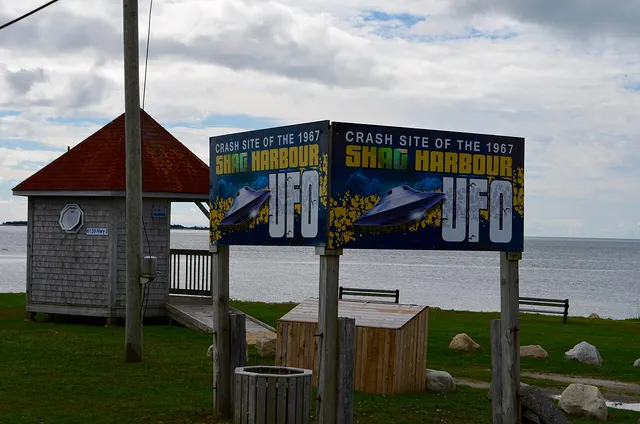
A few minutes up the road are the UFO Gazebo and a picnic site, which the Society describes as offering "a clear view of the exact location where the object was seen entering the water"; as the Condon text notes, nobody saw it enter.
The Society's president, Laurie Wickens, died in 2026, and its UFO XPO, planned for 2 to 4 October 2026 in Yarmouth, was cancelled; the Society says it hopes to see visitors "for our 60th anniversary in 2027". Whether the centre opens in 2027 had not been announced when this was written.
The documents can be read without travelling. The Condon Committee's Case 34 is online in the NCAS transcription of the report; the APRO Bulletin of September-October 1967 is scanned on the Internet Archive; and the Defence memo, with its file reference, is preserved in the Wayback Machine's copy of Library and Archives Canada's exhibit "Canada's UFOs: The Search for the Unknown".
Sources consulted
- University of Colorado (Condon Committee), «Case 34: Canadian Naval Maritime Command — "North Atlantic, Fall 1967", investigator Levine: telephone interviews with a Maritime Command watch officer, an RCMP corporal and a fishing-boat captain (NCAS transcription, Wayback Machine capture)» — Scientific Study of Unidentified Flying Objects, 1969 report
- Aerial Phenomena Research Organization, «UAO Dives Into Sea At Nova Scotia — unsigned report, p. 7, on the sighting of the night of 4 October 1967» — The A.P.R.O. Bulletin, September-October 1967, 1967 newspaper archive
- Canada. Department of National Defence, «UFO Report, Lower Wood Harbour, N.S. — undated one-page Department of National Defence summary (RG 24, acc. 83-84/167, box 7523, file DRBS 3800-10-1, pt. 1), as reproduced in the exhibit Canada's UFOs: The Search for the Unknown (Wayback Machine capture)» — Library and Archives Canada archive
- Library and Archives Canada, «Shag Harbour, Nova Scotia, October 4, 1967 — exhibit page: no trace of the RCMP reports in the files, a DND memo as the only documentation (Wayback Machine capture)» — Canada's UFOs: The Search for the Unknown, 2005 web
- Brian Dunning, «The Shag Harbour UFO — Skeptoid episode 565, with transcriptions of the 5 October 1967 RCC telex and the 6 October Turner memo, and fireballs and flares as candidates» — Skeptoid, 2017 web
- Richard Woodbury, «The man who phoned in Canada's most famous UFO sighting became the face of the mystery — on Laurie Wickens's death, with Chris Styles and the 6 October 1967 Turner memo» — CBC News, 2026 newspaper archive
- Shag Harbour UFO Incident Society, «The Shag Harbour UFO Incident (1967) – Official Account & Historical Overview» — shagharbourincident.ca, 2026 web
- Shag Harbour UFO Incident Society, «Plan Your Visit — Shag Harbour Incident Interpretive Centre: address, season, hours and contact» — shagharbourincident.ca, 2026 web
- Tourism Nova Scotia, «Shag Harbour UFO Centre — listing with season dates for 2025» — novascotia.com, 2025 web
- Municipality of the District of Barrington, «Shag Harbour UFO Incident — visitor page» — barringtonmunicipality.com web
- NICAP, «Shag Harbor. Canada. October 4, 1967 — account following Styles and Ledger, with the foam slick and the criticism of the Condon Committee» — nicap.org web
- Shag Harbour UFO Incident Society, «Shag Harbour UFO XPO 2026 — cancellation notice after Laurie Wickens's death» — shagharbourufoexpo.com, 2026 web
Reviewed by V. Serrano on 2026-11-20 · How we verify our content

💬 Field testimonies (0)
No testimonies yet. Add the first.
Add your testimony
🔒 Log in to add a testimony