🦶 CRYPTID SIGHTING · EXP. Nº9045
ACTIVE
Ogopogo
Ogopogo is the name given to a long, serpentine lake monster said to dwell in Okanagan Lake, British Columbia, usually described as a dark, multi-humped creature undulating through the water.
Where and when was Ogopogo sighted?
- Location
- Okanagan Lake, British Columbia, Canada
- Date sighted
- 1980-08-11
- Coordinates
- 49.8, -119.5
- Last updated
LOCATION
What is Ogopogo?
The legend draws on older stories from the Syilx (Okanagan) people, who spoke of a powerful lake spirit, N'ha-a-itk, tied to a particular rocky point and respected, even feared, by those crossing the lake. The first sighting on record by a settler is Susan Allison's, in 1872. The whimsical name "Ogopogo" comes from a 1924 British music-hall song performed at a luncheon in Vernon on 23 August 1926, after which the name stuck and reported sightings rose sharply. Occasional photographs and films followed — Folden in 1968, Thal in 1980 before some fifty tourists at Kelowna, Chaplin in 1989 — none ever considered conclusive. Skeptics point to floating logs, wind-driven waves and otters or beavers swimming in a line; Joe Nickell, who investigated the lake in 2005, set sturgeon aside because their presence in the lake has not been established. Ogopogo has since become a beloved regional icon for the Okanagan Valley, fueling tourism and local pride while remaining scientifically unverified.
What is the history of Ogopogo?
Before there was "Ogopogo" there was nx̌aʔx̌ʔitkʷ, and they were not the same thing.
The Syilx (Okanagan) people give that name to the being of Okanagan Lake in British Columbia. There is no single translation: it has been rendered as "spirit of the lake", "water demon", "water god" and "sacred creature of the water", and the spread itself is telling, because writers have tended to keep whichever version suited their argument. What is constant in the accounts is the practical relationship with it: offerings were made when crossing the lake near Rattlesnake Island, where it was said to dwell, in a subterranean cave beside Squally Point.
In those accounts the being commands the water and the air: no boat could land on the island, it was said, because it would raise a strong wind to prevent it. A being that summons storms is not an animal that eats, breathes and breeds in a cold lake; it is a force of nature, and that is how it worked inside a living belief system.
The tradition predates any English-language sighting report by centuries. The first on record from a settler is that of Susan Allison in 1872; eyewitness accounts have proliferated ever since.
Then came 1926 — the year this file is filed under, though not for the reason usually given.
In 1924 the British songwriter Cumberland Clark wrote a music-hall number called "The Ogopogo: The Funny Fox-Trot", about a palindromically named water-being whose parentage it jokingly ascribed to the union of an earwig and a whale. On 23 August 1926 the song was performed at a luncheon in Vernon, British Columbia. According to the account the investigator Joe Nickell tracked down in the Kelowna library — the report W. H. Brimblecombe published in 1930 in the annual proceedings of the Okanagan Historical and Natural History Society — "the guests left the Kalamalka Hotel to spread the fame of Ogopogo far and wide". The name stuck.
What followed is the interesting part: sightings rose sharply from that point on, and the creature changed character. In Hayden Blackman's words, quoted by Radford, "reported Ogopogo attacks had ceased completely", and the being went from feared to endearing, on its way to becoming the valley's mascot.
The collective sighting that Nickell records, from Arlene Gaal's files, took place on 11 August 1980: some fifty tourists watched something moving off the beach at Kelowna for about forty-five minutes, and Larry Thal of Vancouver filmed it on 8 mm. From then on Okanagan Lake became established as Canada's equivalent of Loch Ness, with decades of sightings, blurry photographs, expeditions and a tourist industry built around it.
Timeline: the documented record of Ogopogo
- Syilx tradition, pre-contact The Syilx people know the lake being as nx̌aʔx̌ʔitkʷ. Offerings are made when crossing near Rattlesnake Island, where it is said to dwell in a subterranean cave beside Squally Point. In the accounts it commands the wind as well: no boat could land on the island.
- 1872 Susan Allison reports the first sighting on record by a white settler. Eyewitness accounts proliferate from then on.
- 1924 The British songwriter Cumberland Clark writes the music-hall song "The Ogopogo: The Funny Fox-Trot", which jokingly ascribes the creature's parentage to an earwig and a whale.
- 23 August 1926 The song is performed at a luncheon in Vernon, British Columbia. According to W. H. Brimblecombe's 1930 report, "the guests left the Kalamalka Hotel to spread the fame of Ogopogo far and wide". The name sticks, and sightings rise sharply immediately afterwards.
- August 1968 Art Folden films an object moving in the water on 8 mm from Highway 97. It is the most cited footage of the case. In 2005 Nickell and Radford restage it at the same spot with land surveyors: the real distance from shore was far shorter than Folden assumed, so the object's size and speed must be scaled down accordingly.
- 11 August 1980 Some fifty tourists watch something moving off the beach at Kelowna for about forty-five minutes. Larry Thal films it on 8 mm. It is the best-documented collective episode of the case; the footage runs about ten seconds and is riddled with defects.
- February 2005 Joe Nickell and Benjamin Radford investigate the lake for a week for National Geographic Television: witness interviews, a review of Arlene Gaal's photographic archive, a sonar sweep and the Folden film experiment. Their conclusion: no proof of a large unknown creature, and the best sightings fit river otters swimming in a line.
Is there a rational explanation for Ogopogo?
There are three things to separate here, and the first is a matter of respect.
nx̌aʔx̌ʔitkʷ is not a cryptid. In Syilx culture it is a spiritual being taking the form of a water serpent, part of a belief system with its own practices. Treating it as "the Indigenous version of Ogopogo" inverts the relationship: it turns a cosmology into a primitive draft of a Western popular-culture creature. Benjamin Radford, who investigated the lake in 2005, said who performs that merger: "Almost invariably it is white writers, not native people, who insist that N'ha-a-itk and Ogopogo are one in the same." The folklorist Michel Meurger called the mechanism "the scientification of folklore": casting the Indigenous narrator as a "noble savage" whose account is then conscripted as zoological evidence.
Celeste Ganassin, then curator of education at the Kelowna Museum, put it bluntly to Radford: "People pick and choose parts of the First Nations myths to fit their needs, to support whatever argument they are trying to make." On the petroglyphs sometimes offered as ancient portraits of the animal she said: "There is no true academic evidence that specifically states that First Nations people ever put down in petroglyphs the shape of N'ha-a-itk. The pictures didn't come with captions." She also told him that "you can't look at a First Nations group anywhere without finding a tradition of some sort of entity in a lake they had to respect or fear", and Radford drew the consequence: anyone offering the N'ha-a-itk story as evidence for Ogopogo must also explain why all the other lakes with similar traditions "also supposedly have lake monsters that no one has found".
Second: the 1926 collective sighting. It is the most-repeated claim about this case online — some thirty people, or thirty carloads, on the beach at Okanagan Mission, all seeing the same thing at once. It appears, dated September 1926, in the sightings timeline of "Welcome to Ogopogo Country", a website made in 2001 by the Centre culturel Marie-Anne-Gaboury of Edmonton for Canada's Digital Collections programme and now preserved by Library and Archives Canada. The entry reads: "One afternoon, telephone repairmen working on top of a telegraph pole espied Naitaka just offshore of the Okanagan Mission district. Thirty carloads of citizens pulled up to watch, completely blocking the road." The timeline names no newspaper and no witness for the entry. The same page puts the Vernon luncheon in July and has Bill Brimblecombe singing the song; Nickell, working from Brimblecombe's own 1930 report, dates the luncheon to 23 August 1926 and notes that Brimblecombe has been wrongly named as the song's author. Neither Nickell's 2006 article nor Radford's mentions a collective sighting in 1926. What is documented in 1926 is the naming, and the mass episode with a record and a film is the one from 1980.
Third: the Western cryptid, where empirical analysis genuinely applies.
Nickell set the sturgeon aside: "at Okanagan their presence has not been established; indeed, rewards of up to $10,000 have failed to produce a single sturgeon."
What does live in that lake is the Northern River Otter, and there the best candidate appears. Nickell drew a composite of the features witnesses repeat most often and set it beside otters swimming in a line: the match with dark "humps" advancing in file is striking, and, in the source he quotes, "Otters are among the fastest swimmers of all animals", which accounts for the speeds attributed to the creature. The famous films point the same way: the Chaplin video (1989) was dismissed by wildlife experts as "most likely a large river otter or beaver"; the DeMara video (1992) is consistent with several otters — and, to an FBI video specialist, with debris from a fallen tree bobbing in the water; and with the Folden film (1968) the team went back to the site with land surveyors. Measuring the real distance from shore, the object turned out to be far closer than Folden had assumed, so its size and speed had to be scaled down accordingly.
And then there is the lake itself, which explains a great deal. The Okanagan is long, deep, narrow and windy — the place name Squally Point says so — with currents and a surface that generates persistent interference waves. In a body of water like that, a wake, a drifting log or a line of ripples produces with great reliability the illusion of dark humps advancing in file.
Last comes the detail Radford found most awkward for the animal hypothesis. Quoting Hayden Blackman, he notes that once the song had given the creature its name "reported Ogopogo attacks had ceased completely", and comments: "No real-world animals exhibit such a temperamental about-face." His reading is that "the public's perception of Ogopogo — independent of its actions — influenced reports of the monster's behavior."
Can you visit Ogopogo?
Okanagan Lake runs some seventy-nine miles, about 127 km, from Penticton at its southern end to its northern tip near Vernon, in Joe Nickell's figures in the Skeptical Inquirer, which give a maximum depth of 762 feet (232 m).
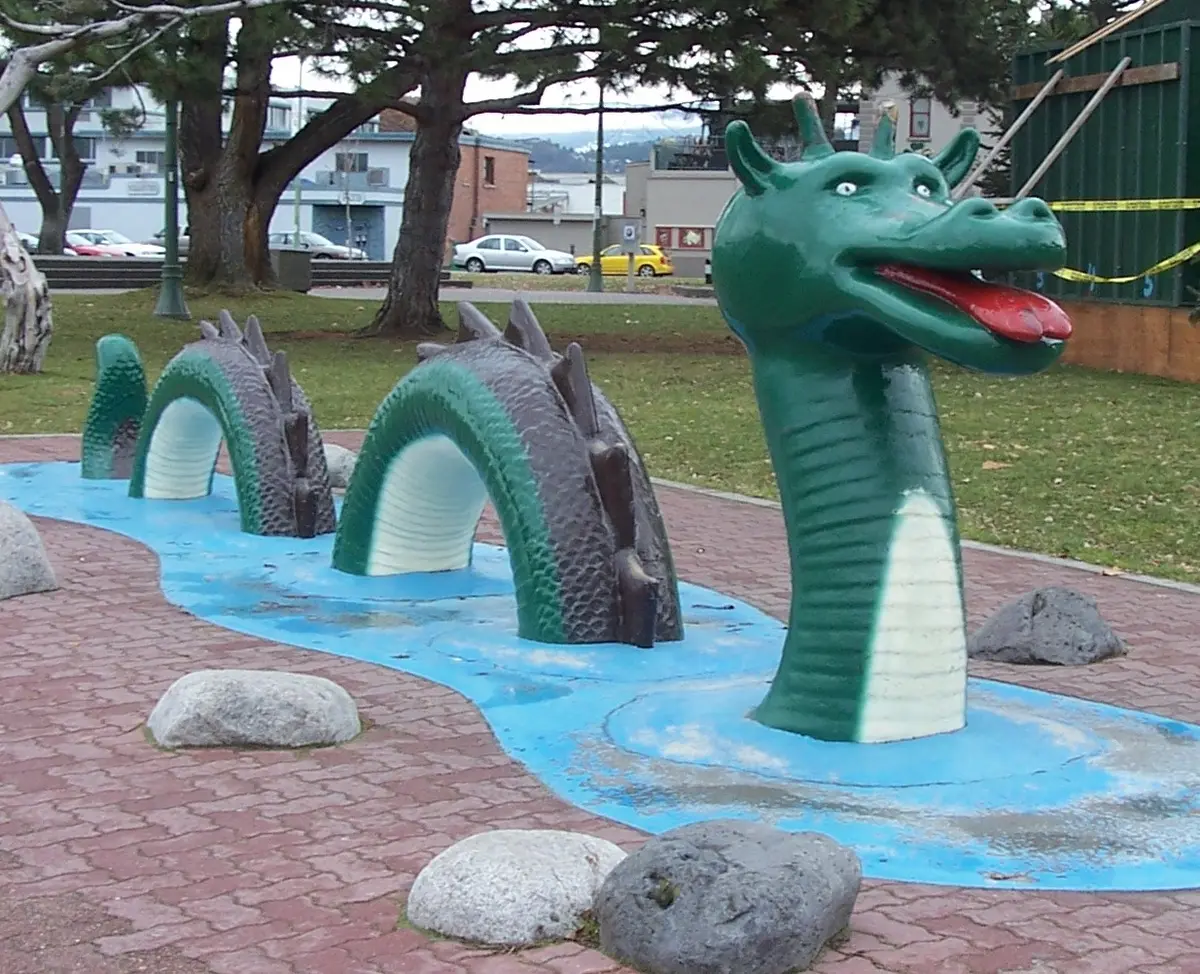
In Kelowna the Ogopogo statue stands in Kerry Park, at 1480 Mill Street on the downtown waterfront promenade, next to the sculpture "Spirit of the Sail", as Tourism Kelowna's listing for the park describes it. The City of Kelowna's public art catalogue records the figure as painted fiberglass and dates its entry into the civic collection to 1998, when the public art programme began. The name itself changed hands in 2021: Daily Hive reports that the copyright on "Ogopogo", held by the City of Vernon since 1956, was transferred that year to the Syilx Nation.
Rattlesnake Island and Squally Point, where the syilx account places the offerings and the creature's cave, are on the east side of the lake. Canada's official register of geographical names places the island at 49.748 N, 119.717 W and the point about 2.5 km south-south-west of it. That shore belongs to Okanagan Mountain Provincial Park, which BC Parks places "on the east side of Okanagan Lake, just opposite Peachland". BC Parks describes 33 km of undeveloped shoreline with six marine campgrounds, and a park with no public roads: the upland is reached on foot, on horseback or by bicycle, from a north parking lot on the Kelowna side or a south lot that is reached from Naramata by Chute Lake Road. The same page warns that parts of the park have burned and that hazards remain off the main trails.
The Sncewips Heritage Museum, run by Westbank First Nation at Unit 260, 525 Highway 97, Kelowna, opened as a museum on 14 June 2014 and reopened in its present space on 1 February 2020; its website, read on 24 September 2026, gives opening hours of 10 a.m. to 5 p.m. from Monday to Friday. Tourism Kelowna's own history of the creature, written by Justin DeMerchant in 2020, gives its syilx name, nx̌aʔx̌ʔitkʷ, and describes the offerings made when crossing the lake near Rattlesnake Island.
Sources consulted
- Justin DeMerchant, «The legend, the spirit, the creature: the history of Ogopogo — la tradición syilx y nx̌aʔx̌ʔitkʷ» — Tourism Kelowna, 2020 web
- Joe Nickell, «Ogopogo: The Lake Okanagan Monster — la investigación de campo, el esturión, las películas y las nutrias» — Skeptical Inquirer, 2006 academic
- Benjamin Radford, «Ogopogo the Chameleon — nx̌aʔx̌ʔitkʷ frente a Ogopogo, la canción de 1924 y el pico de avistamientos» — Skeptical Inquirer, 2006 academic
- Canadian History Ehx, «The story of Naitaka, the Okanagan lake creature better known as Ogopogo» — Daily Hive Canada, 2023 newspaper archive
- Tourism Kelowna, «Kerry Park — 1480 Mill Street, on the Downtown Kelowna Waterfront Promenade, with the Ogopogo statue and "Spirit of the Sail"» — tourismkelowna.com, park listing (read 24 September 2026), 2026 web
- City of Kelowna, «Ogopogo — painted fiberglass sculpture, added to the Public Art Collection when the programme began in 1998» — kelowna.ca, Public Art Collection, 2026 web
- BC Parks, «Okanagan Mountain Park — east side of Okanagan Lake opposite Peachland, 33 km of undeveloped shoreline, six marine campgrounds, no public roads» — bcparks.ca (read 24 September 2026), 2026 web
- Natural Resources Canada, «Canadian Geographical Names Database — Rattlesnake Island (49.748056, -119.716944) and Squally Point (49.726111, -119.724722)» — Canadian Geographical Names Database, geonames API (queried 24 September 2026), 2026 archive
- Westbank First Nation, «Sncewips Heritage Museum — Westbank First Nation, Unit 260, 525 Highway 97, Kelowna; opened 14 June 2014, reopened 1 February 2020; Monday-Friday 10 a.m.-5 p.m.» — sncewips.com (read 24 September 2026), 2026 web
- Centre culturel Marie-Anne-Gaboury d'Edmonton, «Welcome to Ogopogo Country — Sightings: The Okanagan Lake Monster, 1926 (telephone repairmen and "thirty carloads of citizens" at Okanagan Mission, September 1926; no source given)» — Canada's Digital Collections, 2001; archived by Library and Archives Canada, 2001 archive
Reviewed by V. Serrano on 2026-07-31 · How we verify our content
📎 Source: Folclore (curado)
💬 Field testimonies (0)
No testimonies yet. Add the first.
Add your testimony
🔒 Log in to add a testimony