👻 HAUNTED PLACE · EXP. Nº9046
ACTIVE
Banff Springs Hotel
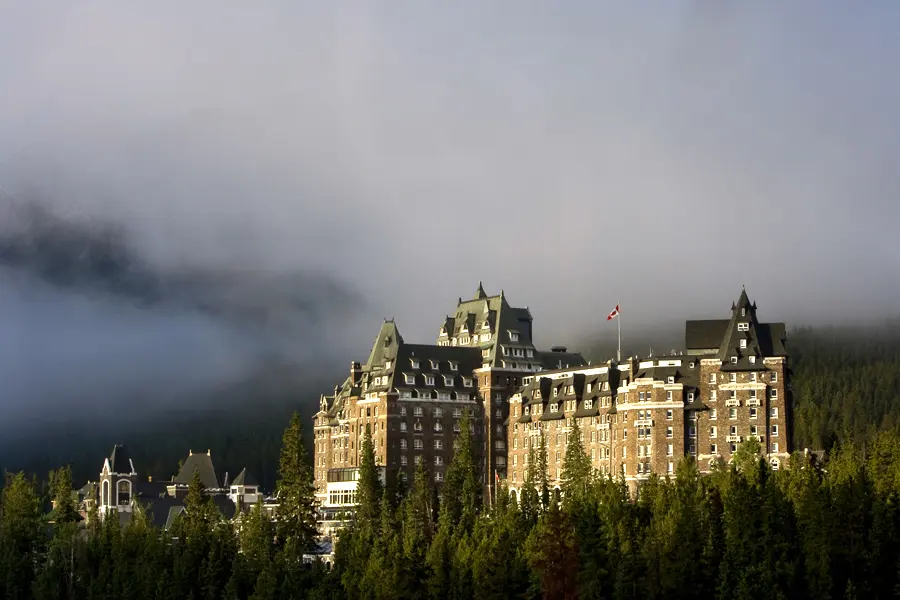
The Canadian Pacific Railway opened the Banff Springs Hotel on 1 June 1888 to give its transcontinental line something to sell, and the castle in the photographs is not that hotel: the building Parks Canada protects was raised between 1911 and 1928, after a fire destroyed the wooden north wing in 1926.
Where is Banff Springs Hotel?
- Location
- Alberta, Canada
- Type
- Hotel / inn
- Coordinates
- 51.165, -115.562
- Last updated
LOCATION
Why is Banff Springs Hotel said to be haunted?
Three ghost stories travel with it - a bride who fell on the marble staircase, a sealed room 873, and a helpful bellman named Sam - and the most striking thing about them is who dismantles them. In October 2025 the hotel itself published the debunking: no written record confirms a bride dying or even being hurt, room 873 is a gap left when a mid-century renovation merged two rooms into one suite, and Sam was a real bellman on the payroll until the 1950s. The Whyte Museum archive in Banff, which holds 1,491 records on the hotel, holds none at all on Sam McAuley. This is the story of a luxury hotel, the park built around it, and the people the park removed.
What is the history of Banff Springs Hotel?
The hotel exists because a railway needed passengers. The Canadian Pacific Railway pushed its transcontinental line through the Bow Valley and completed it in 1885, and the mountains it crossed produced almost no freight to pay for the track. The answer, driven by William Cornelius Van Horne, was to sell the scenery: a chain of resort hotels along the line, of which Banff Springs was the first in the Rockies. The same years produced the park. Ottawa reserved the hot springs on the flank of Sulphur Mountain rather than let rival claimants develop them, and the reserve grew into Canada's first national park.
The Banff Springs Hotel opened for business on 1 June 1888. The Banff historian Eleanor G. Luxton gives that date; the building was a five-storey wooden structure by the American architect Bruce Price, room for roughly 280 guests, with the mineral water piped indoors. It worked only in good weather. H.C. Stovel's Banff Guide of 1915, printed in town by the Crag and Canyon, still calls it "the official cognomen of the C.P.R. hotel" and notes that it is "for the present ... open only during summer".
What stands today is not that hotel, and the distinction matters for every story told about the place. Between 1900 and 1910 the firm of Hutchinson, Wood and Miller added a five-storey wing. From 1911 to 1914 Walter S. Painter raised an eleven-storey tower of steel, concrete and limestone, replacing Price's cedar shingles with a Scottish baronial silhouette. A fire in 1926 burned the north wing to the ground, and from 1927 to 1928 J.W. Orrock built the main block in Rundle stone. When Parks Canada made the hotel a National Historic Site of Canada on 24 June 1988, it dated the designated fabric to 1911-1928. The 1888 opening is a date; it is not the building in the photograph.
The park around it was made by removing people, and that half of the history is missing from almost every ghost account. The valley is home ground to the Îyârhe Nakoda - the Bearspaw, Chiniki and Goodstoney First Nations - and to Siksika, Kainai, Piikani, Tsuut'ina and Métis communities. Theodore Binnema and Melanie Niemi traced in Environmental History how they were pushed out of the new park between roughly 1890 and 1920, in the name of sport hunting, tourism and game conservation. Stovel's 1915 guide shows the job already done: it explains that Sundance Canyon is named for a ceremony the Stoney "used to" hold on the plateau above the falls, and it places them "on the reservation to the east of Rocky Mountains Park".
They were then invited back as an attraction. The same guide records "Stoney Indians' annual sports ... held each year" on the racecourse near the park - the gathering that became Banff Indian Days, studied by Courtney W. Mason, which the tourism industry ran for most of a century. On 11 August 1939 the Crag and Canyon reported that Chief Walking Buffalo and Chief Jacob Two-Young-Man had made Helen Keller a sister of the tribe at the Banff Springs, giving her the name White Eagle Plume.
The hotel stayed seasonal for another thirty years: it opened for four-season tourism only in 1969. After the Canadian Pacific's restructuring in 2001 it has traded as the Fairmont Banff Springs, with 724 guest rooms and suites.
Timeline: the documented record of Banff Springs Hotel
- 1885 The Canadian Pacific Railway completes its transcontinental line and Ottawa reserves the hot springs on Sulphur Mountain rather than let rival claimants exploit them. The reserve becomes Canada's first national park, and the railway starts planning a hotel to fill its trains.
- 1 June 1888 The Banff Springs Hotel opens for business, according to the Banff historian Eleanor G. Luxton: a five-storey wooden building by the American architect Bruce Price, for about 280 guests, open only in summer.
- 1914 Walter S. Painter completes an eleven-storey tower of steel, concrete and limestone begun in 1911. It is the first part of the building that visitors photograph today.
- 1915 H. C. Stovel's Banff Guide, printed by the Crag and Canyon, describes the hotel at length and notes it opens only in summer. It contains no ghost story about the hotel; its only mentions of a ghost concern the Ghost River east of the park. It also places the Stoney “on the reservation to the east of Rocky Mountains Park” and describes their annual sports at the racecourse.
- 1926 A fire burns the north wing of the hotel to the ground.
- 1928 J. W. Orrock completes the main block in Rundle stone, begun in 1927. The staircase and ballrooms of the ghost stories belong to this building, not to the 1888 one.
- 11 August 1939 The Crag and Canyon reports that Chief Walking Buffalo and Chief Jacob Two-Young-Man of the Stoney Nakoda made Helen Keller a sister of the tribe at the Banff Springs, giving her the name White Eagle Plume.
- 1969 The hotel opens to four-season tourism for the first time, after eighty years of working only in the warm months.
- 24 June 1988 Parks Canada designates the hotel a National Historic Site of Canada, dating the protected building to 1911-1928 and crediting Walter S. Painter and J. W. Orrock.
- 2000 Rosemary Ellen Guiley's Encyclopedia of Ghosts and Spirits fixes the bellman story in print: “the phantom bellman reportedly is Sam McAuley, a former bellman, who died in 1969”. Later collections give 1975 and 1976 for the same death.
- 2014 Canada Post issues the first Haunted Canada stamps. Mark Leslie recalls going on CTV's Canada AM the day they appeared to discuss legends “such as the ghost bride of the Banff Springs Hotel”.
- October 2025 The hotel publishes a page giving, “for the very first time”, what it calls the true stories behind its legends: no written record confirms a bride's death, room 873 is a numbering gap left by a mid-century renovation, and Sam was a real bellman who worked there “as late as the 1950's”.
Is there a rational explanation for Banff Springs Hotel?
The unusual thing about the Banff Springs ghosts is that the most useful sceptic on the record is the hotel itself.
In October 2025 the Fairmont Banff Springs published a page presenting, "for the very first time", what it called "the true stories behind the legends". On the ghost bride it says: "Because no written record confirms a bride passing, or even being injured, around this time at the Banff Springs Hotel we must assume that this story was written by some creative staff member or guest over the years." That is the business that profits from the legend stating that the death at its centre has no record. It is simultaneously the best citation available and the strongest argument against the story.
The building agrees. The hotel places the bride in the late 1920s; the stone chateau whose staircase she is said to descend was built between 1911 and 1928, according to the Parks Canada designation. Versions that push her back to "the early twentieth century", as many listings still do, put her on a staircase that did not yet exist, inside a wooden hotel that had already burned.
Room 873 is the one claim that is physically checkable, and the hotel checks it: "In truth, the mid-century redesign of the hotel created the opportunity to combine two small guest rooms together to create one larger suite with a single door. The extra door was removed but a pot light in the hallway was left behind indicating the space where the door once was." It adds that "adventurous spirit hunters" knocking on that wall wake the guests sleeping on the other side. A gap in the room numbering left by a renovation is not a sealed murder scene.
Sam was a person, and the printed record cannot agree on when he died. Rosemary Ellen Guiley's Encyclopedia of Ghosts and Spirits states that "the phantom bellman reportedly is Sam McAuley, a former bellman, who died in 1969". A later ghost collection has the same bellman "passed away in 1975"; another has "Macauley died in 1976". The hotel, which would be his employer, gives no surname at all and says only that the tale is "based around a real bellman who worked at the hotel as late as the 1950's" and that he "passed in the 1970's". Two spellings of the name, three death years, and no confirmation from the payroll.
The archives are silent as well. The Whyte Museum of the Canadian Rockies holds the reference collection for Banff. Searched on 11 August 2026, its research catalogue returns 1,491 records for "Banff Springs Hotel" and 1,429 for "Banff Indian Days" - and zero for "Sam McAuley", zero for "Sam Macauley", zero for "ghost bride" and zero for "room 873". So is the period literature: Stovel's 1915 Banff Guide runs to roughly 20,000 words, uses the word "hotel" 45 times and describes the Banff Springs in detail, yet its only two uses of "ghost" refer to the Ghost River east of the park, and "haunted", "phantom" and "apparition" never appear. Every printed version of the three legends that I have been able to date belongs to the 1990s or later; the wording most often repeated today was fixed by Guiley and by Dennis William Hauck's International Directory of Haunted Places, both published in 2000.
What is documented is the commercial afterlife. The hotel notes the bride's image "minted on a commemorative coin and printed on a stamp"; Canada Post issued Haunted Canada stamp series in 2014, 2015 and 2016, and Mark Leslie recalls in Creepy Capital going on CTV's Canada AM the day the first set appeared to discuss legends "such as the ghost bride of the Banff Springs Hotel". The page that debunks the legends was itself published in October, in time for Halloween.
Can you visit Banff Springs Hotel?
The Fairmont Banff Springs is a hotel at 405 Spray Avenue, Banff, Alberta T1L 1J4. Its guest-services page, read on 23 September 2026, gives 724 guest rooms and suites, check-in at 16:00 and check-out at 12:00 noon, and The Canadian Encyclopedia dates its opening to four-season tourism to 1969. The town walking tour run by the hotel is stated to be "exclusive to guests of Fairmont Banff Springs" and is booked by e-mail, on 403 760-1446 or through a guest's personal booking link.
Visitors who are not staying get in through the restaurants and bars, and through one outside operator. Alberta Food Tours runs "Eat the Castle", a food and drink tour inside the hotel limited to 12 people, with stops that include the Rundle Bar, Grapes and the 1888 Chop House; its 2026 general admission, for ages 14 and over, is CA$240.75. Afternoon tea is served every day from 11:30 to 14:30 and is booked on +1 403 762 6860.
Parking is in a three-level covered parkade beside the Convention Centre with 415 spaces, at 39 CAD a night self-parked and 59 CAD valet, both with unlimited access; the hotel charges guests' electric vehicles free. Pets pay a "one-time cleaning fee of $50 CAD per day", to a maximum of 100 CAD for two, and service dogs are free. The hotel describes most areas as wheelchair accessible, lends wheelchairs, bed lifts and transfer benches, has several accessible rooms with roll-in showers and recommends booking the equipment in advance through [email protected].
The hotel is inside Banff National Park, and Parks Canada charges admission to the park. Its fees page, last modified on 12 February 2026, lists daily admission at 12.25 CAD for adults, 10.75 for seniors of 65 and over and 24.50 for a family or group of up to seven arriving in one vehicle; visitors of 17 and under enter free. The annual Discovery Pass costs 83.50, 71.50 and 167.50 CAD in the same categories. Admission was free from 19 June to 7 September 2026 under the Canada Strong Pass.
The hotel's ghost-stories page adds that people looking for the vanished room 873 used to knock on the wall where its door had been, disturbing the guests asleep on the other side, who sometimes knocked back.
Sources consulted
- Fairmont Banff Springs (Accor), «Ghost Stories of Fairmont Banff Springs» — Official hotel website, 2025 archive
- Parks Canada, «Banff Springs Hotel National Historic Site of Canada» — Directory of Federal Heritage Designations, 1988 report
- Eleanor G. Luxton, «Banff: Canada's First National Park - A History and a Memory of Rocky Mountains Park» — Summerthought, 1975 book
- H. C. Stovel, «50 Switzerlands in One: Banff the Beautiful, Canada's National Park» — Crag and Canyon, Banff, 1915 book
- Theodore Binnema and Melanie Niemi, «'Let the Line be Drawn Now': Wilderness, Conservation, and the Exclusion of Aboriginal People from Banff National Park in Canada» — Environmental History 11(4), 724-750, 2006 academic
- Branka Baic-Bender, «Banff Springs Hotel» — The Canadian Encyclopedia (Historica Canada), 2024 web
- Courtney W. Mason, «The Banff Indian Days tourism festivals» — Annals of Tourism Research 53, 77-95, 2015 academic
- Crag and Canyon, «Stoney Indians at Banff Springs Make Helen Keller Tribe Sister» — Crag and Canyon (Banff), Friday 11 August 1939, 1939 newspaper archive
- Rosemary Ellen Guiley, «The Encyclopedia of Ghosts and Spirits» — Checkmark Books, 2000 book
- Whyte Museum of the Canadian Rockies, «Research Collections catalogue (searched 11 August 2026)» — Archives and Special Collections, Banff, 2026 archive
- Mark Leslie, «Creepy Capital: Ghost Stories of Ottawa and the National Capital Region» — Dundurn Press, 2016 book
- Fairmont Banff Springs (Accor), «Guest Services and Location & Contact» — Official hotel website, 2026 web
- Parks Canada, «Banff National Park - Fees» — Government of Canada, 2026 report
- Dennis William Hauck, «The International Directory of Haunted Places» — Penguin Books, 2000 book
Reviewed by V. Serrano on 2026-08-11 · How we verify our content
💬 Field testimonies (0)
No testimonies yet. Add the first.
Add your testimony
🔒 Log in to add a testimony