🦶 CRYPTID SIGHTING · EXP. Nº0555
ACTIVE
Cadborosaurus
Cadborosaurus is one of the few sea monsters with a datable birthday.
Where and when was Cadborosaurus sighted?
- Location
- Cadboro Bay, British Columbia, Canada
- Date sighted
- Unknown
- Coordinates
- 48.449, -123.286
- Last updated
LOCATION
What is Cadborosaurus?
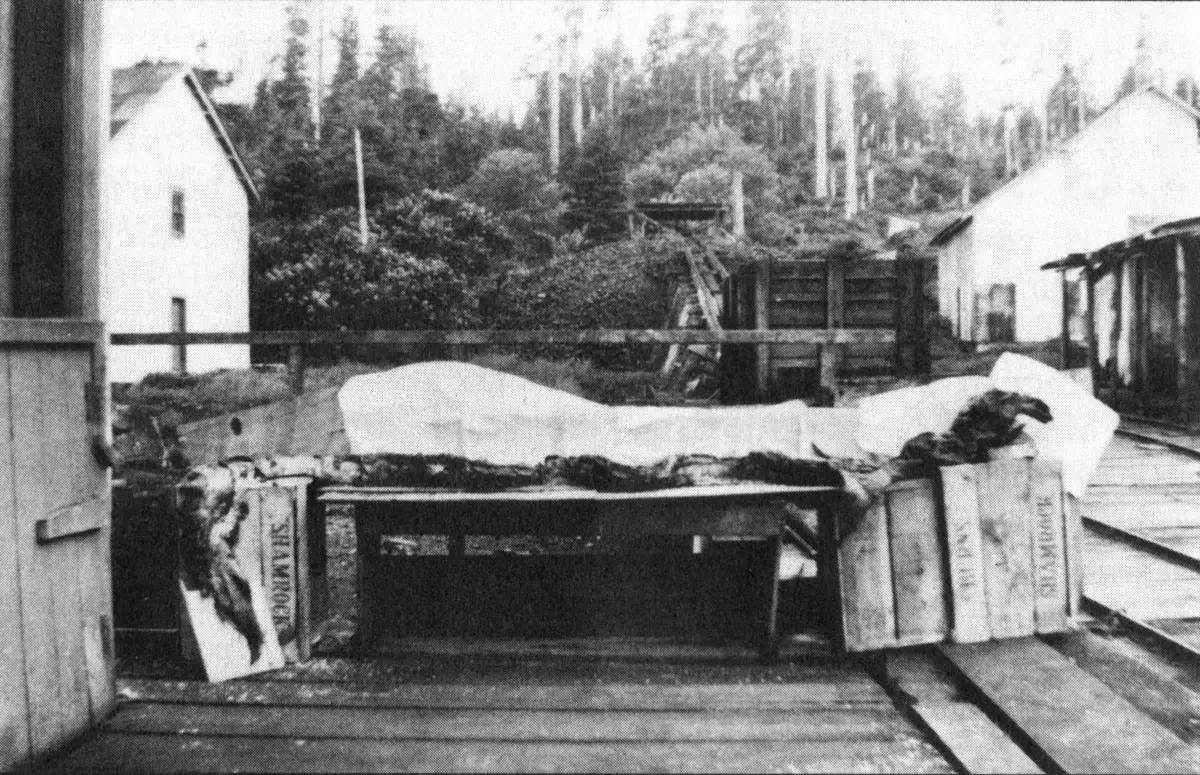
On 5 October 1933 the Victoria Daily Times gave its front page to Major W. H. Langley, Clerk of the British Columbia Legislature, who had seen something off Chatham Island four days earlier; the story carried no name for the animal and no legend behind it. The name appears in print twelve days later, on 17 October 1933, when the same paper explains that Cadborosaurus 'was officially selected... some days ago' because it honoured the bay, and that the abbreviation 'Caddy' would no doubt prevail. What followed was a newspaper season: a camel-faced creature backed by 'some fifteen veracious witnesses', a rivalry with Seattle and Vancouver over who owned it, and on 7 December 1933 the fisherman Ellwood White's forty-foot animal with a horse-shaped head and three sinuous humps, seen from a canoe in Baynes Channel. The best-known evidence, a carcass laid out at the Naden Harbour whaling station in 1937, was identified at the time by the director of the Provincial Museum as a premature baleen whale.
What is the history of Cadborosaurus?
Most sea monsters have no birthday. This one does, and it can be read, day by day, in the newspapers that made it.
On Thursday 5 October 1933 the Victoria Daily Times ran a page-one story headed "Yachtsmen Tell of Huge Sea Serpent Seen Off Victoria". Major W. H. Langley, a Victoria barrister and Clerk of the British Columbia Legislature, had been sailing with his wife off Chatham Island the previous Sunday — 1 October — when something surfaced beside the kelp. The paper paired his account with one that had not been public before: F. W. Kemp, of 2115 Marne Street, had watched something in the same water with his wife and son in August of the previous year, and the Times noted that "while neither had knowledge of the other's experience, their descriptions tallied exactly when they were consulted". The animal was put at "nearly eighty feet long and about as wide as the average automobile".
That first story has no name in it. It also has no Indigenous tradition in it, no legend, and no antiquity of any kind.
The name arrives twelve days later. On Tuesday 17 October 1933 the Times carried the front-page headline "Cadborosaurus Is Sighted Again By Island Residents", above a report of three duck hunters rowing on the Chemainus River, and inside the same issue the paper explained itself in a single passive sentence: "Cadborosaurus was officially selected as the name of the sea serpent some days ago. It was adopted because it honored the locality in which the serpent was first seen, and fits in with the designations by which other prehistoric animals are known. Cadborosaurus will denote the species, but the abbreviation, 'Caddy,' no doubt will" be what people say. Both names — the formal one and the nickname that outlived it — are in print on the same day, and no person is credited with either.
What followed was eleven days of civic competition. On 18 October the Associated Press told New York that the creature "possesses a camel face, according to the testimony of some fifteen veracious witnesses" — the camel head, not the horse head, was the standard description of that autumn. On 20 October the Times reported a Burrard Inlet sighting and grumbled that Vancouver, "anxious to crash in on the tremendous publicity which Victoria has received from the discovery of Cadborosaurus, was making an attempt to steal 'Caddy'". On 22 October the Daily Colonist gave a front-page piece to refuting Seattle's claim that "Amy Cadborosaurus" — the Victoria papers used the feminine name all that autumn — was really a blackfish visiting from the American side. By 28 October a Victoria football club had a "squad of fishermen out looking for" it as a half-time promotion.
The single best-known early account is the one in the Daily Colonist of Thursday 7 December 1933, page 2, and it is worth reading exactly. "Ellwood White, young fisherman, of the trolling launch Wholestorm, saw Amy Cadborosaurus early Monday morning" — that is, on 4 December. He was trolling for spring salmon from a canoe in Baynes Channel, opposite Cadboro Bay but over on the Chatham Island side, at about 7.30, and judged the thing to be moving at twenty-five miles an hour. "Mr. White said it kept its head several feet above the surface of the water as it traveled, and behind there were three distinct humps and a portion of what he concluded must have been the tail showing. The head was shaped like that of a horse, and the humps worked sinuously like a snake as it moved through the water." Under the subhead "FORTY FEET LONG": "It would be about forty feet in length, he should judge." The far more quotable line printed alongside belongs to someone else — Cyril B. Andrews, who swore an affidavit before Justice of the Peace G. F. Parkyn that he "had gazed into the mouth of a monster some forty feet long, as it gulped down a wounded duck", off Bedwell Harbour on Sunday 3 December.
Then the physical evidence. In July 1937 a long, decayed, tapering carcass was taken from the stomach of a sperm whale killed off Langara Island and laid out for photographs at the Naden Harbour whaling station on Graham Island, in what is now Haida Gwaii. Parts of it did not vanish: a section of backbone about six feet long, a piece of baleen and a piece of skin were forwarded to the Provincial Museum in Victoria, and on Friday 23 July 1937 the Victoria Daily Times published the result under the headline "Mammal Not 'Caddy's' Son". Francis Kermode, the museum's director, said there was "little doubt" the pieces came from "a baleen whale, which he believed was of premature birth". A verdict was reached within days, by a named official, in the local paper.
Fifty-eight years later the zoologist Edward L. Bousfield and the oceanographer Paul H. LeBlond published a formal species description, Cadborosaurus willsi, arguing for a surviving reptile. It filled Supplement 1 of Amphipacifica, a journal Bousfield himself edited, and two of the journal's three editors printed their objection to it in the same volume.
Timeline: the documented record of Cadborosaurus
- August 1932 F. W. Kemp, of 2115 Marne Street, Victoria, watches something in the channel off Chatham Island with his wife and son. He does not go to the press at the time; his account is published only after Langley's, in the Victoria Daily Times of 5 October 1933, which notes that the two descriptions 'tallied exactly' although neither man knew of the other.
- 1 October 1933 Major W. H. Langley, barrister and Clerk of the British Columbia Legislature, and his wife see something beside the kelp off Chatham Island while sailing. The report is the trigger for everything that follows.
- 5 October 1933 The Victoria Daily Times prints 'Yachtsmen Tell of Huge Sea Serpent Seen Off Victoria' on page one, putting the animal at 'nearly eighty feet long and about as wide as the average automobile'. The story contains no name for the creature and no reference to any Indigenous tradition.
- 17 October 1933 First appearance in print of the word Cadborosaurus that we have been able to date: a page-one headline in the Victoria Daily Times. Inside the same issue the paper explains that the name 'was officially selected... some days ago' because it 'honored the locality in which the serpent was first seen', and that 'the abbreviation, Caddy,' will no doubt prevail. No individual is credited with the coinage in 1933.
- 18 October 1933 An Associated Press dispatch from New York reports that the creature 'possesses a camel face, according to the testimony of some fifteen veracious witnesses'. The camel head, not the horse head, is the standard description of that autumn.
- 4 and 7 December 1933 Ellwood White, trolling for spring salmon from a canoe in Baynes Channel at about 7.30 on the morning of Monday 4 December, describes a black animal about forty feet long with a head 'shaped like that of a horse' and three humps that 'worked sinuously like a snake'. The Daily Colonist publishes it on Thursday 7 December, alongside the affidavit of Cyril B. Andrews — sworn before Justice of the Peace G. F. Parkyn — that he had 'gazed into the mouth of a monster some forty feet long, as it gulped down a wounded duck' off Bedwell Harbour on 3 December.
- 23 July 1937 Under the headline 'Mammal Not Caddy's Son', the Victoria Daily Times reports that Francis Kermode, director of the Provincial Museum, has examined the backbone, baleen and skin forwarded from the Naden Harbour whaling station and finds 'little doubt' they came from a baleen whale 'of premature birth'. The backbone is about six feet long. This is the only identification of the material ever published.
- 25 January and 5 February 1963 The Daily Colonist photographs the clay model of a 'seventy-five-foot-long Cadborosaurus serpent' designed by the wood carver S. Rudy Seyfort and approved by the Saanich parks and recreation committee; eleven days later, under the headline 'Kiddy-Caddy Gets Funds', it reports that Saanich council has voted $3,500 for the concrete serpent at Cadboro-Gyro Park.
- 25 February 1979 The Islander, the Sunday magazine of the Daily Colonist, publishes the retrospective that names Archie Wills, news editor of the Times, as the man who compiled the sightings and 'came up with... a composite beast of many colors', and that attributes the coinage to 'an old Indian legend' about a maiden named Cadboro and a youth named Saurus. It is this article, forty-six years after the fact, that supplies most of what is repeated about the naming today.
- 1995 Edward L. Bousfield and Paul H. LeBlond publish 'An account of Cadborosaurus willsi, new genus, new species' as Supplement 1 of Amphipacifica, a journal Bousfield edited, designating a 1937 photograph as the type specimen. Two of the journal's three editors print their objection in the same volume; Aaron Bauer and Anthony Russell publish a technical critique in Cryptozoology the following year.
- 2011 Michael A. Woodley, Darren Naish and Cameron A. McCormick reinterpret the small 'juvenile cadborosaur' that William Hagelund reported catching in 1968 as a bay pipefish, Syngnathus leptorhynchus, in the Journal of Scientific Exploration.
Is there a rational explanation for Cadborosaurus?
The composite. The most damaging document about Caddy was published by the local press itself. On 25 February 1979 The Islander, the Sunday magazine of the Daily Colonist, described how the animal had been assembled. Langley's report "reached Archie Wills, news editor of the Times, and the paper gave it a front page story. In no time, Archie was swamped with a rash of phone calls and letters, all from people who claimed to have seen the beast also. Patiently, Archie wrote them all down… What he came up with, was a composite beast of many colors… With a head like a camel, or a dog or a horse. A long snaky body — 30 feet, 18 feet maybe, but 12 feet long for sure." That is a newsroom account of the fourth and hardest-to-see way a legend gets damaged: not by falsifying any single testimony, but by fusing many into one animal. Every feature of Caddy is somebody's genuine report; the animal that carries all of them at once was made at a desk.
The ancient-tradition clause. Three Indigenous words circulate wherever Caddy is described: hiyitl'iik (Manhousaht), numkse lee kwala (K'ómoks) and t'chain-ko (shíshálh). English Wikipedia carries all three in one sentence, and the source it cites for them is Cadborosaurus: Survivor from the Deep by Bousfield and LeBlond — the proponents' own popular book, published sixty-two years after the naming. So the antiquity of the creature rests, in the end, on the testimony of the men who named the species.
That is not proof the words are invented, and it would be wrong to say so without looking. So we looked, twice, in two corpora, with controls.
In the full-text archive of Victoria's British Colonist / Daily Colonist, 1858 to 1980, the three words return zero hits between them. Controls run in the same archive on the same day: "cadborosaurus", 101 hits; "sea serpent", 411. In the Internet Archive's full-text book corpus, hiyitl'iik returns 2 hits, numkse 2 and t'chain-ko 3 — and every one of them is a cryptozoology or popular-mystery title (Bertin 2003, Kirk 1998, Newton 2009, Jeans 2004, and a book about alien abductions). Controls in that same corpus, run the same way: Sisiutl, the double-headed serpent of Kwakwaka'wakw tradition, 270 hits, in Kwakiutl ethnography and art history; Manhousaht, 10 hits, including Nancy Turner's plant-technology volumes, in which the Manhousaht elder Luke Swan is a named collaborator; "Comox language", 15 hits, including the BC Indian Language Project reports. The corpus indexes exactly the ethnographic and linguistic literature that would carry these words. It does not carry them.
Two further details point the same way. Darren Naish notes that hiyitl'iik is glossed by its promoters as "he who moves from side to side" — a horizontal undulator, which is precisely what Caddy is said not to be. And the 1979 Islander piece states that Wills coined the name "in honor of an old Indian legend" about a maiden called Cadboro and a young man called Saurus, turned into Gonzales Hill and a sea serpent respectively. Cadboro is an English place name, from the Hudson's Bay Company schooner Cadboro; saurus is Greek. A legend whose two lovers are named after the halves of a 1933 newspaper coinage is a back-formation, and it was printed as tradition in a serious retrospective.
None of this touches the beings that really are documented on this coast. Sisiutl is real, old and well recorded. It is simply not this animal, and the merger is performed almost entirely by non-Indigenous writers.
The objects, and the date on the negative. It is often written that the Naden Harbour remains were never examined. They were, in July 1937, and by the director of the Provincial Museum, who identified backbone, baleen and skin as a premature baleen whale. The same coast offers a control case with a laboratory attached: in 1931 a carcass found on the beach at Henry Island was taken to Prince Rupert, inspected by Dr. Neal Carter of the Dominion experimental fisheries station, who called it a mammal, and its skull and parts were forwarded to the federal biological station at Nanaimo, whose director identified them as the remains of a basking shark. What survives of the 1937 carcass today is three photographs — one by the station supervisor F. S. Huband, two from an album compiled by the first-aid officer G. V. Boorman — and no tissue that anyone has been able to produce for testing since. As of August 2026 no genetic analysis of the Naden Harbour material has been published; the identification that does exist is Kermode's, and it is eighty-nine years old.
The ordinary explanations, with names on them. The Victoria Daily Times of 24 July 1937 ran a signed piece by Dr. Paul Bartsch of the U.S. National Museum, who described watching a "sea serpent" of ten or a dozen loops off the Philippines resolve itself into a line of porpoises playing follow-the-leader, and argued that a giant squid with its two long arms extended fore and aft makes "a magnificent bearded sea serpent 120 feet long of himself". Later work has whittled the case down further: Bousfield and LeBlond's species name rests on a photograph designated as the type specimen, which zoological nomenclature does not allow; Aaron Bauer and Anthony Russell published a technical demolition in Cryptozoology in 1996; and in 2011 Michael Woodley, Darren Naish and Cameron McCormick reinterpreted the small "juvenile cadborosaur" that William Hagelund said he caught in 1968 as a bay pipefish, Syngnathus leptorhynchus.
And the incentive was never hidden. On 8 May 1934 the Colonist was openly measuring Caddy against the "$5,000,000 worth of publicity" it reckoned Loch Ness had "wrested" that year, and in 1965 the same paper credited "the enterprising Chamber of Commerce" with the creature's world-wide fame.
Can you visit Cadborosaurus?
Cadboro-Gyro Park, Saanich, British Columbia. The bay that gave the animal its name is a public municipal park at the end of Sinclair Road, a short drive northeast of downtown Victoria, and it is free and open. It has a sandy beach, washrooms, a water bottle filling station, parking and a seasonal wheelchair beach ramp, put in place around the Victoria Day long weekend.
The reason to come with children is the concrete menagerie: a giant octopus, a salmon and a sea serpent, cartoon-like and made to be climbed. Saanich does not date them on its own page, so here is the archive: on 25 January 1963 the Daily Colonist photographed a clay model of a "75-foot-long Cadborosaurus serpent which Saanich may build for kiddies to play on at Cadboro-Gyro Park", designed by the wood carver S. Rudy Seyfort — a carver and designer then working for the provincial government — and reported that the Saanich parks and recreation committee had approved it. Eleven days later, on 5 February 1963, the same paper ran "Kiddy-Caddy Gets Funds": Saanich council had put $3,500 for the concrete serpent into its parks capital budget the previous night. The playground around the sculptures was rebuilt in 2014; the animals themselves are sixty years older than that, and are the reason the park is often called the sea-serpent playground.
The water where it happened is harder. Baynes Channel, where Ellwood White was trolling from a canoe on 4 December 1933, runs between Ten Mile Point and the Chatham Islands, and no road reaches any of it. Kayakers launch from Cattle Point, just north of Oak Bay Marina, for Discovery Island Marine Park, which has a campsite, a pit toilet, picnic tables and no drinking water. BC Parks is blunt about the crossing: "these waters can be treacherous, as strong currents and frequent winds create dangerous conditions, including rip tides. Crossings are best made at slack tide in calm weather." There is no safe anchorage and no moorage in the park.
And one line that is not optional. The northern portion of Discovery Island, the whole of Chatham Island and several nearby islets are First Nations Reserve lands, and BC Parks states that they "are closed to the public and trespassing is not permitted"; others form the Oak Bay Islands Ecological Reserve and may not be entered either. The honest way to see the water of the 1933 sightings is from a boat, from Cattle Point, or from the beach at the park that keeps the name.
Sources consulted
- Unsigned, «Yachtsmen Tell of Huge Sea Serpent Seen Off Victoria» — Victoria Daily Times (p. 1), 1933 newspaper archive
- Unsigned, «Cadborosaurus Is Sighted Again By Island Residents; and the paper's note that the name 'was officially selected... some days ago'» — Victoria Daily Times (p. 1), 17 October 1933, 1933 newspaper archive
- Unsigned, «Salmon Fisherman Saw Cadborosaurus Near Cadboro Bay» — The Daily Colonist, Victoria (p. 2), 7 December 1933, 1933 newspaper archive
- Unsigned, «Mammal Not 'Caddy's' Son: Portions of Sea Monster Sent to Museum Are From Baleen Whale» — Victoria Daily Times, 23 July 1937, 1937 newspaper archive
- Unsigned, «Caddy (retrospective feature in The Islander, pp. 14-15)» — The Daily Colonist, Victoria, 25 February 1979, 1979 newspaper archive
- Edward L. Bousfield and Paul H. LeBlond, «An account of Cadborosaurus willsi, new genus, new species, a large aquatic reptile from the Pacific coast of North America» — Amphipacifica 1 (Supplement 1), 1-25, 1995 academic
- Unsigned, «Kiddy-Caddy Gets Funds (and 'Beach Toy Suggested In Saanich', 25 January 1963)» — The Daily Colonist, Victoria, 5 February 1963, 1963 newspaper archive
- Michael A. Woodley, Darren Naish and Cameron A. McCormick, «A baby sea-serpent no more: reinterpreting Hagelund's juvenile 'cadborosaur' report» — Journal of Scientific Exploration 25(3), 495-512, 2011 academic
- Darren Naish, «The Case of the Cadborosaurus Carcass: a Review» — Tetrapod Zoology, 2020 report
- Paul Bartsch, «Real Marine Animals Active for Stories of Sea Serpents, Says Museum Expert» — Victoria Daily Times, magazine section, 24 July 1937, 1937 newspaper archive
- BC Parks, «Discovery Island Marine Park - Know before you go» — Government of British Columbia, 2026 report
- District of Saanich, «Cadboro-Gyro Park (signature parks)» — District of Saanich, 2026 report
Reviewed by V. Serrano on 2026-08-14 · How we verify our content
📎 Source: Enigma Atlas
💬 Field testimonies (0)
No testimonies yet. Add the first.
Add your testimony
🔒 Log in to add a testimony