👻 HAUNTED PLACE · EXP. Nº9474
ACTIVE
Nahanni National Park Reserve
The valley in Canada's Northwest Territories that the newspapers called Headless Valley is Nahʔą Dehé, Dene homeland for as much as 10,000 years, and its sinister map is younger than the story that produced it.
Where is Nahanni National Park Reserve?
- Location
- Northwest Territories, Canada
- Type
- Park
- Coordinates
- 61.6, -125.685
- Last updated
LOCATION
Why is Nahanni National Park Reserve said to be haunted?
In 1905 William McLeod of Fort Liard went up the South Nahanni after gold with his brother Frank and a third man; a search party found the two brothers' bodies in 1908 at what is now Deadmen Valley, and the third man was never found. The soberest surviving account, an unsigned typescript filed in the University of Alberta's northern collection, describes no beheading at all — it uses the word headless for a different victim entirely. The decapitated version travels: it is dated 1905, 1906, 1908 or vaguely "the early 1900s" depending on who is retelling it, and the bodies are variously tied to trees or not. Canada's own place-name register shows Deadmen Valley was made official only in 1961, fourteen years after a Vancouver Sun reporter flew in and made the legend national. The park was inscribed by UNESCO in 1978 and is co-managed with the Dehcho First Nations.
What is the history of Nahanni National Park Reserve?
The land in this story has a name much older than the story. It is Nahʔą Dehé, the South Nahanni, and Parks Canada records that Dene people and their ancestors have used the country in and around the park for as much as 10,000 years. In the late 1800s the Mountain Dene who had not settled around the trading posts still came down the river each spring in moose-skin boats up to 20 metres long — six to ten untanned hides sewn together and stretched over a spruce frame — traded a winter's fur, dismantled the boat, sold the hides too, and walked back up into the high country with whatever their pack dogs could carry.
Gold changed the traffic. An undated typescript held in the Boreal Institute for Northern Studies library at the University of Alberta, catalogued as Polar Pam 6211 under the title "General Information Concerning the South Nahanni River or 'Headless Valley' Region", sets out the sequence in flat, unexcited prose. Gold was first found at the mouth of the Flat River in 1900; a further strike in 1904 brought a small rush. Among those who joined it was William McLeod of Fort Liard, who came out the following year with several ounces of what was reported to be coarse gold. Late in 1905 he went back up the South Nahanni with his brother Frank and a third man. "Nothing more was heard from them and a search party was organized and set out in 1908," the sheet records. "The bodies of the McLeod brothers were located on the lower river at a point now known as 'Deadman's Valley'. The third member of the party was never heard of again."
The sheet gives no cause of death for the McLeods and no detail of their bodies. It uses the word headless of a body once, a few lines later, for a different man.
The McLeods were not strangers dropped into somebody else's country. T. W. Paterson, in Lost Bonanzas of Western Canada (1983), describes Willie and Frank as the "halfbreed sons of a Fort Liard factor for the Hudson's Bay Co." — Métis men born to the river system they died in. A third brother, Charlie, kept going back in after them for decades, and the writer John Harris, in Tungsten John (2000), puts "the three McLeod brothers, Willie, Frank, and Charlie" at the exact point where the legend starts.
Other deaths accumulated, and the same typescript lists them without drama. Some years after 1908 a trader at Ross River Post in the Yukon, Poole Field, received a letter from a prospector named Jorgenson announcing a rich strike; Field crossed the continental divide by dog team to the rendezvous near the mouth of the Flat River and found Jorgenson's headless body. About 1930 another prospector, Phil Powers, failed to return from a trip upriver, and his remains were found in the burned ruins of his cabin.
What turned a scatter of northern deaths into a national property was a newspaper. In the winter of 1947 a young Vancouver Sun reporter, Pierre Berton, hired the pilot Baker to fly him in — the Encyclopedia of British Columbia records the charter and the series of articles Berton wrote about the trip. His biographer A. B. McKillop dates the dispatch Berton filed from inside the valley to 8 February 1947, and cites a Headless Valley radio series whose first instalment was titled "The Myth of Headless Valley". Berton himself, looking back in his memoir Starting Out, wrote of exploiting Headless Valley "as a literary property" and of a "Headless Valley industry" that he could not stop.
Three of the four names on the official map that recall the story were approved after Berton's dispatches of 1947. Natural Resources Canada's Canadian Geographical Names Database gives the day each sinister name was approved: McLeod Creek on 7 April 1945, Funeral Range on 5 March 1959, Headless Range on 4 June 1959, and Deadmen Valley on 2 March 1961 — fifty-three years after the search party found the bodies.
Protection came later still. UNESCO records that Nahanni National Park was established in 1976 and inscribed on the World Heritage List in 1978 under criteria (vii) and (viii); Parks Canada goes further and calls it "the first site in the world to be granted World Heritage status". In 1987 the protected stretch of the Nahʔą Dehé was proclaimed a Canadian Heritage River, and on 9 June 2009 Canada added 2,500,000 hectares to the reserve. Parks Canada now manages roughly 30,000 km² — an area it compares to Belgium — jointly with the Dehcho First Nations, through the Nahʔą Dehé Consensus Team. The park keeps "reserve" status pending the settlement of outstanding Indigenous land claims.
Timeline: the documented record of Nahanni National Park Reserve
- 1900 Gold is first discovered at the mouth of the Flat River, according to the account the Boreal Institute typescript takes from the 1937 Canadian Alpine Journal.
- 1904 A further strike causes a small rush to the district. Among those taking part is William McLeod of Fort Liard, who comes out the following year with several ounces of what is reported to be coarse gold.
- Late 1905 William McLeod goes back up the South Nahanni with his brother Frank and a third man. Nothing more is heard from any of them.
- 1908 A search party sets out and locates the bodies of the McLeod brothers on the lower river, at the place now called Deadmen Valley. The third man is never found. The account records no beheading; the word headless is used instead for the later death of the prospector Jorgenson, whose body was found by the trader Poole Field.
- About 1930 The prospector Phil Powers fails to return from a trip up the river; his remains are later found in the burned ruins of his cabin.
- 1937 Harry Snyder of Montreal leads one of the best organised expeditions to the region, using river boats and aircraft. Accounts appear in the Canadian Geographical Journal and the Canadian Alpine Journal — the first substantial published survey of the country.
- 7 April 1945 McLeod Creek is approved as an official Canadian place name, thirty-seven years after the bodies were found.
- 8 February 1947 Pierre Berton, then a young reporter on the Vancouver Sun, files a dispatch from inside the valley after chartering the pilot Baker. A series of articles and a radio series follow; Berton later called the result a "Headless Valley industry".
- 1956 Berton publishes The Mysterious North, whose section "The Legend of Headless Valley" opens with a chapter called "The Myth" and continues with "Sixty-eight Below". The reporter who created the sensation dismantles it himself.
- 1959 Funeral Range (5 March) and Headless Range (4 June) become official place names — twelve years after the newspaper campaign, and half a century after the deaths they allude to.
- 2 March 1961 Deadmen Valley is approved as an official Canadian place name, fifty-three years after the search party found the McLeods there.
- 1973 Ranulph Fiennes publishes The Headless Valley after his own expedition, still describing the McLeods' headless skeletons and dating the discovery only to "the early 1900s".
- 1976 Nahanni National Park is established, covering 4,766 km² of the South Nahanni.
- 1978 The park is inscribed on the UNESCO World Heritage List under criteria (vii) and (viii), for its canyons, waterfalls, karst and hot springs. Parks Canada describes it as the first site in the world to receive the status.
- 1987 The protected stretch of the Nahʔą Dehé (South Nahanni River) is proclaimed a Canadian Heritage River.
- 9 June 2009 Canada adds 2,500,000 hectares to the national park reserve, taking it to about 30,000 km². The World Heritage boundary stays as originally inscribed, now almost entirely surrounded by the larger reserve, which Parks Canada and the Dehcho First Nations manage together.
Is there a rational explanation for Nahanni National Park Reserve?
The most useful thing to do with the Headless Valley story is to line the versions up and watch them disagree.
Ranulph Fiennes, who led an expedition there and published The Headless Valley in 1973, places the headless skeletons of the McLeod brothers on a gravel wash near Prairie Creek and dates the discovery only to "the early 1900s". Joanne Moore's Nahanni Trailhead (1980) puts the discovery in 1906 and has the bodies headless and tied to trees. A. C. Lewis's Nahanni Remembered (1997) has the brothers dying in 1905. John Harris, in Above the Falls (2007), simply catalogues the incompatible variants: in the stories they were "tied to trees and headless, or merely headless, or headless and just out of their eiderdowns". The one account here that was written closest to an archive — the Boreal Institute typescript, which builds on Harry Snyder's 1937 expedition reports in the Canadian Geographical Journal and the Canadian Alpine Journal — gives 1908, describes no beheading at all, and applies the word headless to a different man entirely: the prospector Jorgenson, found by Poole Field. J. G. Nelson and Harvey Locke, in The Magnificent Nahanni (University of Regina Press, 2017), keep the safety catch on and write only of "the apparently headless bodies".
The same typescript supplies the mundane reading, and it was written while the sensation was still running. "Recent news stories associating pestilence, murder, and mystery with the valley are believed to be greatly exaggerated," it says. "Undoubtedly several people have lost their lives in the region, but fatalities of this nature can always be expected in remote districts, when adequate preparation, including provision of sufficient food, has not been made by parties planning to spend long periods away from civilization." Its explanation is drowning and starvation after canoe accidents, followed by scavenging animals.
Berton became the story's best debunker. Having sold the legend to a national audience in 1947, he gave The Mysterious North (1956) a section titled "The Legend of Headless Valley" that opens with a chapter called "The Myth" and continues with one called "Sixty-eight Below" — the temperature his party actually met in what one of the book's own photograph captions calls the "so-called 'Tropical Valley'". The warm, sheltered, prehistoric refuge of the 1947 headlines was not there.
The claim that deserves the most care is the "hidden hostile tribe", because a real people is standing underneath it. Parks Canada publishes the Dene account of the Naha: a mountain-dwelling people who raided the lowlands until Dene warriors tracked them through the canyon by Tło Dehé (Prairie Creek), surrounded their camp at night, threw open the tent flaps and found the fires still smouldering and nobody inside. In the Dene telling that is a story about a people who vanished — and about a possible link to the Navajo far to the south, suggested by similarities between the dialects. Parks Canada's account says nothing about the McLeods, and the Boreal Institute typescript, written in answer to the "recent news stories", names no hostile people: the only Indigenous people it mentions are local hunters and trappers who trade their furs at the posts at the mouth of the South Nahanni and at Fort Liard. The hot springs work the same way. What the pulp version calls a curse is Gahnįhthah, which Parks Canada describes as a sacred site, home of the horizon walker Yamba Deja, who created Dene law, and which holds the largest tufa mounds in Canada.
Can you visit Nahanni National Park Reserve?
Nahanni National Park Reserve is genuinely remote, and the practical facts matter more than the folklore.
There are no public roads. Parks Canada states that visitors must reach the park by air or hike in, and that the vast majority arrive by chartered floatplane from Fort Simpson or Yellowknife in the Northwest Territories, Muncho Lake in British Columbia, or Watson Lake in Yukon. A trip reservation is mandatory for anyone staying overnight in Nahanni or in neighbouring Nááts'įhch'oh National Park Reserve.
The main office is at 10005 100 Street, PO Box 348, Fort Simpson NT X0E 0N0 (867-695-6558), with a second office at Nahanni Butte (867-695-6748); both use [email protected]. Fort Simpson opens daily 08:30–12:00 and 13:00–17:00 from 1 July to 31 August, and Monday to Friday the rest of the year; Nahanni Butte opens Monday to Friday from 1 July to 30 September and closes for the winter. On the fee schedule published by Parks Canada and current when this entry was written in August 2026, the northern-park backcountry excursion and camping fee is $37.00 per person per day or $259.00 for the year, valid across the northern parks; a fishing permit is $15.00 a day or $51.25 a year.
Recreational drones are prohibited inside the park, with fines of up to $25,000. Parks Canada lists weather, wildfire, bears, and river hazards — water levels, water temperature and flash floods — as the main dangers, and expects visitors to assess their own skills and equipment honestly. In August 2026 the park was carrying two active notices: wildfire recovery in Fort Simpson affecting visitor services and park operations, and bear warnings at Tthetaehtłų́ah (The Gate) and Gahnįhthah Mįe (Rabbitkettle Lake).
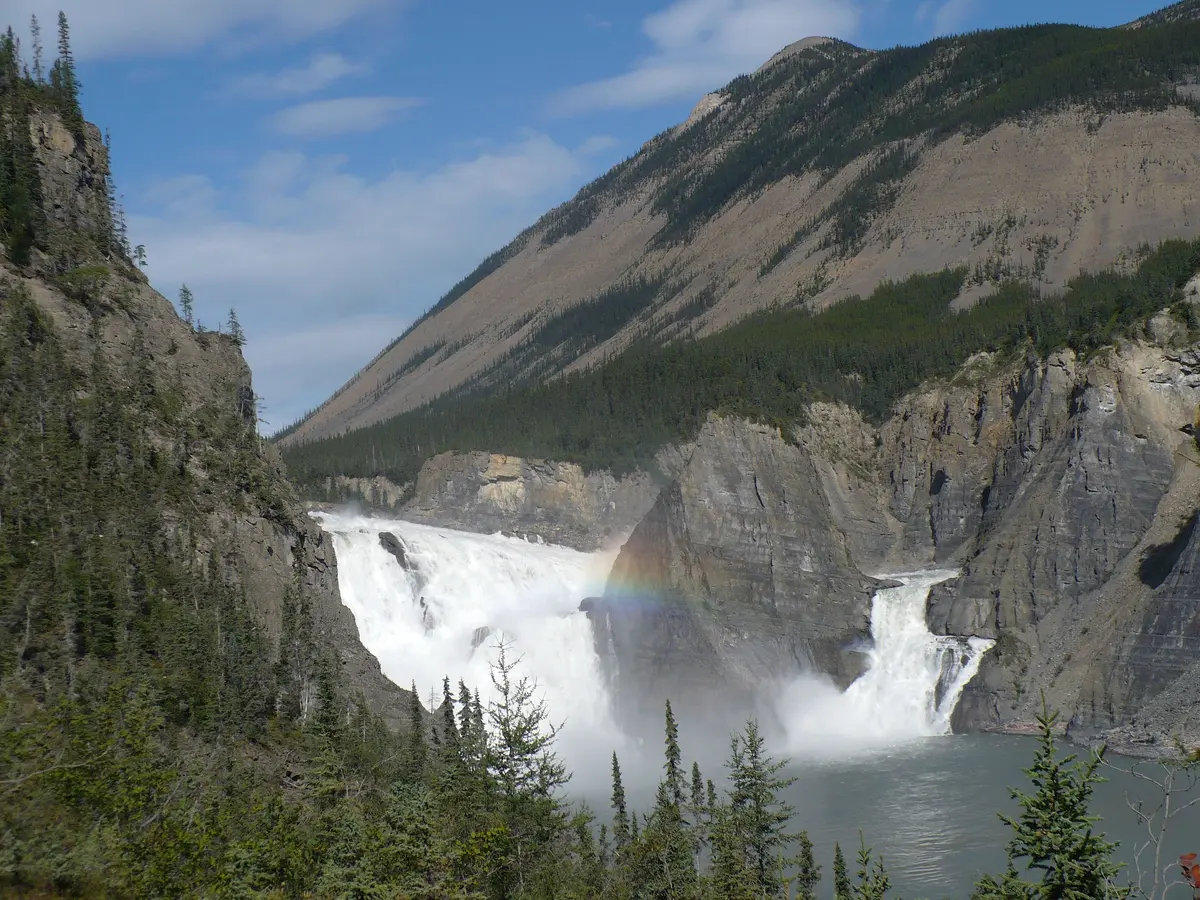
What people actually come for is not Deadmen Valley. It is Náįlįcho (Virginia Falls), where the South Nahanni drops from twice the height of Niagara; the granite spires of the Cirque of the Unclimbables, including the Lotus Flower Tower; the Nahanni karst; and the river itself, a Canadian Heritage River that, according to Parks Canada, National Geographic ranks among its top twenty tourism adventures in the world. Parks Canada interpreters and the community programme at Nahanni Butte present the country as Dene homeland rather than as a mystery — which, on the evidence, is the more interesting story.
Sources consulted
- Unsigned typescript, 3 leaves, «General Information Concerning the South Nahanni River or "Headless Valley" Region» — Boreal Institute for Northern Studies Library, University of Alberta (Polar Pam 6211); undated, mentions the Alaska Highway and answers "recent news stories" archive
- Natural Resources Canada, «Canadian Geographical Names Database — Deadmen Valley, Headless Range, Funeral Range, McLeod Creek (Northwest Territories)» — Geographical Names Board of Canada, official name-approval decisions archive
- Parks Canada, «Nahanni National Park Reserve — Culture and history» — parks.canada.ca, 2026 web
- Parks Canada, «Nahanni National Park Reserve — Nature and science, Activities and experiences, Plan your visit» — parks.canada.ca, 2026 web
- UNESCO World Heritage Centre, «Nahanni National Park — World Heritage List, ref. 24: Outstanding Universal Value, integrity and management» — whc.unesco.org, 2026 report
- Pierre Berton, «The Mysterious North (section "The Legend of Headless Valley": "The Myth", "Sixty-eight Below")» — Alfred A. Knopf, 1956 book
- A. B. McKillop, «Pierre Berton: A Biography» — McClelland & Stewart, Toronto, 2008 book
- J. G. Nelson and Harvey Locke, «The Magnificent Nahanni: The Struggle to Protect a Wild Place» — University of Regina Press, 2017 academic
- T. W. Paterson, «Lost Bonanzas of Western Canada» — Sunfire, Langley, B.C., 1983 book
- John Harris, «Above the Falls» — TouchWood Editions, Victoria, B.C., 2007 book
- Ranulph Fiennes, «The Headless Valley» — Hodder and Stoughton, London, 1973 book
- Parks Canada, «Nahanni National Park Reserve — Fees» — parks.canada.ca, 2025 web
- Joanne Ronan Moore, «Nahanni Trailhead: A Year in the Northern Wilderness» — Deneau & Greenberg, Ottawa, 1980 book
- A. C. Lewis, «Nahanni Remembered» — NeWest Press, Edmonton, 1997 book
- Daniel Francis (ed.), «Encyclopedia of British Columbia (entry on the pilot Baker and the 1947 Headless Valley flight)» — Harbour Publishing, Madeira Park, B.C., 2000 book
- Pierre Berton, «Starting Out: The Days of My Youth, 1920-1947» — McClelland & Stewart / Penguin Books, Toronto, 1987 book
- John Harris, «Tungsten John: Being an Account of Some Inconclusive but Nonetheless Informative Attempts to Reach the South Nahanni River by Foot and Bicycle» — New Star Books, Vancouver, 2000 book
Reviewed by V. Serrano on 2026-08-13 · How we verify our content
💬 Field testimonies (0)
No testimonies yet. Add the first.
Add your testimony
🔒 Log in to add a testimony