👻 HAUNTED PLACE · EXP. Nº9476
ACTIVE
Grand Theatre (London, Ontario)
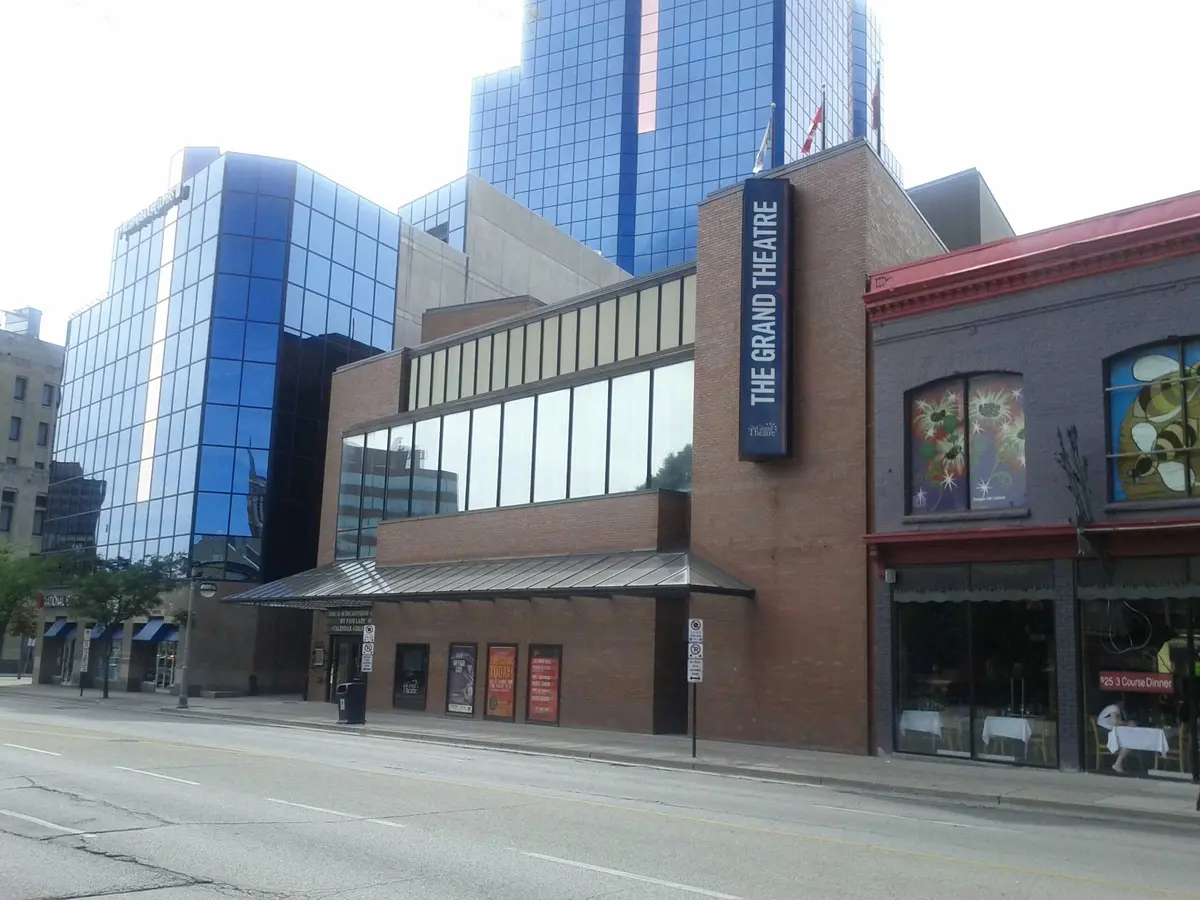
The Grand Theatre at 471 Richmond Street is a working professional playhouse whose ghost has a name, an owner's deed and a datable paper trail.
Where is Grand Theatre (London, Ontario)?
- Location
- Ontario, Canada
- Type
- Theater
- Coordinates
- 42.986, -81.251
- Last updated
LOCATION
Why is Grand Theatre (London, Ontario) said to be haunted?
Ambrose J. Small — the Toronto impresario who, with Colonel C. J. Whitney of Detroit, built this theatre after fire destroyed London's previous Grand Opera House — vanished from his Toronto office on 2 December 1919, hours after closing the sale of his circuit for $1.7 million. He was never found. What London inherited was not a sighting but a murder theory: the Dictionary of Canadian Biography records a caretaker at the London Grand who had smelled fumes from its furnace and claimed Small had been killed and burned there. The theatre's own 125th-anniversary history dates the first rumours of "a supernatural being living within the Grand" to 1952, thirty-three years later. Today the Grand does not hide the story, it sells it: backstage tours are advertised partly on "our resident ghost, Ambrose Small", and in October 2022 the theatre premiered a play it had commissioned about him. Small's connection to the building is the one thing here that is beyond dispute.
What is the history of Grand Theatre (London, Ontario)?
London's Grand Theatre exists because an earlier theatre burned down.
The city's first Grand Opera House was the house the big touring companies played, and in 1900 it was destroyed by fire. The theatre's own 125th-anniversary history is blunt about what happened next: "After a fire destroyed London's previous Grand Opera House the year prior, Colonel Whitney and theatre magnate Ambrose J. Small built a new theatre." Colonel C. J. Whitney was a Detroit manager who controlled a large Ontario circuit, part of it in partnership with Small; the pair bought land on the west side of Richmond Street, next to the Western Hotel, and put up the New Grand Opera House at what is today 471 Richmond Street.
It opened on Monday 9 September 1901 with a production of "Way Down East". By the theatre's account it held up to 1,850 people for a single performance, it was wired for electricity, it had its own telephone number — 176 — and its proscenium arch carried a mural by the Toronto painter Frederick S. Challener. That arch is the one thing from 1901 still standing.
So the link between Ambrose Small and this building is not a later embellishment. It is the founding fact of the place, and it predates the theatre most people associate with him: according to the Dictionary of Canadian Biography, Small did not buy the Grand Opera House in Toronto — his headquarters and the room he vanished from — until 1903, two years after London's opened. By 1912 the American manager Michael Bennett Leavitt was describing Small's circuit of 34 theatres, half of them outside Ontario, as "one of the most carefully booked . . . in America".
In late November 1919 Ambrose and Theresa Small sold that chain to Trans-Canada Theatres Limited of Montreal for $1.7 million. The negotiation had run from August to November and was handled by Small's solicitor, a Londoner named Flock. The Dictionary of Canadian Biography dates the receipt of the first $1 million to 1 December and the deposit of the cheque to the following morning; the theatre's own account, drawing on Sheila Johnston's history of the building, has the sale closing and the payment landing on 2 December itself. The two versions differ by a day, and no source consulted here resolves it.
What is not in dispute is Tuesday 2 December 1919. Theresa Small banked the cheque while her husband ordered a Cadillac, a fur coat and jewellery for her. Flock met him at his Toronto office that afternoon and left at about 5:30 p.m. Nobody credible saw Ambrose Small again. Because he was known to travel and to womanise without telling anyone, his absence was not reported for weeks; the public first learned of it on 3 January 1920, when the Toronto Daily Star ran an item quoting Flock by long-distance telephone from London.
The building outlived him comfortably. Trans-Canada went bankrupt in 1924 and Famous Players bought the Grand and fitted it for film. The second balcony came out in 1930. Four amateur companies merged in 1934 as London Little Theatre, which bought the building outright in 1945 — Famous Players turned down a higher bid to let them have it. In 1971 the company turned professional as Theatre London. In December 1975, mid-run of a children's "Hansel and Gretel", the wiring and plumbing gave out, and between 1977 and 1979 the architects Peter Smith and Bill Larkin of Lett/Smith demolished everything except three walls and the proscenium arch, rebuilding around them for $5.5 million. The Grand reopened on 28 January 1979. The company took the building's name in 1983, the main house became the Spriet Stage in 2017, and the lobbies and studio were modernised again in 2020. In 2026 the theatre is marking 125 years on the site.
Timeline: the documented record of Grand Theatre (London, Ontario)
- 1900 Fire destroys London's previous Grand Opera House, the house the big touring companies had played.
- 9 September 1901 Colonel C. J. Whitney of Detroit and Ambrose J. Small open the New Grand Opera House at 471 Richmond Street with "Way Down East": up to 1,850 seats, electric light, telephone 176 and a proscenium mural by Frederick S. Challener.
- 1903 Small buys the Grand Opera House in Toronto, two years after opening London's. It becomes his headquarters and the building he will vanish from.
- Tuesday 2 December 1919 Theresa Small banks the first million from the sale to Trans-Canada Theatres while Ambrose orders her a Cadillac, a fur coat and jewellery. His solicitor leaves his Toronto office at about 5:30 p.m.; nobody credible sees Small again.
- 3 January 1920 The Toronto Daily Star breaks the story, quoting Small's London solicitor Flock: "I left Mr. Small in his office about 5:30pm on Tuesday, December 2 and further than that I know nothing about him." The sale, he says, covered six houses.
- 1923 Small is pronounced dead for the purposes of probate. His body is never found and no kidnapping charge is ever pressed against anyone.
- 1952 By the theatre's own account, this is the year "rumours of a supernatural being living within the Grand began to circulate" — thirty-three years after the disappearance, and during the amateur London Little Theatre era.
- 28 January 1979 The Grand reopens after a $5.5 million rebuild that demolished everything except three walls and the proscenium arch. The interior Small knew no longer exists.
- 8 August 2003 (archived) The theatre's official website states that "according to informed sources" Small has not missed an opening night in 76 years, and names David Jacobs as the night watchman who spoke to him. No source is given for either claim.
- 8 October 2010 A single editor adds to the English Wikipedia article the sentence that the night watchman "swore he saw Mr. Small entering The Grand Theatre" weeks after the disappearance. It carries no source then and none now.
- 2 December 2019 On the centenary the theatre commissions "Grand Ghosts" from playwright Trina Davies and holds a free evening at which the audience is invited to share its own sightings.
- 18 October – 5 November 2022 "Grand Ghosts" premieres on the Spriet Stage, directed by Jillian Keiley: a vaudeville-flavoured show in which the theatre's ghosts replay 2 December 1919 every Halloween.
Is there a rational explanation for Grand Theatre (London, Ontario)?
Start with geography. Ambrose Small disappeared from an office in Toronto, about 170 km from London in a straight line, and the last person known to have seen him — his own solicitor — left him there at about half past five. No source consulted places him in the London building on 2 December 1919 or afterwards.
What London inherited was not a sighting but a murder theory. The Dictionary of Canadian Biography states it plainly, in an entry written by Kathleen D. J. Fraser: one line of speculation had Theresa Small taking a lover in London, and "at the Grand Opera House there, a Small holding, a caretaker who had smelled fumes from its furnace claimed that Theresa and her lover had murdered and incinerated Small. Whether the story is true or not, he lingers in legend as the theatre's ghost." That is the documented root of the London haunting: an accusation about a boiler, never substantiated, that curdled into a resident spirit.
The date the story becomes a ghost story is worth having, and the theatre supplies it. Its 125th-anniversary timeline puts the ghost in the London Little Theatre era, not in 1919: "In 1952, rumours of a supernatural being living within the Grand began to circulate." That is thirty-three years after Small vanished. The theatre's own marketing contradicts it — a 2019 press release says that "from the time of his disappearance, Ambrose Small has been spotted in and around The Grand London" — and the marketing version is the later one.
The attributions get vaguer the closer you look. The theatre's official website, as archived on 8 August 2003, reported that "according to informed sources" Small had not missed an opening night in 76 years; no source is named. The English-language Wikipedia article has said since 8 October 2010 that "the night watchman swore he saw Mr. Small entering The Grand Theatre" weeks after the disappearance — an unsourced sentence added by a single editor, still uncited today, and the ultimate origin of the version this file used to carry. The 2003 site tells it differently again: there the watchman has a name, David Jacobs, and he is said to have talked to Small on the night itself, prompting police to search the London theatre. Neither version has been traced here to a document from 1919 or 1920.
Finally, the incentive is on the record and the institution does not hide it. Backstage tours are sold partly on "our resident ghost, Ambrose Small"; the Grand commissioned Trina Davies to write "Grand Ghosts", premiered in October 2022; and at the centenary event in December 2019 the audience was invited to share their own sightings. Whatever people experience in the building, they are experiencing it in a theatre that has been telling them who to expect. And they are not standing in Small's theatre: apart from three walls and the arch, everything he knew was demolished in 1977.
Can you visit Grand Theatre (London, Ontario)?
The Grand Theatre occupies 471 Richmond Street, London, Ontario N6A 3E4, on Richmond Row just south of Dufferin Avenue. The box office answers on 519-672-8800 and at [email protected]. On 9 September 2026 the theatre's visit-planning page gave summer hours of 9am to 5pm Monday to Thursday and 9am to 1pm on Friday, with the weekend closed "except one hour prior to performances on performance days"; the 2026/27 season was on sale through tickets.grandtheatre.com the same day.
The house a ticket-holder enters is the Spriet Stage, the 1901 auditorium. The theatre's own 125th-anniversary history records that the rebuilding of 1977-1979 added a second stage while "demolishing much of the old building except for the main stage and its famed proscenium arch", and that the arch carries a mural by the painter Frederick Challener. Everything on the Richmond Street frontage dates from that rebuilding. Downstairs, the former McManus studio now trades as the Auburn Developments Stage, a black box reseated show by show.
The theatre sells no ghost tour. What it does run is a 60-minute backstage tour of both stages at $10 plus tax, booked in advance and capped at fifteen participants, pitched at ages 16 and over; children from 12 are admitted accompanied. On 9 September 2026 the tour page still carried the notice "Backstage tours for the 2024/25 Grand season have concluded. Scheduled Tour Dates for the 25/26 season will be announced soon!" — two seasons stale, with no dates released.
The accessibility page, read the same day, lists "An elevator with access to all levels of the venue"; wheelchair-accessible seats on the Orchestra level of the Spriet Stage; accessible washrooms on every floor plus a universal washroom; one wheelchair kept on site; hearing devices with an integrated neck loop; open-captioned performances offering "real-time subtitling in English"; ASL-interpreted performances; relaxed performances; large print alongside braille bar menus on request; and a complimentary ticket for one support person holding an Access 2 Entertainment or CNIB card. The backstage tour is the exception: the theatre states that "due to the heritage nature of our building, some areas are not fully accessible to wheelchairs", and warns that participants "walk through the theatre, climb stairs and navigate narrow spaces".
Sources consulted
- Kathleen D. J. Fraser, «SMALL, AMBROSE JOSEPH» — Dictionary of Canadian Biography, vol. 14, University of Toronto/Université Laval, 1998 academic
- The Grand Theatre, «A New Playhouse for London: 125 Years of Live Performance» — grandtheatre.com, 2026 web
- Sheila M. F. Johnston, «Let's Go to The Grand! 100 Years of Entertainment at London's Grand Theatre, pp. 41-45 — extract reproduced in full by the theatre, including the Toronto Daily Star item of 3 January 1920. Consulted through that transcription, not the book itself, which is access-restricted.» — Natural Heritage/Natural History Inc., Toronto, 2001 book
- The Grand Theatre, «Grand Theatre official website, history section (docnum 1-9), as archived by the Internet Archive on 8 August 2003» — Internet Archive Wayback Machine, 2003 archive
- Jennifer Matthews, «The Grand announces Grand Ghosts by Trina Davies (press release, 2 December 2019)» — The Grand Theatre, London, Ontario, 2019 report
- The Grand Theatre, «Grand Ghosts — production page (18 October to 5 November 2022, dir. Jillian Keiley)» — grandtheatre.com, 2022 web
- Wikipedia contributors, «Grand Theatre (London, Ontario) — revision 389527036 of 8 October 2010, in which the night-watchman sentence is first added without a source» — English Wikipedia, 2010 archive
- The Grand Theatre, «Backstage Tours; Accessibility; Plan Your Visit (consulted 12 August 2026)» — grandtheatre.com, 2026 web
Reviewed by V. Serrano on 2026-08-12 · How we verify our content
💬 Field testimonies (0)
No testimonies yet. Add the first.
Add your testimony
🔒 Log in to add a testimony