🦶 CRYPTID SIGHTING · EXP. Nº6501
ACTIVE
Dobhar-chú
Dobharchú is the ordinary Irish word for an otter. It is what the dictionaries say: Cormac's Glossary explains it as dobur, water, plus cú, hound; the Electronic Dictionary of the Irish Language and Ó Dónaill's Foclóir Gaeilge-Béarla both gloss it with one word, otter.
Where and when was Dobhar-chú sighted?
- Location
- Glenade, condado de Leitrim, Ireland
- Date sighted
- Unknown
- Coordinates
- 54.363, -8.268
- Last updated
LOCATION
What is Dobhar-chú?
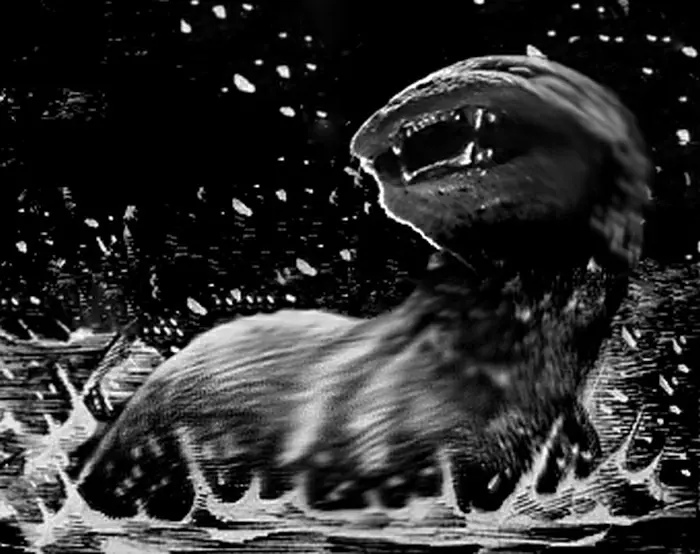
Translate it literally as “water hound”, however, and you have invented a monster — which is roughly what happened to the beast of Glenade Lough in County Leitrim. There really is an eighteenth-century sandstone grave slab in Conwal burial ground carrying a carved animal transfixed by a barbed weapon, and lettering that Patrick Tohall read in 1948 as Grace Con, wife to Ter MacLoghlin, dated 24 September 1722. What the stone does not say is that anything killed her. When the story first reached print, in an 1896 note to the Journal of the Royal Society of Antiquaries of Ireland, the woman had no name and no date, and the avenger was “her husband (or brother according to some accounts)”. The name Grace Connolly comes from the inscription and from an anonymous poem of about 1920. Behind all of it stands a real animal, and a genuine Irish and Scottish belief in a king of the otters.
What is the history of Dobhar-chú?
The word is most of the mystery.
Dobharchú is the ordinary Irish word for an otter. It is built from dobhar, an old word for water, and cú, hound — literally "water-hound" — and the etymology was already being explained in Ireland more than a thousand years ago, in Cormac's Glossary. The Electronic Dictionary of the Irish Language files doburchú under one flat definition: otter. Niall Ó Dónaill's Foclóir Gaeilge-Béarla (1977), the standard modern dictionary, gives the same single gloss. Ireland's National Terminology Database still lists it today, alongside madra uisce and dobhrán, as a live Irish term for Lutra lutra.
So a large part of "the beast of Glenade" is a problem of translation. Rendered into English as "water hound", dobharchú names an unknown animal; rendered as the dictionaries render it, it names an otter.
The same word carried a second, folkloric sense in the northwest of Ireland and in Gaelic Scotland: not an otter but the otter, a king or master of the species, credited with a hide that healed all diseases. Roderic O'Flaherty recorded the belief in 1684, in a description of West Connacht first printed in 1846, and Scottish and Irish lexicographers from Edward Lhuyd to Patrick Dinneen kept noting it alongside the plain zoological sense.
The Glenade story itself enters print in 1896. Writing to the Journal of the Royal Society of Antiquaries of Ireland, Miss L. A. Walkington reported that on a visit to Bundoran she had heard "a legend concerning a tombstone in the graveyard of Caldwell" and had gone to see it. Her account runs: "A young married woman went to wash her clothes in a stream near the house, and an animal called by the natives a dhuraghoo… came out of the river and attacked her. Her husband (or brother according to some accounts) missing her went to look for her, and found her dead and the beast sucking her blood." A companion, Miss Jefferson, sketched the stone on the spot; Walkington noted a Maltese cross below the lettering, and that "two other tombstones are shown in connexion with the story, one bearing an image of the horse". She closed by asking whether "some antiquary may be able to throw light on the legend".
The earliest published account gives no name for the woman, and no date.
Forty years later the schoolchildren of north Leitrim wrote the story down again for the Irish Folklore Commission, and the National Folklore Collection has digitised what they collected. Joseph Rooney, 50, of Sracleighreen told it to Patrick J. Rooney at Largy school: "about three hundred years ago a woman named Mrs Mc Loughlin went to the lake shore to wash clothes." At Cloonty, Annie M. Gallagher recorded a version in which the avenger is the dead woman's brother, and noted that "in Conwell graveyard in Glenade there is a picture of a Dobarcu carved on a tombstone". At Mastersons school near Manorhamilton the story is barely recognisable: two women washing, a baby carried off, and the man killed and buried at Ahamlish in County Sligo under a stone carved with a dobharchú. Six Leitrim versions survive, and not one of them gives the woman a name, and not one gives a year.
The name and the year come from two later places. The first is the gravestone. The second is a poem: an anonymous sixteen-verse ballad, "The Dobhar-chú of Glenade", of unverified authorship and probably composed around 1920, which dates the events roughly two hundred years earlier and supplies the cast the internet now repeats — Terence McGloughlan and his wife Grace Connolly.
The scholarly account of the stones is Patrick Tohall's, published in the same journal that had printed Walkington's query 52 years earlier: "The Dobhar-Chú Tombstones of Glenade, Co. Leitrim (Cemeteries of Congbháil and Cill-Rúisc)", JRSAI 78 (1948), pp. 127-129. The plural in the title matters. Tohall documented two stones. The surviving one is in Congbháil (Conwall) burial ground at Drummans: a recumbent sandstone flag roughly 4 ft 6 in by 1 ft 10 in, dated 24 September 1722, its legible lettering naming Grace Con, wife to Ter MacLoghlin — Tohall pointed out that "Ter" is Terence and that, by Gaelic custom, a married woman kept her maiden name, which is why the stone calls her Con; locally, he added, she was still spoken of as Gráinne. His description of the carving, set in a panel about 17.5 by 7 inches, is precise: "a recumbent animal having body and legs like those of a dog… The paws, however, appear unusually large, while the long, heavy neck and the short head into which it shades off, together with the tiny ears are all like those of an Otter." The head and neck are thrown back along the spine and a clenched human fist drives a barbed weapon down through the base of the neck.
The second stone, which almost every retelling omits, stood at Cill Rúisc (Kilroosk) at the southern entrance to Glenade and was said to be Terence's own. By the First World War it had broken in two; the halves were set on a boundary wall and then vanished. Tohall could find only one man who remembered the animal carved on it, and that man said it looked less like a dog than like a horse — which is precisely what Walkington had been shown in 1896, when a second stone "bearing an image of the horse" was pointed out as the husband's.
Timeline: the documented record of Dobhar-chú
- 1684 — the first printed water-hound Roderic O'Flaherty, in his Chorographical Description of West or H-Iar Connaught, records a man dragged into Lough Mask in County Mayo by a beast "of the pitch of an ordinary greyhound, of a black slimy skin", who stabbed it with a pocket knife and escaped. O'Flaherty adds: "The like, they say, is seen in other lakes of Ireland; they call it Dovarchu, i.e. a water dog, or Anchu, which is the same."
- 24 September 1722 — the date on the slab The date carved on the recumbent sandstone flag in Conwal burial ground, which Patrick Tohall read in 1948 as commemorating Grace Con, wife to Ter MacLoghlin. Tohall judged the stone contemporary with the death, since comparable slabs in the same graveyard belong to 1722-1760. The inscription records a name and a date; it says nothing about any animal.
- 1896 — the legend reaches print, unnamed and undated Miss L. A. Walkington publishes "A Bundoran Legend" in the Journal of the Royal Society of Antiquaries of Ireland, reporting a tombstone in "the graveyard of Caldwell" and a story about "a young married woman" killed by an animal "called by the natives a dhuraghoo". Her companion Miss Jefferson sketched the stone on the spot. Walkington gives no name for the woman and no year, says the avenger was "her husband (or brother according to some accounts)", and notes that two further stones were shown in connection with the story.
- 1896 — the king of all the lakes Replying in the same journal, the naturalist H. Chichester Hart reports the version he had heard at Ballyshannon: the "Dorraghow" was "The King of all the Lakes, and Father of all the Otters. He can run his muzzle through the rocks. He was as big as five or six otters." His informant, Hart adds, thought the creature had been long dead.
- 1912 — the dictionaries assembled Charles Alston prints the lexicographic dossier: the Highland Society's Dictionary defining dobhar-chu, on Edward Lhuyd's authority, as "a kind of otter supposed to be the king of the species"; M'Alpine's gloss of an otter "which has no existence but in Donald's imagination", whose skin "can heal all diseases"; and Dinneen's 1904 dictionary noting that in County Donegal the word was used of a mythical otter-like animal.
- c. 1920 — the poem that named her An anonymous sixteen-verse ballad, "The Dobhar-chú of Glenade", of unverified authorship and probably composed around this date, tells the story in full and dates it about two hundred years earlier. It is the source of the names now attached to the legend everywhere: Terence McGloughlan and Grace Connolly. In its version Grace goes to the lake to bathe, not to wash clothes, and Terence returns with a gun.
- 1937-1939 — the schoolchildren write it down For the Irish Folklore Commission's Schools' Collection, north Leitrim pupils record six versions from named neighbours: Joseph Rooney, 50, of Sracleighreen ("about three hundred years ago a woman named Mrs Mc Loughlin"); James Mc Gurrin, 51, of Cartrongibbagh; Maurice Mac Grath, 64, a teacher at Carrigeengeare; and versions collected by Annie M. Gallagher at Cloonty, in which the avenger is the woman's brother, and by Brigid O'Rourke at Killanummery, in which husband and brother go back with a gun. In Donegal the same collection has Anna Ní Giolla Easpuig, 68, of Mín na bhFachrán calling the dobharchú of Loch Unna Rí an Madadh Uisge, king of the water-dogs. No Leitrim account names the woman or gives a year.
- December 1948 — Tohall counts two stones Patrick Tohall publishes "The Dobhar-Chú Tombstones of Glenade, Co. Leitrim (Cemeteries of Congbháil and Cill-Rúisc)" in the Journal of the Royal Society of Antiquaries of Ireland, vol. 78, pp. 127-129. He describes and photographs the Conwal slab, reads its lettering as Grace Con, wife to Ter MacLoghlin, judges it contemporary with the death because comparable slabs there date from 1722-1760, and records that the second stone, at Kilroosk and said to be the husband's, had broken in two by the First World War and then vanished — the one man who remembered its carving said the animal looked more like a horse than a dog. Tohall closes by quoting a Donegal phrase collected by Seán Ó hEochaidh: the dobharchú is "the seventh cub of the common otter".
- 1977 — the dictionary settles the word Niall Ó Dónaill's Foclóir Gaeilge-Béarla, the standard modern Irish-English dictionary, enters dobharchú as a masculine noun with a single English gloss: otter. The Electronic Dictionary of the Irish Language gives the same one-word definition for the Old and Middle Irish doburchú.
- 2013 — counting the real animal The National Otter Survey of Ireland 2010/12, published by the National Parks and Wildlife Service, records otter field signs at 63.3% of sites surveyed, an estimated 93.6% occupancy after correction for survey bias, and a population of about 7,800 breeding females. Ireland, the report concludes, remains a stronghold for Lutra lutra.
Is there a rational explanation for Dobhar-chú?
The central problem is lexical: the creature's name is the dictionary word for an otter. An Irish speaker in 1722 who said a dobharchú had come out of the lake may have been saying, in the most ordinary words available, that an otter had come out of the lake. Almost every English retelling since has translated the name literally and treated the literal translation as a description.
Tohall made the same distinction in 1948: as Karl Shuker summarises him, in both Ireland and Scotland the word has two meanings: one is simply the otter, and the other is a mythical otter-like beast, a sense still widely used in the County Leitrim region. The second sense has a long paper trail: Roderic O'Flaherty recorded it in Connacht in 1684, and the dictionaries Charles Alston collected in 1912 define the dobhar-chu as "a kind of otter supposed to be the king of the species". The word does two jobs at once, and an English translation keeps only one of them.
The stone is genuine, and its inscription is short. There really is an eighteenth-century sandstone slab in Conwal burial ground carrying a carved animal transfixed by a weapon. Its legible lettering, per Tohall, names Grace Con, wife to Ter MacLoghlin, and gives the date 24 September 1722. It carries no statement that she was killed by a beast, or that the animal in the panel killed her. The link between the woman and the carving comes from the story told about the stone. In 1896 that story was already attached to a tombstone in the graveyard, and it gave the woman no name. The carving is also easy to misread: Karl Shuker records that some colleagues shown photographs took the carved human fist for the animal's head.
The details that make the story look like evidence are the youngest parts of it. In 1896 the woman has no name and no date. In 1937-1939 the Schools' Collection versions still give neither, and they disagree on who avenged her, on sword or gun, on whether he was alone, and in one Manorhamilton version on who died at all. The name Grace Connolly and the year 1722 arrive from the gravestone's inscription and from a poem of about 1920.
The Schools' Collection can be searched, and on 25 September 2026 a search of the National Folklore Collection's Schools' Collection for dobharchú returned 13 story records and 20 transcripts, six of the stories from County Leitrim. A search for Grace Connolly returned one story, "Grace Dieu", from Gracedieu in County Dublin, matched through a collector surnamed Connolly. The surname Connolly on its own returned 654 stories, so the name is abundantly indexed; in the 1930s it is never attached to the Glenade beast.
The zoology sets limits. The Eurasian otter is the only otter in Ireland, and Karl Shuker gives its length as up to about 4 ft (1.2 m) on average, with a confirmed maximum of 4.5 ft (1.4 m). Ireland is a genuine stronghold for it — the National Otter Survey of Ireland 2010/12 recorded field signs at 63.3% of sites, corrected to an estimated 93.6% occupancy, with about 7,800 breeding females — so a countrywoman washing clothes at a lake shore in the 1700s had an excellent chance of meeting one. Male otters in Irish rivers hold territories averaging about 13 km, which they mark.
Attacks on people do happen: the Canadian Medical Association Journal published in 2016 the case of a 52-year-old woman bitten by a North American river otter.
How Grace Con died is not settled by the stone: it gives a name and a date; the cause of death comes from the story, and the oldest printed version of the story, in 1896, does not name her.
Can you visit Dobhar-chú?
The surviving slab is in Conwal graveyard, Congbháil, in the townland of Drummans in north County Leitrim, at 54.408308° N, 8.313167° W. The Historic Graves project catalogues the ground as LE-CNWL against recorded monument number LE003-008002 and counts 207 memorials in it. Its record states that the graveyard was "Surveyed by local community volunteers in the Summer of 2023 with the support of Leitrim County Council and funding from the Heritage Council". The R280 passes the gate on its way from Kinlough, about 5 km to the north, down the Glenade valley towards Manorhamilton. The only parking is on the verge of that road.
Families from the valley still bury their dead in this ground. The carving is cut on a recumbent sandstone flag, and recumbent sandstone flags flake: Tohall reported in 1948 that part of the relief had already been lost that way. Raking light early or late in the day is what makes the incised lines legible in a photograph.
Glenade Lough lies further up the valley at 54.36444° N, 8.27028° W. It runs 1.6 km (1 mile) from north-west to south-east, covers 0.74 km² (0.3 sq mi) and reaches 11.5 m (38 ft) at its deepest, 66 m (217 ft) above sea level between the Dartry Mountains to the west and Arroo to the east. Manorhamilton is 9 km (6 miles) to the south-east and Kinlough 12 km (7 miles) to the north. The R280 runs along the eastern shore of the lough. That shore and the fields behind it are private farmland, and Ireland has no general right to roam: crossing a field without the landowner's permission is trespass, and much of this ground is grazed.
The second stone, from Cill Rúisc near the southern entrance to Glenade, has gone. Tohall recorded that it had broken in two by the First World War, that the halves were set on a boundary wall and that they then disappeared.
The Eurasian otter lives in this catchment and is strictly protected in Ireland under the Wildlife Acts and under Annexes II and IV of the EU Habitats Directive. Disturbing an animal or its holt is an offence.
Sources consulted
- Roderic O'Flaherty, «A Chorographical Description of West or H-Iar Connaught, written A.D. 1684 (ed. James Hardiman, Irish Archaeological Society, 1846) — the Lough Mask attack, p. 20» — Irish Archaeological Society, Dublin; digitised copy, Internet Archive, 1684 book
- Miss L. A. Walkington, «A Bundoran Legend (note, p. 84)» — The Journal of the Royal Society of Antiquaries of Ireland, 5th ser. vol. VI (consecutive vol. 26); digitised copy, Internet Archive, 1896 academic
- H. Chichester Hart, «Bundoran Legend — reply to Miss L. A. Walkington's query (note, p. 180)» — The Journal of the Royal Society of Antiquaries of Ireland, 5th ser. vol. VI (consecutive vol. 26); digitised copy, Internet Archive, 1896 academic
- Patrick Tohall, «The Dobhar-Chú Tombstones of Glenade, Co. Leitrim (Cemeteries of Congbháil and Cill-Rúisc), vol. 78, no. 2, pp. 127-129» — The Journal of the Royal Society of Antiquaries of Ireland, 1948 academic
- National Folklore Collection, University College Dublin, «The Schools' Collection (1937-1939): thirteen dobharchú narratives, six of them from Co. Leitrim — vols. 0190 p. 229, 0192 pp. 312 and 318, 0193 p. 420, 0197 p. 401, 0201 p. 265, 1040 p. 29, 1047 p. 21» — Bailiúchán na Scol / dúchas.ie, 1938 archive
- Electronic Dictionary of the Irish Language, «eDIL s.v. doburchú (dil.ie/17278): 'otter', citing Cormac's Glossary — dobur usce, unde dicitur dobarc[h]ú .i. cú uisci» — Royal Irish Academy / Queen's University Belfast, 2019 academic
- Niall Ó Dónaill, «Foclóir Gaeilge-Béarla, s.v. dobharchú, masculine noun: 'otter'» — An Gúm, Dublin; online at teanglann.ie, 1977 book
- Charles H. Alston, «Wild Life in the West Highlands — chapter on the beaver and Scottish tradition, pp. 35-38, collecting the dictionary senses of dobhar-chu» — James MacLehose and Sons, Glasgow; digitised copy, Internet Archive, 1912 book
- Neil Reid, Brian Hayden, Mathieu G. Lundy, Stéphane Pietravalle, Robbie A. McDonald and W. Ian Montgomery, «National Otter Survey of Ireland 2010/12, Irish Wildlife Manuals No. 76» — National Parks and Wildlife Service, Department of Arts, Heritage and the Gaeltacht, Ireland, 2013 report
- Matthew P. Cheng, Leighanne O. Parkes, Katryn Paquette, Cédric P. Yansouni and Todd C. Lee, «River otter bite in a 52-year-old woman: managing animal bites, CMAJ 188(13), E513-E516» — Canadian Medical Association Journal, 2016 academic
- Karl P. N. Shuker, «The Dobhar-chú — Trailing Ireland's Mysterious Master Otter, Part 1: Glenade Lake and a Gravestone (reproduces Tohall's 1948 description of the carving verbatim)» — ShukerNature, 2020 web
Reviewed by V. Serrano on 2026-08-11 · How we verify our content
📎 Source: Enigma Atlas
💬 Field testimonies (0)
No testimonies yet. Add the first.
Add your testimony
🔒 Log in to add a testimony