👻 HAUNTED PLACE · EXP. Nº9046
ACTIVE
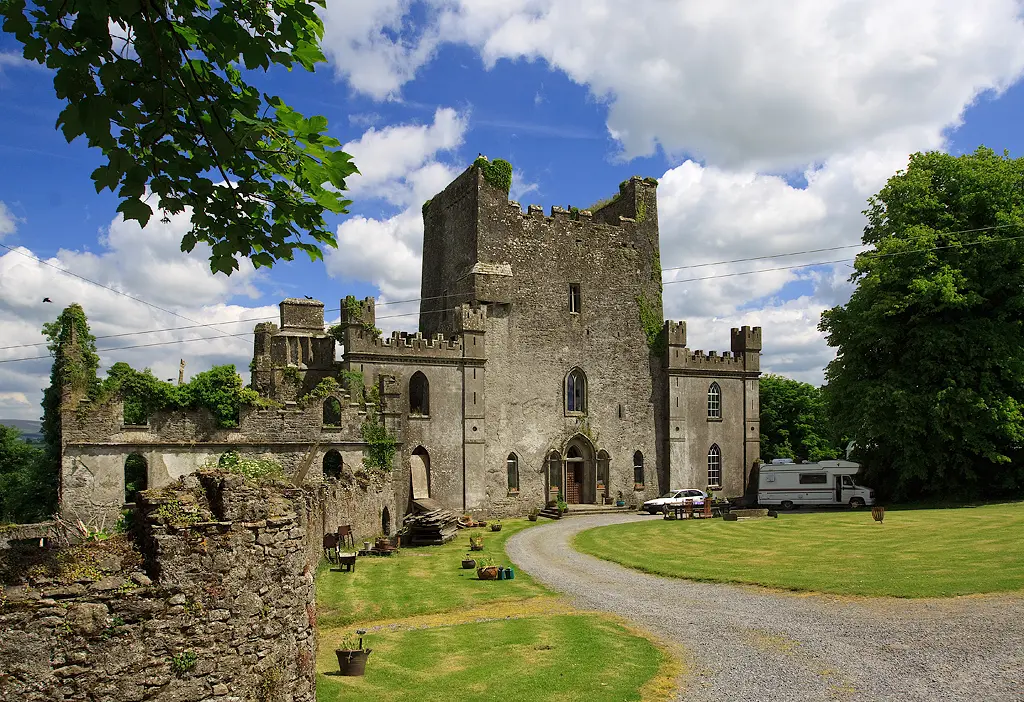
Leap Castle
Leap Castle in County Offaly was the stronghold of the O'Carroll clan, an Irish family whose internal rivalries turned lethal inside its own chapel: legend holds that one O'Carroll brother, a priest, was run through with a sword by his own sibling while celebrating Mass, giving the room its lasting name, the "Bloody Chapel."
Where is Leap Castle?
- Location
- County Offaly, Ireland
- Type
- Castle
- Coordinates
- 53.028, -7.809
- Last updated
LOCATION
Why is Leap Castle said to be haunted?
Workers clearing the chapel in the early 20th century reportedly found a hidden oubliette packed with human remains, believed to be prisoners starved or dropped to their deaths onto spikes below. The castle's later owner, Jonathan Darby, wrote in the 1900s of encountering an "elemental" presence he described as a foul-smelling, shadowy figure with an animal-like form, an account that has become central to Leap's paranormal reputation and drawn researchers ever since. Restored after a 1922 fire during the Irish Civil War left it a ruin for decades, the castle now hosts overnight paranormal investigations.
What is the history of Leap Castle?
The real history of Leap Castle is bloodier than its ghost stories, and far better documented.
The tower stands on a rock guarding the pass through the Slieve Bloom Mountains, and its name — Léim Uí Bhanáin, the Leap of the O'Bannons — belongs to the family who built it as vassals of the O'Carrolls, Princes of Ely. It was the O'Carrolls who made it notorious. The family record published today by the castle's own owners reads like a ledger of killings. Mulrony O'Carroll, remembered as the Great, died at Leap in 1532 after forty-two years in charge, and the succession collapsed into a feud that ran for three generations. His son Fearganhainm was killed by the O'Mulloys in 1541. Fearganhainm's son Teige “the One-Eyed” was killed by his own kinsman Cahir; Cahir was slain in 1554 by Teige's younger brother William “the Pale” Odhar; William was murdered by his O'Conor relations in 1581; William's son John was killed the following year by Teige's son Mulrony; and John's brother Charles killed Mulrony in revenge, was knighted in 1586, and was himself cut down in 1600 — payback, the same family record says, for having murdered 150 of his own men and several MacMahon nobles in their sleep after a feast.
Somewhere in that wreckage sits the story that named the upper chapel: an O'Carroll bursting in on his brother, a priest, and killing him at the altar for beginning Mass without him. The castle's own website introduces it as legend, and the family's own list of who killed whom names no murdered priest among them.
The Darbys took the place in the seventeenth century — the present owners date it to 1649 and a Cromwellian soldier, Jonathan Darby, paid in land instead of money; other accounts say 1642 and a marriage. They held it for the better part of three hundred years. Jonathan Charles Darby, the last of the line at Leap, married Mildred Dill in 1889, and it was she, not he, who made the castle famous.
The end came in the Irish Civil War. In the early hours of Sunday 30 July 1922 eleven armed men knocked at the door, gave the caretaker Richard Dawkins twenty minutes to get his wife and baby out, poured petrol through the north wing and set it alight. Neighbours spent the Sunday carting away whatever had survived. At 4.20 on the Monday morning the raiders returned and burned the rest. The shell stood open to the sky for half a century until the Australian Peter Bartlett bought it in 1974 and began putting it back together.
Timeline: the documented record of Leap Castle
- 1532 Mulrony O'Carroll dies at Leap after forty-two years as chief, and the succession collapses into a three-generation feud. Tradition places the killing of an O'Carroll priest at the altar of the upper chapel in this struggle — but the family's own record of the feud names no priest among the dead.
- 1600 Charles O'Carroll, knighted in 1586, is killed in reprisal for having murdered 150 of his own men and several MacMahon nobles in their sleep after a feast. It is the last O'Carroll generation to hold Leap.
- 1649 The castle's owners date the arrival of the Darbys to this year: Jonathan Darby, a soldier of the Cromwellian forces, is given Leap and its land in lieu of pay. It returns briefly to John O'Carroll in 1664 and is taken back in 1667. Other accounts date the handover to 1642 and to a marriage.
- 1889 Jonathan Charles Darby, heir to Leap, marries Mildred Dill. She begins publishing Gothic fiction under the male pen name “Andrew Merry” and holds séances inside the castle.
- December 1908 The Occult Review devotes forty of its seventy-two pages to “Kilman Castle: The House of Horror”, edited by “Andrew Merry”. It is the first published account of the Elemental — told through an invented narrator, in a castle given a false name and a false location. Editor Ralph Shirley notes that the owner had always refused to let the Society for Psychical Research investigate.
- January 1909 The magazine prints three letters “in confirmation” of the haunting, all forwarded by “Andrew Merry” and all published without signatures. One describes a tall figure clothed in red, lit from within and holding a dagger — the earliest printed version of Leap's “Red Lady”.
- 1910 Mildred Darby publishes The Hunger, a novel of the Famine years. Her husband, who disapproved of her writing, forbids her to publish anything further; her unpublished work stays in the castle.
- 30–31 July 1922 Eleven armed raiders burn Leap Castle over two nights of the Irish Civil War. The caretaker Richard Dawkins testified in the claims court that he was held at gunpoint at 2.20 a.m., given twenty minutes to remove his wife and baby, and kept outside until five. More than 150 of Mildred Darby's unpublished stories and two complete novels burned with the house.
- 1991 Peter Bartlett, the Australian who had bought the ruin and begun restoring it, died in 1989. In 1991 the traditional musician Seán Ryan buys Leap Castle, and he has lived there since with his wife and daughter.
Is there a rational explanation for Leap Castle?
Almost everything Leap Castle is famous for can be traced to a single publication, and that publication announced itself as a story.
In December 1908 The Occult Review gave forty of its seventy-two pages to “Kilman Castle: The House of Horror”, credited as “Edited by Andrew Merry” — the pen name of Mildred Darby, the lady of the house. The castle is renamed, relocated “near the west coast of Ireland”, and handed to an invented owner called Maurice O'Connoll. The Elemental is not described by Darby at all: it is described by a fictional narrator, Captain Gordon of a native Indian regiment, who empties a revolver into it. The editor, Ralph Shirley, conceded that “the narrative takes the form of a story”, and admitted in the same paragraph that the owner of the castle “would never respond to the appeals of the Society [for Psychical Research] to permit investigation”. The corroboration printed the following January — three letters “in confirmation” — is unsigned, the names withheld, and it was Darby herself who supplied them to the magazine.
The oubliette behaves the same way. In Darby's 1908 text the host says “a couple of cartloads of old bones and bone dust” were cleared out and reburied in the churchyard by “some superstitious old ancestor”, generations before his time. The castle's website today says three cartloads of skeletons, removed during the Darbys' own renovations. Popular retellings raise the count past 150 and move the discovery to twentieth-century workmen. No excavation report, no inventory and no bones survive to settle it.
Before 1908, the Elemental appears in no published record at all.
Can you visit Leap Castle?
Leap Castle stands in the townland of Leap, County Offaly. It is a private house about 6 km (3.7 miles) north of Roscrea and 10 km (6.2 miles) south of Kinnitty on the R421, at 53.0281° N, 7.8085° W. Sean Ryan and his wife Anne have lived in it since 1991 while repairing it. The National Inventory of Architectural Heritage carries the site as registration number 14939007 at Irish Transverse Mercator 212896/197477. It rates the castle of national importance and describes a building that "lay in ruins until it was bought approximately thirty years ago and it being restored at present".
The castle's website has withdrawn its opening hours and its telephone number. Captured on 9 September 2026, leapcastle.net presents itself as "An independent historical and architectural archive for Leap Castle, County Offaly, Ireland". Its visiting page opens with the sentence "Leap Castle is a private home as well as a historic building" and then says that its opening arrangements and its visitor information are "being reviewed for accuracy". The same page adds that "Historic opening hours and personal contact details from earlier versions of this site are not republished here because they may no longer be current". The hours of 10.00 to 17.00 and the owner's mobile number still circulate on third-party listings; they come from a version of the site that has been taken down.
There is no ticket office and no car park at the gate. The building is a tower house under repair, with rough ground underfoot.
Sources consulted
- Andrew Merry (pen name of Mildred Darby), «Kilman Castle: The House of Horror» — The Occult Review, vol. VIII, no. 6, pp. 308-347, ed. Ralph Shirley (William Rider & Son, London), 1908 newspaper archive
- The Occult Review, «Correspondence: The House of Horror (three letters forwarded by “Andrew Merry”)» — The Occult Review, vol. IX, no. 1, pp. 44-48, ed. Ralph Shirley (William Rider & Son, London), 1909 newspaper archive
- Noel Guerin, «The most haunted castle in Ireland: the story of novelist Andrew Merry (aka Mrs Mildred Darby) of Leap Castle, Co. Offaly» — Offaly History Blog, Offaly Historical & Archaeological Society (citing National Library of Ireland MS 17,877), 2018 web
- Noel Guerin, «The Burning» — Leap Castle, official site of the owners (summarising Richard Dawkins's evidence to the claims court), 2023 web
- Sean and Anne Ryan, «The O'Carrolls» — Leap Castle, official site of the owners, 2023 web
- Sean and Anne Ryan, «The Bloody Chapel» — Leap Castle, official site of the owners, 2023 web
- The Irish Aesthete, «Feeling Haunted (Leap Castle, County Offaly)» — theirishaesthete.com, 28 June 2021 (read 10 October 2026), 2021 web
Reviewed by V. Serrano on 2026-07-29 · How we verify our content
💬 Field testimonies (0)
No testimonies yet. Add the first.
Add your testimony
🔒 Log in to add a testimony