👻 HAUNTED PLACE · EXP. Nº9475
ACTIVE
Shelbourne Hotel
The Shelbourne has stood on the north side of St Stephen's Green since 1824, when Martin Burke of County Tipperary took three Georgian houses and named his hotel after William Petty, 2nd Earl of Shelburne.
Where is Shelbourne Hotel?
- Location
- Dublin, Ireland
- Type
- Hotel / inn
- Coordinates
- 53.339, -6.256
- Last updated
LOCATION
Why is Shelbourne Hotel said to be haunted?
Thackeray slept there in 1842 and called it "an extremely big red house"; British soldiers fired a machine gun from its roof at the Irish Citizen Army in the park during Easter Week 1916; and in 1922 the committee that drafted the Constitution of the Irish Free State met in room 112, now the Constitution Room. The ghost is far younger than any of that. It begins in 1965, when the American investigator Hans Holzer brought the English medium Sybil Leek to the hotel and published the result two years later in The Lively Ghosts of Ireland: a child crying at night who, questioned under trance, was said to give the name Mary Masters, an age of about seven and cholera as the cause of death. Almost everything repeated online since - the name, the age, the fifth-floor room - descends from those three nights. Elizabeth Bowen's 1951 history of the hotel does not mention her, and neither does the hotel.
What is the history of Shelbourne Hotel?
The Shelbourne is older than the building that carries its name. In 1824 Martin Burke, a Tipperary man, took three Georgian houses on the north side of St Stephen's Green - the modern nos. 27 to 29 - and turned them into a hotel for country families who wanted a fashionable Dublin address. He borrowed the name from William Petty, 2nd Earl of Shelburne, the former British prime minister; the hotel's own history page adds that Shelburne had been "previous owner of the site".
The first traveller's account of the place is also the best. William Makepeace Thackeray came to Dublin in the summer of 1842 and put the hotel into The Irish Sketch Book the following year, spelling it as everyone then did, "Shelburne". The car, he wrote, "stops before an extremely big red house, in that extremely large square, Stephen's Green". For six-and-eightpence a day he got "a copious breakfast" in the coffee-room, "a perpetual luncheon" spread there too and "a plentiful dinner" ready at six o'clock, and a bedroom he called "a queer little room and dressing-room on the ground-floor, looking towards the Green". He also noticed the detail that became the hotel's founding anecdote: "the landlord himself does not appear", but "lives in a private mansion hard by". When Elizabeth Bowen wrote the hotel's history in 1951 she reached for the same line - Thackeray's was "the Shelbourne of Martin Burke - landlord who did not appear".
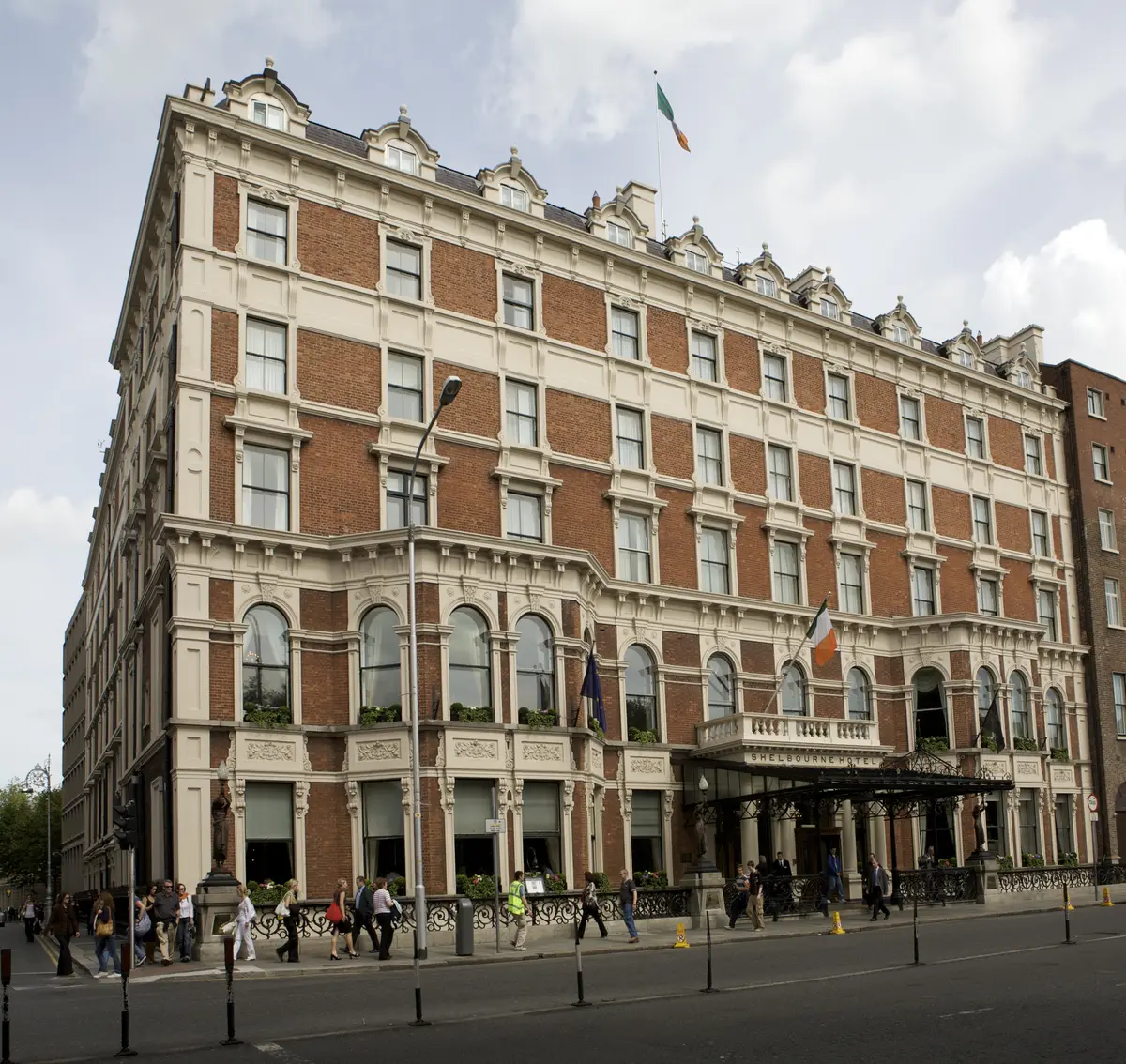
Thackeray's red house was replaced. Between about 1865 and 1867 John McCurdy rebuilt and unified the properties into the ten-bay, five-storey block that stands today: red brick in Flemish bond with rendered dressings, a mansard roof and a Corinthian portico under a wrought-iron canopy. The National Inventory of Architectural Heritage, which registers the building as 50100243, dates the bronze Nubian figures on their granite pedestals to 1866/7 and calls the hotel "one of Dublin's social and architectural landmarks".
Its two political weeks are documented from opposite sides of the barricade. On Easter Monday 1916 the Irish Citizen Army dug into St Stephen's Green and failed to take the tall buildings around it. Margaret Skinnider, who was there and was shot four days later, remembered in Doing My Bit for Ireland (1917) that "the British had taken possession of a hotel at one side of the Green - the Hotel Shelbourne - and had placed a machine-gun on the roof. At four o'clock in the morning they began firing." From the Royal College of Surgeons she asked Commandant Michael Mallin to let her cycle up with a bomb on an eight-second fuse and throw it through a Shelbourne window; Mallin agreed the plan was good but "much too dangerous". Six years later the hotel housed the other half of the story: from January to March 1922 the committee that drafted the Constitution of the Irish Free State met here, chaired in name by Michael Collins - who, the National Archives archivist Antoinette Doran notes, attended only two meetings - and run in practice by Darrell Figgis. The room was 112, now the Constitution Room, and the hotel still keeps the table.
The Horseshoe Bar opened in 1957. Kennedy Wilson bought the hotel in 2014 and says it refurbished the facade, the suites, the corridors and the lobbies from 2016, then the main Georgian staircase in 2017, work that won an Irish Georgian Society Conservation Award. It trades today as The Shelbourne, Autograph Collection, part of Marriott.
Timeline: the documented record of Shelbourne Hotel
- 1824 Martin Burke, from County Tipperary, takes three Georgian houses on the north side of St Stephen's Green and opens a hotel, naming it after William Petty, 2nd Earl of Shelburne. The hotel's own history page describes Shelburne as the site's previous owner.
- March 1832 Asiatic cholera reaches Ireland for the first time, at Belfast, spreading to Dublin and then Cork. Nigel Johnston puts the toll at around 50,000 dead in little over twelve months. Any cholera death on this site before this date is impossible.
- 1843 William Makepeace Thackeray publishes The Irish Sketch Book, describing his 1842 stay: "an extremely big red house", six-and-eightpence a day, "a queer little room and dressing-room on the ground-floor", and a landlord who "does not appear". It is the earliest first-hand account of the hotel and contains nothing supernatural.
- c. 1865-1867 John McCurdy rebuilds and unifies the houses into the present ten-bay, five-storey block in red brick with a Corinthian portico. The National Inventory of Architectural Heritage dates the bronze Nubian figures at the door to 1866/7. The building Thackeray slept in is gone.
- 24-29 April 1916 British troops occupy the hotel and fire a machine gun from the roof onto the Irish Citizen Army in St Stephen's Green. Margaret Skinnider, who was in the park, records the 4 a.m. opening fire and her rejected plan to bomb a Shelbourne window with an eight-second fuse.
- January-March 1922 The committee drafting the Constitution of the Irish Free State meets in room 112, now the Constitution Room. Michael Collins chairs it in name but attends only two meetings, according to the National Archives archivist Antoinette Doran; Darrell Figgis acts as chair in practice.
- 1951 Elizabeth Bowen publishes a book-length history of the hotel. It quotes Thackeray on the absent landlord and it contains no ghost: a full-text search on 13 August 2026 finds "Martin Burke" in four editions of Bowen and "Mary Masters" in none.
- 1965 Hans Holzer, his wife Catherine and the English medium Sybil Leek stay at the hotel. Over three nights Leek reports a crying child in her room; under trance the child is said to give the name Mary Masters, an age of about seven, and cholera as the cause of death.
- 1967 Holzer publishes the sitting in The Lively Ghosts of Ireland (Ace Books). This is the earliest datable printed appearance of the Shelbourne ghost, and every later version descends from it.
- 1977 John J. Dunne retells the story in Haunted Ireland, placing Mary Masters "perhaps back in the years before the Shelbourne was formed from four separate houses bought by Martin Burke in 1824" - four houses, where the hotel and the architectural record say three.
- 2004 Padraic O'Farrell's Irish Ghost Stories gives the girl's death as the cholera epidemic of 1832 - the only date in circulation that is epidemiologically possible.
- 8 August 2013 The actress Lily Collins tells Jimmy Fallon's show that while filming Love, Rosie she heard "a giggle" and three fire doors slamming outside her room. IrishCentral reports that hotel staff afterwards told her about Mary Masters, placing the ghost on the sixth floor - not in any numbered room.
- 2014 Kennedy Wilson buys the hotel. It says it refurbished the facade, suites, corridors and lobbies from 2016 and the main Georgian staircase in 2017, winning an Irish Georgian Society Conservation Award.
- 13 August 2026 All 127 pages in theshelbourne.com's sitemaps are downloaded and searched. "1824" appears on 126 pages and "Constitution" on 17; "Mary Masters", "apparition" and "paranormal" appear zero times, and every instance of "ghost" is the CSS class btn-ghost. The Wayback Machine holds 2,534 URLs from the domain, none containing "ghost" or "haunt".
Is there a rational explanation for Shelbourne Hotel?
Everything specific in the Shelbourne ghost story - the name, the age, the illness, the room - entered print at a single moment, and that moment can be dated.
In 1965 the Austrian-American investigator Hans Holzer came to Dublin with his wife Catherine and the English medium Sybil Leek (widely miscopied since as "Sybil Lee"). Holzer published the result in 1967 in The Lively Ghosts of Ireland: over three nights Leek reported a child crying in her room, and under trance the child was said to give the name Mary Masters, an age of about seven, and cholera as the cause of death. There is no earlier account. Elizabeth Bowen's book-length history of the hotel, published in 1951, is the control: searching the Internet Archive's book corpus on 13 August 2026, the exact phrase "Martin Burke" returns four editions of Bowen, while "Mary Masters" returns 53 books and not one of them is hers. The standard history of the Shelbourne does not know this ghost.
The dates do not survive contact with each other. The version most repeated online kills Mary of cholera in 1791. Asiatic cholera did not reach Ireland until March 1832 - Belfast first, then Dublin, then Cork - forty-one years later, and it killed an estimated 50,000 people in little over a year. Padraic O'Farrell's Irish Ghost Stories (2004) says 1832, which at least is possible; IrishCentral, reporting Lily Collins in 2013, says 1846. The variant that ties the haunting to Great Famine burials fails on simpler arithmetic: the Famine began in 1845, twenty-one years after Burke opened his hotel in the very houses concerned. Dublin's cholera dead are accounted for elsewhere - RTE Brainstorm reported in 2024 that more than 1,600 sets of remains found during the 2015 Luas works at Grangegorman, beside the penitentiary used as the city's cholera hospital, were reinterred at Glasnevin. Nothing puts a burial ground under the north side of St Stephen's Green.
The room number is in worse shape. Holzer's account and almost every retelling put Leek on the fifth floor, in room 526; a minority say 256. When Lily Collins described a giggle and slamming fire doors on Jimmy Fallon's show on 8 August 2013, the staff she spoke to afterwards placed the ghost on the sixth floor. No published source gives room 302 - the number this entry itself carried until August 2026, with nothing behind it. Unexplained.ie states that 526 no longer exists after the hotel's internal refurbishment; that could not be confirmed here, and the hotel does still number rooms in the 500s, since it names Suite 538 after Countess Markievicz.
The hotel's own position is silence, and here silence is evidence. On 13 August 2026 all 127 pages listed in theshelbourne.com's sitemaps were downloaded - about 15 MB of HTML. "1824" appears on 126 of them and "Constitution" on 17; "Mary Masters", "apparition" and "paranormal" appear zero times, and every single occurrence of the string "ghost" is the CSS class btn-ghost. The Wayback Machine holds 2,534 distinct URLs from the domain and not one of them contains "ghost" or "haunt". A business that sells its 1922 committee room, its Thackeray anecdote and its Hollywood guest list is not selling its ghost.
Can you visit Shelbourne Hotel?
The Shelbourne is a working hotel at 27 St Stephen's Green, Dublin 2, D02 K224 (+353 1 663 4500), trading as The Shelbourne, Autograph Collection. The National Inventory of Architectural Heritage records it as reg. no. 50100243, rated of national importance: a corner-sited ten-bay, five-storey hotel built about 1865 to designs by John McCurdy, at the junction of St Stephen's Green North and Kildare Street, overlooking the north-east corner of the green. The facade seen from the park is therefore McCurdy's; the "extremely big red house" Thackeray stopped at in 1842 was the building it replaced.
On 24 September 2026, 133 of the 134 pages listed in the hotel website's sitemaps were downloaded and searched. None of them mentions Mary Masters, an apparition or the paranormal; "ghost" occurs only as the name of a button style in the page code, and "haunt" only in the description of the Horseshoe Bar as "a favoured haunt" of musicians and writers. A search of 127 pages on 13 August 2026 had given the same result.
The same day the site's banner announced guest-room renovations until May 2027, warning that "some noise may occur". The Spa page dates the closure of the Spa to 6 June 2026 and expects it back in May 2027. The Terrace is to stay closed for the season and reopen in 2027, and the Health Club is open on a limited basis to hotel guests only, with its pool, sauna and steam room shut.
Hours and prices below were read on the hotel's pages on 24 September 2026. The Horseshoe Bar, which the hotel says opened in 1957, lists Monday to Friday 16:00-23:30, Saturday 14:00-00:30 and Sunday 14:00-23:00. No. 27 Bar & Lounge opens at 10:30 on weekdays and at 12:00 at weekends. The 1824 Bar, whose pair of murals by Paul Slater includes Countess Markievicz according to the hotel's history page, serves hotel residents only. Afternoon tea in the Lord Mayor's Lounge is served daily at 12:00, 14:30 and 17:00 and must be booked in advance, from 79 euros per person for the classic tea or 102 euros with champagne; the suspension until 20 September that the hotel had announced in August no longer appeared on the lounge's page. The Saddle Room serves its pre-theatre menu daily from 17:30 to 18:30, with the three-course price given as 47 euros on one page of the site and 49 euros on another.
The nearest Luas Green Line stops are St Stephen's Green, about 350 m west at the north-west corner of the park, and Dawson, about 380 m north-north-west, both measured in a straight line on OpenStreetMap. The hotel offers valet parking only, at 50 euros per 24 hours, with cars kept in a nearby public car park. Its accessibility page lists valet parking for vehicles adapted for drivers who use wheelchairs, an accessible route from the public entrance, and accessible guest rooms with 32-inch (81 cm) doorways, grab bars and lowered locks.
Room 112, where the hotel says the 1922 committee drafting the Irish Constitution met, is now the Constitution Room, let for private dining and meetings; the hotel states that the original table and chairs are still in it. St Stephen's Green, the public park across the road, faces the whole front.
Sources consulted
- Hans Holzer, «The Lively Ghosts of Ireland» — Ace Books, New York, 1967 book
- Elizabeth Bowen, «The Shelbourne: A Centre in Dublin Life for More Than a Century» — Alfred A. Knopf, New York (US edition, as The Shelbourne Hotel), 1951 book
- William Makepeace Thackeray, «The Irish Sketch Book» — Smith, Elder & Co. (1887 collected edition consulted), 1843 book
- Margaret Skinnider, «Doing My Bit for Ireland» — The Century Co., New York, 1917 book
- National Inventory of Architectural Heritage, «Shelbourne Hotel, 27-31 Saint Stephen's Green, Dublin 2 (reg. no. 50100243)» — Buildings of Ireland, Department of Housing, Local Government and Heritage, 2016 report
- Antoinette Doran, National Archives of Ireland, «Practicalities of the future: the 1922 Constitution Committee» — RTE Century Ireland / National Archives Commemoration Programme, 2022 report
- The Shelbourne, Autograph Collection, «Our History» — Official hotel website (consulted 13 August 2026), 2026 web
- Padraic O'Farrell, «Irish Ghost Stories» — Gill & Macmillan, Dublin, 2004 book
- John J. Dunne, «Haunted Ireland: Her Romantic and Mysterious Ghosts» — Appletree Press, Belfast, 1977 book
- Nigel Johnston, «Cholera in Ireland, 1832-3 - popular hysteria and mysticism» — History Ireland, vol. 34 no. 2 (March/April 2026), 2026 academic
- RTE Brainstorm, «How Dublin dealt with the 19th century cholera epidemic» — RTE, 2024 web
- IrishCentral staff, «Lily Collins haunted by ghost of girl in Dublin hotel while filming» — IrishCentral, 8 August 2013, 2013 web
- The Shelbourne, Autograph Collection, «Sitemaps, accessibility, dining and renovation notices (127 pages downloaded 13 August 2026)» — Official hotel website, 2026 web
- Internet Archive / Open Library, «Search Inside the book corpus: "Martin Burke" vs "Mary Masters" (searched 13 August 2026)» — Open Library full-text search, 2026 archive
- Kennedy Wilson, «The Shelbourne Hotel (case study)» — Kennedy Wilson Europe, 2026 report
- The Shelbourne, Autograph Collection, «Bar, lounge, restaurant, spa, health club, terrace, accessibility and FAQ pages, and all 134 sitemap URLs (133 downloaded and searched 24 September 2026)» — Official hotel website (consulted 24 September 2026), 2026 web
Reviewed by V. Serrano on 2026-08-13 · How we verify our content
💬 Field testimonies (0)
No testimonies yet. Add the first.
Add your testimony
🔒 Log in to add a testimony