👻 HAUNTED PLACE · EXP. Nº9046
ACTIVE
Loftus Hall
Loftus Hall stands alone at the tip of the windswept Hook peninsula in County Wexford, and the first surprise is its age: Ireland's National Inventory of Architectural Heritage dates the present nine-bay Classical mansion to 1870-71, built for the fourth Marquess of Ely on the footings of a much older house.
Where is Loftus Hall?
- Location
- County Wexford, Ireland
- Type
- House / mansion
- Coordinates
- 52.149, -6.911
- Last updated
LOCATION
Why is Loftus Hall said to be haunted?
The legend attached to it is older than the walls. A stranger takes shelter one stormy night, joins the family at cards, and young Anne Tottenham stoops under the table and sees a cloven hoof. What the earliest datable printing of the tale actually says, in an American newspaper of 1882, is stranger and sadder: that the devil story was invented by the family to explain away a daughter who fell in love with a passing horseman, lost her reason and was shut up in the tapestry room until she died. The same inventory that dates the house files the legend among its apocryphal ones. The Hall was a hotel, a convent, a ruin and, from 2012, one of Ireland's most heavily marketed haunted attractions. It closed to visitors in 2020 and has since been sold.
What is the history of Loftus Hall?
The house that stands at the tip of the Hook peninsula today is younger than the ghost story attached to it, and that single fact rearranges everything else.
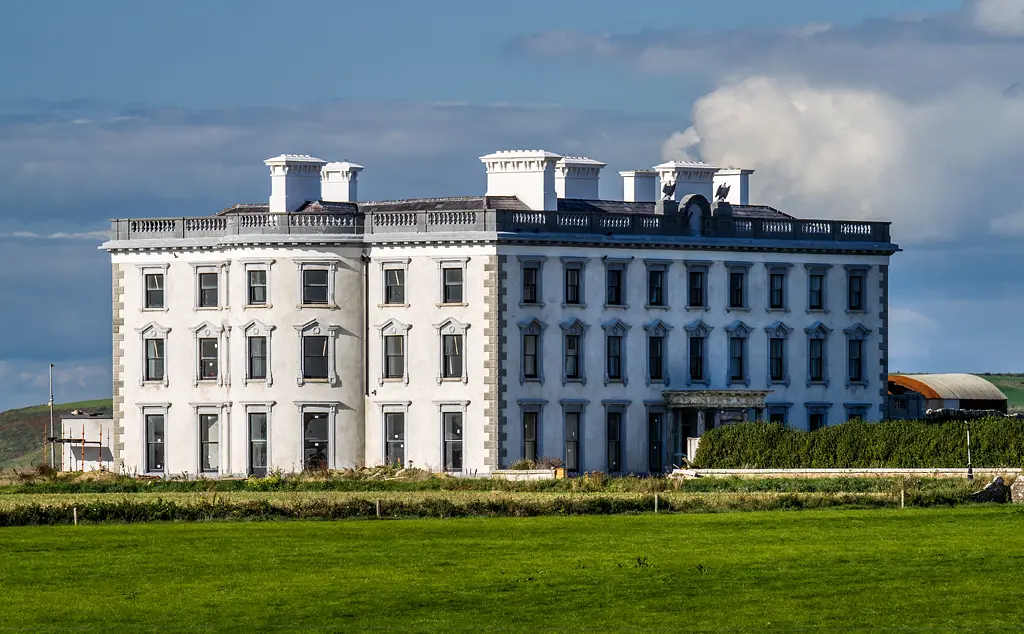
Ireland's National Inventory of Architectural Heritage records Loftus Hall (Reg. 15705401) as a detached nine-bay three-storey country house built 1870-1 for John Henry Wellington Graham Loftus (1849-89), fourth Marquess of Ely. It is not a Gothic pile: the inventory describes a Classical composition with vermiculated quoins, a dentilated cornice under a balustraded parapet, hood mouldings and open bed pediments over the windows, and reception rooms defined by bows modelled on Osborne House. Inside there were encaustic tiles, marble chimneypieces, an imperial staircase under a stained-glass lantern, and plasterwork by James Hogan and Sons of Great Brunswick Street, Dublin, recorded in The Irish Builder of 15 May 1874 and the Freeman's Journal of 6 November 1875. One nineteenth-century judgement quoted by the inventory is that the stucco was "designed to resemble a grand hotel".
The 1870s house replaced an earlier one on the same ground. The inventory says the composition retains "at least the footings" of a house of 1680-4, illustrated in volume IV of Philip Herbert Hore's History of the Town and County of Wexford (1901). The traditional foundation date of 1350 by the Redmond family — the figure the twenty-first-century tourist operation built its "665 years" and "666th anniversary" branding on — belongs to family tradition rather than to the surviving fabric.
The fourth Marquess died in 1889, aged forty; the inventory notes the estate's later connection with John Henry Loftus (1851-1925), fifth Marquess of Ely. Its occupancy notes then read like a summary of the twentieth century: occupied in 1901 and 1911; in alternative use 1916-35 and 1937-83; in alternative use again 1983-91 with hotel among its historic uses; for sale in 1991; vacant in 2007; for sale in 2008. The Hall's own history page, archived by the Internet Archive, filled in the names: bought in 1917 by the Sisters of Providence as a convent and a school, bought in 1983 by Michael Devereux, who ran it as the Loftus Hall Hotel until the early 1990s.
The last chapter is documented to the day. Ireland's Residential Property Price Register records the sale of "Loftus Hall, Fethard on Sea" on 29 July 2011 for €300,000. The buyers were the Quigley family of Carrig-on-Bannow; Aidan Quigley appears in the Hall's press releases as proprietor. They repaired the roof and the fallen staircase lantern, cleared the five acres of walled gardens from 2015-16, and from 2012 sold guided tours of the ground floor, garden entry, adult-only "lockdowns" and Samhain events. Ghost Adventures filmed there; the gothic feature The Lodgers was shot on location in 2016 and reached Irish cinemas in March 2018.
Timeline: the documented record of Loftus Hall
- 1680-84 The house whose footings the present building still retains is put up, and is later illustrated in volume IV of Philip Herbert Hore's History of the Town and County of Wexford (1901). The 1350 foundation attributed to the Redmond family belongs to tradition, not to surviving fabric.
- 1790 The earliest incident in the surviving narrative: the anonymous narrator's father, a guest of Mrs Tottenham, is given the tapestry chamber, feels something heavy land growling on the bed and the covers pulled off, fires a pistol up the chimney and finds the door still locked. He tells it as an annoyance, not an apparition.
- Before December 1861 According to the 1882 preamble, the conversation at Windsor Castle turns to ghosts shortly before Prince Albert's death and the Marchioness of Ely tells the Queen the Loftus Hall story. Victoria replies that she does not believe in such things, and asks that it not be repeated in front of the Prince.
- 1867 The Rev. Charles Dale, English tutor to the young Marquess of Ely, describes in a letter what happened to him in the tapestry room: something jumped on the bed growling and the bedclothes were pulled off. He adds that he did not see any lady and heard nothing but the growling.
- Autumn 1868 The narrator returns and finds the tapestry chamber gone as such: the closet removed, the room enlarged, two windows added, the old tapestry stripped and a billiard table standing where Anne's bed had been. Two years later the whole house is demolished and rebuilt.
- 1870-71 The present Loftus Hall is built for John Henry Wellington Graham Loftus, fourth Marquess of Ely: nine bays, three storeys, a Classical front with a balustraded parapet and interiors by James Hogan and Sons of Dublin. The house shown to visitors as the scene of the legend post-dates the legend by a century.
- 22 October 1882 The earliest datable printing of the full narrative appears in the New-York Tribune as "A Story Told the Queen", reprinted by the Sacramento Daily Record-Union on 4 November and the Memphis Daily Appeal on 12 November. It presents the cloven-hoof scene as a legend invented to cover up a young woman's breakdown and confinement.
- 1914 St John D. Seymour and Harry L. Neligan reprint the same text in True Irish Ghost Stories, still without naming its author. Seymour's own foreword warns that he cannot guarantee the genuineness of a single incident in the book.
- 29 July 2011 The Residential Property Price Register records the sale of "Loftus Hall, Fethard on Sea" for €300,000. The buyers, the Quigley family, repair the roof and the fallen staircase lantern and open guided tours in 2012; by 2016 the operation is marketing a "666th anniversary" counted from the traditional date of 1350.
- 30 August 2020 Last day of the last season open to the public, a six-week window announced on the Hall's own site under pandemic restrictions. By December 2020 the home page reads "Closed For Public Access"; in October 2021 it runs a final clearance sale of memorabilia, and from 15 December 2021 the site is offline for good.
Is there a rational explanation for Loftus Hall?
The oldest full telling of the Loftus Hall legend that can be dated is not a defence of the devil story. It is a debunking of it.
That telling ran in the New-York Tribune on 22 October 1882 and was reprinted within weeks by the Sacramento Daily Record-Union (4 November) and the Memphis Daily Appeal (12 November) under the headline "A Story Told the Queen". Its unnamed author is described as a rector and rural dean in the late Established Church of Ireland and a Justice of the Peace for two counties. He tells of Anne, daughter of Charles Tottenham by his first wife the Hon. Anne Loftus, left at the Hall with a cold father and a stepmother; of a young gentleman who arrives on a stormy night, is loved, and rides away; and of the girl's reason giving way, so that she was confined in the tapestry chamber and died there. Only then does he write the sentence that modern retellings drop: "A wild legend was invented to account for [the] calamity." In his version the family preferred to be thought haunted by the Devil so that "the story of her wrongs should sink into oblivion, and be classed as an old wife's tale of horns and hoofs".
Even the card game is different. It is whist, four-handed; Anne drops a ring, not a card; and the stranger "vanished in a thunderclap, leaving a brimstone smell behind him". There is no ball of fire, no hole punched through the roof and no scorch mark anywhere in the 1882 text, or in the version St John D. Seymour and Harry L. Neligan reprinted in True Irish Ghost Stories in 1914. The burnt roof is a later addition. The Hall's owner, Aidan Quigley, told the press that the stranger crashed through the roof "and the very same roof has been irreparable ever since" — a claim that sits badly beside two facts from his own side: the house was built in 1870-1, and his own conservation page describes repairing that roof and the collapsed staircase lantern.
The date does not survive either. The 1882 account says only "about the middle of the eighteenth century". The National Inventory files the story as one of two "apocryphal legends" attached to the house, dating it 1765 (the other being the belief that the mansion was built for a royal visit that never happened). English Wikipedia has said 1775 since 2008. A Wikipedia version live in 2014-15 said instead that the Tottenhams "came to mind the mansion in 1766" — and that vanished sentence is where this site's own 1766 came from. Three incompatible years, none of them from a document.
The man at the table changes too. The Hall's press releases named him "Charles Tottenham Loftus, the then owner". Burke's Peerage and Baronetage (1846) shows that the Charles Tottenham who took the name Loftus was born 23 January 1738, inherited only in 1783, married Jane Myhill in 1766 and had two sons and no daughters. Burke does confirm the marriage the 1882 narrator relies on — the Hon. Anne Loftus married a Charles Tottenham, and her sister Elizabeth married Sir John Tottenham — so the family frame is real. Anne the daughter is another matter: in the Internet Archive's full-text book corpus the phrase "Anne Tottenham" returns 29 hits, and every pre-1970 one is Seymour's book or an unrelated 1814 volume, against 351 hits for "Loftus Hall" in the same corpus. No burial, no will, no memorial.
And the earliest witness was not neutral. The 1882 preamble states his purpose: the testimonies prove "that impalpable spirits not only appear, but can exert very great force" — an argument written in the heyday of table-turning. The Marchioness of Ely did tell the tale to Queen Victoria at Windsor, according to that same preamble; the Queen "replied that she [did] not believe in such things". Seymour, who preserved the text, was blunter still about his own book: "For myself I cannot guarantee the genuineness of a single incident."
Can you visit Loftus Hall?
Loftus Hall has not opened to the public since the summer of 2020. The last season announced on the attraction's own website, loftushall.ie, reopened the house "from July 18th to August 30th" that year, closed on Mondays and Fridays, with every house tour booked online in advance for contact tracing and "No Cafe or gift shop on site this season". In the Wayback Machine capture of 18 December 2020 the home page read "Closed For Public Access" and sold a 360-degree online house tour for €9.99. The same notice was still there in the captures of April and October 2021, and the October one also advertised a "Final Week Clearance Sale" of Loftus Hall memorabilia at "€5 or Less". From 15 December 2021 the archive records the address answering with an authentication error (HTTP 401), and it was still doing so at the end of 2022.
In 2026 the loftushall.ie domain carries "Haunted Halls Ireland", a content site of Irish ghost stories that presents itself as a guide for "like minded ghost story fans". Its Loftus Hall page, read on 24 September 2026, says the house has "been shuttered for years", that it was "sold to new owners in recent years" and that the plans for it remain "partially under wraps". The other domain, loftushall.com, returned HTTP 410 to the Wayback Machine in November 2024, and on 24 September 2026 its server did not respond. Mike Searle, who photographed the house for Geograph on 12 September 2023 with a telephoto lens from the adjacent grid square, wrote in his caption: "The house has since been sold, and is no longer open to the public."
The house stands in the townland of Loftushall on the Hook peninsula, near Fethard-on-Sea in County Wexford, off the R734, the regional road that runs through Fethard to Hook Head lighthouse. The National Inventory of Architectural Heritage records it as Reg. No. 15705401, a "detached nine-bay three-storey country house, built 1870-1", rated Regional, with the farmyard complex as 15705402 and the walled garden as 15705403. The coordinates on the record, 274615, 100138, are in the Irish Grid. The estate is in private hands, and Searle's picture was taken from outside it.
Sources consulted
- National Inventory of Architectural Heritage, «Loftus Hall, Loftushall, County Wexford — Reg. No. 15705401 (with the farmyard complex 15705402 and walled garden 15705403)» — Department of Housing, Local Government and Heritage, Ireland, 2007 report
- Anonymous, described as a rector and rural dean of the late Established Church of Ireland and a J.P. for two counties, «A Story Told the Queen (Sacramento Daily Record-Union, 4 November 1882, p. 3; first traced in the New-York Tribune, 22 October 1882, and reprinted in the Memphis Daily Appeal, 12 November 1882)» — Sacramento Daily Record-Union (Chronicling America, Library of Congress), 1882 newspaper archive
- St John D. Seymour and Harry L. Neligan, «True Irish Ghost Stories, chapter IX "Ancestral Ghosts", pp. 234-248 (Loftus Hall); foreword at pp. ix-xiii» — Hodges, Figgis & Co., Dublin; Humphrey Milford / Oxford University Press, London, 1914 book
- John Burke and Bernard Burke, «A Genealogical and Heraldic Dictionary of the Peerage and Baronetage of the British Empire, entry "Ely, Marquess and Earl of", pp. 370-371» — Henry Colburn, London, 1846 book
- Loftus Hall (Quigley family), captured by the Internet Archive, «loftushall.ie, the visitor attraction's own website: history, conservation and opening pages plus home-page captures from 2014 to the site going offline in December 2021» — Wayback Machine, Internet Archive, 2021 archive
- Property Services Regulatory Authority, «Residential Property Price Register, sale of "Loftus Hall, Fethard on Sea", County Wexford, 29 July 2011, €300,000» — propertypriceregister.ie (full PPR-ALL dataset), 2011 report
- Mike Searle, «Loftus Hall, Loftushall, Co. Wexford (1), photograph S7400, taken 12 September 2023, with the photographer's note that the house has been sold and is no longer open to the public» — Geograph Britain and Ireland (CC BY-SA 2.0), 2023 web
- Wikipedia contributors, «Loftus Hall, English Wikipedia, revision of 21 February 2014 (oldid 596489480), the version that dated the Tottenhams' arrival to 1766 — the source of the date this entry previously carried» — Wikipedia, 2014 web
Reviewed by V. Serrano on 2026-08-12 · How we verify our content
💬 Field testimonies (0)
No testimonies yet. Add the first.
Add your testimony
🔒 Log in to add a testimony