👻 HAUNTED PLACE · EXP. Nº9474
ACTIVE
Kilmainham Gaol
Kilmainham Gaol in Dublin opened in 1796 and held political prisoners from the start: after Robert Emmet's rising of 1803 the servant Anne Devlin was imprisoned and tortured there, and in 1923 its 'A' compound, built for about a hundred, held between 185 and nearly 300 women.
Where is Kilmainham Gaol?
- Location
- Dublin, Ireland
- Type
- Prison
- Coordinates
- 53.342, -6.309
- Last updated
LOCATION
Why is Kilmainham Gaol said to be haunted?
Between 3 and 12 May 1916 fourteen leaders of the Easter Rising, among them Patrick Pearse and James Connolly, were shot in its Stonebreakers' Yard, and Joseph Plunkett married Grace Gifford in the prison chapel hours before his execution. The gaol closed in 1924 and stood derelict until volunteers began restoring it, unpaid, in 1960; the museum opened in April 1966 and passed to the Office of Public Works in 1986. Its ghost stories, such as the chapel lights said to have switched themselves back on during the restoration, are in print in ghost books such as Richard Jones's Haunted Britain and Ireland (2001). The one first-hand account of something unexplained is Grace Plunkett's own, and she called it telepathy.
What is the history of Kilmainham Gaol?
Kilmainham Gaol was built to hold the enemies of the state. Fourteen days in May 1916 turned it into the reason that state lost Ireland.
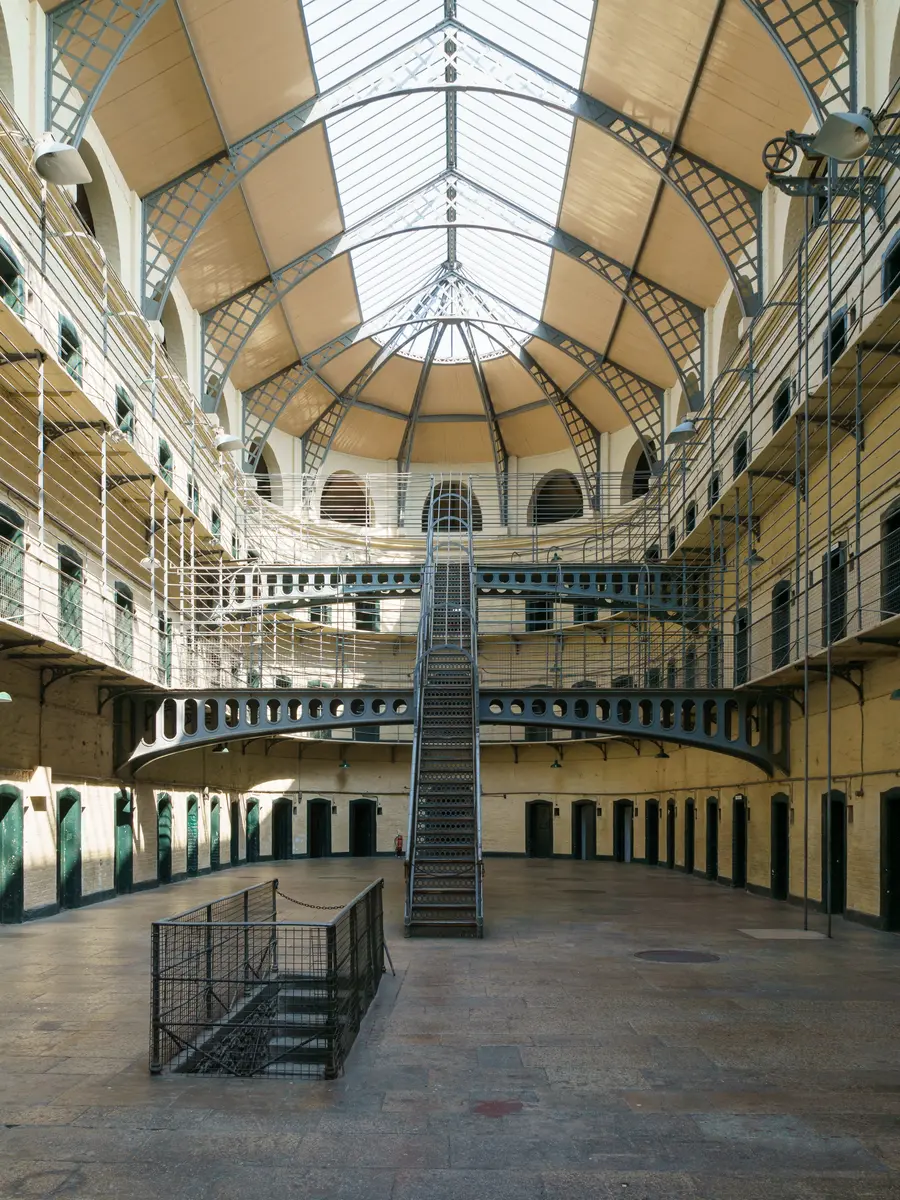
The Grand Jury of County Dublin decided in 1786 to replace the old prison near Mount Brown, and the architect John Trail (c. 1725-1801) set the new building on Gallows Hill, chosen for its drainage and its air. It cost £22,000 and opened in 1796 as the New Gaol. In 1857 John McCurdy won an open competition to rebuild the collapsing east wing; it opened in 1861 as a panopticon in stone and iron, ninety-six cells all visible from a single platform, and that vaulted hall is the photograph everyone knows. Political prisoners passed through from the start: after Robert Emmet's rising of 1803 the servant Anne Devlin was held there and tortured for information she never gave, and Alfred Webb's 1878 Compendium of Irish Biography says she "suffered more than two years' imprisonment". But it is 1916 that fixed the building's meaning.
After the Easter Rising surrender, prisoners were tried by Field General Court Martial at Richmond Barracks, behind closed doors and without defence counsel, then moved to Kilmainham to be shot. Between 3 and 12 May 1916, fourteen men were executed by firing squad in the Stonebreakers' Yard, a yard named for the hard labour once done in it. On 3 May: Patrick Pearse, Thomas Clarke, Thomas MacDonagh. On 4 May: Joseph Plunkett, Edward Daly, Michael O'Hanrahan and Willie Pearse. On 5 May: John MacBride. On 8 May: Éamonn Ceannt, Michael Mallin, Con Colbert and Seán Heuston. On 12 May: Seán Mac Diarmada and James Connolly. Seven had signed the Proclamation.
Company Sergeant Major Samuel Henry Lomas commanded a firing party on 3 May and kept a diary, published a century later by Mick O'Farrell. MacDonagh, he wrote, "was marched in blindfolded... Death was instantaneous"; Pearse "whistled as he came out of the cell"; Clarke, "an old man, was not quite so fortunate, requiring a bullet from the officer to complete the ghastly business".
On the night of 3 May, in the prison chapel, Joseph Plunkett married Grace Gifford hours before his execution. Her own account, given to the Bureau of Military History in 1949, has none of the romance later attached to it. She bought the ring from a man named Stoker who lived opposite the Gaiety. "I was brought in and was put in front of the altar; and he was brought down the steps; and the cuffs were taken off him; and the chaplain went on with the ceremony; then the cuffs were put on him again." She was never left alone with him: "not for a minute. I had no private conversation with him at all." Returning that night to say goodbye, "a man stood there, with his watch in his hand, and said: 'Ten minutes'."
James Connolly had been shot through the ankle at the GPO and was held in Dublin Castle. On 12 May he was brought to Kilmainham by ambulance and carried into the yard because he could not stand. The manner of it reached Westminster: on 30 May 1916 Laurence Ginnell asked the Commons whether Connolly had been carried on a stretcher, propped in a chair and executed in that condition, and what precedent existed for executing a dying man. Harold Tennant, Under-Secretary for War, refused the ground: doctors had certified him "in a fit state to undergo his trial", he "was wounded just above the instep", and there was "no reason why in the interests of humanity the execution should have been delayed".
By then the political damage was done. On 11 May, with Connolly and Mac Diarmada still alive, John Dillon told the Commons: "You are letting loose a river of blood, and, make no mistake about it, between two races who, after three hundred years of hatred and of strife, we had nearly succeeded in bringing together." The executions stopped the next day.
Seven years later the gaol filled again, and mostly with women. Sinéad McCoole's survey of prison records and autograph books identified 554 women imprisoned in 1923. Kilmainham's 'A' compound was meant for about a hundred; official records list 185 there on 8 March 1923, while Annie MacSwiney counted nearly 300 in February, aged from fourteen to close on seventy. Grace Gifford Plunkett, the bride of 1916, was one of them. In late April 1923 some 270 women resisted removal to the North Dublin Union by linking arms in rows of four.
The last republican prisoners left in 1924 and the building simply stopped. Rory O'Dwyer's account of the "wilderness years" records no maintenance whatsoever, a structure judged dangerous by the early 1950s, and rumours that the Board of Works was inviting tenders for its demolition. A Dublin engineer, Lorcan Leonard, assembled a committee; the government approved its plan on 26 February 1960 and handed over the keys instead of a budget. Up to 200 tradesmen worked unpaid in the evenings and at weekends, funded by donations from visitors queuing in the rain, clearing trees twenty and thirty feet high out of the yards. The museum opened in the east wing in April 1966, inaugurated by President Éamon de Valera, who had been under sentence of death in the same building in 1916 and was among the last prisoners to leave it. The society handed the gaol to the Office of Public Works in 1986.
Timeline: the documented record of Kilmainham Gaol
- 1796 The New Gaol opens on Gallows Hill after a decade of building, designed by John Trail for the Grand Jury of County Dublin at a cost of £22,000.
- 1803 Anne Devlin is imprisoned after Robert Emmet's rising and tortured for information she refuses to give. Alfred Webb's 1878 Compendium records that she "suffered more than two years' imprisonment".
- 1861 The rebuilt east wing opens to John McCurdy's competition-winning design: ninety-six cells all visible from a single central platform, the panoptic hall that became the building's emblem.
- 3 May 1916 First three executions in the Stonebreakers' Yard: Patrick Pearse, Thomas Clarke and Thomas MacDonagh. Company Sergeant Major Samuel Lomas, commanding a firing party, wrote in his diary that Pearse "whistled as he came out of the cell".
- Night of 3-4 May 1916 Joseph Plunkett marries Grace Gifford in the prison chapel hours before his execution. In her 1949 witness statement she recalled that his handcuffs were removed for the ceremony and put back on immediately after, and that she was never alone with him “not for a minute”.
- 11 May 1916 John Dillon tells the House of Commons: “You are letting loose a river of blood… between two races who, after three hundred years of hatred and of strife, we had nearly succeeded in bringing together.” The executions stopped the next day.
- 12 May 1916 Seán Mac Diarmada and James Connolly are the last to be shot. Connolly, wounded in the ankle, is brought from Dublin Castle by ambulance and carried into the yard. On 30 May the Commons asked whether he had been propped in a chair and shot in that condition; the Under-Secretary for War replied only that doctors had certified him fit to stand trial.
- 8 March 1923 During the Civil War, official records list 185 women held in Kilmainham's 'A' compound, built for about a hundred; Annie MacSwiney had counted nearly 300 in February, aged from fourteen to close on seventy. Grace Gifford Plunkett, the bride of 1916, was among them.
- 1924 The last republican prisoners leave and the gaol ceases to function. Éamon de Valera, under sentence of death in the same building in 1916, is among the last out. No maintenance follows; by the early 1950s the structure is judged dangerous.
- 26 February 1960 With demolition rumoured, the government approves the plan of a committee assembled by the Dublin engineer Lorcan Leonard and hands over the keys rather than a budget. Up to 200 tradesmen work unpaid in the evenings and at weekends.
- April 1966 The museum opens in the restored east wing, fifty years after the Rising, inaugurated by President Éamon de Valera. The volunteer society handed the gaol to the Office of Public Works in 1986.
Is there a rational explanation for Kilmainham Gaol?
The Office of Public Works runs Kilmainham as a museum. Its visitor page, read on 4 October 2026, states that "Access is by guided tour only", sells daytime public tours and lists no evening or paranormal event. The volunteers who restored the gaol did use the word: the bibliography of Jacqueline Van Voris's 1967 life of Constance Markievicz lists a booklet called Ghosts of Kilmainham, published by the Kilmainham Jail Restoration Society in 1963.
The one first-hand account of something unexplained connected with the building is in a primary source, and its author gave it her own name. In her 1949 statement to the Bureau of Military History, Grace Plunkett described "a peculiar faculty" that let her feel when someone was thinking of her: "It is a sort of telepathy." The morning after the papers reported the first executions she woke "as if I were being pulled out of bed by an unseen force", went to the priest and told him Joe was going to be executed. She was describing her own premonition thirty-three years after the event, and she called it telepathy.
The stories that circulate are of a different kind. One has a caretaker during the 1960s restoration, named in later retellings as Dan McGill, coming back to find that the chapel lights he had only just switched off had been switched on again; it is in print in Richard Jones's Haunted Britain and Ireland (2001), some forty years after the restoration began. The other has a volunteer painting alone in the old dungeon who was thrown across the room and held back by invisible hands on the stairs.
The building supplies its own effects. McCurdy's east wing is ninety-six cells of bare stone and iron under a glass roof, a single open hall around which footsteps and voices carry. The museum's visitor page warns that "During the winter months the Gaol building is very cold so please dress appropriately". In the Stonebreakers' Yard two crosses mark the place of the executions: according to the National Inventory of Architectural Heritage, one where thirteen of the leaders stood and one where James Connolly was shot.
The best-known fact about that yard exists in two versions. The National Inventory's description of the memorial says that Connolly, "carried into the yard on a stretcher, was tied to a chair and executed", and on 30 May 1916 Laurence Ginnell asked the Commons whether he had been "propped up in a chair there, and shot in that condition". Hubert "Ned" O'Keeffe, clerk of St James's parish, wrote down what the prison chaplain, Father Eugene McCarthy, told him: Connolly "elected to stand like the rest, but failed. he was then tied to a chair but slumped so much that he overbalanced. Finally, he was strapped on a stretcher and placed in reclining position against the wall." The most witnessed death in the building's history reached writing in two forms, one of them from the priest who anointed the body.
Can you visit Kilmainham Gaol?
Kilmainham Gaol Museum, on Inchicore Road in Kilmainham, Dublin 8, is run by the Office of Public Works. The site lies 3.4 km west of the General Post Office on O'Connell Street in a straight line. Entry is by guided tour, and the museum requires tickets to be pre-booked online.
Tickets are released 28 days ahead at midnight Irish time. Cancellations and any additional places appear on the site from 09:15 on the morning of the visit itself. Tickets are non-transferable and non-refundable, though a booking made for the wrong day or time can be refunded if the museum is emailed within an hour of it being made. Groups of ten or more must book in advance through [email protected].
Prices read from the museum's own visitor page on 22 September 2026: adult €8, senior €6, student €4, and family €20 for two adults with two or three children under 18. Children under 12 enter free and still need a ticket.
The Courthouse visitor centre opens from 09:30 to 17:15 and the museum from 10:30 to 17:15; on 23 December they close at 16:15 and 16:45, and the site closes altogether from 24 to 27 December inclusive. The guided tour of the building takes one hour, and the museum asks visitors to allow roughly 90 minutes for the whole visit. Tours are given in English and in Irish, with information leaflets in Spanish, Italian, German and French.
Dublin Bus route 60 runs from Wellington Quay and from Heuston Station; routes G1 and G2 run from Spencer Dock and Wellington Quay. The nearest Luas stop is Suir Road, on the red line. The gaol has no car parking of its own; the Irish Museum of Modern Art car park is five minutes' walk away, and limited coach parking is available on Inchicore Road. Buggies, wheelie bags and large items of luggage are not permitted on the tour, and the museum does not recommend the visit for children under six.
The tour ends in the Stonebreakers' Yard, where fourteen of the leaders of the 1916 Rising were shot between 3 and 12 May 1916. Patrick Pearse was the first of them and James Connolly the last. The prison chapel on the same route is where Joseph Plunkett married Grace Gifford on the night of 3 May 1916, hours before he was executed; her account of that night is Witness Statement 257 in the Bureau of Military History, and it can be read in full online.
Sources consulted
- Grace Plunkett, «Witness Statement 257: Mrs Grace Plunkett, née Gifford, widow of Joseph Plunkett» — Bureau of Military History 1913-21, Military Archives of Ireland, 1949 archive
- House of Commons, «Continuance of Martial Law (Ireland), House of Commons debate, 11 May 1916» — Hansard, UK Parliament (Historic Hansard), 1916 archive
- House of Commons, «Execution of James Connolly, House of Commons questions, 30 May 1916» — Hansard, UK Parliament (Historic Hansard), 1916 archive
- Rory O'Dwyer, «'The wilderness years': Kilmainham Gaol, 1924-1960» — History Ireland, vol. 18 no. 6, 2010 academic
- Sinéad McCoole, «'Suspect' women: why were more than 500 females imprisoned during the Civil War?» — The Irish Times, 2023 newspaper archive
- Mick O'Farrell, «'Pearse whistled as he came out of his cell': diary of a 1916 executioner» — The Irish Times, 2 August 2014, 2014 newspaper archive
- Kilmainham Gaol Museum (Office of Public Works), «The Building» — Institutional site history, 2026 archive
- National Inventory of Architectural Heritage, «Kilmainham Gaol, Inchicore Road, Dublin 8 — Building of the Month» — Buildings of Ireland, Department of Housing, Local Government and Heritage, 2016 report
- Alfred Webb, «A Compendium of Irish Biography: Anne Devlin» — M. H. Gill & Son, Dublin, 1878 book
- Century Ireland, «14 men executed in Kilmainham Gaol» — RTÉ / Boston College Century Ireland project, 2016 newspaper archive
- Kilmainham Gaol Museum (Office of Public Works), «Restoration» — Institutional site history, 2026 archive
- Kilmainham Gaol Museum (Office of Public Works), «Plan a Visit» — Official visitor information, 2026 web
- St James's Parish, James's Street, Dublin, «1916 and the Parish of St James (Hubert 'Ned' O'Keeffe's account of Father Eugene McCarthy at the executions)» — Parish website web
- Richard Jones, «Haunted Britain and Ireland (Kilmainham Gaol entry: the chapel lights switched back on during the restoration)» — London: New Holland, pp. 124-125, 2001 book
- Jacqueline Van Voris, «Constance de Markievicz: In the Cause of Ireland (bibliography lists 'Ghosts of Kilmainham', Kilmainham Jail Restoration Society, 1963)» — Book; the entry appears in its bibliography, p. 359, 1967 book
Reviewed by V. Serrano on 2026-07-29 · How we verify our content
💬 Field testimonies (0)
No testimonies yet. Add the first.
Add your testimony
🔒 Log in to add a testimony