📜 LEGEND · EXP. Nº0270
ACTIVE
The Dullahan
The Dullahan is Ireland's headless horseman, and he is far easier to date than to trace.
Where does the legend of The Dullahan come from?
- Location
- Ireland
- Kind of legend
- Ghost story
- Coordinates
- 53.413, -8.244
- Last updated
LOCATION
What is the legend of The Dullahan?
Everything usually said about him — the head the colour of mouldy cheese, the whip made from a human spine, the black steed, the gates that fly open, the fear of gold, the descent from a beheading god called Crom Dubh — appears together in a single modern book, Bob Curran's A Field Guide to Irish Fairies of 1997. Go back to the text that first put the word in print, Thomas Crofton Croker's Fairy Legends and Traditions of the South of Ireland (1828), and the picture changes completely. Croker's headless huntsman rides a white horse, carries no whip at all, and is a dead neighbour looking for company on the road home. The basin of blood belongs to a coach at Doneraile; the whip that puts out the eyes of anyone who stares belongs to that coach's driver, in an account sent to Croker by a lady near Cork. What Irish itself remembers is not the rider but the vehicle: the cóiste bodhar, the headless coach, which has a dictionary entry and dozens of accounts in the national folklore archive.
What is the history of The Dullahan?
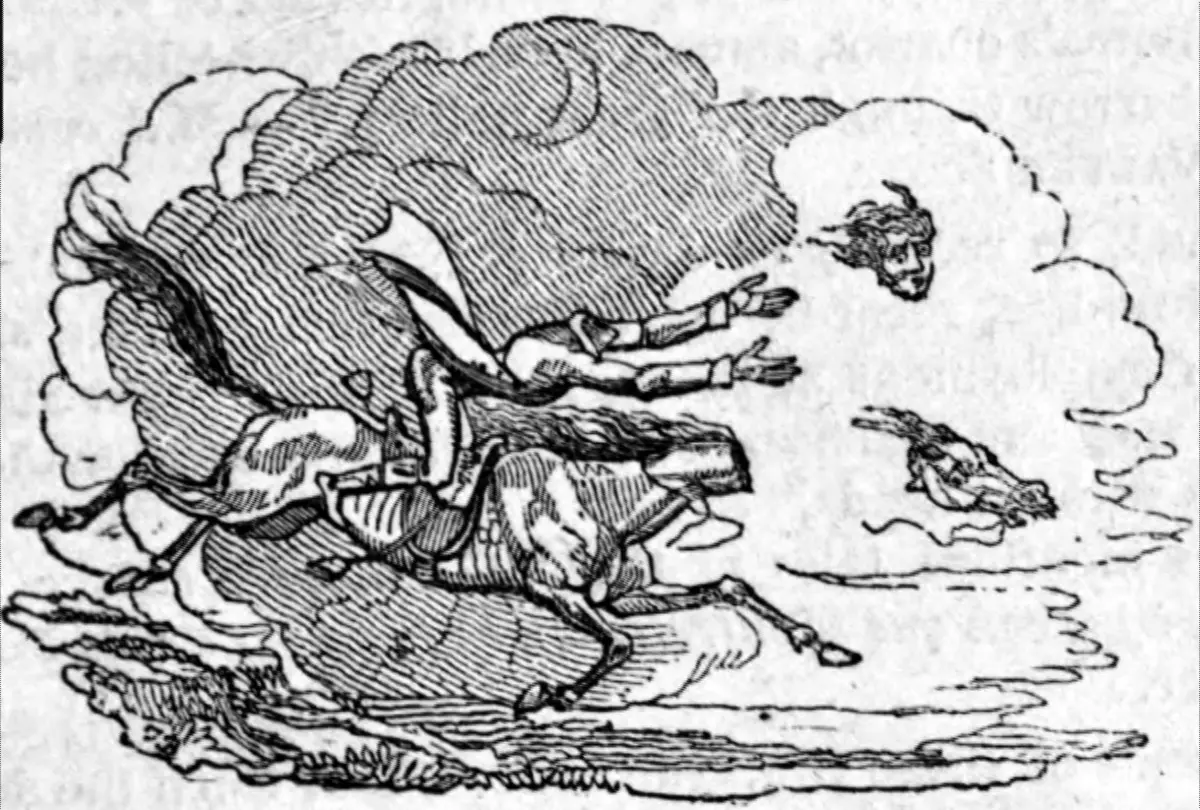
The best-known modern portrait of the Dullahan, which we come to below, makes him "one of the most spectacular creatures in the Irish fairy realm" and the embodiment of an ancient Celtic god. He is easier than that to date, because the traits repeated about him today have a printed trail, which the paragraphs below follow from Thomas Crofton Croker in the 1820s, through W. B. Yeats in 1888, to that portrait of 1997; and one of Croker's books is hanging on this very page: the engraving above is the tailpiece to "The Headless Horseman" in the 1834 edition of his Fairy Legends and Traditions of the South of Ireland, at p. 239.
Croker devoted a whole section to "The Dullahan" in Part II of the Fairy Legends (London: John Murray, 1828), pp. 85–152: five pieces — "The Good Woman", "Hanlon's Mill", "The Harvest Dinner", the comic ballad "The Death Coach" and "The Headless Horseman" — with notes. On the name he printed a communication from Edward O'Reilly, "author of the best Irish Dictionary extant": "Dulachan (in Irish Dubhlachan) signifies a dark, sullen person. The word Durrachan, or Dullahan, by which in some places the goblin is known, has the same signification." Croker then contradicted his own authority in the next line: "The correctness of this last etymology may be questioned, as Dubh, black, is evidently a component part of the word." He also noted, drily, that headless people are found everywhere, "although here alone they seem to have a peculiar name".
Read them and the modern portrait falls apart, because it is assembled out of them wrongly. Croker's headless horseman is a dead huntsman who broke his neck at Kilcummer hill and now wants a riding companion; he is jovial, he loses a wager, and he is mounted "on the body and legs of a white horse full eighteen hands and a half high". His head, carried under the right arm and finally pocketed in his scarlet hunting-coat, "looked like a large cream cheese hung round with black puddings; no speck of colour enlivened the ashy paleness of the depressed features"; "two fiery eyes of prodigious circumference, with a strange and irregular motion, flashed like meteors", and "a mouth reached from either extremity of two ears". And he carries no whip at all: Croker says explicitly that he rode "unaided by whip or spur, and disdaining the use of stirrups".
The basin of blood and the whipped-out eyes are in Croker, and in his notes both belong to the coach and its driver. In a note to "Hanlon's Mill" (1828, II: 109) he reports a black coach drawn by headless horses running nightly from Castle Hyde to Glanafauna, and driving every Saturday night through Doneraile: "should any one be so fool-hardy as to open the door, a basin of blood is instantly flung in their face." In the note to "The Death Coach" (II: 136–137) he prints "the following account of the Dullahans and their coach", communicated "by a lady resident in the neighbourhood of Cork": "The coachman has a most marvellously long whip, with which he can whip the eyes out of any one, at any distance, that dares to look at him." The spine appears a few pages earlier, in the joke ballad, as a piece of the vehicle: "Their spokes are of dead men's thigh bones, / And the pole is the spine of the back!" Croker himself, who was collecting comparatively for the Grimms, printed the Danish parallel beside it: Thiele's oppressive lords of Glorup, whose coach blinds anyone who fails to hide his face.
The 1834 revised one-volume edition (Murray, Albemarle Street) tightened the section and lost the Doneraile note altogether, and it is that edition, at p. 239, that carries the vignette after Daniel Maclise and William Henry Brooke reproduced here. In 1888 W. B. Yeats reprinted the material in Fairy and Folk Tales of the Irish Peasantry and made the decisive move in a single editorial sentence, filed under the Banshee: "an immense black coach, mounted by a coffin, and drawn by headless horses driven by a Dullahan. It will go rumbling to your door, and if you open it, according to Croker, a basin of blood will be thrown in your face." From Yeats onward the Dullahan is the coachman, so the coachman's properties become his. Yeats's guess at an origin was offered as a guess: "In Norway the heads of corpses were cut off to make their ghosts feeble. Thus came into existence the Dullahans, perhaps."
The word itself has an odd record in Irish lexicography. O'Reilly's own dictionary, in the enlarged edition of 1864 with John O'Donovan's supplement, runs dubhlaod, dubhladh, dubhlaighim, dubhlaidh, dubhlaitheach, dubhlan — and has no dubhlachán at all. Dinneen's Foclóir Gaedhilge agus Béarla (Irish Texts Society, 1904) has none either; what it does have, under cóiste, is "c. bodhar, the 'headless coach,' a spectral vision". The vehicle is lexicalised in Irish. The rider is not.
The portrait everyone repeats today was fixed in 1997, by Bob Curran and Andrew Whitson's A Field Guide to Irish Fairies (Belfast: Appletree Press), whose text the publisher's own website, Ireland's Eye, put online: "The head is the colour and texture of stale dough or mouldy cheese"; "He uses a human spine as a whip"; "an artefact made of gold may frighten him away, for dullahans appear to have an irrational fear of this precious metal"; and "he is thought to be the embodiment of an ancient Celtic god, Crom Dubh, or Black Crom", worshipped by "the prehistoric king, Tighermas, who ruled in Ireland about fifteen hundred years ago", a god who "demanded human lives each year, the most favoured method of sacrifice being decapitation". The mouldy-cheese head, the spine whip, the fear of gold and the Crom Dubh origin all appear together in that text.
Timeline: the documented record of The Dullahan
- 1820 John Murray publishes the London edition of Washington Irving's Sketch Book, containing "The Legend of Sleepy Hollow". The claim that Irving's headless rider descends from the Dullahan is repeated constantly, but Irving's horseman reaches print eight years before the word Dullahan appears in Croker's section — and from the same publisher.
- 1828 Croker's Part II (London: John Murray) prints the section "The Dullahan", pp. 85–152. It contains everything genuinely old in this entry: Edward O'Reilly's note on the name, the Doneraile basin of blood at p. 109, the Cork lady's account of a coachman with "a most marvellously long whip" at pp. 136–137, and Charley Culnane's white-horsed, whipless headless huntsman.
- 1834 The condensed and revised one-volume edition (London: Murray, Albemarle Street) cuts "The Harvest Dinner" and the Doneraile note, and adds the engraving after Daniel Maclise and William Henry Brooke at p. 239 — the last page of "The Headless Horseman". O'Reilly, who had been "Mr. O'Reilly" in 1828, is now "the late Mr. Edward O'Reilly".
- 1864 The enlarged edition of O'Reilly's own Irish-English Dictionary appears with John O'Donovan's supplement. Walking its alphabetical run — dubhlaod, dubhladh, dubhlaighim, dubhlaidh, dubhlaitheach, dubhlan — there is no entry for dubhlachán. The etymology Croker printed never reached the lexicographer's printed pages.
- 1888 W. B. Yeats's anthology appears in London (Walter Scott). Its editorial note under the Banshee turns the Dullahan into the driver of the coach-a-bower and repeats the basin of blood "according to Croker", then offers a Norwegian origin with the word "perhaps". The transfer of the coachman's properties to a solitary rider starts here.
- 1904 Patrick S. Dinneen's Foclóir Gaedhilge agus Béarla (Irish Texts Society) glosses cóiste bodhar under cóiste as "the 'headless coach,' a spectral vision". It has no headword for dubhlachán. In Irish, the vehicle is a dictionary word and the rider is not.
- 1937–1938 The Schools' Collection gathers folklore from Irish schoolchildren. A search of its stories on dúchas.ie on 10 October 2026 returns 224 for "banshee" and none for "dullahan" (the word appears only in two transcripts), while the coach is everywhere: Michael Cotter of Mainistir Phádraig Naofa, Co. Galway, takes down from Mrs Geary that the cóiste bodhar "was a carriage driven by a headless man who was dressed in black", and at Cloonadrum, Co. Clare, Brian Ó hUiginn records from Mrs B. Thynne, aged 85, that in about 1889 it was heard at Ennistymon House and "next morning Sir Burton Mc Namara died in London".
- 1997 Bob Curran and Andrew Whitson publish A Field Guide to Irish Fairies (Belfast: Appletree Press). Its Dullahan chapter, put online by the publisher's own site Ireland's Eye, supplies the mouldy cheese, the spine whip, the black steed, the gates that fly open, the fear of gold and the Crom Dubh origin.
Is there a rational explanation for The Dullahan?
The Crom Dubh clause is the part of the modern portrait that can be checked against primary texts. The king it names, Tighearnmas, is a figure of the pseudo-history: the Annals of the Kingdom of Ireland by the Four Masters, in John O'Donovan's edition (Dublin: Hodges & Smith, 1848–51), record under the Age of the World 3656 that he died "at the meeting of Magh Slecht, in Breifne, at the worshipping of Crom Cruach, which was the chief idol of adoration in Ireland", and that "this happened on the night of Samhain precisely". The idol in the annals is Crom Cruach. The Metrical Dindshenchas, in Edward Gwynn's edition of the poem on Mag Slecht, describes what was offered to it: "For him ingloriously they slew their hapless firstborn with much wailing and peril, to pour their blood round Cromm Cruaich", and "Milk and corn they asked of him speedily in return for a third part of all their progeny". The poem speaks of firstborn children and of blood poured round the idol; neither it nor the annal entry mentions a head or a beheading.
The gold has a source that can be pointed at. The same annal entry, M3656.2, opens with Tighearnmas's achievements before it records his death: "It was by Tighearnmas also that gold was first smelted in Ireland, in Foithre Airthir Liffe. It was Uchadan, an artificer of the Feara Cualann, that smelted it." The Mag Slecht poem adds that "the figure of the Cromm was formed of gold". The 1997 text names the same king in the same paragraph in which it advises keeping a gold object to hand, and it calls the dullahan's fear of the metal "irrational".
The dates in that paragraph do not match the annals either. It places Tighermas "about fifteen hundred years ago". The Four Masters put his death in the Age of the World 3656, and their reckoning reaches the first year of the Age of Christ only after the Age of the World 5194, more than fifteen centuries later.
Under the borrowed inventory there is an Irish death omen with a dictionary entry of its own: the cóiste bodhar, which Patrick Dinneen glossed in 1904 as "the 'headless coach,' a spectral vision".
Can you visit The Dullahan?
The map pin, at 53.4129, −8.2439, stands for Ireland as a whole, which is what the entry's region field says. A reverse look-up in OpenStreetMap on 23 September 2026 places it in the townland of Curry, in the Ahascragh electoral division of County Galway. The places the sources name lie in other counties.
Croker's tales are set in County Cork. Charley Culnane sets off homewards from the little sheebeen at Ballyhooly, along the Blackwater, after a day in Fermoy; Ballyhooly is at 52.1441, −8.3979 in OpenStreetMap. The Saturday-night coach drives through Doneraile (52.2171, −8.5848), and the ballad names Rathcooney, Glanmire, Tivoli, Ballintemple, Blackrock and the Old Head of Kinsale, all within reach of Cork city. The 1997 field guide by Bob Curran and Andrew Whitson, in the version its publisher put online, moves the creature to "the more remote parts of counties Sligo and Down" and quotes a storyteller, W. J. Fitzpatrick, "from the Mourne Mountains in County Down", who saw it "on the brow of the hill between Bryansford and Moneyscalp"; the text gives no date for his account and no archive reference. Bryansford and Moneyscalp are 2.5 km apart, near Castlewellan.
The Schools' Collection places the coach in Clare and Galway. A story written down at the school of Cluain an Droma (Cloonadrum) from Mrs B. Thynne of Liscannor, aged 85, says the Cóiste Bodhar was heard about 1889 at Ennistymon House, "the home of Doolin McNamara's": an old servant opened the avenue gate just as it swept past, and next morning Sir Burton McNamara died in London (CBÉS vol. 0624, p. 314). Ennistymon House is now the Falls Hotel in Ennistymon, and its website was taking bookings on 23 September 2026. A second testimony comes from a school in County Galway (CBÉS vol. 0084, p. 165).
The texts can be read online. Croker's Part II of 1828 and the revised volume of 1834 are on the Internet Archive, and the Schools' Collection pages are transcribed on dúchas.ie, the site of the National Folklore Collection at University College Dublin, under a Creative Commons BY-NC 4.0 licence.
Sources consulted
- Washington Irving, «The Sketch-Book of Geoffrey Crayon, Gent., containing "The Legend of Sleepy Hollow" (issued in numbers 1819–1820; London edition by John Murray, 1820)» — New York and London, 1820 book
- Thomas Crofton Croker, «Fairy Legends and Traditions of the South of Ireland, Part II — section "The Dullahan", pp. 85–152» — London: John Murray, 1828 book
- Thomas Crofton Croker, «Fairy Legends and Traditions of the South of Ireland (condensed and revised one-volume edition; "The Headless Horseman" ends at p. 239, with the Maclise/Brooke vignette)» — London: Murray, Albemarle Street, 1834 book
- Edward O'Reilly, supplement by John O'Donovan, «An Irish-English Dictionary, with a supplement containing many thousand Irish words (s.vv. dubhlaod–dubhlan)» — Dublin, 1864 book
- W. B. Yeats (ed.), «Fairy and Folk Tales of the Irish Peasantry — editorial note to "The Banshee"» — London: Walter Scott, 1888 book
- Patrick S. Dinneen, «Foclóir Gaedhilge agus Béarla: An Irish-English Dictionary (s.v. cóiste: "c. bodhar, the 'headless coach,' a spectral vision")» — Dublin: Irish Texts Society / M. H. Gill & Son, 1904 book
- National Folklore Collection, University College Dublin, «Bailiúchán na Scol / The Schools' Collection: "An Cóiste Bodhar", CBÉS vol. 0624 p. 314 (Cloonadrum, Co. Clare) and "The Cóiste Bodhar", CBÉS vol. 0084 p. 165 (Co. Galway)» — dúchas.ie, 1938 archive
- Bob Curran, «The Dullahan (Ireland's Eye, the publisher's own online adaptation of A Field Guide to Irish Fairies by Bob Curran and Andrew Whitson, Belfast: Appletree Press, 1997)» — irelandseye.com, 1997 web
- John O'Donovan (ed. and trans.), «Annála Ríoghachta Éireann / Annals of the Kingdom of Ireland by the Four Masters, vol. 1 — entries M3656.1–2 (Tighearnmas at Magh Slecht; the first smelting of gold in Ireland)» — Dublin: Hodges & Smith; electronic edition CELT, University College Cork, 1848 book
- Edward Gwynn (ed. and trans.), «The Metrical Dindshenchas — the poem "Mag Slecht" on Cromm Cruaich» — Todd Lecture Series, Royal Irish Academy; electronic edition CELT, University College Cork, 1924 book
Reviewed by V. Serrano on 2026-08-17 · How we verify our content
📎 Source: Enigma Atlas
💬 Field testimonies (0)
No testimonies yet. Add the first.
Add your testimony
🔒 Log in to add a testimony