👻 HAUNTED PLACE · EXP. Nº9475
ACTIVE
Charleville Castle
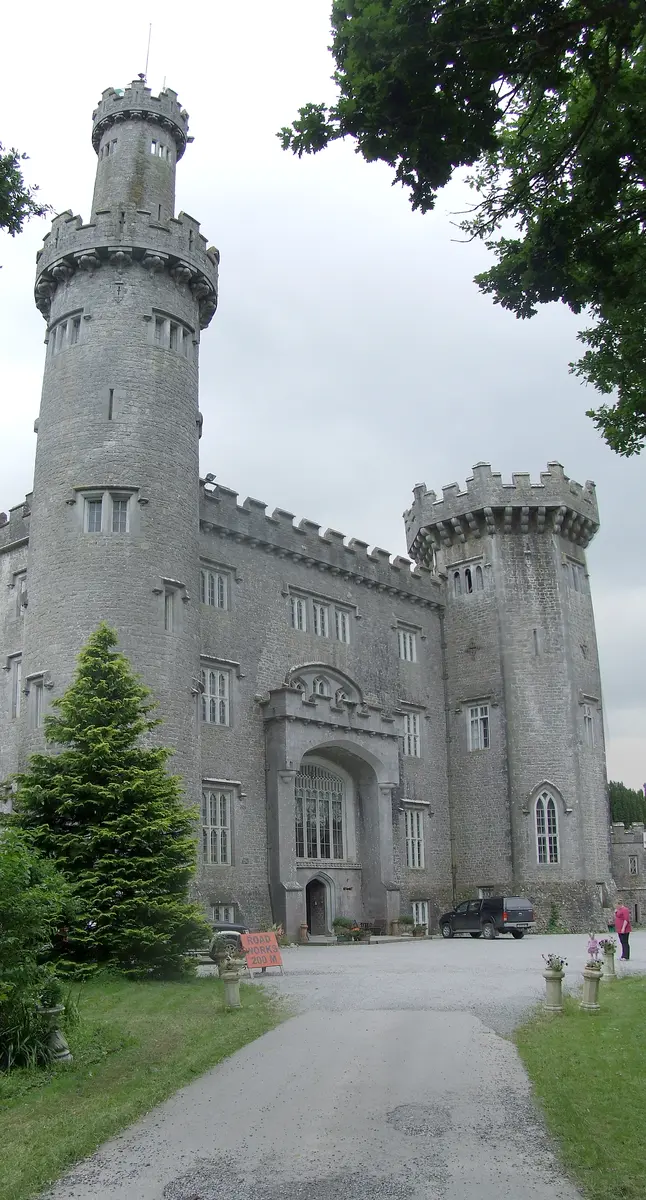
Charleville Castle, a Gothic house built for the 1st Earl of Charleville to designs by Francis Johnston and finished around 1812, stands in an oak demesne bordering Tullamore in County Offaly.
Where is Charleville Castle?
- Location
- County Offaly, Ireland
- Type
- Castle
- Coordinates
- 53.26, -7.528
- Last updated
LOCATION
Why is Charleville Castle said to be haunted?
Its ghost has something most ghosts lack: a catalogue number. Lady Harriet Hugh Adelaide Bury, born 1854, second daughter of the 3rd Earl and already an orphan, died at the castle in April 1861 after trying to slide down a banister that a newspaper of the day called "highly polished and as slippery as glass". Her family's cuttings survive in Offaly County Library, and the travel writer Thomas Lacy, who had seen her alive in 1855, printed her death in 1863 — with no suggestion whatsoever that she had stayed. Nor is there one in Samuel Lewis in 1837, or in the folklore the schoolchildren of Tullamore collected in 1937-39, who wrote down the great oak by the gate and nothing else. The haunting is datable from 2001, when American television arrived.
What is the history of Charleville Castle?
The house that everyone calls Charleville Castle was never christened one. Its builder named it Charleville Forest, and Offaly History reads that choice as deference to the oaks: the demesne already had a giant tree "dominating like a watch tower the carriage drive to the town" before there was any castle to look at.
The estate was called Redwood until the 1740s. A first mansion went up in 1641; Charles Moore, Lord Tullamore, bought house and demesne in 1740 and renamed the place Charleville. It passed to his great-nephew Charles William Bury (1764-1835), who inherited at six months old and spent the rest of his life accumulating titles: Baron Tullamore in 1797, Viscount Charleville in 1800, Earl of Charleville in 1806, Fellow of the Royal Society in 1803, President of the Royal Irish Academy from 1812 to 1822.
He commissioned Francis Johnston, the architect of the GPO in Dublin, and the works ran roughly from 1800 to 1812 — sources disagree on whether the design was ordered in 1798 or the first stone laid in 1801. What the building looked like when new is not a matter of reconstruction: Samuel Lewis walked it and printed the description in 1837, in the entry for Tullamore of his Topographical Dictionary of Ireland. "The mansion is a spacious structure, erected in the style of an English baronial castle, from designs by Mr. Francis Johnston; the demesne contains about 1500 statute acres richly wooded, and comprises two artificial lakes, the larger of which is studded with islands." Lewis also recorded what the money had done to the town: Tullamore had been "an insignificant village, consisting almost wholly of thatched cabins" until a fire — started, he says, by the mismanagement of a fire balloon — let the Earl rebuild it.
Then the family fell apart, and quickly. The 2nd Earl gambled the estate into embarrassment and left in haste in 1844 to avoid his creditors; he died in 1851. His son Charles William George, the 3rd Earl, came back to Charleville that same year with a young wife, Arabella Case, and expectations the town shared. Arabella died of scarlatina in 1857, aged 35. The Earl died in 1859, aged 37. Their five children — Lord Tullamore, Lady Katherine, Lady Harriet, Lady Emily and the Honourable John William Bury — were made wards of Chancery and left at the castle in the care of their uncle, the Hon. Alfred Bury.
In April 1861 the second daughter died on the stairs. Lady Harriet Hugh Adelaide Bury, born 1854, had been to the nursery to wash her hands; on the way back she tried to slide down the banister, "which was highly polished and as slippery as glass", lost her balance and fell. The newspaper cuttings her family kept are catalogued today in Offaly County Library as item 37 of the Charleville Forest Papers, and describe her as "a fine, promising child", aged seven.
The deaths did not stop. The 4th Earl died in New York in 1874, aged 22. Uncle Alfred, who had raised the orphans, became the 5th Earl and died childless in 1875. Lady Emily Alfreda (1856-1931), the youngest of the sisters, inherited; she married Captain Kenneth Howard in 1881 — he took the name Howard-Bury — and was widowed in 1885. Their son Charles Kenneth Howard-Bury was educated privately at Charleville and went on to lead the 1921 Mount Everest reconnaissance expedition. (Offaly Archives dates him 1883-1963 and says he was born in London; the standard biographical references give 15 August 1881 and Charleville Castle. I have not been able to settle it.) In 1912 he inherited Belvedere House at Mullingar from a cousin, and from that date, in the archive's flat phrase, "Charleville Castle ceased to be used by the family". He inherited the Charleville estate itself in 1931 when his mother died, auctioned most of the castle's furniture and paintings in 1948, and died in 1963, leaving Charleville to his cousin Major William Bacon Hutton-Bury and Belvedere to Rex Beaumont.
In 1970 David Hutton-Bury leased the castle to Michael McMullen for thirty-five years, ending nearly six decades of disuse; six main rooms were restored in the early 1980s. In 1987 Bridget Vance and her mother Constance Vance-Heavey took over the leasehold, and the building is run today by the volunteer Charleville Castle Heritage Trust.
Timeline: the documented record of Charleville Castle
- 1740 Charles Moore, Lord Tullamore, buys the Redwood house and demesne, built in 1641, and renames the property Charleville.
- 1798-1812 Charles William Bury builds the present house to designs by Francis Johnston, and calls it Charleville Forest rather than Charleville Castle. He is made Baron Tullamore in 1797, Viscount Charleville in 1800 and Earl of Charleville in 1806.
- 1837 Samuel Lewis describes the house in his Topographical Dictionary of Ireland as "erected in the style of an English baronial castle, from designs by Mr. Francis Johnston", on a demesne of about 1,500 acres with two artificial lakes. No ghost and no sacred grove appear in the entry.
- 1855 The Wexford-born travel writer Thomas Lacy visits Charleville and sees Lady Harriet, then about two years old, being pulled along the gravel walk in a light vehicle by two nursery maids.
- 1857-1859 Arabella, 3rd Countess of Charleville, dies of scarlatina in 1857 aged 35; her husband the 3rd Earl dies in 1859 aged 37. Their five children become wards of Chancery under their uncle, the Hon. Alfred Bury, at the castle.
- April 1861 Lady Harriet Hugh Adelaide Bury, born 1854 and second daughter of the 3rd Earl, dies at the castle. Returning from the nursery after washing her hands she tries to slide down the banister, "which was highly polished and as slippery as glass", and falls. The newspaper cuttings are held by Offaly County Library, which gives her age as seven.
- 1863 Lacy prints the death on page 162 of Sights and Scenes in Our Fatherland: she "lost her life by a melancholy accident, she having fallen over the handrail of the staircase of the castle, upon which she was sliding, in the month of April, 1861". The book records druids, ghosts and superstitions elsewhere; at Charleville it records none.
- 1890 John Wright's King's County Directory describes the tree by the gate as "the King of the Forest", a gigantic oak with a spread of 130 feet, and notes that the great storm of 1839 blew down 5,000 oaks in the forest. No druidic association is mentioned.
- 1912-1948 Charles Kenneth Howard-Bury inherits Belvedere House at Mullingar and, in the words of the Offaly Archives authority record, "from this time, Charleville Castle ceased to be used by the family". He inherits the Charleville estate itself in 1931 on the death of his mother, Lady Emily Alfreda, and in 1948 auctions most of the castle's furniture and paintings.
- 1937-1939 Pupils of the Mercy convent school in Tullamore compile a local dossier for the Schools' Collection. Volume 0807, page 7 records that the demesne and forest "contain 1500 acres" and that "the biggest oak tree in the United Kingdom is there near Entrance gate". Nothing is said of a ghost.
- 1963 Lightning splits the King Oak's trunk from top to bottom and the tree survives. Colonel Charles Howard-Bury, head of the family, dies at Mullingar in 1963 — 20 September, by the standard biographical dating — which locals read as confirmation of the Bury omen that a falling branch foretells a family death.
- 1970-1987 David Hutton-Bury leases the castle to Michael McMullen for thirty-five years, ending fifty-eight years of abandonment; six main rooms are restored in the early 1980s. In 1987 Bridget Vance and Constance Vance-Heavey take over the leasehold.
- 1996 Thomas Pakenham includes the King Oak in Meetings with Remarkable Trees, estimating its age at anywhere from 400 to 900 years and calling it a candidate for the oldest living plant in Ireland. He describes a tree, not a ritual site.
- 13 April 2001 The earliest fixed appearance of the Charleville ghost story that I could date is a broadcast: "Charleville: Haunted Irish Castle Dare", series 2 episode 7 of The Scariest Places on Earth, on Fox Family, hosted by Linda Blair.
- September 2002 Most Haunted films at Charleville Forest Castle for series 1, episode 15. It is one of only four Irish locations the programme visited, alongside Leap Castle, Kinnitty Castle and Castle Leslie.
- 23 July 2008 Ghost Hunters International devotes "Castle of the Damned", season 1 episode 10, to Charleville Castle and Samlesbury Hall in England.
- 6 November 2017 The Charleville Castle Heritage Trust publishes its own account under the title "Hauntings…", naming Harriet, listing singing, laughing and screams, a little girl in a blue and white dress with blue ribbons, and the three television programmes — and closing with "here is another good reason to come and visit us!" Ghost-hunt operators now reproduce the paragraph almost word for word.
- Summer 2026 The Trust's home page announces that public tours are paused and the castle closed "until further notice while a number of projects and essential works take place". The notice is absent from the Internet Archive's capture of 7 June 2026 and present on 17 August 2026.
Is there a rational explanation for Charleville Castle?
This is an unusual case in one respect: the ghost has a birth certificate. Harriet Bury existed, the fall happened, and the paperwork survives in a county archive. What has no documentary trace at all is the haunting.
The control is Thomas Lacy. He toured Charleville in 1855, saw Harriet herself being pulled along the gravel walk by two nursery maids, and when he published Sights and Scenes in Our Fatherland in 1863 he went back into his manuscript to add her death: "It was with feelings of deep regret I saw the death of Lady Harriet announced through the public journals, who lost her life by a melancholy accident, she having fallen over the handrail of the staircase of the castle, upon which she was sliding, in the month of April, 1861." Two years after the event, by a writer who was plainly moved by it, and not one word about a haunting. And Lacy was no sceptic about such things: across the book's 372,419 words he writes about ghosts four times, haunts three times, superstition four times and druids eight times — druids' chairs at Killiney, a supposed altar of human sacrifice, druidical circles near Kenmare. He had the vocabulary. He simply had nothing to attach it to here.
Samuel Lewis is the same story in 1837: 47 mentions of druids across the volume, a detailed paragraph on Charleville Forest, no ghost and no sacred grove. And in 1937-39 the schoolchildren of the Mercy convent in Tullamore compiled a local dossier for the National Folklore Collection with chapters titled "Ancient Castles", "Historical Tradition" and "Old Houses". Searching the Schools' Collection for "Charleville Forest" returns no stories at all and exactly one transcript — volume 0807, page 7 — which says the demesne "and forest contain 1500 acres" and that "the biggest oak tree in the United Kingdom is there near Entrance gate". They singled out the tree and said nothing about a dead child on the stairs. The same archive holds 1,907 ghost stories, 224 banshee stories and 10 mentions of Leap Castle, the other haunted castle in Offaly, so the silence is not the search engine's.
What can be dated is the telling. The earliest fixed appearance of the ghost that I could pin down is broadcast, not printed: "Charleville: Haunted Irish Castle Dare", The Scariest Places on Earth, Fox Family, 13 April 2001; then Most Haunted, series 1 episode 15, September 2002; then Ghost Hunters International, "Castle of the Damned", 23 July 2008. The Trust's own version went online as a blog post titled "Hauntings…" on 6 November 2017, and it ends with the quiet part out loud: "here is another good reason to come and visit us!" That paragraph is now copied nearly verbatim on the sales pages of the companies that sell overnight ghost hunts here.
And the copy is wrong where the archive is right. The Trust calls Harriet the "youngest daughter of the third Earl" — she was not. The same archive dates Harriet 1854-1861 and her sister Lady Emily Alfreda 1856-1931, and describes Emily in so many words as the youngest daughter of the 3rd Earl; Emily outlived them all and inherited the estate. The Trust also gives Harriet's age as 8; the archive that actually holds the newspaper cuttings says seven, and Lacy, who saw her in 1855, puts her "then in her third year". Meanwhile the Trust's own history page mentions no ghost at all, and the homepage sells the building to search engines as "Haunted Castle Ireland". Both voices belong to the same volunteers.
The grove of druids deserves its own line. The King Oak is real, measured and old — Thomas Pakenham put its age at anywhere from 400 to 900 years in Meetings with Remarkable Trees (1996), and John Wright's King's County Directory had already called it "the King of the Forest" in 1890, with a spread of 130 feet. None of those descriptions mentions druids. The pre-Christian ritual attached to it circulates only on ghost-tourism sites, without a text, a passage or a century to point at. Even the family's own omen — that a falling branch means a Bury will die — has an arithmetic problem: Offaly History dates the lightning strike that split the trunk to "late 1963" and has Colonel Howard-Bury dropping dead "a few weeks later", but the standard biographical dating puts his death on 20 September 1963. For the sign to precede the death, the storm has to be moved back into the summer.
As for the stairs themselves, no physics is missing. Charleville's principal staircase is cantilevered stone, and a seven-year-old going over a waxed handrail falls a long way onto a hard floor. That is what killed her, and it is grim enough without help.
Can you visit Charleville Castle?
The front page of the Charleville Castle Heritage Trust still carried a notice headed "Public Tours Temporarily Paused" when it was read on 22 September 2026: the castle "will now be closed for public tours until further notice while a number of projects and essential works take place". The Trust adds that updates "will be shared here and through our social media channels as soon as further information becomes available". The Internet Archive's capture of 7 June 2026 does not contain the notice, and no reopening date is given.
Even before the pause the Trust's wording was cautious: "We make every attempt to keep the castle open to the public. However, as the Castle is voluntarily run, sometimes we cannot offer regularly scheduled times." The building has no statutory opening days under Section 482; it has opened for Heritage Week and for concerts, festivals and private hires. The Trust publishes no ticket prices online. Its contact page carries two email addresses, [email protected] and [email protected], and gives the postal address as Charleville Castle, Tullamore, Co. Offaly, Eircode R35 RP77.
The demesne lies about a mile south of Tullamore on the Birr road. Some 1,142 acres of oak, ash, elm and conifer — down from the 1,500 acres Lewis recorded in 1837 — are walked daily by people from the town. The King Oak stands near the entrance drive by the 1860 gate lodge. Charleville's oak woods are among the most extensive in County Offaly and carry conservation designations. The demesne also holds Camden Tower, recorded in the National Inventory of Architectural Heritage as number 14917011: a triangular-plan tower folly of four storeys, raised around 1820. It is roofless and derelict. The inventory notes that "the exact date of construction of this folly, known as 'Camden Tower', is unknown" and that "a tower is shown on the 1786 maps which set out design proposals for the demesne". An 1840s stone underpass built for the 3rd Earl is number 14917014.
Overnight paranormal investigations at the castle are sold by third-party operators, whose calendars are not synchronised with the Trust's own notices.
Sources consulted
- Offaly County Library, «Newspaper cuttings relating to the death of Lady Harriet Bury, a minor (IE OCL P43/37, Charleville Forest Papers)» — Offaly Archives, 1861 archive
- Thomas Lacy, «Sights and Scenes in Our Fatherland (p. 162)» — Simpkin, Marshall and Co., London, 1863 book
- Samuel Lewis, «A Topographical Dictionary of Ireland, vol. II, entry "Tullamore"» — S. Lewis and Co., London, 1837 book
- National Folklore Collection, UCD, «The Schools' Collection, Volume 0807, Page 007 — Tulach Mór (Clochar na Trócaire)» — dúchas.ie, 1938 archive
- National Folklore Collection, UCD, «Search results for "Charleville Forest" in the Schools' Collection (0 stories, 1 transcript; controls: ghost 1,907, banshee 224, Leap Castle 10)» — dúchas.ie, 2026 archive
- Charleville Castle Heritage Trust, «Charleville Castle Heritage Trust — History» — charlevillecastle.ie, 2023 web
- Offaly History, «The 'King Oak' of Charleville Demesne, Tullamore (blog no. 772)» — offalyhistoryblog.com, 2025 web
- Charleville Castle Heritage Trust, «Hauntings… (Trust blog post)» — charlevillecastle.ie, 2017 web
- Eleanor Ridley, «The ghost of Charleville Castle, Tullamore (blog no. 105)» — Offaly History Blog, 2018 web
- TheTVDB, «The Scariest Places on Earth, series 2 episode 7: "Charleville: Haunted Irish Castle Dare" (Fox Family, 13 April 2001)» — thetvdb.com, 2001 web
- Higgypop, «Most Haunted Episodes Filmed In Ireland» — higgypop.com, 2018 web
- Rotten Tomatoes, «Ghost Hunters International, season 1 episode 10: "Castle of the Damned" (23 July 2008)» — rottentomatoes.com, 2008 web
- Charleville Castle Heritage Trust, «Charleville Castle Heritage Trust — home page, "Public Tours Temporarily Paused"» — charlevillecastle.ie, 2026 web
- Irish Historic Houses, «Charleville Forest Castle, Tullamore, County Offaly» — irishhistorichouses.com, 2024 web
- National Inventory of Architectural Heritage, «National Inventory of Architectural Heritage, reg. 14917011 (Camden Tower) and 14917014 (demesne underpass), Charleville Demesne, Tullamore» — buildingsofireland.ie, 2004 report
- Offaly County Library, «Authority record: Bury, Charles Kenneth Howard- (1883-1963), and related entities Lady Emily Alfreda Howard-Bury (1856-1931) and Capt. Kenneth Howard-Bury (1846-1885)» — Offaly Archives, 2024 archive
Reviewed by V. Serrano on 2026-08-17 · How we verify our content
💬 Field testimonies (0)
No testimonies yet. Add the first.
Add your testimony
🔒 Log in to add a testimony