👻 HAUNTED PLACE · EXP. Nº9475
ACTIVE
St. Kevin's Church, Camden Row, Dublin
St. Kevin's Church, Camden Row, Dublin is a location reputed to be haunted in Dublin, IE. Its reputation comes from reported apparitions, unexplained phenomena and eyewitness accounts gathered over time.
Where is St. Kevin's Church, Camden Row, Dublin?
- Location
- Dublin, IE
- Type
- Church / religious site
- Coordinates
- 53.336, -6.267
- Testimonies
- 0
- Last updated
LOCATION
Why is St. Kevin's Church, Camden Row, Dublin said to be haunted?
The ruin in St Kevin's Park, off Camden Row in Dublin 8, is what is left of a Church of Ireland parish church built around 1750 on the foundations of a medieval one, first mentioned in the annals in 1226. It is the burial place of Dermot O'Hurley, Archbishop of Cashel, hanged outside Dublin in June 1584 after being tortured in Dublin Castle; a Dublin citizen named William Fitzsimons recovered the body and buried it here that evening, and the grave drew pilgrims for centuries. The apparition attached to the site was printed by Oliver J. Burke in 1879, in an appendix footnote, as a legend: the archbishop reading the canon of the Mass over a phantom altar on dark and tempestuous nights, everything vanishing at the raising of the Host. The church held its last service on 28 April 1912. Dublin City Council took the site over in 1962, catalogued the headstones, reset most of them along the walls and opened the park in 1971. Entry is free.
What is the history of St. Kevin's Church, Camden Row, Dublin?
St Kevin's Park holds the shell of a parish church, and the National Inventory of Architectural Heritage describes what is standing as a "Freestanding T-plan ruined Church of Ireland church, built c. 1750, comprising nave and north transept" (reg. no. 50110036, surveyed 27 April 2017). The same record carries the site much further back: it "was listed as the property of Holy Trinity Priory in about 1179". Dublin City Council's Culture Date with Dublin 8 project puts the first mention in the annals at 1226 and gives a parish reaching "from the mouth of the Dodder to Milltown". The church stood outside the city walls in the Irish-speaking quarter, and from the thirteenth century it belonged to the Manor of St Sepulchre, under the Archbishop of Dublin. Until 1778 the street outside carried the church's name, recorded on Dublin maps as Keavans Port in 1673, Cavan's Port in 1709 and Saint Kevan's Port in 1714, before it became Camden Street.
Dermot O'Hurley was appointed Archbishop of Cashel by Gregory XIII in September 1581, arrested in 1583, tortured in Dublin Castle and hanged in June 1584. The near-contemporary account of David Rothe, Bishop of Ossory, printed by Dean Thomas Kinane in 1893, is where the connection to this graveyard comes from: "The holy man was hanged in a wood near the city, and at evening was buried in the half-ruined church of St. Kevin, and it is stated that many miracles have been wrought there; and, in consequence, the old church has been restored, and a road opened to it, which is much frequented by the people, who go to recommend themselves to the prayers of the holy martyr." Kinane also supplies the name that has dropped out of every modern retelling. The body went first to the prison ground; a Dublin citizen called William Fitzsimons, "a second Joseph of Arimathea", then "got privately possession of the holy relic of the body of the martyr", encased it in a wooden urn and buried it at St Kevin's.
The day of the execution divides the sources, and the calendar narrows it. Rothe puts the hanging at dawn on the Friday before Sir John Perrot took the sword of office on a Sunday; in the Julian calendar then in use in Ireland, 19 June 1584 fell on a Friday and 21 June on a Sunday. Kinane held the matter closed: "The discrepancy as to the day of his execution is now settled by the State Papers recently published." By his reading the warrant "was signed by the Lords Justices on the 19th of June (old style)" and O'Hurley "received the martyr's crown on the following morning at three o'clock, June the 20th (old style)."
The parish was absorbed into the new parish of St Peter, Aungier Street, in 1680, and St Kevin's became its chapel of ease. In 1698, under the Penal Laws, the church was offered to the Huguenot community as a place of worship and burial ground, while Catholic families went on burying there into the nineteenth century. The present ruin dates from around 1750, and the NIAH gives the fabric as 1740-1760, while Dublin City Council's own park page dates it "from around 1780". A claim travelled with the furniture of the new church: Culture Date with Dublin 8 records that the eighteenth-century font "in which the Duke of Wellington had been baptised" went to Taney parish in Dundrum, where it stands in St Nahi's Church. The register of St Peter's, the mother church, records the christening of Arthur Wesley on 30 April 1769.
The graveyard's largest moment in Irish public life came in 1823. William John Fitzpatrick, writing in 1900 from the priest's own printed account, names the dead man as Arthur D'Arcy, "a prominent citizen of Dublin, and brother of Mr. John D'Arcy, D.L., afterwards Lord Mayor", killed by a fall from his horse. The Vicar-General, the Rev. Michael Blake, later Bishop of Dromore, had taken off his hat at the graveside when the sexton stopped him: "an order of Dr. Magee, the Protestant Archbishop, was rung in my ear, that I must not offer any prayer over that grave! Gracious heavens! is there a country in the universe so degraded as Ireland?" On 10 November 1823 Daniel O'Connell priced the insult for the Catholic Association: "In the case of Mr. D'Arcy, his friends paid ten pounds burial fees, for which, indeed, they had the privilege of seeing his remains insulted." The campaign that followed produced Goldenbridge in 1829 and, after it, Glasnevin. The stone in the park still records who owned the plot: it "Belongs to JOHN DARCY, Brewer, Usher's St", and lists among the burials "his eldest brother, ARTHUR DARCY".
St Kevin's was separated from St Peter's in 1876 and a new church by Sir Thomas Drew was consecrated on the South Circular Road on 8 April 1889. The old building, restored in 1872, served until 1912; the church historian Patrick Comerford dates the last service to 28 April 1912, under Canon Thomas Chatterton Hammond. The bell was sold for scrap in 1919. In 1962, after long negotiations, ruin and graveyard passed to Dublin Corporation, and the park opened officially in 1971. What became of the headstones is set out by the council without ceremony: "Before it was opened as a public park, all of the gravestones were catalogued and most were removed from their original location and placed upright along the boundary walls." A photographic transcription made between October 2016 and March 2017 records about 120 of them. One ends "Deeply mourned by her brother, THOMAS MOORE, the Bard | of his much beloved country, Ireland." Another reads "Here Lies the Body of | VINCENT WALDRE | Architect &tc &tc | Whose modest and Intrinsic | Merit | Gained him many Friends | He departed this life August | 3rd 1814 in the 71st year" — Vincenzo Valdrè, the Italian artist who painted the ceilings of St Patrick's Hall in Dublin Castle, and whose date of death the reference works give only as "reportedly in August 1814".
Timeline: the documented record of St. Kevin's Church, Camden Row, Dublin
- c. 1179 The NIAH record notes the site "was listed as the property of Holy Trinity Priory in about 1179".
- 1226 First mention of St Kevin's Church in the annals, according to Dublin City Council's Culture Date with Dublin 8 project.
- 19 or 20 June 1584 Archbishop Dermot O'Hurley is hanged in Dublin and buried the same evening at St Kevin's. Kinane names William Fitzsimons as the citizen who recovered the body.
- 1609 With pilgrims coming to the grave, the church is rebuilt and a new entrance made, according to the NIAH appraisal.
- 1698 Under the Penal Laws the church is offered to the Huguenot community as a place of worship and cemetery.
- 10 November 1823 Daniel O'Connell tells the Catholic Association that Arthur D'Arcy's friends "paid ten pounds burial fees" at St Kevin's and saw the graveside prayer forbidden.
- 1872 The church is restored and continues in use for worship.
- 28 April 1912 Last service in the old church, under Canon Thomas Chatterton Hammond; the font goes to Taney parish in Dundrum.
- 1962 After long negotiations the ruin and graveyard are transferred to Dublin Corporation to be developed as a park.
- 1971 St Kevin's Park opens officially, the gravestones having been catalogued and most of them reset along the boundary walls.
- 2020 Archaeological monitoring at the former TUD campus next door records St Kevin's church and graveyard as monument DU018-020078 (licence 19E0554).
- 26-27 March 2023 The haunted category and the folklore section quoting Burke are added to the English Wikipedia article within seven hours of each other, by one editor.
Is there a rational explanation for St. Kevin's Church, Camden Row, Dublin?
The oldest printed version of the apparition that I have been able to read is a footnote in Oliver J. Burke's History of the Lord Chancellors of Ireland (1879), placed in the appendix under the heading "PAGE 67, LINE 20.": "The bones of Archbishop O'Hurley were interred in St. Kevin's churchyard, Dublin. Multitudes of pilgrims have for three centuries thronged to his tomb, which the fancy, perhaps the superstition, of the people clothed with many legends. One is, that on dark and tempestuous nights, the spectre of the murdered archbishop, arrayed in mourning and gory vestments, is to be seen reading the canon of the Mass by sickly lights, on a phantom altar raised over his grave." At the rising of the Host, Burke ends, "the lights are out, and the altar is gone!" He files the story as legend in the same sentence in which he tells it.
Two of the books that are supposed to carry the story do not. Dean Thomas Kinane's Life of Dr. O'Hurley (1893), the book quoted on the memorial plaque in the park itself, contains no spectre, apparition or phantom in its 24,700 words, against 137 occurrences of "Hurley" in the same file. John T. Gilbert's History of the City of Dublin, the work cited on Wikipedia both for O'Hurley's burial here and for the graveyard's use by Catholics and Quakers, does not contain the name anywhere: across three volumes and about 432,000 words the string "Hurley" gives zero, with "Dublin" at 964, 731 and 605 occurrences in the same three files, the nearest hits being "Thurloe", "Thurles" and "Shurley".
The wording in circulation has also been damaged: Burke wrote that pilgrims "have for three centuries thronged to his tomb"; the sentence now printed on Wikipedia, and copied from there into this site's own earlier text, reads "for three centuries flocked to his tomb", credited to a 2012 folk-tale collection rather than to the 1879 book it comes from. Burke's "phantom altar" became a "makeshift altar", which is a different object: an altar that somebody built.
The paranormal label can be dated off the page history. The category "Reportedly haunted locations in Ireland" was added to the Wikipedia article at 21:03 UTC on 26 March 2023 (revision 1146768273) and the folklore section carrying the Burke quotation went in at 03:38 UTC the following morning (revision 1146816926), both by the same editor. Sampled once a year from 2009 to 2023, the article carries no ghost in it before that week. Dublin City Council's park page, the NIAH record and the council-backed Culture Date with Dublin 8 entry contain no instance of ghost, haunt, spectre, spirit or apparition, against 93, 29 and 62 occurrences of church or park in the same three files. The park is council-run, entry is free and there is no ticket office.
The other half of the story circulating about this site is that the twentieth-century clearance left the dead anonymous. Dublin City Council states that the stones were catalogued before they were moved; the inscriptions had already been published by the Rev. R. A. Maffett in the Journal of the Association for the Preservation of the Memorials of the Dead in Ireland, and were surveyed again by Brian J. Cantwell in 1987 in South Dublin: Camden Row, now in the National Archives in Dublin; and where a stone has gone illegible, as with the Keogh, Joly and D'Arcy plots, a plaque beside it carries the text.
Can you visit St. Kevin's Church, Camden Row, Dublin?
St Kevin's Park is at 8 Camden Row, Dublin 8, off Wexford Street, and Dublin City Council runs it. Entry is free. The council publishes the hours month by month: 10:00-17:00 in January and December, 10:00-17:30 in February and November, 10:00-20:30 in April and September, 10:00-21:30 in May and August, and 10:00-22:00 in June and July, with March and October split either side of the clock change, and with the standing note that "Some parks with a large number of gates will start to close half an hour before the above times to allow enough time for all gates to be closed at the designated hour." The park is listed as "Wheelchair accessible" and the contact number given is 012225278.
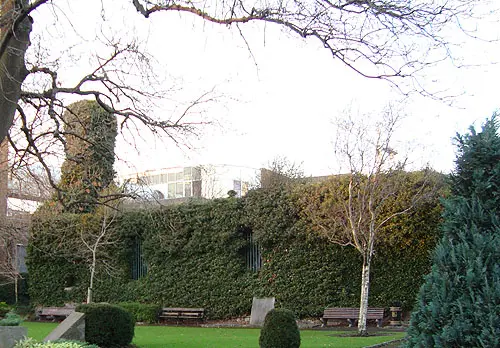
The church is a shell, described in the NIAH record as "Now roofless and ruinous", with "Grave-slabs to floor to interior" behind a locked gate; the 2016-17 photographic survey notes of one slab that it is "inside the locked nave of the Church. Took the shot through the gate." The memorial to Archbishop Dermot O'Hurley stands at the south-eastern corner of the church. The headstones are ranged along the church wall and the perimeter walls, some still in place, and at least one of them was reset upside down when it was moved. The graveyard's south boundary wall carries what the NIAH record calls a "Tudor-arch vehicular entrance with dressed granite voussoirs", with a camber-arch pedestrian entrance beside it.
The council records the value of the ivy on the walls: "The native ivy that grows on the walls of the church and boundary walls is particularly valuable for wildlife, providing nesting sites year-round and nectar for bees, butterflies and wasps", and lists three bat species in the park, the Leisler's bat, the common pipistrelle and the soprano pipistrelle.
Two pieces of St Kevin's are elsewhere in Dublin. The font is in St Nahi's Church in Dundrum, and the Victorian St Kevin's on the South Circular Road, closed after a final service on 28 January 1983, was converted into apartments in the 1990s.
Sources consulted
- Kinane, Very Rev. Dean Thomas H., «The Life of Dr. O'Hurley, Archbishop of Cashel» — Dublin, 1893 book
- Burke, Oliver J., «The History of the Lord Chancellors of Ireland, from A.D. 1186 to A.D. 1874 (Appendix, note to 'Page 67, line 20')» — Longmans, Green & Co., London, 1879 book
- Fitzpatrick, William John, «History of the Dublin Catholic Cemeteries» — Dublin, 1900 book
- Gilbert, John T., «A History of the City of Dublin, vol. I (checked as a negative control: no occurrence of O'Hurley)» — James McGlashan, Dublin, 1854 book
- National Inventory of Architectural Heritage, «St. Kevin's Church, Camden Row, Church Lane South, Dublin 8 - NIAH survey record, reg. no. 50110036» — Department of Housing, Local Government and Heritage, 2017 report
- Dublin City Council, «St. Kevin's Park - park record, history and opening hours» — dublincity.ie, 2026 report
- Culture Date with Dublin 8 (Dublin City Council), «St. Kevin's Park - history of the site» — culturedatewithdublin8.ie, 2026 web
- Comerford, Patrick, «The mediaeval ruins of Saint Kevin's Church still stand near Camden Street» — patrickcomerford.com, 2022 web
- Wilson, Bridgid (contributor); after Maffett and Cantwell, «Headstones: St. Kevin's Graveyard, Camden Street, Dublin - photographic transcription, October 2016 to March 2017» — Ireland Genealogy Projects Archives (archived copy, 11 August 2024), 2017 archive
- Rice, Kim (AMS-CRDS), «2020:115 - DUBLIN 8: TUD, Kevin Street Lower (licence 19E0554); records St Kevin's church and graveyard as DU018-020078» — Excavations.ie / Wordwell Ltd., 2020 report
- Wikipedia contributors, «St. Kevin's Church, Camden Row, Dublin - Wikipedia revision 1146816926, 27 March 2023 (the edit that added the folklore section)» — English Wikipedia, 2023 web
- Wikipedia contributors, «Vincenzo Valdrè (Vincent Waldré, 1740-1814), painter of the St Patrick's Hall ceilings, Dublin Castle» — English Wikipedia, 2026 web
Reviewed by V. Serrano on 2026-09-07 · How we verify our content
💬 Field testimonies (0)
No testimonies yet. Add the first.
Add your testimony
🔒 Log in to add a testimony