👻 HAUNTED PLACE · EXP. Nº9475
ACTIVE
Montpelier Hill
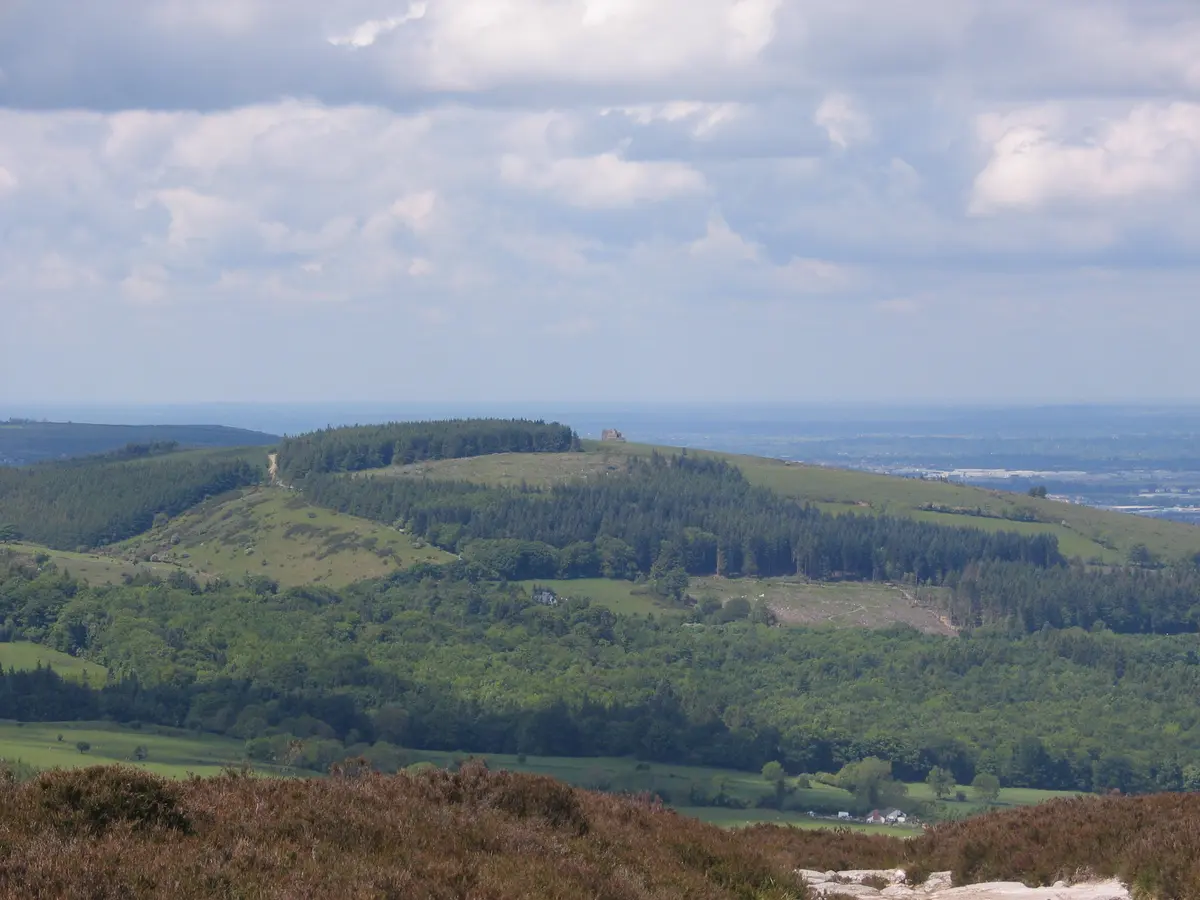
Montpelier Hill rises 383 metres over south Dublin, and the squat granite ruin on its summit — known to every Dubliner as the Hell Fire Club — may be the most storied building on the city's skyline.
Where is Montpelier Hill?
- Location
- Dublin, Ireland
- Type
- Ruin / ancient site
- Coordinates
- 53.252, -6.33
- Last updated
LOCATION
Why is Montpelier Hill said to be haunted?
It began prosaically: a shooting lodge built around 1725 for William Conolly, Speaker of the Irish House of Commons, whose masons quarried a 5,000-year-old passage tomb for building stone. When a storm stripped the slate roof soon afterwards, local tradition — recorded from schoolchildren's informants in 1937-39 — said the Devil had blown it off in revenge for the desecrated cairn. Conolly's answer was a massive arched stone vault that still roofs the building three centuries later. The lodge's diabolical fame rests on the Dublin Hellfire Club of the late 1730s, aristocratic blasphemers whose documented haunt was actually the Eagle Tavern on Cork Hill: the club's historian, David Ryan, found no evidence they ever met on the hill. The tale of a cloven-hoofed stranger at the card table was collected here in the 1930s — and, almost beat for beat, at Loftus Hall in Wexford. In 2016, archaeologists digging behind the ruin found rare megalithic art.
What is the history of Montpelier Hill?
Long before the Hell Fire Club, the summit of Montpelier Hill belonged to the dead. Two Neolithic passage tombs stood there, monuments of the same tradition as Newgrange, raised roughly 5,000 years ago on a northern shoulder of the Dublin Mountains with the whole plain of the city at their feet. The antiquarians knew what became of them. William Domville Handcock, the historian of Tallaght parish, put it flatly in 1899: "Formerly there was a large cairn on the top of Mont Pelier; but a great portion of it was utilized in building the house there. The remains of the cairn are still to be seen."
The house was the work of William Conolly, Speaker of the Irish House of Commons and reputedly the richest man in Ireland. In 1723 he bought Rathfarnham Castle and its estate for 62,000 pounds from Philip, Duke of Wharton — by a neat irony, the man who had founded the original Hellfire Club in London in 1719. Around 1725 Conolly built a hunting lodge, called Mount Pelier, on the summit of the hill above his new deer park, and his builders helped themselves to the ancient cairn for stone. He had little time to enjoy it: he died in 1729, four years after it went up.
Soon after construction, a storm tore off the slate roof. Conolly rebuilt it to last — an arched roof of stone, put together, as the standard accounts describe it, like the arch of a bridge. That vault is the building's signature. It has kept the lodge standing, and roofed, through three centuries of abandonment, which is why the "ruin" on the skyline reads from below as a solid black hump rather than a broken shell. The neighbourhood drew its own conclusion about the storm. When the Irish Folklore Commission sent notebooks into the schools in 1937-39, the entry from Firhouse school, in the lowlands below the hill, recorded the explanation the district still gave: "People said the Devil blew off roof because of the desecration of cairn the stones of which were used to build Hell Fire Club." The same notebook lists the building's other nicknames: "Connollys Folly", "The Kennel", "The Haunted House".
The club that gave the lodge its lasting name was real, and briefly infamous. The Dublin Hellfire Club was founded around 1737 by Richard Parsons, first Earl of Rosse — described by the historian David Ryan as "a notorious libertine fond of playing outrageous practical jokes" — together with the painter James Worsdale. Its members drank hard, mocked religion and cultivated a diabolical reputation on purpose. The worst of them, Henry, fourth Baron Barry of Santry, was convicted and sentenced to death in 1739 for stabbing a servant; his connections won him a reprieve and he died in exile in Nottingham. The scandal helped finish the club, which had effectively disbanded by the early 1740s.
What the record does not show is the club on the hill. Its documented meeting place was the Eagle Tavern on Cork Hill, beside Dublin Castle — in the city, not the mountains. Handcock allowed in 1899 that the tradition of meetings at the lodge "may have been founded on fact"; Weston St. John Joyce, in The Neighbourhood of Dublin (1912), was blunter, judging "it is tolerably certain that it was never one of the regular meeting-places of that mysterious and iniquitous body". A century later David Ryan, the club's modern historian, wrote after years in the archives: "I never found any evidence to definitively link the Dublin Hellfire Club with the ruined hunting lodge on Mountpelier." Popular retellings pass around a connecting thread — that after Conolly's death the lease of the lodge came to the Earl of Rosse — but the archaeologists who later dug the site state that they have found no clear demonstrable link between the club, or its principal members, and the Conolly family. At some point in the eighteenth century the interior was damaged by fire; the surviving stories about how it happened contradict one another, and tradition moves the revellers downhill afterwards, to the steward's house at Killakee.
The hill's later history is quieter. Joseph Holt, a general of the 1798 rebellion, sheltered in the ruin. In 1800 the Conollys sold the lands to Luke White; through his descendants they passed to the Massy family, and when the Massys went bankrupt in the 1920s the estate fell to the State, which planted the slopes with the conifers of today's Hellfire Wood. Tradition adds one flourish along the way: for Queen Victoria's visit to Ireland in 1849, tar barrels are said to have been set alight on top of the lodge — and the stone vault shrugged off the bonfire. In October 2016 the site returned to the news for its oldest layer rather than its darkest: a community excavation led by archaeologist Neil Jackman confirmed that the mound behind the lodge is the quarried remains of a passage tomb, and recovered a polished stone axehead, worked flint, burnt bone and, against all odds, a stone bearing rare megalithic art.
Timeline: the documented record of Montpelier Hill
- 1723 William Conolly, Speaker of the Irish House of Commons, buys Rathfarnham Castle and its estate for 62,000 pounds from Philip, Duke of Wharton — founder, in London in 1719, of the original Hellfire Club.
- c. 1725 Conolly builds the Mount Pelier hunting lodge on the summit, quarrying stone from the Neolithic passage tomb. Soon afterwards a storm strips the slate roof, which is replaced with the arched stone vault that still stands.
- 1729 Conolly dies, four years after the lodge was finished.
- c. 1737 The Dublin Hellfire Club is founded by Richard Parsons, first Earl of Rosse, and the painter James Worsdale; its documented meeting place is the Eagle Tavern on Cork Hill, in the city.
- 1739 Club member Henry, fourth Baron Barry of Santry, is convicted and sentenced to death for stabbing a servant; reprieved through his connections, he dies in exile. The club effectively disbands by the early 1740s.
- 1798 Joseph Holt, a general of the 1798 rebellion, shelters in the abandoned lodge.
- 1800 The Conolly family sells the lands to Luke White; they later pass to the Massy family and, after the Massy bankruptcy in the 1920s, to the State, which plants the modern forestry.
- 1849 Tradition holds that tar barrels are set alight on the roof to mark Queen Victoria's visit to Ireland; the stone vault survives the bonfire.
- 1912 Weston St. John Joyce writes that the lodge "was never one of the regular meeting-places" of the Hellfire Club, whose ordinary rendezvous was the Eagle Tavern.
- 1937-39 The Schools' Collection records the district's traditions: the Devil blew off the roof for the desecration of the cairn (Firhouse); a card player sees a stranger's "cows foot" under the table (Dundrum); a cheat is burned in a whiskey barrel (Dundrum).
- 2012 David Ryan publishes Blasphemers & Blackguards, the standard history of the Irish hellfire clubs, and states he found no evidence definitively linking the Dublin club to the Montpelier lodge.
- October 2016 A community excavation led by Neil Jackman confirms the passage tomb behind the lodge and recovers a polished stone axehead, worked flint, burnt bone and a stone bearing rare megalithic art.
- 2024 The Dublin Mountains Visitor Centre project — branded "Hellfire" — reaches detailed design, with conservation works to the lodge planned and trail improvements scheduled for 2026-27.
Is there a rational explanation for Montpelier Hill?
The core of the legend — satanic rites in the lodge — has a sourcing problem that Montpelier's own chroniclers have acknowledged for more than a century. The Dublin Hellfire Club existed, but every documented trace of its meetings is urban, at the Eagle Tavern on Cork Hill. Joyce judged the hilltop association doubtful as early as 1912; David Ryan, whose Blasphemers & Blackguards (2012) is the standard history, states he never found evidence definitively linking club and lodge. The club's genuinely dreadful record — a member sentenced to death for killing a servant — supplied the raw material; the conspicuous black ruin on Dublin's skyline supplied the stage set.
The famous tale of the Devil at the card table is a migratory legend, not a local memory. The Schools' Collection of 1937-39 preserves it at Montpelier in a Dundrum schoolboy's version — a dropped card, "one of the men had a cows foot", the stranger vanishing, the witness dropping dead — with no fireball and no damage to the house. The same collection preserves the same scene, almost beat for beat, attached to Loftus Hall in County Wexford: "What did she see only the devil's cloven foot." Modern retellings that have the Devil exit in a ball of fire that destroys the roof run into an awkward witness: the roof. The documented roof story is meteorological — a storm stripped the slates soon after construction — and the arched stone replacement has stood ever since, reportedly even through the tar-barrel bonfire of 1849. A vanished roof is the one detail any visitor can refute by looking up.
Whether anyone in 1725 actually blamed the Devil for the storm is a separate question. The attribution is first safely attested, for this revision, in the folklore record of 1937-39; Handcock's 1899 parish history states the quarrying of the cairn as plain fact, but the full-text archives that would date the Devil story's first appearance in print were unavailable when this was checked, so its earliest printed occurrence remains an open question. No contemporary 1725 source for it has been produced.
There is no commercial ghost operation on the hill: the forest is free to enter, and the State bodies now redeveloping the site publish archaeology rather than apparitions — though it is telling that the planned visitor centre was branded "Hellfire" after a consultation exercise, a measure of what the legend is worth to tourism. Inside, the lodge is unlit, cold and bare stone; that, rather than anything on record, does most of the atmospheric work attributed to the building.
Can you visit Montpelier Hill?
Montpelier Hill is a free public forest recreation site owned by Coillte, the State forestry company, about 6.5 km south of Rathfarnham on the R115 Killakee road. The Hell Fire Club car park at the foot of the hill has around 70 spaces and a bike rack, with seasonal gates: roughly 7 am to 9 pm in summer and 8 am to 5 pm in winter (the hours published by Coillte and South Dublin County Council differ slightly, so check before a late descent — cars can be locked in).
Two waymarked loops start from the car park: the Montpelier Loop (4 km, about 1 hour, moderate, climbing a broad but steep forest track to the ruin) and the Forest Loop (5.5 km, about 1.5 hours), plus three fixed orienteering courses. The summit is open and exposed, with wide views over Dublin city and bay; bring proper footwear and weather layers. The lodge itself is freely accessible but unlit, with uneven floors and low doorways — a torch helps — and there are no toilets, water or café on the hill. The long-distance Dublin Mountains Way crosses the summit, and Massy's Wood, with its own trails, lies directly across the road.
Be aware of works: the Dublin Mountains Visitor Centre project (a visitor centre, a tree-top walkway to Massy's Wood and conservation works to the lodge) was upheld by the courts in 2021 and reached detailed design in 2024, with trail improvement works scheduled between January 2026 and July 2027, so expect localised closures and machinery. The hill is hugely popular at Halloween, when the car park fills early.
Sources consulted
- National Folklore Collection, University College Dublin, «The Schools' Collection, volume 0795, page 29 (Firhouse school, Co. Dublin): "Hell-Fire Club"» — dúchas.ie, 1938 archive
- National Folklore Collection, University College Dublin, «The Schools' Collection, volume 0797, page 231 (Dundrum (B.) school, Co. Dublin): "Hell Fire Club", collected by Liam Conway from William Conway» — dúchas.ie, 1938 archive
- National Folklore Collection, University College Dublin, «The Schools' Collection, volume 0873, page 203 (Aughclare school, Co. Wexford): "A Story of Loftus Hall"» — dúchas.ie, 1938 archive
- William Domville Handcock, «The History and Antiquities of Tallaght in the County of Dublin (2nd edition)» — Hodges, Figgis & Co., Dublin, 1899 book
- David Ryan, «Uncovering the origins of Dublin's Hellfire Club» — The Irish Times, 2012 newspaper archive
- Susan Daly, «Five thousand years of death: the secrets uncovered at the Hellfire Club site» — TheJournal.ie, 2016 newspaper archive
- Abarta Heritage / Neil Jackman, «The Hellfire Club Archaeological Project (project history pages)» — abartaheritage.ie, 2017 web
- Coillte, «Hell Fire Club recreation site» — coillte.ie, 2026 web
- South Dublin County Council, «The Hellfire Club (visitor information)» — sdcc.ie, 2026 web
- South Dublin County Council / Coillte, «Dublin Mountains Visitor Centre — project status» — hellfiredublinmountains.ie, 2026 web
- Wikipedia contributors, «Montpelier Hill» — Wikipedia (English), 2026 web
Reviewed by V. Serrano on 2026-08-17 · How we verify our content
💬 Field testimonies (0)
No testimonies yet. Add the first.
Add your testimony
🔒 Log in to add a testimony