👻 HAUNTED PLACE · EXP. Nº9475
ACTIVE
Duckett's Grove
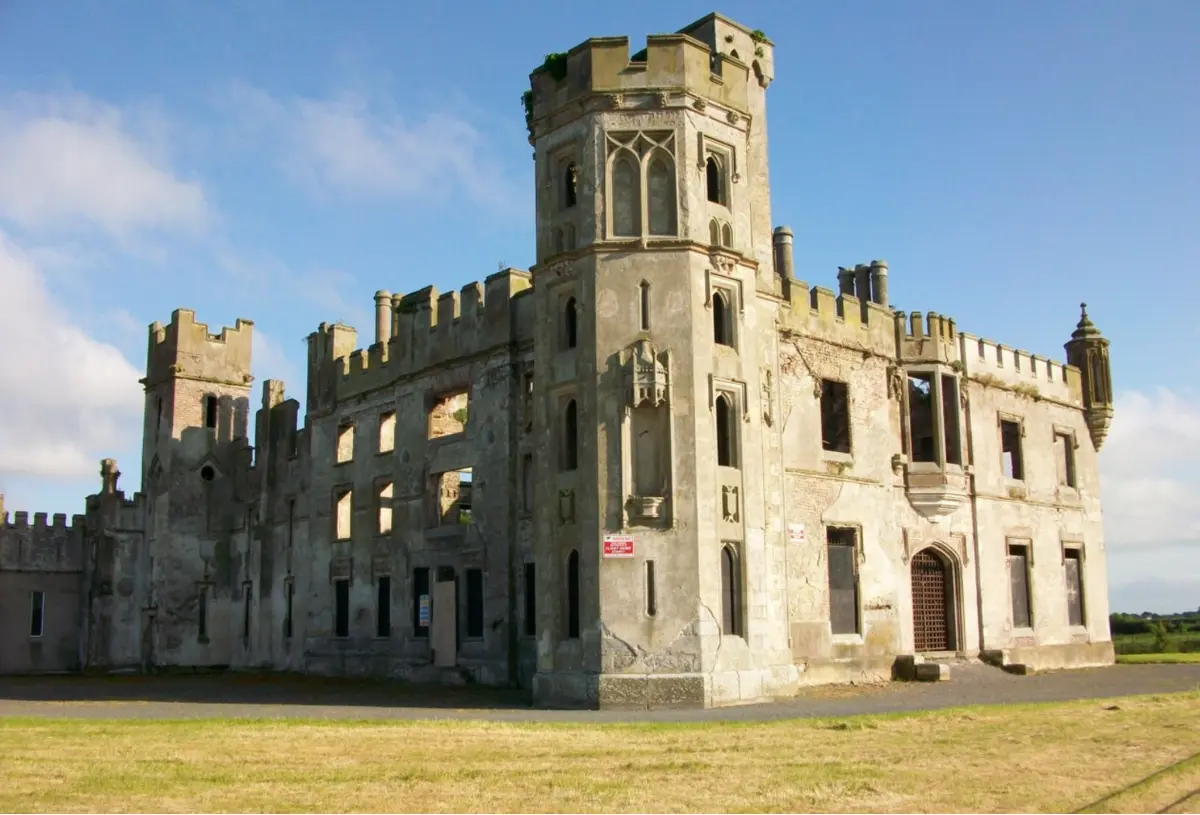
Duckett's Grove, in Irish Garrán Duckett, rises out of the Carlow countryside as a shell of Gothic towers, empty windows and empty niches.
Where is Duckett's Grove?
- Location
- County Carlow, Ireland
- Type
- Ruin / ancient site
- Coordinates
- 52.857, -6.814
- Last updated
LOCATION
Why is Duckett's Grove said to be haunted?
Its core is a Georgian country house of about 1745; the castellated Gothic mantle was wrapped around it by the architect Thomas Cobden about 1825 and extended by John Macduff Derick about 1845. In 1883 the estate ran to 11,646 acres across six counties, on figures the owner himself certified as correct. Fire gutted the house on 19 April 1933, by which time the family had gone and twenty-eight local farmers and labourers owned the demesne. The building is sealed and cannot be entered; the walled gardens and pleasure grounds around it are a free public park, and a woman ran a riding school in the outbuildings until 2004.
The ruin's fame rests on a banshee, and that fame can be dated. Syfy's Destination Truth broadcast live from here in search of one on St Patrick's Day 2011, and the crowds followed. The curse usually attached to the story, a piseog laid on the Ducketts by a grieving mother, appears in no source older than that broadcast: not in the official brochure, not in the architectural record, and not in the folklore Carlow schoolchildren collected in 1937.
What is the history of Duckett's Grove?
Duckett's Grove stands in the townland of Rainestown, County Carlow, and the family that gave it its name were newcomers. Thomas Duckett, the first of the name in Ireland, arrived at the end of the seventeenth century and in 1695 bought the townland of Kneestown, a holding of under 500 acres. His descendant Jonas Duckett settled at the Grove and died in 1797. The house the visitor sees began around 1745 as a detached three-storey-over-basement Georgian country house, built on the site of a smaller one.
The silhouette came later, and in two campaigns. About 1825 the Carlow architect Thomas Alfred Cobden (1794-1842) wrapped the Georgian block in a castellated Gothic mantle for John Dawson Duckett - turrets, crenellations, gargoyles, canopied niches full of statues, an octagonal viewing tower. About 1845 John Macduff Derick (1810-1859) extended it again, adding the granite ashlar viewing tower on an octagonal plan, more turrets, entrance screens, the stable complex, and the enormous castellated gate lodge known as The Towers. Over the master bay window Derick cut the family's two mottoes: "Spectemur agendo", let us be judged by our acts, and "Je veux le droit".
The scale of what paid for it can be measured rather than guessed. In the 1883 edition of John Bateman's The Great Landowners of Great Britain and Ireland, "Duckett, William, of Duckett's Grove, Carlow" holds 11,646 acres across six counties - 5,004 in Queen's County, 4,923 in Carlow, 1,156 in Wicklow, 499 in Kildare, 48 in Wexford and 16 in Dublin - worth £9,702 a year. Bateman's three-asterisk mark against the name means the figures were returned to him by the owner himself as correct. The website built around the John Sweeney Collection records roughly fifty outdoor staff in the nineteenth century, working a twelve-hour day for nine shillings a week, starting at seven in summer and half past seven in winter.
William Dawson Duckett died at the house on 22 June 1908, aged eighty-six, the last of the male line. He had married Anna Maria Morony in 1868; she died in 1894, and in November 1895, at seventy-three, he married the twenty-one-year-old Maria Georgina Thomson. There were no children. Maria left Duckett's Grove for Dublin about 1916 - according to the family collection, after threats from neighbours who had turned hostile - and later moved to England until she felt safe to come back.
What happened next was not a curse. Successive Land Acts had already cut the estate to some 1,300 acres. In June 1921 Mrs Duckett's entire stock and outdoor effects went under the hammer over two days. By an indenture of 12 July 1921 the demesne passed to four trustees - the farmer Thomas Murphy of Straboe, the Carlow merchant Michael Doyle, and two Catholic curates, Fr Edward Campion and Fr John Kelly - acting for the Killerig Land Committee, twenty-eight local farmers and labourers who bought the place with a £32,000 loan from the Bank of Ireland and meant to turn the mansion into a forestry college. On 25 June 1921 the Nationalist and Leinster Times printed a trespass warning: damage had been done on the estate "not only to ordinary property, including timber, but also to certain works of art around the magnificent mansion". The niches in the photograph are empty for a reason.
During the Truce the house was an Irish Republican Army refresher-training camp; Captain Mac Curtin reported taking command there on 11 August 1921, and his weekly reports to GHQ survive in the Collins Papers in the Military Archives. Cumann na mBan trained there too: a photograph taken in 1921 on the north-eastern steps shows May Bourke, Eithne Coyle and the nurse Linda Kearns, who had escaped from Mountjoy by rope ladder the previous October, standing on a Union Jack. The contents of the house were auctioned over three days in December 1923, and Duckett's Grove was left empty.
By 1933 the property belonged to Thomas Thompson and Sons, engineers, of Carlow and Dublin. Locals had put out a small fire in one of the rooms the week before. On Wednesday 19 April 1933 the caretaker - John Sweeney, the former head gardener, appointed in 1930 - told the Nationalist that a beam in the chimney over the north gateway had been found alight before he went to bed and that he had thrown water on it; next morning the whole house was "a complete mass of flames". Captain J. Sweeney of the Carlow Fire Brigade, the caretaker's first cousin, reported receiving the call at 12:10 and reaching the fire at half past one with eight men: "Owing to inadequate water supply it was impossible to cope with the flames." Ammunition left hidden since 1921 exploded in the heat. The Irish Independent put the damage at £12,000 to £15,000, only partly insured.
Maria Georgina Duckett died in 1937 leaving £97,735. Her only daughter, Olive Thompson O'Grady, got one shilling - "the angry shilling" - and the rest was left to British-based Protestant charities. Her will said: "My daughter Olive, be it clearly understood, is cut off to a shilling. Had she been an ordinary, good daughter, she would have had all she could have wished for." Olive contested it, and after a twelve-day High Court hearing in Dublin in 1939 the will stood; she was given the interest for life on £7,000.
The ruin was not abandoned, either. From 1976 until her death on 9 July 2004, Frances Brady (1928-2004) lived in a single room in the north wing beside the courtyard and ran a horse-riding school and animal sanctuary in the outbuildings. A plaque to her stands at the north-western courtyard doorway she used. Carlow County Council bought the ruin, its yards and its two walled gardens - about eleven acres of a former twelve-thousand-acre estate - in September 2005, during Heritage Week; replanting began in January 2007 and the gardens opened to the public that September.
Timeline: the documented record of Duckett's Grove
- 1695 Thomas Duckett, the first of the name in Ireland, buys the townland of Kneestown in County Carlow, a holding of under 500 acres. His descendant Jonas Duckett settles at Duckett's Grove and dies in 1797.
- c. 1745 A detached three-storey-over-basement Georgian country house is built on the site of a smaller one, the core still visible in the entrance block.
- c. 1825 Thomas Alfred Cobden adds the castellated Gothic mantle for John Dawson Duckett. About 1845 John Macduff Derick extends it with the granite ashlar octagonal viewing tower, entrance screens and stable complex.
- 1883 John Bateman's survey of great landowners credits William Duckett of Duckett's Grove with 11,646 acres across six counties and £9,702 a year. The three asterisks beside the entry mean the owner returned the figures as correct.
- 22 June 1908 William Dawson Duckett dies at the house aged 86, last of the male line, leaving his second wife Maria Georgina, whom he had married in 1895 when he was 73 and she 21.
- 1909-1911 The Journal of the County Kildare Archaeological Society records that the house stands in the townland of Rainestown, and in the same volume prints local testimony and a glossary explaining that a banshee follows old Gaelic families and is never summoned by a curse.
- 12 July 1921 Twenty-eight local farmers and labourers, through the Killerig Land Committee, buy the demesne with a £32,000 loan from the Bank of Ireland, intending a forestry college. That summer the house becomes an IRA and Cumann na mBan training camp, and the Nationalist reports damage to the statuary.
- 19 April 1933 Fire destroys the interior. The caretaker had found a chimney beam alight the night before and thought he had put it out; the Carlow Fire Brigade received the call at 12:10 and could not cope for want of water. Damage was put at £12,000-£15,000, only partly insured.
- 1939 After a twelve-day High Court hearing in Dublin, the will of Maria Georgina Duckett stands: her daughter Olive, cut off with "the angry shilling" from an estate of £97,735, is granted only the interest for life on £7,000.
- 1976-2004 Frances Brady (1928-2004) lives in one room of the north wing beside the courtyard and runs a riding school and animal sanctuary in the outbuildings until her death on 9 July 2004. A plaque marks the doorway she used.
- September 2005 Carlow County Council acquires the ruin, its yards and the two walled gardens - about eleven acres - during Heritage Week. Replanting begins in January 2007 and the gardens open to the public that September.
- 17 March 2011 Syfy's Destination Truth broadcasts a four-hour live special from the ruin in search of a banshee. Weeks later the Irish Examiner reports crowds, a council closure for safety work and a named council official confirming the surge of interest.
- October 2018 Scarefest, Carlow's Halloween festival, sells out its ticketed night-time paranormal investigation inside the ruin, advertised as "one of the most haunted places in Ireland".
Is there a rational explanation for Duckett's Grove?
The banshee of Duckett's Grove has a birthday, and it is recent.
On St Patrick's Day 2011 the American series Destination Truth broadcast a four-hour live special from the ruin on Syfy, "on a quest to find a banshee", with viewers pressing a "Banshee Button" on the feed whenever they saw something odd. The Irish Examiner covered the aftermath on 22 April 2011: the Killarney Paranormal Society had investigated, the council had closed the building outside 8am-8pm for safety work, and Seamus O'Connor, Carlow County Council's director of housing, told the paper that "after a full night's investigation in the castle, a good bit of activity was detected, which piqued a lot of people's interest". The same article repeated a claim we can now correct: that the house "has not been inhabited since 1916". Frances Brady lived in it until 2004.
Before the broadcast, the record is quiet, and the quiet is measurable. Abandoned Ireland's page on the ruin, archived in February 2009 and again in January 2013 without a word changed, has no ghost and no banshee in it. Fáilte Ireland and Carlow Tourism's own eight-page brochure runs to 1,694 words with "Duckett" on thirty-two lines and "banshee", "ghost", "haunted" and "curse" at zero. Carlow Tourism's current visitor page is the same: zero, with "Duckett" twenty times. The National Inventory of Architectural Heritage record (reg. 10300305, rated of National importance) describes fabric and nothing else.
The folklore archive is the strongest test, and it fails the story outright. The Schools' Collection, compiled by Irish schoolchildren in 1937 and 1938 - four years after the fire, from people who had known the house full - contains "Duckett's Grove" exactly twice, both in CBÉS 0907: a note on a forge run by a Mr Byrne around 1892, and a note on lime kilns between the Grove and Kenagh. Neither mentions the family, a death, a curse or a cry. The same archive returns 793 transcripts for "banshee" and 186 for "Tullow", so the search works; there is simply nothing there.
What a banshee was believed to be in this district is on record too, and it does not fit. The Journal of the County Kildare Archaeological Society for 1909-1911 prints a glossary definition - "the apparition of a low-sized woman, clothed in white, with her hair down; she follows certain members of the old Celtic stock, and her appearance, keening outside the house, denotes a death in the family" - and a local explanation of where banshees come from: paid keeners who must go on keening "till the seventh generation is out of whoever they were paid to keen for". A banshee attaches to an old Gaelic family; she is not summoned, and no curse is involved. The Ducketts were an English Protestant family who bought their first land in Carlow in 1695.
The curse itself - a piseog laid by the mother of a young woman said to have died on the estate - cannot be traced to any source older than the broadcast. Searching the full text of Internet Archive's book corpus, "Duckett's Grove" together with "piseog" returns nothing at all, against fifteen results for "Duckett's Grove" with "banshee", and of those fifteen the only book that actually links the two is Tony Locke's Irish Ghost Tales (The History Press, 2015), published four years after the Syfy special. The version that circulates online, in which the dead girl was a mistress of William Duckett killed in a riding accident, is an unsourced allegation about a named man who died in 1908, and it does not appear in the brochure, the architectural record, the folklore archive or the family's own document collection. It is not repeated here.
There is also a till. Since at least 2018, Scarefest - Carlow's Halloween festival, launched by Visit Carlow with the support of Carlow Tourism and Carlow Local Enterprise Office - has sold ticketed night-time paranormal investigations inside the ruin, "said to be one of the most haunted places in Ireland"; the Saturday session in October 2018 sold out. That superlative belongs to whoever sells the ticket, not to the record. The contradiction is the interesting part: the same county tourism body whose written material about Duckett's Grove contains not one paranormal word backs a festival whose main draw is the ghost.
Two things remain open. Tony Locke's chapter could not be read: the scan is lending-restricted and Archive.org returned an identical 403 page for the search and for the control, and Google Books was returning quota errors all day, so no conclusion about what Locke actually writes should be drawn from this page. And nothing here rules out that people in Carlow told banshee stories about the Ducketts before 2011; it establishes only that nobody wrote them down where the archives can be searched.
Can you visit Duckett's Grove?
Duckett's Grove is a free public park open every day of the year. The address is Duckett's Grove Walled Gardens and Pleasure Grounds, Kneestown, County Carlow, eircode R93 RF80, about ten kilometres (six miles) from Carlow town; the map point for this entry is 52.8574, -6.8135. The National Inventory of Architectural Heritage surveyed it under registration number 10300305 with a rating of National, in the townland of Rainestown, and dates the building to between 1730 and 1760. Traffic from Dublin or Waterford leaves the M9 at junction 4 and follows the signs for Castledermot.
Carlow Tourism gives the gates as open from 8:30 to 20:30 between April and October and from 8:30 to 17:00 between November and March, with no admission charge. Free guided tours of the ruin and the gardens run at 12:30 and at 14:30 from Friday to Sunday, starting from the reception point in the courtyard and bookable at duckettsgrove.digitickets.co.uk; groups can arrange other times on 059 9130411. The same page still carries the most recent winter suspension of individual tours, "from December 14th 2025 - March 2026".
A free audio guide is handed out at that reception point, narrated in the voices of people who lived and worked on the estate: William Duckett, his wife Maria, her daughter Olive O'Grady, Mr Mitchell the steward and Mr O'Brien the head gardener.
The ruined house is sealed and cannot be entered. What is open on foot is the courtyard, the two interconnecting walled gardens and the wooded pleasure grounds. There are toilets; a car and coach park; a playground; and a craft studio in the courtyard, NicAngels Candles, open on selected weekdays. The tea and coffee service is described as intermittent through the year. Carlow Tourism lists the access as "Restricted Wheelchair Access".
The night-time paranormal investigations inside the ruin are a separate ticketed event for over-18s, run in late October as part of the Scarefest Halloween festival.
Sources consulted
- John Bateman, «The Great Landowners of Great Britain and Ireland (entry: Duckett, William, of Duckett's Grove, Carlow)» — Harrison & Sons, London (4th ed.), 1883 book
- County Kildare Archaeological Society, «Journal of the County Kildare Archaeological Society, vol. VI (1909-1911): notice of Duckett's Grove in the townland of Rainestown; County Kildare folk-tales and glossary entries on the banshee» — Edward Ponsonby, Dublin, 1911 academic
- National Folklore Collection, University College Dublin, «The Schools' Collection, volume CBÉS 0907 (Rathvilly district): the only two references to Duckett's Grove in the 1937-38 folklore survey, on a forge and on lime kilns» — dúchas.ie, 1938 archive
- John Sweeney Collection, reproduced by James Doyle, «Contemporary press on the fire: "Carlow Mansion Destroyed by Fire" (Evening Herald, 20 April 1933), "Carlow Castle Gutted" (Irish Independent, 21 April 1933) and the Carlow Fire Brigade report (Nationalist and Leinster Times, 22 and 29 April 1933)» — duckettsgrove.ie, 1933 newspaper archive
- Kerrie Kennedy, «Castle prepares for ghost hunters siege» — Irish Examiner, 2011 newspaper archive
- National Inventory of Architectural Heritage, «Duckett's Grove, Rainestown, Carlow - survey record, reg. no. 10300305, rating National» — Department of Housing, Local Government and Heritage, 1999 report
- Fáilte Ireland and Carlow Tourism, «Duckett's Grove Walled Gardens & Pleasure Grounds (official eight-page visitor brochure)» — carlowtourism.com, 2008 report
- James Doyle, «The John Sweeney Collection: indentures, auction notices, Military Archives reports and family papers of Duckett's Grove» — duckettsgrove.ie, 2019 archive
- Carlow Tourism, «Duckett's Grove Walled Garden and Pleasure Grounds - opening hours, guided tours and facilities» — carlowtourism.com, 2026 web
- Darren Hassett, «Scarefest coming to Carlow on October 26 with paranormal investigations at Duckett's Grove» — Carlow Live, 2018 newspaper archive
- Tony Locke, «Irish Ghost Tales: and things that go bump in the night (contains a chapter titled "Duckett's Grove"; text not consulted, see the sceptical section)» — The History Press, 2015 book
Reviewed by V. Serrano on 2026-08-20 · How we verify our content
💬 Field testimonies (0)
No testimonies yet. Add the first.
Add your testimony
🔒 Log in to add a testimony