🦶 CRYPTID SIGHTING · EXP. Nº0555
ACTIVE
Encantado
The encantado is not an animal waiting to be discovered. The animal is Inia geoffrensis, the Amazon river dolphin, described to science long before anyone in Europe called it enchanted, and listed as Endangered by the IUCN in 2018 and by Brazil in 2022.
Where and when was Encantado sighted?
- Location
- Middle Solimões (Tefé), Amazonas, Brazil
- Date sighted
- Unknown
- Coordinates
- -3.349, -64.71
- Last updated
LOCATION
What is Encantado?
What is genuinely remarkable is what riverine Amazonians say about it: that a boto can come ashore as a stranger in white who keeps his hat on, dance all night at a river festa, and be gone before dawn. The accounts are old. Henry Walter Bates wrote one down at Ega and published it in 1863, with the sexes the other way round; Couto de Magalhães printed the male version in 1876. And they are still told — not as folklore, but as things that happened to named people in places you can point at. The anthropologist Deborah de Magalhães Lima argues that the tidy "legend of the boto" is a simplified translation of those first-person accounts, assembled by tourist pages and school websites. No naturalist ever proposed the encantado as an undescribed species: the word cryptid can be traced to a single anonymous edit on a fan wiki in 2012. Meanwhile the dolphin itself has been halving in number every ten years.
What is the history of Encantado?
The animal at the centre of this entry was never missing. Henry Walter Bates, collecting on the Amazon between 1848 and 1859, already filed it under a Latin binomial — "called Bouto or porpoise by the natives (Inia Geoffroyi of Desmarest)" — and described how it broke the surface, that it usually went in pairs, and where it was most abundant. What Bates could not file was what people told him about it.
At Ega, the town on the Tefé that now bears the river's name, he wrote down the oldest version of the story we have been able to date. "Many mysterious tales were recounted about the Bouto," he reported: one held that a bouto "once had the habit of assuming the shape of a beautiful woman, with hair hanging loose to her heels, and walking ashore at night in the streets of Ega, to entice the young men down to the water." She took her victim round the waist and went under "with a triumphant cry". In the 1863 telling the seducer is a woman and the prey is a man — the reverse of the version repeated everywhere today. Bates added the detail that matters most for the animal: "no one ever kills these animals voluntarily". It took him years to find a fisherman willing to harpoon one for his collection. The man was called Carepira; he took the reward when his finances were low and "repented of his deed ever afterwards, declaring that his luck had forsaken him from that day."
Thirteen years later the male version reached print. In O Selvagem (1876) Couto de Magalhães wrote that "the lot of the fishes was entrusted to Uauyará. The animal into which he transforms himself is the boto"; that no supernatural being of the Indians had furnished so many legends; and that "many of them attribute their first child to some trick of this god, who sometimes surprised them bathing, sometimes turned himself into the figure of a mortal to seduce them". The people of Pará, he added, tell that on moonlit nights the lakes of the Amazon often light up, and that the songs of the feasts and the stamping of the dances with which Uauyará amuses himself can be heard. Herbert Smith translated that passage in 1879 and set it beside the water-maiden tales of the lower Amazon with a caveat that has aged well: he suspected those had been "introduced by the Portuguese", but held that "there was, undoubtedly, an aboriginal myth" underneath, to which Old World stories had been "tacked".
João Barbosa Rodrigues went further. He had published the boto and uyara legends in the Revista Brazileira in 1881, and in the introduction to Poranduba Amazonense (1890) he classed them among the "leftovers of old Roman beliefs instilled in the Portuguese", shipped over along with the witches on broomsticks. The same volume preserves, in its vocabulary, the Nheengatu name of the animal: pirá-yauara, fish-jaguar.
That nineteenth-century argument — indigenous myth, Iberian import, or both — was never settled, and the twentieth century changed the question rather than answering it. Eduardo Galvão's Santos e Visagens (1955), Raymundo Heraldo Maués's work from 1990 onwards, Candace Slater's Dance of the Dolphin (1994), Edna Alencar's 2002 doctoral thesis and Deborah de Magalhães Lima's fieldwork on the middle Solimões all record the same thing: these are not told as folklore. They are told as things that happened, to the speaker or to somebody the listener knows, in places with names: on Lima's stretch of the Solimões, the mouth of the Japurá is known as the site of a city of the encantados.
Timeline: the documented record of Encantado
- 1863 Henry Walter Bates publishes The Naturalist on the River Amazons. In the chapter on Ega he records the oldest datable version of the story: a bouto that came ashore at night "in the shape of a beautiful woman" to lure young men into the water. He also notes that no one kills the animal voluntarily, and names Carepira, the fisherman who finally harpooned one for him and regretted it for the rest of his life.
- 1876 Couto de Magalhães prints in O Selvagem the male version: Uauyará, to whom the lot of the fishes was entrusted, transforms into the boto, and "many of them attribute their first child to some trick of this god". It is the earliest printed appearance of the paternity motif we have been able to fix.
- 1879 Herbert Smith translates the passage into English in Brazil, the Amazons and the Coast and adds a caution: he believes the water-maiden tales were "introduced by the Portuguese", but that underneath them "there was, undoubtedly, an aboriginal myth" to which Old World stories had been tacked.
- 1890 João Barbosa Rodrigues, who had published the boto and uyara legends in the Revista Brazileira in 1881, classes them in Poranduba Amazonense among the "leftovers of old Roman beliefs instilled in the Portuguese". The same book's vocabulary gives the Nheengatu name of the animal: pirá-yauara, fish-jaguar.
- 1994 Candace Slater publishes Dance of the Dolphin, built on fieldwork in and around Parintins, Carauari, Macapá and Porto Velho and more than 200 hours of recordings. Her conclusion is not zoological: storytellers use these narratives, rather than any other kind, as the frame for extended commentary on the changes under way in Amazonia.
- 3 November 2012 At 12:09 UTC an anonymous address creates the page "Encantado" on Cryptid Wiki with the edit summary "Encantado are crypids." Its text as read on 4 October 2026, last edited on 20 August 2026, carries the zoological candidate: "it is possible that they are a new species of dolphin".
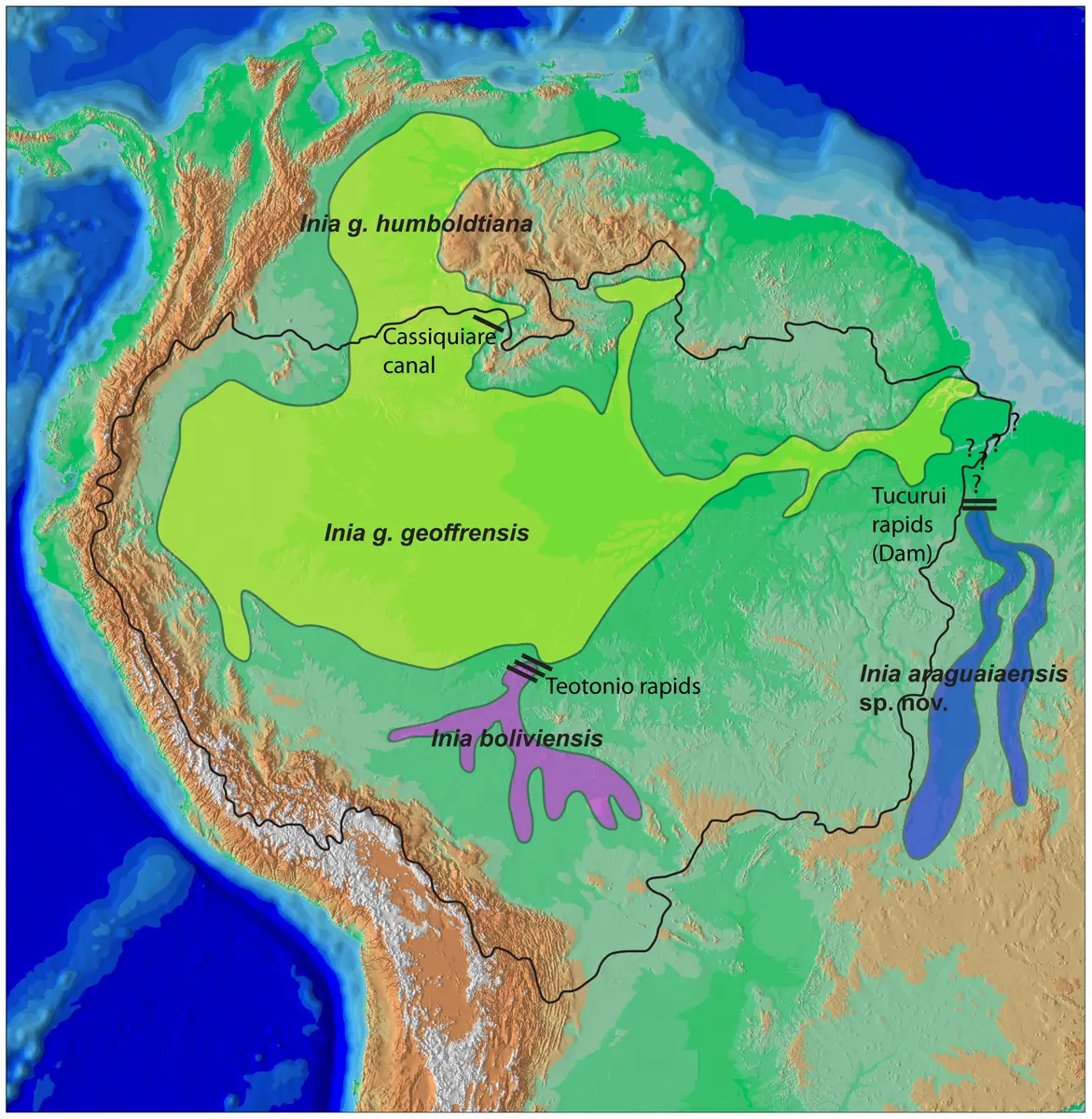
- 22 January 2014 Hrbek, da Silva, Dutra, Gravena, Martin and Farias describe Inia araguaiaensis in PLOS ONE. Their distribution map of the genus is uploaded to Wikimedia Commons the next day by the user WolfmanSF under CC BY 2.5, and is the image this entry has carried ever since.
- 2014 (in force from 1 January 2015) Brazil suspends the piracatinga fishery for five years by joint MPA/MMA instruction, because botos and caimans were being killed for bait. Writing in 2018, da Silva and colleagues report the prohibition "is due to be re-evaluated after five years, although there is increasing evidence that it is being widely ignored". It was renewed in July 2023 by Interministerial Ordinance MPA/MMA no. 4 of 30 June 2023, with no fixed term; we could not open the ministry's own page on 15 August 2026 and have found no record of its revocation.
- 2018 Twenty-two years of standardised surveys at Mamirauá — 363 counts between November 1994 and January 2017 — show the boto population halving every ten years, a decline of 6.7% a year since 2000. The authors find "no obvious reason other than fishery-related mortality". The same year the IUCN moves Inia geoffrensis to Endangered.
- 7 June 2022 Brazilian Ministry of the Environment Ordinance no. 148 updates the national list of threatened species. Entry 760 reads: Cetartiodactyla, Iniidae, Inia geoffrensis, EN — Endangered. Inia araguaiaensis, the species on this entry's map, is listed as Vulnerable.
- July 2026 Mocajuba, in Pará, keeps the stairway of its Mirante do Boto closed and steps up enforcement under a 2025 municipal decree issued on IBAMA and ICMBio advice: visitors may not feed, touch or approach the dolphins.
Is there a rational explanation for Encantado?
What these narratives are has been studied on the ground. Deborah de Magalhães Lima, an anthropologist at the Federal University of Minas Gerais who worked in the communities of Vila Alencar and Caburini on the middle Solimões in 2005 and 2009, opens her study by naming the practice: "it is common to find references to the 'legend of the boto' in articles on Amazonian popular culture, to compose — together with the curupira, the matinta pereira, the iara, the mapinguari — an exotic and savage portrait of the region." Her argument is that the tidy "legend" is a simplified translation of particular, first-person accounts of encounters, and she prints her exhibits in full: the Pará state government's tourism page, the IBGE's page for teenagers, and the Portuguese Wikipedia article. The government text she reprints has the elegant young man who dances all night, the hat he always wears because "a strong smell of fish" comes from his head, the departure "before the day dawns", and the boto credited with "the paternity of all the children of single mothers". In the narratives she recorded, the speakers have names: Sr. Antenor, 65, who pointed at the water and said "this water we see is only a lid; underneath it is all city"; his brother-in-law Afonso; Dona Nila, 102, who came back only because she refused a cashew fruit; Lázaro, taken at 17 and afterwards a healer.
On one point the narratives run the other way. In the tidy version the children exist. In the narratives they do not: the offspring attributed to a boto are called botinhos and never survive. Lima records miscarriages and infants who die soon after birth, and notes that in all her fieldwork Slater never met anyone who was a filho de boto (Slater 1994: 99).
The label "cryptid" can be checked against the edit history of the English Wikipedia page. On 15 August 2026 all 124 revisions of the English Wikipedia page Encantado, from 11 April 2005 to 31 October 2022, were swept through the MediaWiki API for the string crypt, and none contained it. The page held the article on the dolphin legend until October 2015, when it was merged into River dolphin, and has been a disambiguation page since December 2016, whose entry Encantado (mythology) redirects to River dolphin. The English Wikipedia List of cryptids does not mention it (revision of 27 September 2026). Control run on the same endpoint with the same regular expression on the same day: the article Mapinguari had 519 revisions, 450 of which contain crypt, the first on 5 November 2005, and the List of cryptids names it twice. Where the label does exist it can be dated to the minute. On Cryptid Wiki the page Encantado was created at 12:09 UTC on 3 November 2012 by an anonymous address whose edit summary reads, misspelling included, "Encantado are crypids." Its text as read on 4 October 2026, last edited on 20 August 2026 to add categories, supplies the zoological candidate no ethnographer ever asked for — "it is possible that they are a new species of dolphin", "may be a species of hybrid dolphin, although human and dolphin reproduction is not possible" — and adds that "It has also appeared in the Philippines." That is the entire conversion: one sentence, one anonymous editor, no naturalist.
There is an irony in our own file. The image attached to this entry is not a photograph of anything mysterious: it is a figure from a taxonomic paper, the distribution map of the genus Inia published by Hrbek, da Silva, Dutra, Gravena, Martin and Farias in PLOS ONE on 22 January 2014 when they described Inia araguaiaensis as a new species. A page filed under cryptid sightings has been illustrated, since 2014, with the range map from a formal species description.
Two cautions to close. The amulets: Siciliano and colleagues (2018) bought 131 "dolphin love charms" in 34 shops and markets and sequenced 38 of them: three were Guiana dolphin, Sotalia guianensis, ten were domestic pig — "Pigs are used to fake love charm products in Rio de Janeiro" — and ten contained no animal material. And the darkest published reading, which belongs here because leaving it out would be flattering: Borges Junior, Gonçalves and Ceccarelli (2021) argue that a story which names a father who cannot be prosecuted has also served to cover incest, infidelity and sexual violence. None of this makes the people who tell these stories credulous. It makes the label we hung on them wrong. One limit is declared rather than hidden: Slater's book is lending-restricted on Internet Archive and its search-inside returned "Item not available" on 15 August 2026, so her passages here are read through Lima's verbatim citations, with the page numbers Lima gives.
Can you visit Encantado?
There is no site to visit here, because the animal is not hidden and the narratives are not attached to a viewpoint. What can be visited is the river they come from and the institutions that study the dolphin.
Manaus is the usual base. The National Institute of Amazonian Research (INPA) has run boto research from the city for decades under Vera M. F. da Silva — the researcher whose field assistant, Sr. João Pena, a fisherman of 66, told Lima his own account of meeting a mulher-bota, and then repeated his nephew's reproach for going on television to "tell lies". INPA's Bosque da Ciência in Manaus is open to the public. The meeting of the waters, where the black Rio Negro runs beside the pale Solimões without mixing, is the standard half-day trip out of the city, and botos are routinely seen along it.
Tefé, on the upper Solimões, is the gateway to the Mamirauá Sustainable Development Reserve — the flooded forest where Lima and Edna Alencar worked, and where the twenty-two-year dolphin count behind the extinction estimates was made. The reserve's community-run Uakari Lodge is reached by air from Manaus to Tefé and then about an hour and a half upriver by fast boat, with fixed check-in days (Tuesdays and Fridays); book through the lodge rather than turning up.
One warning, and it is not decoration. Feeding and touching wild botos is not a harmless souvenir: it changes the animals' behaviour and has been regulated or stopped wherever it grew unmanaged. At Anavilhanas National Park, near Novo Airão, contact has been under ICMBio rules since the early 2010s — the park's own page returned HTTP 403 to us on 15 August 2026, so check the current terms before booking rather than trusting a tour operator's description. At Mocajuba, in Pará, the municipal authority acted on IBAMA and ICMBio recommendations with a 2025 decree and, as of July 2026, keeps the stairway of the Mirante do Boto closed with signage and enforcement: visitors may not feed, touch or approach the animals. Where a platform advertises swimming with dolphins, that is the practice these measures exist to stop.
Sources consulted
- Henry Walter Bates, «The Naturalist on the River Amazons, chapter XI ("Excursions around Ega"), p. 296 — the bouto passage; the Inia Geoffroyi identification is at p. 96 of the same edition» — London, John Murray (unabridged edition consulted at Internet Archive, identifier naturalistonriv00bate), 1863 book
- José Vieira Couto de Magalhães, «O Selvagem, part II, pp. 137-138 — "A sorte dos peixes foi confiada a Uauyará. O animal em que elle se transforma é o boto" (Herbert Smith cites the passage as p. 139)» — Rio de Janeiro, Typographia da Reforma, 1876 book
- Herbert H. Smith, «Brazil, the Amazons and the Coast, pp. 571-573 — "Oiara, the water-maidens", with the translation of Couto de Magalhães and the note on Portuguese introduction» — New York, Charles Scribner's Sons, 1879 book
- João Barbosa Rodrigues, «Poranduba Amazonense — introduction (boto and uyara as Portuguese imports; the 1881 Revista Brazileira publication is cited in footnote 5) and vocabulary ("Boto, (Nh.) Pirájauara")» — Rio de Janeiro, Typographia de G. Leuzinger & Filhos, 1890 book
- Candace Slater, «Dance of the Dolphin: Transformation and Disenchantment in the Amazonian Imagination» — Chicago and London, The University of Chicago Press — lending-restricted on Internet Archive; passages read through the verbatim citations in Lima (2014), pp. 99, 187-189, 252, 277-278, 1994 book
- Deborah de Magalhães Lima, «O homem branco e o boto: o encontro colonial em narrativas de encantamento e transformação (médio rio Solimões, Amazonas), pp. 173-201» — Teoria & Sociedade, número especial "Antropologias e Arqueologias, hoje" (UFMG), 2014 academic
- Vera M. F. da Silva, Carlos E. C. Freitas, Rodrigo L. Dias & Anthony R. Martin, «Both cetaceans in the Brazilian Amazon show sustained, profound population declines over two decades» — PLOS ONE 13(5): e0191304, 2018 academic
- Anthony R. Martin & Vera M. F. da Silva, «Amazon river dolphins Inia geoffrensis are on the path to extinction in the heart of their range» — Oryx 56(4), pp. 587-591, 2021 academic
- Ministério do Meio Ambiente (Brazil), «Portaria MMA n.º 148, de 7 de junho de 2022 — national list of threatened species, entry 760: Inia geoffrensis, EN» — Diário Oficial da União, 8 June 2022, edition 108, section 1, p. 74, 2022 report
- Salvatore Siciliano et al., «Dolphins, love and enchantment: tracing the use of cetacean products in Brazil» — Frontiers in Marine Science 5: 107, 2018 academic
- D. P. Borges Junior, R. C. Gonçalves & P. R. Ceccarelli, «Sexualidade e mitologia na encantaria amazônica da lenda do Boto: um ensaio psicanalítico» — Estudos de Psicanálise 55, pp. 1-20, 2021 academic
- Cryptid Wiki contributors, «Cryptid Wiki, page "Encantado" — full revision history, from its creation on 3 November 2012 (12:09 UTC, anonymous, summary "Encantado are crypids.") to the revision of 20 August 2026 (text read again on 4 October 2026)» — cryptidz.fandom.com, MediaWiki API, consulted 15 August 2026, 2012 archive
- Wikipedia contributors, «English Wikipedia, article "Encantado" — all 124 revisions between 11 April 2005 and 31 October 2022 swept for crypt* (zero matches); control on "Mapinguari", 519 revisions, 450 matches» — en.wikipedia.org, MediaWiki API, consulted 15 August 2026, 2005 archive
- Tomas Hrbek, Vera M. F. da Silva, Nicole Dutra, Waleska Gravena, Anthony R. Martin & Izeni P. Farias, «A new species of river dolphin from Brazil or: how little do we know our biodiversity — source of the Inia distribution map used to illustrate this entry» — PLOS ONE 9(1): e83623; figure uploaded to Wikimedia Commons on 23 January 2014 by WolfmanSF, CC BY 2.5, 2014 academic
- Diário do Pará (DOL), «Prefeitura de Mocajuba proíbe visitação e interação com botos — Mirante do Boto closed, 2025 municipal decree on IBAMA and ICMBio advice» — dol.com.br, 15 July 2026, 2026 newspaper archive
Reviewed by V. Serrano on 2026-08-15 · How we verify our content
📎 Source: Enigma Atlas
💬 Field testimonies (0)
No testimonies yet. Add the first.
Add your testimony
🔒 Log in to add a testimony