📜 LEGEND · EXP. Nº0270
ACTIVE
Iara, the Mother of the Water
Iara is Brazil's mermaid: a beautiful woman of the rivers who lures men into the water, and one of the best-documented cases of a legend that everybody calls ancient and that nobody can find before the nineteenth century.
Where does the legend of Iara, the Mother of the Water come from?
- Location
- Río Amazonas, Manaus (Amazonas), Brazil
- Kind of legend
- Creature legend
- Coordinates
- -3.119, -60.022
- Last updated
LOCATION
What is the legend of Iara, the Mother of the Water?
What the colonial chroniclers do record, from Gândavo in 1576 to Cardim and Barlaeus, is the ipupiara, a water-being that drowned fishermen and ate their eyes, noses and fingertips; its females were said to look like beautiful long-haired women, but nothing in the record says they sang, seduced or enchanted anyone. The song, the black hair with water-hyacinth flowers in it and the willing drowning were written down on the Amazon in 1879 by the naturalist Herbert Smith, who added on the same page that he believed the Portuguese had brought them; Bates had said the same in 1863 and Barbosa Rodrigues would say it in 1881. In 1947 Câmara Cascudo put it flatly: the Iara is European, and the Indian did not know her before. The green hair comes from a novel of 1871, where it is river weed. And the story of Iara the warrior thrown into the Solimões by her father has no source older than a blog.
What is the history of Iara, the Mother of the Water?
The Iara is usually introduced as ancient Tupi folklore. The colonial record does hold a water-being that kills people, documented from the 1560s and in print from 1576: the hipupiára, a man-eater of the coast and the river mouths.
In 1564, at the captaincy of São Vicente, something came ashore at night. An enslaved Indigenous woman belonging to the captain saw it moving on the meadow beside the sea and went to wake the captain's son, Baltesar Ferreira; he did not believe her, sent her out to look again, and she came back "more frightened, affirming and repeating over and over that there walked there a thing so ugly that it could only be the devil". Ferreira went out in his shirt with a sword, fought the creature and killed it. Pero de Magalhães Gândavo printed the account in Lisbon in 1576, in chapter 9 of his História da província Sancta Cruz, and printed a picture of the animal with it — fifteen palms long, hairy all over, with great bristles like moustaches on its snout. "The Indians of the land call it in their tongue Hipupiára, which is to say water-demon." Gândavo opens the chapter by warning that most of the portraits then circulating "andam errados", and that the story of its death "conta-se por differentes maneiras": the earliest printed version of this creature is already complaining about the versions it is competing with.
Gabriel Soares de Sousa, a sugar planter, wrote a chapter of his Tratado descritivo do Brasil (1587) headed "Que trata dos homens marinhos". His upupiara come up the freshwater rivers in summer, take fishermen and shellfish-gatherers off their rafts, drown them, and the bodies wash up on the ebb tide "mordidos na boca, narizes e na sua natura". He is counting his own losses: "as quaes fantasmas ou homens marinhos mataram por vezes cinco indios meus". A sugar-master at his mill saw a shape bigger than a man at the water's edge one night while enslaved African women were washing sugar moulds, and the women told him it was the homem marinho and stayed frightened for days. There is no song in this, no combing, no beauty, and no female.
The beautiful one appears in the third chronicler. Fernão Cardim, a Jesuit, wrote between 1583 and 1601: "Estes homens marinhos se chamão na lingua Igpupiára… parecem-se com homens propriamente de bôa estatura, mas têm os olhos muito encovados. As femeas parecem mulheres, têm cabellos compridos, e são formosas." They are found at the mouths of freshwater rivers. They kill by embracing and kissing their victim so hard that the body is left broken inside while whole outside, and then "dão alguns gemidos como de sentimento" and flee; of those they carry off they eat only the eyes, noses, fingertips, toes and genitals. He dates two deaths at Jaguaripe to 1582. So the long-haired, beautiful water-woman is in the record by 1601 — as the female of a man-eater. Caspar Barlaeus repeated it in Latin in Amsterdam in 1647: the natives' tritons, ypupiaprae, whose females — in the sentence Cardim's 1925 editor transcribes — show flowing hair and a more elegant face.
What happens between that and the modern mermaid happens in the nineteenth century and in books. In Últimos Cantos (1851) Gonçalves Dias published "A Mãe d'Agua", and the poem differs from the modern summary on almost every point. Her hair is gold — "São d'ouro os longos cabellos" — and she braids it with an ivory comb; she has a golden harp, a crystal palace and a royal retinue of sereias; she talks to her victim and never sings; and the victim is a small boy, whose mother stands beside him calling her "a mãe d'agua traidora, que illude os faceis meninos" and "huma bruxa malvada". The poem ends with the boy jumping in and the mother's scream going unanswered. It is a nursery warning about deep water, and it is set nowhere in particular.
The green hair arrives twenty years later and comes with its own explanation. In José de Alencar's novel O Tronco do Ipê (1871) a household storyteller describes her: "Os cabelos verdes, tão verdes, chegavam até os pés e ainda arrastavam; nhanhã não tem visto aqueles fios muito compridos, que às vezes andam boiando em cima d'água? A gente chama de limo; são as tranças dela." It is duckweed. Sousândrade wrote the same image into O Guesa — "Contemplo os limos verdes, bela trança d'Uiara" — and Melo Morais Filho, in "As Uiaras", subtitled a lenda do Rio Negro, made them "mais alvas que dentes das antas, mais louras que a pele das onças". Olavo Bilac, lecturing on Brazilian legends, said it outright: "A Iara é aquela mesma Sereia dos primeiros gregos… e é aquela mesma Lorelei, fada da Germânia, que Heine descreveu."
The modern version was not simply lifted from those poets, though. In 1879 the American naturalist Herbert H. Smith printed, under the heading "Oiara, the water-maidens", what he had been told on the lower Amazon: "Stories of water-maidens are common on the Lower Amazons. The Indians say that these maidens are exceedingly beautiful; they have long, black hair, in which they entwine the flowers of the" — the plant name is damaged in the digitised copy, but his own footnote identifies it as a Pontederia, the water hyacinth that mats the river margins — "they entice the young men by their beauty, and by the sweetness of their songs; once in their embrace, they drag them down into the water, and nothing more is ever heard of them." That is the modern Iara's black hair and song, with her drowning, collected on the river in 1879. Smith then adds: "Although these tales are current among the Indians, I am inclined to think that they were introduced by the Portuguese. But there was, undoubtedly, an aboriginal myth which bore a considerable resemblance to the Old World stories, which have been tacked to it." And he prints the aboriginal myth beside it, in Couto de Magalhães's 1876 text — where the Oiara or Uauyara is male, transforms into the river dolphin, fathers children on women bathing, and lights the lakes on moonlit nights with the sound of his dances.
The modern back-story — Iara the warrior, ambushed by envious brothers, killing them in self-defence, sentenced by her shaman father and thrown into the Solimões, saved by the fishes and the moon — has no known nineteenth-century ancestor. The researcher Andriolli Costa went looking for it in 2022 and reported that he could not find it "nem dos cronistas antigos, nem entre as comunidades interpretativas dos antropólogos e pesquisadores contemporâneos. Seu único registro é um blog do início dos anos 2000."
Timeline: the documented record of Iara, the Mother of the Water
- 1564 At São Vicente, an enslaved Indigenous woman belonging to the captain sees a creature moving on the meadow by the sea and twice goes out to look at it before the captain's son, Baltesar Ferreira, believes her. He goes out in his shirt with a sword and kills it. The witness who forced the identification is unnamed in the source.
- 1576 Pero de Magalhães Gândavo prints the São Vicente story in Lisbon with an engraving of the animal: fifteen palms long, hairy, with bristles like moustaches on the snout. 'The Indians of the land call it in their tongue Hipupiára, which is to say water-demon.' He warns in the same chapter that the portraits then circulating are wrong and the story of its death is told in different ways.
- 1582 Fernão Cardim dates to this year two deaths at Jaguaripe, seven or eight leagues from Bahia: an Indigenous fisherman is chased by an igpupiára and takes refuge on his raft; his master goes out to see the monster, leaves a hand outside the canoe and is taken. Another Indigenous man belonging to Francisco Lourenço Caeiro dies the same year.
- 1587 Gabriel Soares de Sousa devotes chapter CXXVII of his Tratado descritivo do Brasil to the homens marinhos of Bahia. They drown fishermen and shellfish-gatherers and the bodies come ashore bitten on the mouth, the nose and the genitals. He is counting his own dead: 'these phantasms or sea-men have killed five Indians of mine'. There is no female in his account and no song.
- 1601 The ship carrying Fernão Cardim is taken by English privateers and his manuscripts are confiscated and sold on. Samuel Purchas prints them in London in 1625, attributed to the wrong author, Manuel Tristão. The Portuguese text does not appear until 1881, and the annotated edition used here until 1925 — meaning the passage on the beautiful long-haired females circulated in English for two and a half centuries before it circulated in Portuguese.
- 1647 Caspar Barlaeus, in Rerum per octennium in Brasilia (Amsterdam), records the tritons called ypupiaprae by the natives, whose females show flowing hair and a more elegant face. The beautiful long-haired water-female is thus in the European record more than two centuries before the Brazilian Romantics, but always as the female of a man-eater.
- 1851 Gonçalves Dias publishes 'A Mãe d'Agua' in Últimos Cantos. Her hair is gold, she combs it with an ivory comb, she plays a golden harp and keeps a retinue of sereias in a crystal palace; she speaks rather than sings; her victim is a small boy, and his mother calls her a treacherous water-mother and a wicked witch who steals children. Nothing in the poem is Amazonian and nothing in it is green.
- 1863 Henry Walter Bates publishes The Naturalist on the River Amazons. At Ega he records a creature that took the shape of a beautiful woman with hair loose to her heels and walked ashore at night to entice young men into the water — told of the Bouto, the river dolphin, not of the Iara — and adds that 'it is probable these did not originate with the Indians, but with the Portuguese colonists'.
- 1871 José de Alencar's novel O Tronco do Ipê gives the green hair its earliest datable appearance, in the mouth of a household storyteller and with its own explanation attached: the long green threads that float on the water, 'we call it limo; they are her braids'. Sousândrade uses the same image in O Guesa. The colour comes from duckweed and from Brazilian Romanticism, not from Tupi tradition.
- 1879 Herbert H. Smith prints 'Oiara, the water-maidens' in Brazil, the Amazons and the Coast: beautiful maidens with long black hair, water-hyacinth flowers twined in it, who entice young men by their beauty and the sweetness of their songs and drag them under. It is the oldest text in this file that matches the modern Iara story. Smith adds that he thinks the Portuguese introduced these tales, and prints beside them Couto de Magalhães's 1876 Uauyara, who is male and turns into the river dolphin.
- 1881 In the Revista Brazileira, the botanist and ethnographer João Barbosa Rodrigues writes that 'the Iara is the siren of the ancients with all her attributes, modified by nature and by climate', dark-skinned and black-haired where the northern one is blonde and green-eyed. The scepticism about this legend is a hundred and forty-five years old and it comes from a field naturalist of the Amazon.
- 1947 Luís da Câmara Cascudo publishes Geografia dos mitos brasileiros: 'The Iara is European. The Indian did not know her in former times… What existed in Brazil was the Ipupiara, shapeless and evil.' His Dicionário do Folclore Brasileiro sharpens it: no chronicler of colonial Brazil records the mãe-d'água as a mermaid luring by song — 'it is always the Ipupiara, fierce, hungry and brutish'.
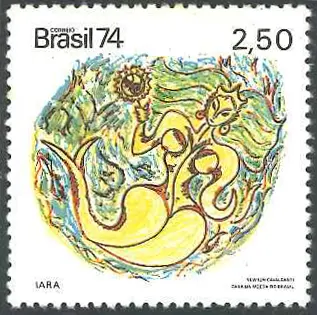
- February 1974 The Brazilian post office issues a commemorative series, Lendas Brasileiras, including a 2.50-cruzeiro stamp labelled IARA, engraved by Newton Cavalcanti at the Casa da Moeda do Brasil. It is the image on this page, and it marks the point at which the legend becomes official.
- 29 January 2022 The researcher Andriolli Costa publishes a note on the version in which Iara is a warrior ambushed by envious brothers and thrown into the Solimões by her father. He reports that he could not find its source in the old chroniclers or among contemporary anthropologists, and that its only record is a blog from the early 2000s.
Is there a rational explanation for Iara, the Mother of the Water?
The doubt about this legend dates from the nineteenth century, and it was first put in writing by people who knew the river. The earliest of them was standing in the Amazon at the time.
Henry Walter Bates, collecting on the river from 1848 to 1859, wrote down at Ega the oldest datable Amazonian version of the modern Iara story: a creature that "once had the habit of assuming the shape of a beautiful woman, with hair hanging loose to her heels, and walking ashore at night in the streets of Ega, to entice the young men down to the water", who grasped her victim round the waist and plunged under "with a triumphant cry". Two things about that passage matter. The creature in it is the Bouto, the river dolphin; and Bates adds, in the same breath, "it is probable these did not originate with the Indians, but with the Portuguese colonists". In 1881, in the Revista Brazileira, the botanist and ethnographer João Barbosa Rodrigues — who had spent years on the Amazon — wrote: "A Iara é a sereia dos antigos com todos os seus atributos, modificados pela natureza e pelo clima." In 1947 Luís da Câmara Cascudo put it flatly in Geografia dos mitos brasileiros: "a Iara, mulher tentadora, é lenda estranha à mítica ameraba. O que possuímos é a europeia… Verdadeiramente o mito brasileiro é o da Boiúna e dos Ipupiaras vorazes." His Dicionário do Folclore Brasileiro entry is the sharpest form of the claim: "Nenhum cronista do Brasil colonial registra a Mãe-d'água como sereia, atraindo pelo canto ou simplesmente transformada em mulher. É sempre o Ipupiara, feroz, faminto e bruto."
Cascudo is right about the role and slightly too strong about the body. Cardim, writing before 1601, does describe the females as looking like women, long-haired and beautiful, and Barlaeus repeats it in 1647: that is the oldest datable trace of a beautiful water-woman in the record. What none of the three colonial chroniclers describes is the song, the seduction, the enchantment or the willing drowning, which are the parts that make her a mermaid.
The opposite caution holds as well. The song and the black hair were collected on the river: Herbert Smith took them down from Amazonian informants and printed them in 1879, and Barbosa Rodrigues, who worked the same rivers, was describing a dark-skinned, black-haired Iara in 1881. They are real oral currency. What the record does not support is the description of her as "Tupí Indigenous folklore" from before contact. Every one of the people who actually collected it on the ground in the nineteenth century said the opposite about its origin, and the indigenous myth they printed alongside it is male and is the dolphin.
The absence can also be measured outside Brazil, in a corpus that had no stake in the argument. Searched on 28 September 2026 in its Internet Archive text file, Stith Thompson's Motif-Index of Folk-Literature — 2,497 pages, the standard international index of narrative elements — contains the words "Iara", "Uiara" and "Ipupiara" zero times. The two places where the letters "iara" do occur are inside Amphiaraos and Ciaran, which is exactly how this kind of proof fails. The controls run in the same pass on the same file: "mermaid" 54 hits, "Brazil" 54, "Amazon" 43. So the index reads fine and does cover Brazil. Motif B81, Mermaid, and its forty subdivisions cite Breton, Icelandic, Estonian, Irish, Livonian, Lappish, Danish, Jewish, Indian, English, Scottish, North Carolinian and Italian sources, and not one South American one. Motif F420.5.2.1.1, "Water-maiden enamors man and draws him under water" — the modern Iara's plot exactly — is attested for the United States, Germany, Iceland, France, Greece and India. F420.5.2.1.2, "Water-spirits lure children into water, offering objects" — Gonçalves Dias's poem exactly — is Austrian, French and English. The South American entries that do exist under water-spirits (Warrau, Toba, Tiatinagua, Cashinawa) are other stories, and the Brazilian citations Thompson does carry — Ehrenreich, Lowie, Métraux, Nimuendajú, Oberg — sit under creation and origin myths.
What killed the men is less mysterious than what they saw. Rationalisations of the ipupiara are themselves nineteenth-century and are printed in Rodolfo Garcia's 1925 notes to Cardim: the editor of the French translation of Gândavo in the Ternaux collection proposed "alguma phoca de tamanho extraordinario", and Varnhagen, annotating Gabriel Soares, answered that it must have been sharks or caimans, "uma vez que não consta haver phócas no litoral brasileiro". Both are guesses on record, and the second is the better one. What is certain is that the rivers drown people.
The first printed use of the name is harder to fix. Couto de Magalhães's male Uauyara comes from O Selvagem (1876), as Smith translates it, and Smith's own Oiara from 1879; the plain form "Iara" is in Barbosa Rodrigues in 1881, as Casemiro quotes him. Sousândrade's Uiara belongs to O Guesa, a poem printed in parts from 1867 to 1902, and the stanza with "os limos verdes, bela trança d'Uiara" sits at pages 45-48 of the undated London edition that Casemiro cites. What riverside communities say today is a separate subject. The anthropologist Deborah de Magalhães Lima wrote in 2014 that the "legend of the boto" is regularly used, together with the curupira, the matinta pereira, the iara and the mapinguari, "para compor… um retrato exótico e selvagem da região", and her own study reads the boto narratives as an origin history of the riverine population of the Amazon.
Can you visit Iara, the Mother of the Water?
There is nothing to visit, and saying where the pin is not is part of the entry. Our marker sits on Manaus, at the meeting of the Negro and the Solimões, by convention: the modern warrior version names the Solimões, and Manaus is the nearest thing the story has to an address. It is not a place where anything is reported to happen. The literary corpus scatters her deliberately — Melo Morais Filho subtitled his "As Uiaras" a lenda do Rio Negro and his "O palácio da mãe d'água" a lenda do Pará; Alencar set her in the Paraíba valley of the south-east; Juvenal Galeno on the north-eastern coast; Gonçalves Dias nowhere at all.
The documents, on the other hand, are free and open, and reading them is the whole point of this entry. Gândavo's História da província Sancta Cruz (1576) with its engraving of the Hipupiára, Gabriel Soares de Sousa's Tratado descritivo do Brasil em 1587, Fernão Cardim's Tratados da terra e gente do Brasil with Rodolfo Garcia's 1925 notes, and Gonçalves Dias's "A Mãe d'Agua" in Últimos Cantos are all transcribed page by page, against facsimiles, on Portuguese Wikisource. Sandra Ramos Casemiro's 181-page master's dissertation on the legend, submitted to the University of São Paulo in 2012, is a free PDF at teses.usp.br and is the single most useful thing written about the subject.
The folklorist who settled the question has a house. Ludovicus – Instituto Câmara Cascudo, at Avenida Câmara Cascudo 377, Cidade Alta, Natal, Rio Grande do Norte, keeps his library and papers and is open Monday to Friday from 9.00 to 17.00. Admission is R$ 14, half price R$ 7, free for visitors over 60 and children under 7, and free for school groups with prior booking. Note the weekday-only hours: it is closed at weekends, when most travellers are in Natal.
The picture on this page is worth a second look, because it is not an illustration of the legend so much as a document of its official adoption. It is a Brazilian postage stamp of 2.50 cruzeiros, engraved by Newton Cavalcanti at the Casa da Moeda do Brasil and issued by the Correios in February 1974 in a commemorative series called Lendas Brasileiras. The word IARA is printed along the bottom edge. In other words: a hundred and ten years after Bates suspected the story had come over with the Portuguese, and twenty-seven after Cascudo wrote that the Indians had not known her, the state postal service put her on a stamp as a Brazilian legend.
Sources consulted
- Pero de Magalhães Gândavo, «História da província Sancta Cruz a que vulgarmente chamamos Brasil, cap. 9, 'Do monstro marinho que se matou na capitania de Sam Vicente no anno de 1564', fls. 31-32, with the engraving of the Hipupiára» — Lisbon, 1576. Read page by page against the facsimile on Portuguese Wikisource, 1576 book
- Gabriel Soares de Sousa, «Tratado descritivo do Brasil em 1587, cap. CXXVII, 'Que trata dos homens marinhos'» — Written 1587; edition Rio de Janeiro, 1879, p. 256. Read on Portuguese Wikisource, 1587 book
- Fernão Cardim, «Tratados da terra e gente do Brasil, cap. XVI, 'Homens marinhos, e monstros do mar'» — Written between 1583 and 1601; first printed in English by Samuel Purchas in 1625; Portuguese edition with notes by Baptista Caetano, Capistrano de Abreu and Rodolfo Garcia, Rio de Janeiro, J. Leite & Cia., 1925, pp. 88-90, 1601 book
- Rodolfo Garcia (ed.), «Editorial note to chapter XVI of Cardim's Tratados — quotes Gândavo (1576), Gabriel Soares (1587) and Barlaeus, Rerum per octennium in Brasilia (Amsterdam, 1647), p. 134; gives Baptista Caetano's etymology y-pypiára, 'that which is inside the water'; and records the seal and shark/caiman rationalisations» — In Fernão Cardim, Tratados da terra e gente do Brasil, Rio de Janeiro, J. Leite & Cia., 1925, pp. 139-140, 1925 book
- Antônio Gonçalves Dias, «A Mãe d'Agua, in Últimos Cantos, pp. 47-57» — Rio de Janeiro, 1851. Full text read page by page on Portuguese Wikisource, 1851 book
- João Barbosa Rodrigues, «Lendas, crenças e superstições, Revista Brazileira, tomo X, p. 37 — 'A Iara é a sereia dos antigos com todos os seus atributos, modificados pela natureza e pelo clima'» — Rio de Janeiro, Typographia Nacional, 1881. Quoted verbatim, with page, in Casemiro (2012), p. 19; the original issue was not consulted, 1881 academic
- Luís da Câmara Cascudo, «Geografia dos mitos brasileiros, pp. 172-181 — 'A Iara é europeia. O índio não a conheceu outrora'» — Rio de Janeiro, José Olympio, 1947. Quoted with page numbers in Casemiro (2012), notes 149, 274 and 277; the original volume was not consulted, 1947 book
- Luís da Câmara Cascudo, «Dicionário do Folclore Brasileiro, entry 'Iara' — 'Nenhum cronista do Brasil colonial registra a Mãe-d'água como sereia, atraindo pelo canto ou simplesmente transformada em mulher. É sempre o Ipupiara, feroz, faminto e bruto'» — São Paulo, Global. Quoted verbatim by Costa (2022); the volume itself was not consulted, 1954 book
- Sandra Ramos Casemiro, «A lenda da Iara: nacionalismo literário e folclore — master's dissertation, 181 pp., on the Iara in Gonçalves Dias, Alencar, Juvenal Galeno, Melo Morais Filho, Sousândrade, Bilac and Mário de Andrade» — Faculdade de Filosofia, Letras e Ciências Humanas, Universidade de São Paulo, 2012 (supervisor Vagner Camilo). Read in full, 2012 academic
- Henry Walter Bates, «The Naturalist on the River Amazons, chapter on Ega — the Bouto that came ashore as a beautiful woman, and the remark that the fables 'did not originate with the Indians, but with the Portuguese colonists'» — London, John Murray, 1863. Full text read at Project Gutenberg, 1863 book
- Stith Thompson, «Motif-Index of Folk-Literature, motifs B81 (Mermaid) and F420.5.2.1.1 (Water-maiden enamors man and draws him under water) — searched 28 September 2026 for 'Iara', 'Uiara' and 'Ipupiara' (zero hits as words; 'iara' occurs only inside Amphiaraos and Ciaran) with controls 'mermaid' 54, 'Brazil' 54, 'Amazon' 43» — Revised edition, 6 vols., digitised in a single 2,497-page file at the Internet Archive, 1958 book
- Andriolli Costa, «Iara — on the origin of the legend, the Cascudo verdict, and the warrior version whose only record is an early-2000s blog» — Cartas de Cultura, Estúdio Ampla Arena, São Paulo, 29 January 2022, 2022 web
- Wikimedia Commons file page, «File:01 - Divulgação de Lendas Brasileiras - Iara.jpg — Brazilian Correios commemorative issue of February 1974 for the Lendas Brasileiras series, engraved by Newton Cavalcanti» — commons.wikimedia.org, licence PD-BrazilGov, 1974 web
- Biblioteca Brasiliana Guita e José Mindlin, «Fernão Cardim (1540-1625) — the manuscripts written 1583-1601, seized by English corsairs in 1601, sold to Samuel Purchas, printed in London in 1625 under the wrong author's name, and published in Portuguese from 1881» — Universidade de São Paulo, bbm.usp.br, 2026 web
- Instituto Câmara Cascudo, «Ludovicus – Instituto Câmara Cascudo — address, opening hours and admission prices» — cascudo.org.br, consulted 16 August 2026, 2026 web
- Herbert H. Smith, «Brazil, the Amazons and the Coast, chapter 'Myths and folk-lore of the Amazonian Indians', section 'Oiara, the water-maidens', p. 572, with Couto de Magalhães's male Uauyara translated from O Selvagem (1876), part II, p. 139» — New York, Charles Scribner's Sons, 1879. Full text read at the Internet Archive, 1879 book
- Deborah de Magalhães Lima, «O homem branco e o boto: o encontro colonial em narrativas de encantamento e transformação (médio rio Solimões, Amazonas) — 'um retrato exótico e selvagem da região'» — Teoria & Sociedade, número especial Antropologias e Arqueologias, hoje, Belo Horizonte, UFMG, 2014, pp. 173 ss., 2014 academic
Reviewed by V. Serrano on 2026-08-16 · How we verify our content
📎 Source: Enigma Atlas
💬 Field testimonies (0)
No testimonies yet. Add the first.
Add your testimony
🔒 Log in to add a testimony